S-Class (W222/C217/A217) [Spyshots] Mercedes-Benz S-Class (W222) Facelift Spy Pics & Info


The Mercedes-Benz W222 is the sixth generation of the Mercedes Benz S-Class. Body styles: W222 (standard), V222 (long), X222 (limousine, Mercedes-Maybach), VV222 (pullman), C127 (coupé), A217 (convertible). Predecessor: S-Class (W221). Successor: S-Class (W223). Production: 2013–2020.
Status
This thread is archived
New comments cannot be posted and votes cannot be cast
erlkoenig-erwischs-klasse-2017-10361.webp


To view this content we will need your consent to set third party cookies.
For more detailed information, see our cookies page.

http://www.mercedes-fans.de/magazin...ideo-bilder-von-der-neuen-s-klasse-2017.10361
 
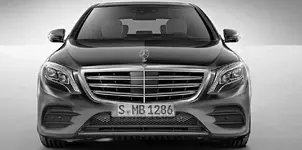
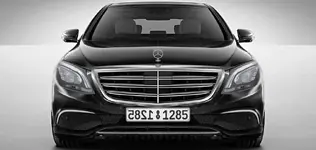
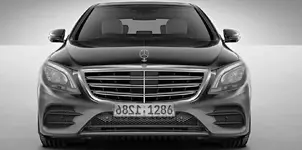
I had some extra time so I decided to photoshop these with the new e class lower facias since the spy shots look somewhat similar to the luxury line of the new e class lower fascia; I'm not the best with photoshop so excuse the poor blending.

First with existing headlamps then with masked facelifted ones.
 

Attachments

  • Like
Reactions: Yaz
I had some extra time so I decided to photoshop these with the new e class lower facias since the spy shots look somewhat similar to the luxury line of the new e class lower fascia; I'm not the best with photoshop so excuse the poor blending.

First with existing headlamps then with masked facelifted ones.

The fourth may as well be crafted by God himself! Wow! Good job!
 
Crazy to think, we should start seeing the next generation S Class out testing soon after this facelift..
 
^ Might be pretty soon, Merc1, as it's rumored to arrive in late 2017. :)


Mercedes-S63-AMG-Sedan-Facelift-001.webp
Mercedes-S63-AMG-Sedan-Facelift-002.webp
Mercedes-S63-AMG-Sedan-Facelift-003.webp
Mercedes-S63-AMG-Sedan-Facelift-004.webp
Mercedes-S63-AMG-Sedan-Facelift-005.webp
Mercedes-S63-AMG-Sedan-Facelift-006.webp
Mercedes-S63-AMG-Sedan-Facelift-007.webp
Mercedes-S63-AMG-Sedan-Facelift-008.webp


Mercedes-AMG S63 Facelift Spy Shots – 600hp Base Power and More

The updated Mercedes-AMG S63 sedan has been spied testing ahead of a debut in late 2016.

These photos show the S63 with a mock-up front bumper covered in camouflage. The bumper isn’t representative of how the production model will look and is merely a prototype unit that is presumably being used to test a revised cooling system.

With the update, the S63’s 5.5-litre twin-turbocharged V8 should receive a small bump in output to around 600 horsepower. The current version of the full-size performance sedan produces 585hp. The 621hp 6.0-litre V12 in the S65 AMG is also expected to receive a bump in power to 650hp.

The biggest change with this new updated model will be the addition of standard all-wheel drive. Mercedes recently announced many of its AMG models will adopt all-wheel drive for better every day drivability – and the S63 and S65 are no exception.

http://gtspirit.com/2016/07/12/mercedes-amg-s63-facelift-spy-shots-600hp-base-power/
 
MB may use Golden nano sponges in the new headlights? :)

9a901f140050c4687f28b0636276e44f.webp

Photo: Osram
The µAFS team shows off its advanced headlamp system's ability to direct beams with a high degree of specificity.

Gold Nanosponges and a Thousand LEDs Make Efficient, Adaptive Headlights

Conventional headlights are extraordinarily wasteful. In order to light up your side of the road, they end up illuminating a bunch of other side of the road (including the eyeballs of other drivers), as well as a significant chunk of the sky—and trees and houses and garden gnomes and lawn flamingos—for no good reason. Won't somebody please think of all of those poor photons, zipping uselessly off into random directions?

Fortunately, the Fraunhofer Institute is very concerned about the fate of photons. They've designed a new type of headlight that illuminates the road ahead better than ever before, using a thousand LEDs—70 percent of which are usually kept in photon-saving mode. That is, turned off.

The ideal headlight would brightly illuminate what you care about, and leave everything else in darkness. We've seen headlights that use lasers or DLP systems to dynamically target and adjust light output, but even those are less efficient than they could be, because they operate by selective occlusion. In other words, the headlights are producing light that they then immediately block, effectively wasting it and leaving the jilted photons feeling useless and depressed. Another option has been to use an array of larger LEDs (typically about 80 of them), with each one hooked up to some expensive and finicky optics.

Fraunhofer's solution is to use a 1024-LED array, with each “pixel” sized at 125 micrometers. The LEDs (which emit 3 lumens each) can be individually controlled, which allows the headlight to selectively distribute the light that it projects at an unprecedented resolution. For example, one headlight is capable of illuminating the road ahead, curves, parked cars, upcoming street signs, and whatever else you want, all at high beam brightness while intelligently avoiding searing the eyeballs of oncoming drivers. Fraunhofer says that on average, only 30 percent of the pixel array needs to be active at once, resulting in a significant efficiency improvement over other LED headlights.

0841ff0a7a7398724f17559a53afc919._.webp

Image: Fraunhofer
Nanoporous gold sponge creates reliable contacts.

This new headlight is the result of a collaborative project called µAFS (for micro Adaptive Front-Lighting Systems), which also involves Infineon,Osram, Hella and Daimler. One particularly tricky part of making this thing work was finding a way to reliably make the 15-µm connections needed to control each one of those LED pixels. The solution to this (and, indeed, to most other problems) was a sponge. This particular sponge is a nanoporous structure made of gold that can be compressed so that it adapts itself to the topography of whatever component you're squishing it against—quickly and easily compensating for any unevenness which might otherwise cause problems.

Beyond mentioning that “the LED chips are currently installed in headlights,” Fraunhofer hasn't said much about when we might expect to see some sort of commercial product. What we can expect is that whenever such a commercial product does become available, it's going to show up first in a Mercedes, meaning that those of us who work for nonprofits will be able to take advantage of them closer to later than sooner.

Source: IEEE Spectrum
 
To view this content we will need your consent to set third party cookies.
For more detailed information, see our cookies page.
 
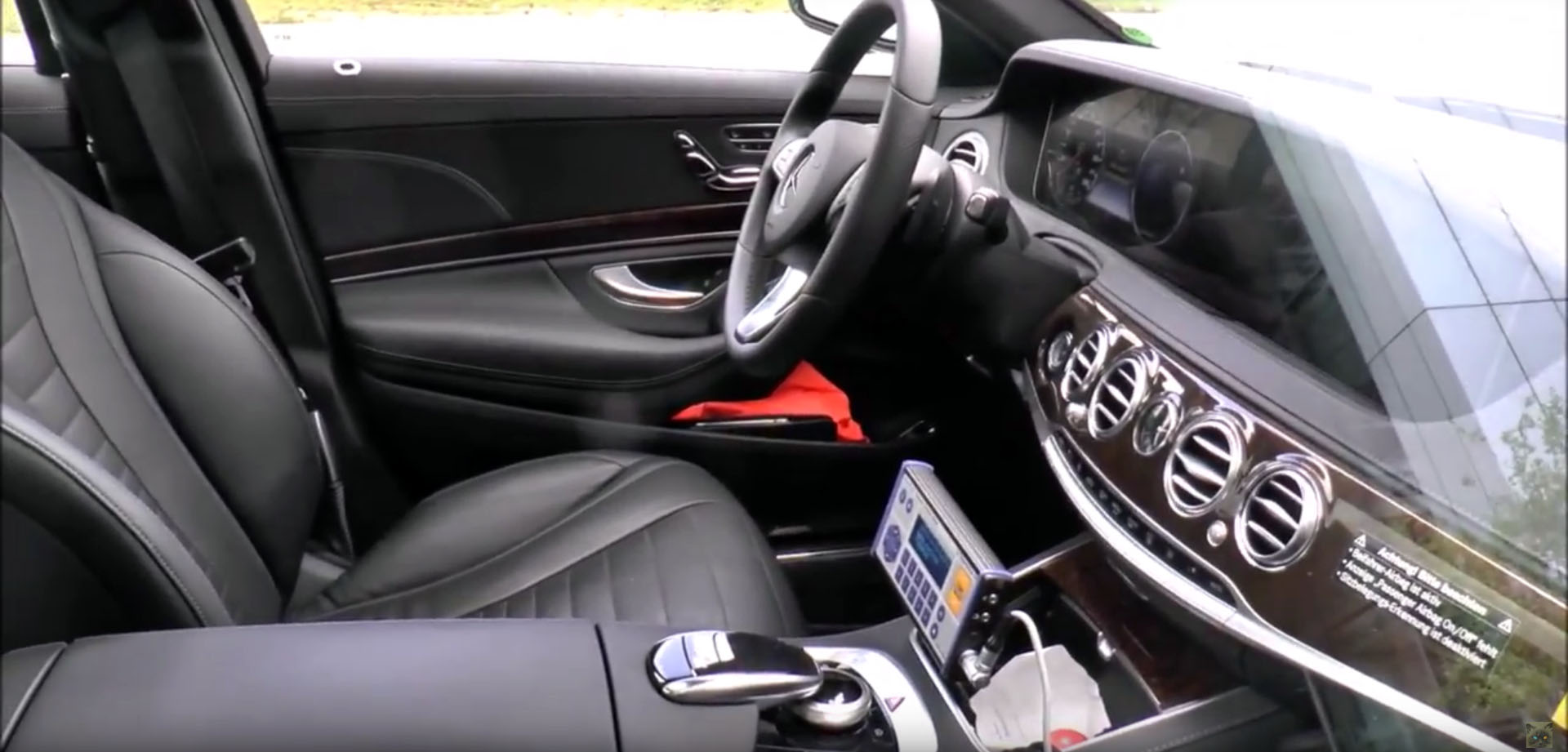
What´s new about the interior? I guess nothing except for the single screen and the steering wheel.
 
Hmmm interesting. The buttons on that steering wheel remind me to those of the old bimmers like the E39.
 
Status
This thread is archived
New comments cannot be posted and votes cannot be cast

Mercedes-Benz

Mercedes-Benz Group AG is headquartered in Stuttgart, Germany. Established in 1926, Mercedes-Benz Group produces consumer luxury vehicles and light commercial vehicles badged as Mercedes-Benz, Mercedes-AMG, and Mercedes-Maybach. Its origin lies in Daimler-Motoren-Gesellschaft's 1901 Mercedes and Carl Benz's 1886 Benz Patent-Motorwagen, which is widely regarded as the first internal combustion engine in a self-propelled automobile. The slogan for the brand is "the best or nothing".
Official website: Mercedes-Benz (Global), Mercedes-Benz (USA)

Trending content

Latest posts


Back
Top