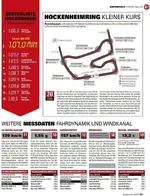
Sport Auto - Nordschleife laptimes


He seems to be using a lot more track and a lot more off the track in the 488 lap and the 675LT lap had traffic (BMW 3-series), so I think we'll see the 675LT beat its previous time in a supertest.

1:37 start, traffic at 2:04.
That car had absolutely no affect on the laptime, it was off the track and Gebhart had to brake because of the coming corner.
 
They also have supertests of Aston Martin Vantage GT8 and Ford Focus RS, as well as Corvette C7 Z06 in the pipeline.
 
That car had absolutely no affect on the laptime, it was off the track and Gebhart had to brake because of the coming corner.
He had to take the inside line rather than the racing line, probably some hesitation too, and he also wasn't going as wide on other corners.
 
What did the 675LT dyno at anyone know?
And how come no Nords lap with 675LT?


I just read the article and 488GTB dyno'd at 700PS...30PS more than claimed by Ferrari.

Weight was 1628 KG with driver.

Everything else seemed within limits. In terms of track setup they didn't adjust anything camber and tow were stock setup.
 
What did the 675LT dyno at anyone know?
And how come no Nords lap with 675LT?


I just read the article and 488GTB dyno'd at 700PS...30PS more than claimed by Ferrari.

Weight was 1628 KG with driver.

Everything else seemed within limits. In terms of track setup they didn't adjust anything camber and tow were stock setup.
Hasn't done a supertest yet, that was just a first test casual attempt. I hope they do one soon.

That doesn't surprise me. Other test cars they've used calculate out at about 750hp given weight and 141mph trap speed.

Did this one trap around 138mph (221kph) by any chance?
 
It doesn't list anywhere trap speed (quarter mile time if you mean)


Here is other info.

0-100 km/h 3.1 sec
0-200 km/h 8.7 sec
0-200-0 13.2 sec

Vmax 330 km/h

36m slalom 139 km/h
1.55G max lateral acceleration

Downforce at 200 km/h 82/123 kg. (more than GT3 RS! 50/94 kg, 458 italia 32/32 kg, 650s 2/62 kg)
 
The Downforce Data isn't measured, it's just a claim from Ferrari. The Author mentions that he doesn't think the car produces so much downforce, as in the high speed turns the front-axle starts to get light (he doesn't have that feeling in a GT3 RS)
 
From memory, Sport Auto's wind tunnel does not have a rolling floor, so the measured DF will not be accurate.
 
They've sort of had mixed luck in recent years with their wind tunnel. Sadly, it isn't always available for some reason. The best we can do is just hope the numbers given by Ferrari are accurate. Luckily, in order to get a general sense for the accuracy of Ferrari's claims, we have the 458 Italia as an example.

Ferrari claim that the 458 has an aerodynamic efficiency (basically lift/drag ratio, but for downforce) of 1.09 (1). They also claim a downforce of 360 kg·f at the car's 325 km/h top speed (1) - this works out to 330 kg·f (3236 N) of drag at 325 km/h. Thus, the drag constant (half the product of the drag area and air density) can be computed as

3236 N / (((325 km/h) * (1 (m/s) / 3.6 (km/h)))^2) = 0.3971 kg/m

We don't know what conditions Ferrari tests its cars at in their CFD simulations, but air density is usually around 1.2 kg/(m^3) (it will vary between 1.15 to 1.25 kg/(m^3) depending on ambient conditions) - as such, we may compute the drag area as

2 * 0.3971 kg/m / (1.2 kg/(m^3)) = 0.6618 m^2

If we follow through with Ferrari's claim that the coefficient of drag is 0.147(f) + 0.213(r) = 0.330, we get the following numbers

Cd = 0.330, A = 0.6618 m^2 / 0.330 = 2.01 m^2

For the record, it really gets under my skin when automakers (or magazines, or forums) only list the drag coefficient when making claims about aerodynamics - and forget to give the reference area. Without the appropriate reference area listed, those numbers (all of them) are completely useless. Imagine two cars, for instance -
car 1 has a drag coefficient of 0.36 and reference area of 2.08 m^2,
car 2 has a drag coefficient of 0.37 and reference area of 1.96 m^2.
If you just went by drag coefficient, you'd be forced to declare car 1 the winner (0.36 vs 0.37), but when you factor in their reference areas, car 2 clearly wins (0.749 m^2 vs 0.725 m^2).*


The Sport Auto supertest of the Ferrari 458 gives the following numbers at 200 km/h (2)

Cd = 0.33, A = 2.022 m^2

This analysis therefore demonstrates that in drag, at least, there is very little difference between the manufacturer's claims and independent testing. The 458's downforce claims, whether due to inaccurate CFD modeling or the static floor of the wind tunnel (as mentioned by WBarnes) were not faithfully replicated; this brings Ferrari's claims into question.

Please bear in mind that this analysis is limited by the number significant figures given in the manufacturer claims, and the accuracy of assumed variables like air density.

(1) Ferrari 458 Italia Sales Brochure. http://www.auto-brochures.com/makes/Ferrari/Ferrari_int 458Italia.pdf

(2) "[Requesting Scans] Ferrari 458 tests" http://www.germancarforum.com/threads/requesting-scans-ferrari-458-tests.55272/

*think it's just a made-up scenario? Check the Sport Auto supertest archives. car 1 is actually the Pagani Zonda F. car 2 is actually the McLaren MP4-12C. It's problems like these which can result in a lot of confusion, and may result in the erroneous conclusion that a car like the Zonda "has less drag" than a car like the McLaren MP4-12C. When you only compare drag coefficients, you're making a critical blunder by omitting any context. It is a cardinal sin that any engineer or enthusiast worth their salt should never commit.
 
You need to download them to your computer first, and then upload them here.
 
Test1.jpg
 

Attachments

The Downforce Data isn't measured, it's just a claim from Ferrari. The Author mentions that he doesn't think the car produces so much downforce, as in the high speed turns the front-axle starts to get light (he doesn't have that feeling in a GT3 RS)
Since you can read german, could you also give us a gist of what they said during the 650s and huracan supertests? Could you tell us whether those downforce numbers were actually tested or manufacturer provided? Thanks.

Huracan: http://www.germancarforum.com/threa...est-911-r-718-boxster-s-m3-cp-vs-c63-s.55850/

650s: http://www.germancarforum.com/threads/sport-auto-issue-3-2015-supertest.52853/
 
Since you can read german, could you also give us a gist of what they said during the 650s and huracan supertests? Could you tell us whether those downforce numbers were actually tested or manufacturer provided? Thanks.

Huracan: http://www.germancarforum.com/threa...est-911-r-718-boxster-s-m3-cp-vs-c63-s.55850/

650s: http://www.germancarforum.com/threads/sport-auto-issue-3-2015-supertest.52853/

Of course :)

Huracan: They did measure it in the wind tunnel. Some notes: Less downforce than R8 V10+ on both axles (5 vs 15 kg on front and 5 vs 37 kg on rear), especially sensible on the rear axle in fast passages on the Nordschleife.

650S: No measurement (data comes from MP4-12C, which was measured). They also don't write about the impressios concerning aerodynamics.
 
Ok, @DeDe or @fuhro, in the Huracan supertest i posted above, the Huracan has 5/5 downforce, but on the 488 supertest, the Huracan has 20/40 downforce. Do you know when they changed it or what happened?
 

Trending content


Back
Top