Full Press Release
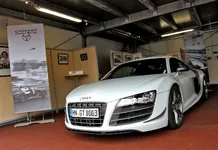
The Audi R8 GT
Now even more dynamic, lighter, more powerful and faster: Audi is launching a
limited-production version of its R8 high-performance sports car – the R8 GT.
The output of its 5.2-liter V10 has been increased to 412 kW (560 hp); vehicle
weight has been reduced by roughly 100 kilograms (220.46 lb). The R8 GT
accelerates from zero to 100 km/h (62.14 mph) in 3.6 seconds and reaches a top
speed of 320 km/h (198.84 mph). The efficient direct-injection engine consumes
only 13.9 liters of fuel per 100 km (16.92 US mpg) on average.
The engineers have reduced the weight of the Audi R8 GT drastically once again
compared to the R8 5.2 FSI quattro. With quattro permanent all-wheel drive (and
without a driver), the Audi high-performance sports car tips the scales at just
1,525 kilograms (3,362 lb), for a power-to-weight ratio of only 2.72 kilograms
(6 lb) per hp. In addition to the aluminum Audi Space Frame body, a number of
new components made of carbon fiber composite play a decisive role in the car’s
low weight.
The R8 GT is a driving machine with breathtaking lateral acceleration and
lightning-fast, nearly instantaneous reactions. The 19-inch wheels keep the car
planted firmly on the asphalt, and the carbon fiber ceramic brakes easily keep the
power under control. The R8 GT gives a whole new meaning to the term “highperformance
sports car.”
Design and aerodynamics
The design of the Audi R8 GT is an expression of highly concentrated power and
a technical sculpture. As always with Audi, it concentrates on the pure essence
and remains free of unnecessary decorations. The dimensions allude to the
contours of the vehicle’s dynamics – 4.43 meters (14.53 ft) long, wheelbase of
2.65 meters (8.69 ft), and 1.93 meters (6.33 ft) wide, but only 1.24 meters
(4.07 ft) tall.
The Audi designers have made numerous modifications to the exterior, many of
which serve to lower the weight and further improve the aerodynamics.
The R8 GT produces even more downforce when driven fast than the production
model – without any increase in the Cd value of 0.36 or frontal area of 1.99 m2
(21.42 sq ft).
The frame of the single-frame grille, its struts and the slats in the air intakes are
matt titanium gray; the grille is painted matt black. The front splitter under the
bumper has a double lip and is made of a carbon fiber composite (CFRP).
Slender, elegantly curved flics at the corners of the nose increase the downforce
on the front axle and are also made of CFRP.
One characteristic highlight of the Audi R8 GT are the standard LED headlights,
which use light-emitting diodes for all functions. They produce bright,
homogeneous light, have a long service life and low energy consumption. The
headlights also give the new top model of the R8 line an unmistakable look, day
or night. The reflectors are reminiscent of open mussel shells; the daytime
running lights each comprise 24 LEDs and appear as a continuous band.
The side view of the R8 GT is dominated by the sideblades, which direct air to
the engine. They, too, are made of matt carbon fiber composite. The same
material is used for the housings of the side mirrors with the LED turn signals.
The housings are mounted on an aluminum base with broken-out slats. Audi has
developed an exclusive five twin-spoke Y design in a titanium-look finish for the
19-inch wheels. The front fenders bear R8 GT badges, and the sill extensions
have been widened.
The modifications to the rear of the car are particularly noticeable. The fixed wing
of matt carbon fiber composite is mounted to the body with two bars and saves
1.2 kilograms (2.65 lb) of weight compared to the production solution. The
ventilation louvers on both sides of the long rear hatch have been redesigned, as
has the CFRP bumper, which frames the large, round tailpipes and vents for the
wheel wells.
The larger diffuser is also made of carbon fiber composite; the license plate bezel
and the wide slats at the rear are finished in matt titanium gray. The tail lights,
which like the front headlights are designed with LED technology, have dark
housings with panes of clear glass. The R8 GT is available in four body colors:
Samoa Orange, metallic; Ice Silver, metallic; and Phantom Black, pearl effect;
Suzuka Gray, matt is available as an option.
Body
The car on which the Audi R8 GT is based – the R8 5.2 FSI quattro – adheres
strictly to Audi’s lightweight construction philosophy, weighing just
1,625 kilograms (3,583 lb) with the standard quattro drive but without the driver.
In keeping with the classic ASF technology, its body is made of aluminum. Cast
nodes and extruded sections form a very high-strength frame, to which the
aluminum body panels are joined by means of positive and friction connections.
Ultra lightweight magnesium is used as the material for the engine frame.
The space frame body, which is largely hand-built in a complex fabrication
process at the production shop at the Neckarsulm site, weighs only
210 kilograms (463 lb). It is very crash-worthy, and lays the foundation for the
uncompromisingly precise handling and high vibrational comfort of the Audi
R8 GT.
In light of this background, the mandate to save another 100 kilograms (220 lb) of
weight was a great challenge for the Audi engineers. They solved it in their own
characteristic way – with high-tech expertise and an approach that incorporated
every field of technology. In the end the scales came to rest at 1,525 kilograms
(3,362 lb) without the driver.
The windshield of the R8 GT is made of thinner glass. The bulkhead between the
passenger cell and the engine compartment is made of a strong, lightweight
polycarbonate, as is the window in the rear hatch that allows the V10 engine to
be seen in all its technical glory. These three modifications amount to a weight
reduction of nine kilograms (19.84 lb). The Audi engineers used thinner sheet
metal and additional cutouts to shave 2.6 kilograms (5.73 lb) from the aluminum
hatch over the 100 liter (3.53 cu ft) luggage compartment at the front of the car.
The rear hatch of the high-performance sports car also had a lot to do with the
weight reduction. It is a self-supporting structure made of carbon fiber-reinforced
plastic – an advantage of 6.6 kilograms (14.55 lb). The rear bumper and the
sideblades of this same material save an additional 5.2 and 1.5 kilograms
(11.46 and 3.31 lb), respectively. With its minimal weight and extremely high
strength, CFRP is the ideal material for a high-performance sports car, and Audi
has broad-based experience in its use.
Interior
The Audi development engineers also went to great lengths to save weight in the
interior of the R8 GT. The new, lightweight carpeting accounts for a weight
reduction of 7.9 kilograms (17.42 lb); the bucket seats with a chassis of glass
fiber-reinforced plastic (GFRP) account for 31.5 kilograms (69.45 lb).
The redesigned selector lever, which bears the serial number of the individual
R8 GT, is made of CFRP and aluminum. The “monoposto,” the large arch around
the ergonomically perfect and spacious cockpit, is made of matt CFRP.
As always with Audi, the interior shows great attention to detail. Rich materials
treat the occupants to a fine look and feel. Sporty black and dark gray dominate.
The sport steering wheel with the flat-bottomed rim, the headliner, the roof posts,
the knee pad, the handbrake lever and the bucket seats are covered with
Alcantara accented with contrasting stitching in a choice of three colors. Interior
lighting is provided by small LEDs.
A novel synthetic material that feels slightly rough to the touch and looks like
sharkskin is used on the bulkhead to the engine compartment, in the door liners,
on the instrument cowl and on the dashboard. The instrument cluster contains
white dials with R8 GT badges; the center tunnel and the door liners sport bodycolor
inlays. The door sills feature trims of matt aluminum, likewise decorated
with the R8 GT logo.
Engine
The V10, whose cylinder head covers are painted red, powers the Audi R8 GT
like a race car. The sprint from zero to 100 km/h (62.14 mph) is a matter of 3.6
seconds; from zero to 200 km/h (124.27 mph) takes only 10.8 seconds. And
acceleration remains brisk until the top speed of 320 km/h (198.84 mph) is
reached.
Changes to the engine electronics coaxed an additional 26 kW (35 hp) from the
high-revving ten-cylinder unit, which now produces 412 kW (560 hp) at 8,000 rpm
from a displacement of 5,204 cc. The engine is electronically limited at 8,700
rpm. The torque curve peaks at 540 Nm (398.28 lb-ft) at 6,500 rpm, 10 Nm
(7.38 lb-ft) more than in the production version. The specific output of the V10 is
79.2 kW (107.6 hp) per liter of displacement. The R8 GT boasts a power-toweight
ratio of only 3.70 kilograms (8.16 lb) per kW, or 2.72 kilograms (6 lb) per
hp.
Among the characteristic features of the V10 is the cylinder angle of 90 degrees,
which lowers the center of gravity. Dry sump lubrication allows the engine to be
installed low. Its highly efficient pump module ensures that the 40-valve engine is
lubricated even under extreme lateral acceleration.
The long-stroke engine (bore x stroke 84.5 x 92.8 millimeters [3.33 x 3.65 in]),
which is hand-built at the factory in Györ, Hungary, weighs only 258 kilograms
(569 lb). It features a crankcase made of a aluminum-silicon alloy that is both
lightweight and very strong. The high silicon content makes the cylinder barrels
extremely durable. The bedplate – a stable frame for the crankshaft bearing
bridges – further enhances the block’s rigidity.
The crankshaft is designed as a common pin shaft in order to combine maximum
rigidity with minimal weight. The connecting rods of the opposing pistons engage
a common crankpin, resulting in alternating firing intervals of 54 and 90 degrees.
This unique rhythm gives the V10 its fascinating sound – a technical music that
gains new facets with increasing revs, with a powerful bass foundation and sharp
overtones. Two flaps in the exhaust system modulate its volume and tone as a
function of load and engine speed.
The powerful, normally aspirated engine consumes an average of 13.9 liters of
fuel per 100 km (16.92 US mpg) – very good fuel economy given the tremendous
power. The FSI gasoline direct injection system injects the fuel into the
combustion chambers at up to 120 bar of pressure. Thanks to the internal
cooling, this allows a high compression ratio of 12.5:1, which once again benefits
efficiency. Tumble flaps in the intake ports optimize the filling of the combustion
chambers by inducing a tumbling motion in the inflowing air. The camshafts, as
well as the oil pump, water pump and parts of the auxiliaries, are powered by
maintenance-free chains located on the rear wall of the engine. This design
principle is an exclusive feature of the V8 and V10 engines that accounts for
much of the compactness of the complete drivetrain. The induction pipe is made
of lightweight plastic and designed for optimized flow conditions through the
ports. The engineers consciously decided not to use a variable intake system in
order to optimize the engine in the upper rev range.
The Audi engineers have also rigorously shaved weight from other engine-related
components. The engineers found 9.4 kilograms (20.72 lb) in the battery, 2.3
kilograms (5.07 lb) in the air intake module and 2.8 kilograms (6.17 lb) in the
insulation of the engine compartment. This was accompanied by a variety of
other measures, such as the use of lightweight steel for the exhaust tailpipe trims.
Drivetrain
The Audi R8 GT has the R tronic on board, which can be controlled via paddles
on the steering wheel. The automated manual transmission offers the
advantages of a manual gearbox – high efficiency, compact dimensions and low
weight – but changes gears much faster than any driver could.
The speed at which the R tronic works varies as a function of engine speed and
the shift program. Two manual and two fully automatic modes are available. At
high load and revs, gear changes take only around one-tenth of a second.
The driver’s commands are transmitted electronically to the switching unit of the
R tronic. Powered by an electric pump, its hydraulic fluid system provides the
required pressure of 40 to 50 bar. The hydraulics actuate the clutch, which at only
215 millimeters (8.46 in) is very compact. This compactness is necessary
because of the low installation position of the R8 engines. Gear changes are
performed with the help of a second hydraulic block.
The R tronic also features the “Launch Control” program, which enables the
R8 GT to spring into action in spectacular style. It modulates the throttle valves in
conjunction with the engagement of the clutch at high startup revs so that the
engine’s power is delivered to the road with minimal wheel slip.
With its longitudinally mounted mid-engine, the Audi R8 GT has a weight
distribution of 43:57, and its quattro powertrain accordingly sends a majority of
the power to the rear axle. The transmission is located behind the V10, and it
includes an auxiliary drive for a prop shaft running below the engine to the front
axle, where a viscous coupling distributes the power. In regular operation, it
diverts roughly 15 percent of the torque to the front axle and can send up to an
additional 15 percent to the front extremely quickly if the rear wheels begin to slip.
The primary component of the viscous coupling is a package of round clutch
disks that rotate in a viscous liquid. If they rotate at greatly different speeds due
to decreasing traction at the rear axle, the oil becomes more viscous as a result
of its internal friction and increased torque is delivered to the front axle. A
mechanically locking differential at the rear axle further improves traction. It
provides up to 25 percent lockup when accelerating and up to 40 percent on the
overrun.
Chassis
The handling of the Audi R8 GT is a pure joy. The high-performance sports car
dazzles with breathtaking lateral acceleration and lightning-like, nearly
instantaneous reactions. Its engine is mid-mounted close to the vertical axis; its
mass is almost negligible during fast direction changes. The R8 GT is dynamic,
highly precise and stable in every situation.
Audi follows the classic racing design when it comes to the suspension – double
wishbones made of aluminum locate the wheels. The hydraulic, power-assisted
rack-and-pinion steering has a direct 16.3:1 ratio for a sensitive connection
between the driver and the road. The optimally tuned coilover suspension lowers
the vehicle body by as much as 10 millimeters (0.39 in). Higher front and rear
wheel camber rates make the handling slightly more agile than with the standard
model.
The top-of-the-line R8 model rolls out of the production shop in Neckarsulm on
19-inch forged wheels. They measure 8.5 J x 19 at the front and 11 J x 19 at the
rear, with 235/35 and 295/30 tires, respectively. A tire pressure indicator is
standard. 305/30 tires are available at the rear in conjunction with the range of
optional wheels. For racing enthusiasts, Audi offers sport tires that provide the
ultimate in performance on dry roads. Because extreme power requires superb
control, internally vented and drilled brake discs of carbon fiber ceramic are
mounted behind the large wheels of the R8 GT.
The discs measure 380 millimeters (14.96 in) in diameter up front and 356
millimeters (14.02 in) at the rear. The friction rings are bolted to the aluminum
caps via elastic elements. All together, they weigh nine kilograms (19.84 lb) less
than steel bolts of the same size. The aluminum brake calipers – with six pistons
up front – are anodized red and are emblazoned with “Audi ceramic.” This color
scheme is exclusive to the R8 GT. In keeping with the principle of lightweight
construction, the Audi engineers have also fought to eliminate every gram of
superfluous weight in the brakes.
The ESP stabilization program can be switched into a Sport mode at the push of
a button to allow fun, but safe, oversteer when accelerating out of a corner. The
driver can deactivate the system entirely for a trip to the race track.
Equipment and trim
Despite the strict lightweight construction concept, the R8 GT does not require
any sacrifices on the part of the driver. The top-of-the-line model offers automatic
air conditioning, two power windows, a navigation system with MMI operating
logic, a powerful sound system, a driver information system, and a parking
system with acoustic and visual display. An assist function that facilitates hill
starts is integrated into the ESP. Two front airbags and the integral headrest
system stand guard, just in case.
Audi offers an optional 465 watt, ten-channel Bang & Olufsen sound system with
12 speakers, a CD changer and the Audi music interface for the easy integration
of a mobile player. There is also a Bluetooth mobile phone interface, with the
innovative seat belt microphone available as an option. Integrated into the belts
are three small microphones; a fourth is mounted on the windshield frame. Other
Audi options include a full leather package, power-adjustable and heated seats, a
multifunction steering wheel, an Alcantara rear shelf, a storage package, controls
covered in leather with contrasting stitching, cruise control and a higher-capacity
90-liter fuel tank.
The price list includes a range of exclusive features for fans of the extraordinary.
Exterior options include two alternative wheels, a body-color front splitter and an
engine compartment lining in matt CFRP with LED lighting. CFRP elements on
the doors, the tunnel, in the cockpit and on the instrument panel are available as
interior options. Others include seat belts in red, orange or gray, floor mats with
the R8 GT logo and CFRP door sill trims illuminated in red. Seats with carbon
fiber composite frames, which are somewhat lighter than the GFRP frames, are
available as an option. The R8 GT logo can be optionally embroidered into the
Alcantara seat coverings.
Audi has put together a race package for passionate racing enthusiasts. It
includes a bolt-in roll bar in red or black, which is certified both for the road and
for the racetrack. Also available are street-certified four-point belts in red or black,
a fire extinguisher and a kill switch for the battery. A front bar module with no
street certification that turns the roll bar into a full-fledged cage is also available
for use on race tracks. A rotary lock for the four-point belt is also available.
Audi is selling the R8 GT in Germany for €193,000. The series is limited to 333
units. Each R8 GT has a badge with its production number on the shift lever
knob.