E-Class (W210) 1995 Mercedes W210 E-class Introduction


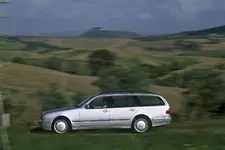
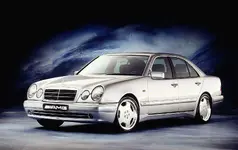
The Mercedes-Benz W210 is the internal designation for a range of executive cars manufactured by Mercedes-Benz and marketed under the E-Class model name in both sedan/saloon (1995–2002) and station wagon/estate (1996–2003) configurations. W210 development started in 1988, three years after the W124's introduction.
It's also the likely reason why few of them are on the road. I don't recall the last time I saw one. Even when my dad wanted to import one from Germany to Sweden roughly 15 years ago, many examples encountered had already developed rust.

Don't even get me started about the W202 C-Class.
But W124 was also heavily struggling from rust problems, especially at the boots where the dampers are connected to the car body, which usually can not be seen but is extremely dangerous.
 
...Don't even get me started about the W202 C-Class.

The pre-MOPF W203s´are notorious rust buckets as well. Somehow, M-B seemingly miraculously resolved the issue with the MOPF. Late-model W203s´ are solid.
 
It's also the likely reason why few of them are on the road. I don't recall the last time I saw one. Even when my dad wanted to import one from Germany to Sweden roughly 15 years ago, many examples encountered had already developed rust.

Don't even get me started about the W202 C-Class.

Yes, “out to pasture” is a saying meaning “dead” or “off the road” in this case. I live on the west coast of the U.S. now so they’re still plenty out and about. I saw very few when I lived on the east coast where it snows.
 
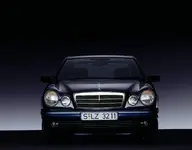
I remember not liking the design at introduction. The double, separate headlights I always held for typical BMW and didn’t understand this unnecessary move.
My brother however, had an 6 cylinder diesel T-model and drove it for years without any problem. The ride was really comfortable as well.
I was also shocked at first about the design of the front lights, as it was totally different to the other Mercedes models. They didn't seem well harmonized with the rest of the cars design. From the front and profile the car looked okay but from the front doors to the rear the W210 wasn't as good looking as other Mercedes saloons. The rear lights looked silly with the oval fog and reverse lights located on the boot lid which strangely didn't always line up well with the light panel on the rear fenders.

As far as I remember these are the launch pics of the W210 in 1995, this emerald green is probably the best colour on this car as well as burgundy metallic.

W210 front.webp
44e89e5915bf40e5385417487290eaa7 E-class Rear.webp
W210-1995.webp
812_780x510_vxg E-Class front.webp
mercedes-w210-e-class-automobiles-de-luxe.webp
MERCEDESBENZE-Klasse-W210--1077_2 rear.webp
 
Silver anniversary: 25 years of Mercedes-Benz E-Class in the 210 model series

  • In 1995, Mercedes-Benz introduced the 210 model series and therefore the new generation of E-Class
  • First E-Class with the twin-headlamp face, introduced in a coupé study in 1993
  • Average sales of more than 200,000 vehicles per year established the saloon as the best-selling vehicle of the luxury class in the world
  • The estate of the 210 model series had an unrivalled spaciousness
Stuttgart. A new generation of E-Class began its successful journey a quarter of a century ago: in 1995, Mercedes-Benz introduced the 210 model series. It was the first time the E-Class with twin headlamps looked out at the world and promptly received the “red dot” design award. Another premiere in the luxury class was the choice between three design and equipment lines: CLASSIC, ELEGANCE and AVANTGARDE. The standard equipment included countless technical highlights from the electronic traction system (ETS) to the seat belt force limiter. Further innovations such as side airbags – a world premiere in this market segment – rain sensors and xenon headlamps were also available as special equipment.

The new E-Class started out in 1995 with the E 200, E 230, E 280, E 320 and E 420 as well as E 220 Diesel, E 290 Turbodiesel and E 300 Diesel. The output ranged from 70 kW (95 hp) in the E 220 Diesel to 205 kW (279 hp) in the E 420. In September 1995, at the International Motor Show (IAA), Mercedes-Benz introduced the E 50 AMG top model with 255 kW (347 hp). Throughout the entire term, the drives continued to be modernised and adjusted, and further models were added to the range – including the innovative E 220 CDI with common-rail direct injection in 1998 and the E 200 compressor in 2000. From 1997, the new M 112 and M 113 V engine series with three valves joined the E-Class.

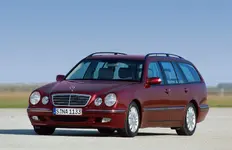
The estate, lauded as a real spatial miracle with the largest cargo volume of its class, was introduced in March 1996 at the Geneva Motor Show. If necessary, an incredible 1,975 litres of luggage space are available. The automatic level control on the rear axle is standard equipment. Special equipment, on the other hand, includes a bench seat in the boot facing against the direction of travel with three-point seat belts, turning the estate into a seven-seater – the van market segment was still establishing itself in Europe.
Unlike its direct predecessor, the E-Class in the 210 model series was not available as a coupé or cabriolet. This segment was continued by the corresponding CLK versions of the 208 model series from 1997 onwards.

In June 1999, the E-Class in the 210 model series received a facelift. Since the premiere, over a million vehicles have been sold. Alongside a subtle body redesign, the standard equipment was expanded, particularly when it came to safety features. For example, all models now had the ESP® Electronic Stability Program, front side airbags and window airbags, whilst side airbags in the rear were available upon request.

Appropriately for the tradition of the E-Class, Mercedes-Benz also offered further versions of the 210 model series beyond the saloon and estate. There was a chassis with a 737-millimetre longer wheelbase and corresponding reinforcements, which was used as the basis for ambulances, for example. Mercedes-Benz also offered the 210 model series with special protection from 1995. The models E 320 and E 420/E 430 were available in special protection class B4. The E 420/E 430 was also available in special protection class B6 – the world’s only vehicle in the luxury class with this particularly high protection class.

In January 2001, Mercedes-Benz introduced the E-Class saloon of the following 211 model series. This debut marked the end of production of the 210 model series saloon after 1,374,409 vehicles. With average sales of more than 200,000 vehicles per year, it established itself as the best-selling executive saloon in the world. The E-Class share of this market segment was an average of 24 per cent; in some countries it was even as high as 40 per cent. The 210 model series estate remained in production until the end of the year – from 1996 to December 2002, more than 257,121 estate vehicles were produced. This meant a total of more than 1.6 million vehicles of the 210 model series in eight years of production. For the saloon, around two thirds of the vehicles had a petrol engine and a third a diesel engine under the bonnet. For the estate, this was almost exactly half and half.

The Mercedes-Benz 210 model series in the press

“auto motor und sport”, Germany, 11/1995 edition, describing the body of the saloon: “Besides representing the bravest leap in style in the history of the Mercedes brand, it also offers a significantly higher utility. More space, particularly in the rear, and increased functionality are directly visible improvements.”

“Road & Track”, USA, December 1995 edition, also offers judgement on the saloons of the 210 model series: “The new E-class is a dramatic departure for Mercedes-Benz. Historically, its cars – particularly the sedans – have been sold to ‘rational’ people seeking durability, timeless styling and understated luxury. But with this new E 320, Mercedes seeks to retain those buyers and attract people who are more emotional about their purchases, those who care more about style, handling and a car’s fun-to-drive quotient.”

Trade magazine “auto motor und sport” had this to say about the estate in its 6/1997 issue: “Otherwise, the estate sets the standards – particularly with its finely tuned suspension, which, even fully loaded, loses none of its smoothness.” And concludes with the sentence: “It is by some distance the best this class has to offer. Because it has not succumbed to a fashion trend that makes the estate an elegant fastback saloon with limited utility.”

06c405_33.webp


06c405_33.webp A95F239.webp a2002f8335.webp A95F1078.webp A95F1335.webp A95F3062.webp A95F3481.webp A98F930.webp A99F1816.webp A99F2142.webp A99F2144.webp A99F2154.webp A2002F8379.webp
 
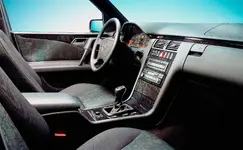
I remember when this car debuted in 1995, it was one of the most talked about cars of that year. The 4 round light design was liked and hated in equal measure as it was the biggest styling change Mercedes had done to its cars for many years and at first many people were shocked when they first saw it. I personally liked the W210 initially but soon I discovered that it was not a bulletproof quality car like the W124 and I wasnt in love with the interior. When the car debuted in South Africa in 1996, I remember a few months later the E39 5-series also hit the market and I managed to sit in both cars after each other at a motorshow and the 5-series blew me away with its interior design, quality and the comfort of its seats. I was actually really disappointed in the Mercedes, thinking that it was far cheaper looking and feeling especially the center console with hard brittle plastics, it never felt as solid as the W124 in any way and was way behind the 5-series. I think the only advantage it had over the BMW was more space in the back seat and bigger boot.
 
My least favorite E-Class. I even like the W212 better, after it got that massive facelift. I tried to find the Automobile Magazine article titled "we like the old one better" referring to the W124. This was a hard change of direction, and it was successful with the sexy CLK coming up next with that 4 round headlamp look that so many came to love, but yeah the W210 was a dreary car inside and out, just too somber, and that would be been ok if it drove/rode as arrogantly as say the W140, but it didn't. Hated this E_Class. The W211 was a downright revelation when it arrived.

M
 
I perceive the W/S210 E-Class as being the most bug-infested rustbucket that ever left the Sindelfingen (and Bremen for the T models) assembly lines. It, along with the pre-MOPF W/S 203 and pre-MOPF W220, rank very high on M-Bs' "List Of Shame". Seriously bad cars. But at least in the case of the W203 and W220, the MOPFs' provided vast improvements. The W210 remained an embarrassingly substandard car.
 
And still, the W210 outsold the mighty BMW E39...

Back then, probably more than now, the aspiration of many German men was: "...irgendwann im Leben ein Mercedes-Benz zu besitzen...". Mercedes-Benz, along with Porsche, enjoyed a "Sonderstellung" among the ranks of German automobiles. And that led to customers dismissing reports of quality snafus with a sleight of the hand. Fast forward... In my neck of the woods at least, one can still frequently see BMW E39 5ers on the road. Many in quite good condition for automobiles whose model cycle ended some 17 years ago following a 7 year production span. But W210s' ? They've become very rare sights. And it's been that way for several years now. I recall seeing a rapidly increasing number of these cars in salvage yards. Most are now gone.
 
Back then, probably more than now, the aspiration of many G...
But the strongest market for the W210 was the USA. There it outsold the E39 even more than in Germany. I suppose the reason is that the first gen C class was a very weak proposal and it could not eat from the sales of the E class, while the E36 and especially the E46 were very strong internal competitors to the E39.
 
I have this issue of Autocar from 1996, where they compared the E39 528i vs W210 E280 and it is one of the best tests I saw between these 2 big rivals. Steve Sutcliff was the guy doing the testing and he gave them a virtually equal rating, saying the E280 was the best W210 and it was the biggest threat yet to dethroning the 528i. The only areas where the Mercedes was inferior was in handling and road holding and interior design/seats, but as an automatic is was surprisingly faster than the BMW.

s-l1600.webp
 
I've written it before and I'll say it again: the W210 was a great car, at least the E320 was. We had one - a 1996 model, and it was seriously fast, sounded good and was well built, despite what is now commonly written. I loved that straight 6!

The facelift kind of ruined it for me though. Yes, some of the plastics weren't that great, but it was assembled well. It was long and slinky in the blue black metallic with grey leather we had.

It doesn't surprise me that it outsold the E39 at all.
 
It sold like hot cakes in Greece, a ratio of 3:1 to the E39, if I recall correctly. The reason was tax related though, since the W210 came with 1.8l engines, while the entry level 520i was a 2.0l one, and everything from 2.0l upwards is taxed like #$%&.
 
$_131.webp

$_10.webp

$_10.webp

$_10.webp


Sadly commonplace in Germany up until several years ago. Very many have since disappeared from our roads.

I suspect that the climates in the southwestern U.S., southern Europe, Australia and the Middle East were far more forgiving. And-the W210 was MECHANICALLY sound.
 
Sadly commonplace in Germany up until several years ago. Very many have since disappeared from our roads.

I suspect that the climates in the southwestern U.S., southern Europe, Australia and the Middle East were far more forgiving. And-the W210 was MECHANICALLY sound.

This one survived the rough Canadian climate.

To view this content we will need your consent to set third party cookies.
For more detailed information, see our cookies page.

I suspect the reason you don't see too many W210s in Germany anymore, is due to the safety inspections in Germany, which I presume are much harder to pass than safety inspections in Russia, for example.

So while the German citizen chooses to scrap his or her W210 that failed the inspection because it needed a new driver's side airbag detonator, the scrap dealer takes the W210, puts it in a container and ships it to countries where they would still be considered "OK" to drive. That's why the W210 is still common place when you watch a Russian dashcam footage.
 
This is truly shocking, the rust problem is a huge negative on this model. I thought all Mercedes models were hot dipped galvanized and had 30 year guarantee for rust? Or is that only on later models?
 

Mercedes-Benz

Mercedes-Benz Group AG is headquartered in Stuttgart, Germany. Established in 1926, Mercedes-Benz Group produces consumer luxury vehicles and light commercial vehicles badged as Mercedes-Benz, Mercedes-AMG, and Mercedes-Maybach. Its origin lies in Daimler-Motoren-Gesellschaft's 1901 Mercedes and Carl Benz's 1886 Benz Patent-Motorwagen, which is widely regarded as the first internal combustion engine in a self-propelled automobile. The slogan for the brand is "the best or nothing".
Official website: Mercedes-Benz (Global), Mercedes-Benz (USA)

Trending content


Back
Top