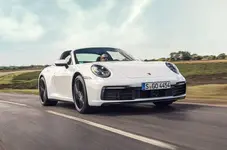
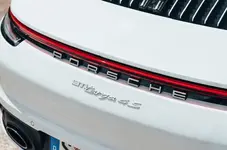
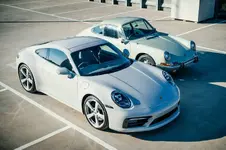
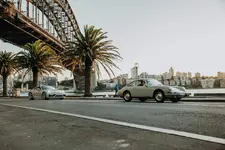
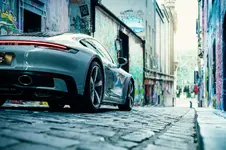
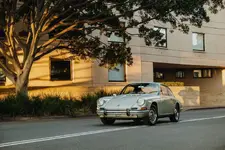
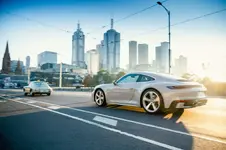
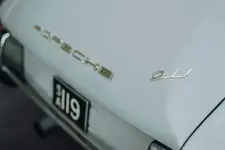
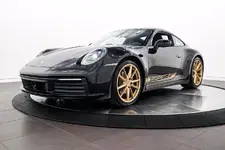
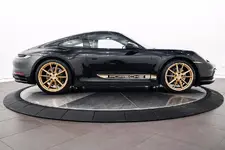
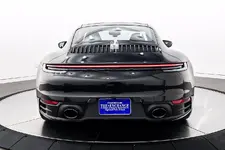
For those curious and ready for a long, long read... ADAC Autotest of the Carrera S (translated from German, thanks to Google once again).
TOTAL | 2.6
The Porsche 911 is one of the most famous vehicles in the world, and for many it is certainly the sports car par excellence. First presented in 1963, Porsche has since built over a million 911s and the current version is the eighth generation. The rear engine and the overall silhouette has been kept over all those generations despite the significant increase in size and various modernizations. Each generation has set new standards in driving dynamics, thanks notably to the continuous introduction of new technologies.
The current 911 comes with rear-axle steering, adaptive dampers as well as active stabilizers and engine mounts in order to once again keep up with the very fast competitors. In addition, it is – in comparison with similarly potent competitors – remarkably suitable for everyday use and blessed with polished manners. Driving comfort is much more than rudimentary, the dual clutch transmission can cover all types of driving conditions and there are even back seats, which are actually only suitable for children – for adults it is more of a torture bench.
There has always been a six-cylinder boxer in the rear, which is, since the facelift of the last generation, using twin-turbo charging. This brings plenty of torque in addition to high revving capability. The finely crafted interior can be customized in a variety of ways, provided you have the appropriate budget.
The budget is the biggest problem: the Carrera S costs at least 120,125 euros, but this price can easily be increased by 50 percent. You also have to refuel quite often, because even if an Ecotest consumption of 10 l/100km may be evidence of high efficiency in a competitive sports car environment, it is in absolute terms simply high. Insurance companies also require premium contributions.
Plus Very precise driving dynamics | Excellent steering | Strong and flexible motor
Minus Not even a rain sensor as standard | Exorbitantly expensive vehicle | Rear seats hardly usable
BODY | 3.3
Fit & Finish | 1.4
+ Porsche has long been recognized for superior driving performance, but also for high standards when it comes to fit and finish. The fit of the interior and body parts is first class, as is the underbody of the vehicle. It is fully clad, only the oil pan and exhaust system can be seen – however, these are absolutely flush with the rest of the underbody, creating an aerodynamically favorable underside.
Everyday use | 4.0
Although the new generation 911 has grown again, with 4.52 meters in length and just over 2 meters wide – including exterior mirrors –, it remains petite in comparison with the sports cars competition. The turning circle – 11 meters – of the test car equipped with the optional rear-axle steering is also absolutely suitable for everyday use. The roof is even usable for holidays: with an appropriate carrier system, up to 75 kilograms can be attached to it; so for example, you can take your skis or snowboards with you on your trip !
- Hauling of loads is not the thing of a 911. Trailer hitches would be out of place on the rear-engined sports car. In general, you shouldn't take too much weight with you, as the permitted payload of the test car is exactly 410 kilograms. If you have a flat tire, you have to hope that the standard tire repair kit will help, as an emergency or spare wheel is not available.
Light and sight | 2.4
The front is easy to assess, but it is more difficult for the back. Parking sensors at the front and the rear are standard feature while a reversing camera or even a 360° camera system are optional. The driver's side rearview mirror has an additional aspherical area to reduce the blind spot. All three rear-view mirrors can optionally be dimmed automatically, and then there is also a rain sensor on board. Porsche only attaches a rear wiper to the 911 at the express customer request.
ADAC all-round visibility measurement result is rather poor, due to wide roof pillars which obstruct the view outside.
+ The low body ensures that even low obstacles around the car can be easily detected. The test vehicle's optional matrix LED headlights, which each have 84 individually switchable LEDs, ensure good visibility even in the dark. All kinds of functions can be implemented, which are activated depending on the driving situation and camera and navigation data. Everything is possible, from cornering and turning lights to fog lights and special motorway lights. Of course, other road users are automatically cut out of the high beam. If there is oncoming traffic and if the situation permits, your own lane will be brightened in order to direct your attention there. The headlight system works excellently in everyday testing. The 911 already has LED headlights installed as standard, but the matrix system is a clear recommendation.
All-round visibility
The all-round visibility rating provides information about the driver's visibility and the impact of window posts and headrests.
Right | 1.5
Front | 4.6
Rear | 4.4
Left | 2.5
Total | 3.7
Front and rear near field
Front and rear near field rating shows how well the driver can recognize obstacles immediately in front of and behind the vehicle.
Front | 0.6
Rear | 2.8
Entry & Exit | 3.7
The fact that the 911 offers a remarkably easy entry compared to other sports cars doesn't really help in the ADAC car test: the 911 is still a sports cars after all !
- Access to rear seats is acceptable only for children, much more difficult for adults. Grab bars could help a bit, but Porsche doesn't offer them.
The optional keyless entry works well, but can be fooled too easily and put the car at risk of being stolen.
Trunk volume | 5
There are backpacks that offer about as much storage space as the luggage compartment between the front wheels... 135 liters fit inside.
Trunk usability | 3.5
To unlock the front hood, you have to press a button in the interior or on the key. Then operate a lever on the hood and it swings open, assisted by gas pressure. The content is easy to access, you just have to bend down a little. If you have chosen the keyless convenience access, you can also move your hand between the license plate and the Porsche crest on the front to unlock it.
- In the dark, one lamp is unfortunately not enough to properly illuminate the cargo space.
Trunk variability | 3.2
The rudimentary rear seat backrest can be folded forward in two parts. Indeed, due to the lack of a hood at the rear, this does not help for bulky items, but you can put a sports bag or something similar on the surface that is created.
- There are no hooks, double floors, tension guides or the like for small items in the front loading compartment or in the area of the folded back seat backrests. At least you get a storage package at no (!) surcharge that includes luggage nets in the passenger footwell and in the luggage compartment.
INTERIOR | 2.9
Operation | 2.1
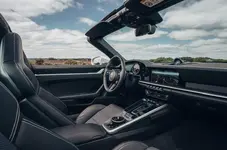
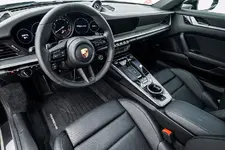
+ The 911 is a very exclusive piece of vehicle construction that, as a novice, is initially approached with respect. After getting in and after the first few meters of travel, however, it quickly becomes clear: the operation of the basic functions is absolutely self-explanatory. In a modern vehicle with a navigation system and a wide variety of vehicle settings, the extremely extensive menu structures are trendy, and Porsche tries to tame them with a touchscreen. The main view consists of largely freely configurable tiles, which can be used to display the various information such as engine data, navigation map, radio station or the contacts of the connected smartphone at all times. For further views and settings you have to navigate into the deeper menus by touch. This works properly when the vehicle is stationary, but while driving, a rotary pushbutton is simpler. It is therefore advisable to select the configurable tiles on the main view so that you no longer have to swipe around in the menu while driving.
The basic climate control operation runs via buttons and levers in front of the small gear selector lever on the center console. Further settings such as air distribution, synchronization of the two climate zones or the intensity of the automatic control must be made using the touchscreen menu. The on-board computer offers all options for monitoring the driving data – except for one value that is important for many drivers: the 911 does not display the current consumption. All switches and buttons are perfectly illuminated, but the tachometer didn't get away with the distribution of the lights: only the (luckily) analog needle and the whole numbers are backlit. This looks tidy and quite classy.
- As usual in a 911, there are five round instruments, which now largely consist of screens. But the outer two can no longer be seen because they are covered by the steering wheel rim. Therefore you have to tilt your head when necessary, which is not fun in everyday life.
Multimedia & Connectivity | 1.5
+ The new 911 is taking the old rear-engined sports car into the digital age. Hands-free system and audio streaming via Bluetooth, extensive voice control, internet radio, its own WLAN hotspot, two USB ports, an SD card reader, a SIM card reader and an online navigation system are included. Digital radio and two different sound systems cost extra. All networked services such as live traffic, weather reports, online radio, etc. are only included for a limited period of time and then cost a surcharge.
Space in front | 2.5
+ Here the 911 shows again that, unlike many other sports cars, it is actually a relatively sensible vehicle: even two-meter tall people can be accommodated in the driver's seat. Inside, the Porsche is cozy with a low seating position and a thick center tunnel, but not overly narrow.
Space at the rear | 5.5
Average adults have no business there; we were unable to determine any measurements for the rear seats with our measuring equipment in the ADAC Autotest.
Interior variability | 4.1
The sports car hardly offers any storage space in the traditional sense, only small door compartments and a narrow compartment under the center armrest. Two cup holders are available. While the pull-out version is easy to use for the front passenger, you can hardly get to the cup holder in front of the center armrest from the driver's seat – a bottle stowed there is also a nuisance when you are driving hard.
COMFORT | 2.9
Suspension | 3.3
Without a correspondingly tight chassis set-up, the Porsche 911 could not excel in terms of driving dynamics – but comfort has not been totally lost to the attention of the developers. The test car came equipped with Porsche Active Suspension Management, which lowers the body by 10 millimeters. The system also includes dampers that can be adjusted in two stages and that also regulate independently. While the sport position is actually more suitable for the circuit, the adaptive dampers in normal mode actually offer comfort suitable for everyday use. Due to the lack of spring travel, deep faults such as manhole covers are strongly felt, but the responsive dampers ensure that the bumps on country roads and highways are fairly smoothly parried.
Seats | 2.5
+ While the standard front seats only offer longitudinal and height adjustment, virtually every part of the seat can be adjusted with the optional "Adaptive sports seats Plus". Seat inclination, side bolsters, lumbar support, everything is electrically adjustable and the desired settings can then be stored in one of three memory spaces. The steering column is also electrically adjustable with the option. Lateral support, shoulder support and general seating comfort are excellent.
- Not only is there hardly any space on the back seat, but seating comfort is also poor on its hard surfaces.
Interior noise | 4.1
- The engine can only be heard very clearly when it is called upon, but the rolling noise of the large wheels is always present. As a result, there is a noise level of 72.8 dB (A) in the interior at a constant speed of 130 km/h.
Air conditioning | 2.5
+ Two-zone automatic air conditioning with automatic air circulation and air quality sensor ensures a pleasant interior climate as standard. The air is ionized for a surcharge. Seat heating at the front and steering wheel heating can also be ordered separately, as can darker tinted windows from the B-pillar.
- Backseats are not included in the climate concept due to the lack of air nozzles – and you cannot open the rear windows.
POWERTRAIN | 0.9
Performance | 0.7
+ With a maximum power of 450 hp and a torque of 530 Nm, the six-cylinder twin-turbo boxer has enough punch to sustainably drive the 1,575 kilogram test car.
Running culture | 1.1
+ Not only is the engine very generous in terms of its maximum output, its responsiveness is also impressive despite the turbocharging. The engine reacts spontaneously to commands from the accelerator and comes out of the lower speed range with great power, works its way up until the speed limiter quickly and does not decrease even at very high speeds.
A six-cylinder boxer is very quiet in itself, and Porsche also installs dynamic engine mounts as part of the optional Sport Chrono Package with two levels of setting – taut (good for the driving dynamics) or soft (good for comfort), depending on what the driving situation requires.
Transmission | 1.1
+ Dual-clutch transmissions often leave a rather clumsy impression when it comes to gear changes or takeoff. The Porsche 911 shows that there is another way. Although you benefit from fast and, if desired (sport modes), hard gear changes, the transmission is also able to provide a very pleasant crawling function. Since eight gears are available, there is always the right gear combination. Depending on the selected transmission mode, the Porsche tends to keep the engine speed in mid-range regions or always shifts up as early as possible. The last gear has a particularly long ratio and is accordingly avoided by the transmission control in the sportier driving modes: At 130 km/h, the crankshaft rotates in eighth gear with only 1,900 rpm. The 911 Carrera S reaches its top speed in sixth gear.
DRIVING CHARACTERISTICS | 1.1
Driving stability | 1.3
+ The driving stability of the 911 is outstanding. It runs the ADAC evasion test with absolutely no problems and without using the ESP. The traction of such rear-wheel drive vehicle is traditionally impeccable thanks to the rear engine. The straight-line stability is also great, it takes heavier gullies to significantly disturb it: an extremely competent sports car does not necessarily have to be set up in a hypersensitive manner.
Steering | 1.1
+ To put it simply and in summary: there is probably no better steering system on the market. The precisely centered steering implements steering commands jaggedly, but not excessively nervously, always gives the right amount of feedback to the driver's hands and demands the right steering force when cornering. That's the way it has to be.
Brakes | 0.9
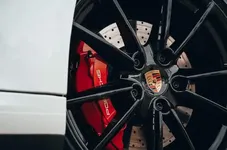
+ 30.9 meters. This is how much the test car needed to decelerate from 100 km/h to a standstill: the braking performance of the wickedly expensive optional brake system with brake discs made of carbon fiber-reinforced ceramic is brutal. Since the controllability is also exemplary, the system can handle circuit visits without complaints and no squeaking occurs even in cold conditions: there is actually no point of criticism of the brake.
SECURITY | 2.8
Active safety & Assistance systems | 1.7
+ Detection of pedestrians, cyclists and vehicles based on the front camera to trigger warning of the driver and emergency braking is installed in every Porsche 911 of the 992 series. There is also a cruise control on board. In option, it can be converted into an adaptive cruise control that works up to 210 km/h. Blind spots including parking assistant, lane departure warning and traffic sign recognition are also available at an additional cost. The tire pressure is measured directly.
Passive Safety | 3.3
No Euro NCAP crash test result available.
Front, side and head airbags are available for the front occupants. The headrests protect people up to 1.85 meters tall at the front.
+ During an emergency braking situation, the windows are closed and the belt tensioners are activated. After a crash, the Porsche automatically activates the brakes, if possible, in order to reduce the risk of subsequent collisions.
- There are no headrests in the back.
Child Safety | 3.9
Pedestrian protection | 2.5
+ The standard emergency brake assistant also recognizes people, and there is also an optional night vision system. In addition, persons recognized in the danger area are specifically illuminated by the headlights if the LED-matrix headlights are specified.
ENVIRONMENT/ECOTEST | 3.3
Consumption / CO2 | 5.5
- With a test consumption of ten liters of Super Plus per 100 kilometers, the 911 can't get a single one of the 60 achievable points in the Ecotest, because this is associated with a CO2 balance of 275 g/km. The consumption per 100 kilometers in detail: 11.1 liters in the city, 8.6 liters outside the city and 11.2 liters in the motorway section of the ADAC Ecotest.
Pollutants | 1.1
+ If the 911 Carrera S does not score a single point in the consumption chapter, it hamsters almost all of them when considering pollutants: 49 out of a possible 50. These 49 points are enough to score two stars in the ADAC Ecotest.
COST | 5.5
Grading scale
Very good (0.6-1.5) Good (1.6-2.5) Satisfactory (2.6-3.5) Sufficient (3.6-4.5) Poor (4.6-5.5)