You are using an out of date browser. It may not display this or other websites correctly.
You should upgrade or use an alternative browser.
You should upgrade or use an alternative browser.
LFA [Official] Lexus LF-A Supercar (Production Version)


- Messages
- 41,225
- Name
- Marcus
Finally some originality from Lexus. The specs sound good and on paper look like the car could top the SLS on a track, but we'll see. Yeah the front is a little goofy, but a lot of cars like this are goofy up front. The front of the concept had to brought down to air-managment reality for production. The interior is really funky too. Just think about it this way, they're debuting it in White which doesn't hide a thing. White highlights every detail of the design and it still isn't an ugly car. Wait until you see it in Black, Red or Blue. This thing is going to finally stun, something Lexus has never, ever done to date.
Less torque than the SLS, bascially the same hp, DCT vs SMG style gearbox, priced about the same (rumored). The main event is the 458i vs MP4-12C, and the bout leading up to the main even is the SLS vs LF-A. Not since early 90's LS vs S wars has Lexus and Mercedes battled like this.
M
Less torque than the SLS, bascially the same hp, DCT vs SMG style gearbox, priced about the same (rumored). The main event is the 458i vs MP4-12C, and the bout leading up to the main even is the SLS vs LF-A. Not since early 90's LS vs S wars has Lexus and Mercedes battled like this.
M
- Messages
- 41,225
- Name
- Marcus
Car and Driver - 2012 Lexus LFA - First Drive Review


The $350,000 Lexus LFA is the richer man’s Ferrari 599GTB. It’s also a bargain.
There’s something slightly weird about this scene. We are about to drive the daunting 12.9-mile Nürburgring Nordschleife track in Germany. In a Lexus. Okay, it’s the exotic LFA, a Ferrari-fighting supercar that will cost about $350,000. But the company built its reputation on smooth, refined, and perfectly nerve-calming cars, so why does the LFA exist? In what parallel universe is this thing remotely Lexus-like?
Lexus claims multiple justifications for the LFA program. The car, it says, casts a halo over the Lexus F line of performance machines. It’s also a way for Toyota to explore new technologies, particularly carbon-fiber construction. And since Lexus says it will be selective about whom it will sell to—car collectors and high-profile individuals who use the car rather than park it—the LFA should raise the cachet of the brand as a whole.
For all that marketing happy-talk, the 2012 LFA is a serious outlier in the Lexus lineup and has had a convoluted gestation. The program started in 2000, and Lexus showed the first concept car at the Detroit auto show in 2005. Next, a convertible version appeared at Detroit in 2008, though it has since been canceled. In the interim, LFA prototypes were spotted testing at the Nordschleife, and further, two race-prepared cars entered the 24-hour race at the Nürburgring in 2008 and 2009. But until now, the company hasn’t said anything about production intent. Lexus is finally ready to admit that a mere 500 will be made, with production starting in December 2010.
Although the car is extravagantly expensive, Lexus says it will lose money on every one. We believe it. The last car that incorporated a similar level of technology, performance, and exclusivity was the $650,000 Ferrari Enzo. At $350,000, the LFA begins to look like something of a bargain. The
LFA is an exotic, two-place, front-engine, rear-wheel-drive coupe. The chassis and body are made largely of carbon-fiber composite, just like those of an Enzo or a Mercedes SLR McLaren. Per Lexus’s scales, the car weighs 3263 pounds—less than a Corvette ZR1.
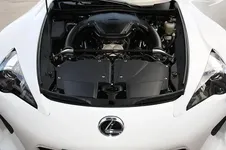
The engine is a 4.8-liter V-10 codeveloped with Yamaha. It’s a compact unit that makes 553 horsepower at 8700 rpm and revs to a giddy 9000 rpm. Maximum torque of 354 pound-feet peaks at 6800 rpm, with 90 percent available between 3700 and 9000 revs.
The rear-mounted, six-speed automated manual transaxle incorporates a Torsen limited-slip differential. Control arms comprise the front suspension, with a multilink arrangement at the back. To keep weight down, the suspension pieces and the remote-reservoir monotube KYB dampers are aluminum.
The Brembo carbon-ceramic brake setup consists of discs 15.4 inches in diameter and six-piston monoblock calipers up front, with 14.2-inch discs and four-piston calipers at the back. Forged aluminum 20-inch BBS wheels sit inside bespoke 265/35 front and 305/30 rear Bridgestone Potenza tires. There are four driving modes: automatic, normal, wet, and sport; the driver can also select manual shift speeds. In sport mode, the stability-control system allows for greater amounts of yaw, but the system can be switched off completely.
When it comes to the styling, there’s a definite Japanese aesthetic, what with all the sharp edges and matte-black vents. But it’s not a head turner like the Enzo or even a Lamborghini Gallardo. We definitely wouldn’t order one in matte black—one of 30 available colors—because it looks like someone forgot to paint it properly.
But there is function underpinning the somewhat sedate form. According to chief engineer Haruhiko Tanahashi, an advantage of using carbon fiber for the bodywork is that it’s possible to make very sharp edges and cutoffs that improve aerodynamic performance. The LFA has a reasonably low coefficient of drag (0.31), and Tanahashi says that the car produces more downforce than any of its competitors. Even the inside edges of the door mirrors are shaped to guide air into scoops over the rear fenders that feed the rear-mounted radiators. A large rear wing incorporating a Gurney flap pops up at speeds above 50 mph.
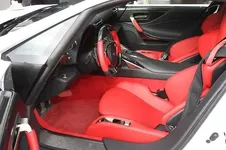
The interior is restrained but tasteful. The car we drove had a mixture of supple leather, carbon fiber, Alcantara, and “satin metal” adorning the cockpit. Lexus will offer seat coverings in 12 shades of leather or 10 alternate hues of Alcantara, with three color choices for the Alcantara headliner. “Roomy” describes the cabin, although luggage space is minimal. The supportive bucket seats have eight-way power adjustments, and the driving position is superb. The minor controls are as easy to find and use as in a standard Lexus sedan, and the LFA even has the same mouse-style operation for its multi*function center-console screen as in an RX350 sport-ute.
The squared-off steering wheel houses a start button and a switch that controls the instrument-panel display. We like that the alloy paddle shifters are fixed to the steering column; the right-hand lever governs upshifts, and the left one is for downshifts.
The most remarkable interior features are seatbelt airbags—which inflate in a crash to spread the impact’s forces over a broader section of the body than a traditional belt—and the instrument display, which is as cool as liquid nitrogen. Alter the vehicle settings, and the large central tachometer, which also incorporates a digital speedometer and a gear indicator, changes appearance. In sport mode, the background color goes from black to white and the increments between the tach’s numbers get bigger. Pressing the display switch on the steering wheel causes the tach to appear to scoot sideways in the instrument panel. This opens a submenu that allows the driver to access features such as a lap timer and even to change the point at which warning lights appear on the tach.
We drove the car on a mixture of autobahn and dual-track roads, as well as at the Nürburging. Everywhere, all day long, it’s an absolute missile. Lexus claims a 0-to-62-mph time of 3.7 seconds and a top speed of 202 mph—utterly believable when considering the LFA’s power-to-weight ratio of 5.9 pounds per horsepower. (A Corvette ZR1’s ratio is 5.3.) It’s not as quick as a Bugatti Veyron, but then, what is? Besides a Top Fuel dragster, of course.
The engine is stunning, providing massive thrust from 4000 rpm and zinging upward to the 9000-rpm redline. Its note is an incredible wail that sounds like an F1 car’s but quieter. The V-10 is so flexible that the driver can deposit the car in sixth gear at relatively low speeds—say 50 mph—floor the throttle, and the car will rocket to 150 mph in a hurry. Use the full nine grand through the gears, though, and the soundtrack is unforgettable, as is the rate that the scenery and other cars close in.
The shifts are smooth and eye-blink quick in manual mode but become a bit clunky in the automatic setting. (This is the case with most single-clutch automated manuals.) When the tach needle approaches redline, the gauge glows red and there are all sorts of overwrought bleeps and bings.
For all that, the most impressive aspect of the car is its stability at speed. We saw just over 170 mph out on the Ring (and somewhat lesser speeds on the autobahn), and even then, the thing feels as planted as a sequoia (the great tree, not the lumbering SUV). Unlike the video-gamey Nissan GT-R, the LFA is much more tactile. The steering has great feel and weight, which is surprising since it’s a fully electric system. The brake pedal, too, is linear and rewarding, while the carbon-ceramic brakes are sensational. On German roads, which are as smooth as a croquet lawn, the LFA rides nicely—it’s firm but well damped. On the Ring, which is actually bumpier than normal German blacktop, we’d say it was stiff but not uncomfortable.
Out on the Nordschleife, even in sport mode, the stability-control system intrudes earlier than we expected, making it difficult to rotate the car into corners with power. But turn off the stability control, and the LFA comes alive. The car’s behavior is then determined by a combination of steering lock and throttle input, just the way a good front-engine, rear-drive car should be. Too little throttle, and the car noses wide; dial in the right amount, and the attitude is neutral. Apply too much power too early, and the tail will slide, but it’s very controllable.
There’s notably more grip above 50 mph, when the active rear spoiler comes into play. The car does everything instantly, with hardly any body roll and loads of grip. Trying hard—but not so hard that the LFA might have a close encounter with the Ring’s many miles of guardrail—we lapped it in just over 8 minutes, at an average speed of 95 mph. (Both the ZR1 and the GT-R have lapped it in 7 minutes 26 seconds with hero drivers at the helm.)
The LFA is the most exciting car to come out of Japan since the GT-R, as it should be for the money Lexus is charging. But it’s more involving than the Nissan and a much more special experience. In many ways, its closest natural rival is the Ferrari 599GTB, although the Lexus is more visceral and exciting and better balanced and more nimble. At the same time, the LFA is easy to drive at everyday speeds, quiet at cruise, and refined, just like a Lexus should be. Whether people can equate the brand with a hugely expensive, hugely competent sports car will be interesting to say the least.
The LFA’s engine is a V-10 simply because that was the layout of Formula 1 cars when Lexus embarked on the project. Plus, according to chief engineer Tanahashi, “We couldn’t get such high revs from a V-8, and a V-12 is too big and heavy.” The 72-degree angle is best for primary and secondary balance on a V-10, Tanahashi adds. Exotic features of this engine include titanium valves and connecting rods, individual throttle bodies for each cylinder, carbon- and silicon-coated rocker arms with integrated oil jets, and magnesium alloy cam covers. The engine spins so quickly that Lexus says it had to use a digital tach because an analog version couldn’t keep up.
To keep the center of gravity low, the engine has a dry-sump oil system, and the oil and water pumps are mounted low and to the rear of the engine. The engine is connected to the transaxle by a massive torque tube—the exhaust system runs underneath this piece to ensure a narrow central tunnel that enabled the engineers to place the occupants lower and closer to the centerline of the car. The obsession with keeping mass within the wheelbase and as low as possible led to a 48/52 percent front-to-rear weight distribution. The six-speed transmission fires off shifts between 0.2 and 1.0 second depending on the program the driver selects.
CHASSIS
A reason this car took so long to emerge is that its chassis construction changed from aluminum to carbon fiber during development. Lexus used carbon fiber to keep weight down, claiming that the body in white is 221 pounds lighter than it would be were it made of aluminum.
The LFA uses a central carbon-fiber-reinforced plastic monocoque with aluminum subframes at the front and rear, which are bolted on and reinforced with glue. If the car is damaged, these subframes can simply be unbolted and replaced. (A full carbon-fiber structure would cost much more and require more repair time.) Sixty-five percent of the body structure is made of carbon fiber, with the remaining 35 percent being aluminum. Lexus decided to produce the carbon fiber in-house, using its own weaving technology. The company also decided to abandon traditional carbon-fiber fixings, in which threaded aluminum inserts are wrapped in the fabric; instead, Lexus engineers used a flanged aluminum collar to link carbon fiber to aluminum.
Lexus says that the structure is incredibly stiff but added some additional crossbraces as a result of the lessons learned in two 24-hour races at the Nürburgring Nordschleife. The best finish in those two races was fourth place in class and 87th overall.
2012 Lexus LFA - First Drive Review - Auto Reviews - Car and Driver
M
The $350,000 Lexus LFA is the richer man’s Ferrari 599GTB. It’s also a bargain.
There’s something slightly weird about this scene. We are about to drive the daunting 12.9-mile Nürburgring Nordschleife track in Germany. In a Lexus. Okay, it’s the exotic LFA, a Ferrari-fighting supercar that will cost about $350,000. But the company built its reputation on smooth, refined, and perfectly nerve-calming cars, so why does the LFA exist? In what parallel universe is this thing remotely Lexus-like?
Lexus claims multiple justifications for the LFA program. The car, it says, casts a halo over the Lexus F line of performance machines. It’s also a way for Toyota to explore new technologies, particularly carbon-fiber construction. And since Lexus says it will be selective about whom it will sell to—car collectors and high-profile individuals who use the car rather than park it—the LFA should raise the cachet of the brand as a whole.
For all that marketing happy-talk, the 2012 LFA is a serious outlier in the Lexus lineup and has had a convoluted gestation. The program started in 2000, and Lexus showed the first concept car at the Detroit auto show in 2005. Next, a convertible version appeared at Detroit in 2008, though it has since been canceled. In the interim, LFA prototypes were spotted testing at the Nordschleife, and further, two race-prepared cars entered the 24-hour race at the Nürburgring in 2008 and 2009. But until now, the company hasn’t said anything about production intent. Lexus is finally ready to admit that a mere 500 will be made, with production starting in December 2010.
Although the car is extravagantly expensive, Lexus says it will lose money on every one. We believe it. The last car that incorporated a similar level of technology, performance, and exclusivity was the $650,000 Ferrari Enzo. At $350,000, the LFA begins to look like something of a bargain. The
LFA is an exotic, two-place, front-engine, rear-wheel-drive coupe. The chassis and body are made largely of carbon-fiber composite, just like those of an Enzo or a Mercedes SLR McLaren. Per Lexus’s scales, the car weighs 3263 pounds—less than a Corvette ZR1.
The engine is a 4.8-liter V-10 codeveloped with Yamaha. It’s a compact unit that makes 553 horsepower at 8700 rpm and revs to a giddy 9000 rpm. Maximum torque of 354 pound-feet peaks at 6800 rpm, with 90 percent available between 3700 and 9000 revs.
The rear-mounted, six-speed automated manual transaxle incorporates a Torsen limited-slip differential. Control arms comprise the front suspension, with a multilink arrangement at the back. To keep weight down, the suspension pieces and the remote-reservoir monotube KYB dampers are aluminum.
The Brembo carbon-ceramic brake setup consists of discs 15.4 inches in diameter and six-piston monoblock calipers up front, with 14.2-inch discs and four-piston calipers at the back. Forged aluminum 20-inch BBS wheels sit inside bespoke 265/35 front and 305/30 rear Bridgestone Potenza tires. There are four driving modes: automatic, normal, wet, and sport; the driver can also select manual shift speeds. In sport mode, the stability-control system allows for greater amounts of yaw, but the system can be switched off completely.
When it comes to the styling, there’s a definite Japanese aesthetic, what with all the sharp edges and matte-black vents. But it’s not a head turner like the Enzo or even a Lamborghini Gallardo. We definitely wouldn’t order one in matte black—one of 30 available colors—because it looks like someone forgot to paint it properly.
But there is function underpinning the somewhat sedate form. According to chief engineer Haruhiko Tanahashi, an advantage of using carbon fiber for the bodywork is that it’s possible to make very sharp edges and cutoffs that improve aerodynamic performance. The LFA has a reasonably low coefficient of drag (0.31), and Tanahashi says that the car produces more downforce than any of its competitors. Even the inside edges of the door mirrors are shaped to guide air into scoops over the rear fenders that feed the rear-mounted radiators. A large rear wing incorporating a Gurney flap pops up at speeds above 50 mph.
The interior is restrained but tasteful. The car we drove had a mixture of supple leather, carbon fiber, Alcantara, and “satin metal” adorning the cockpit. Lexus will offer seat coverings in 12 shades of leather or 10 alternate hues of Alcantara, with three color choices for the Alcantara headliner. “Roomy” describes the cabin, although luggage space is minimal. The supportive bucket seats have eight-way power adjustments, and the driving position is superb. The minor controls are as easy to find and use as in a standard Lexus sedan, and the LFA even has the same mouse-style operation for its multi*function center-console screen as in an RX350 sport-ute.
The squared-off steering wheel houses a start button and a switch that controls the instrument-panel display. We like that the alloy paddle shifters are fixed to the steering column; the right-hand lever governs upshifts, and the left one is for downshifts.
The most remarkable interior features are seatbelt airbags—which inflate in a crash to spread the impact’s forces over a broader section of the body than a traditional belt—and the instrument display, which is as cool as liquid nitrogen. Alter the vehicle settings, and the large central tachometer, which also incorporates a digital speedometer and a gear indicator, changes appearance. In sport mode, the background color goes from black to white and the increments between the tach’s numbers get bigger. Pressing the display switch on the steering wheel causes the tach to appear to scoot sideways in the instrument panel. This opens a submenu that allows the driver to access features such as a lap timer and even to change the point at which warning lights appear on the tach.
We drove the car on a mixture of autobahn and dual-track roads, as well as at the Nürburging. Everywhere, all day long, it’s an absolute missile. Lexus claims a 0-to-62-mph time of 3.7 seconds and a top speed of 202 mph—utterly believable when considering the LFA’s power-to-weight ratio of 5.9 pounds per horsepower. (A Corvette ZR1’s ratio is 5.3.) It’s not as quick as a Bugatti Veyron, but then, what is? Besides a Top Fuel dragster, of course.
The engine is stunning, providing massive thrust from 4000 rpm and zinging upward to the 9000-rpm redline. Its note is an incredible wail that sounds like an F1 car’s but quieter. The V-10 is so flexible that the driver can deposit the car in sixth gear at relatively low speeds—say 50 mph—floor the throttle, and the car will rocket to 150 mph in a hurry. Use the full nine grand through the gears, though, and the soundtrack is unforgettable, as is the rate that the scenery and other cars close in.
The shifts are smooth and eye-blink quick in manual mode but become a bit clunky in the automatic setting. (This is the case with most single-clutch automated manuals.) When the tach needle approaches redline, the gauge glows red and there are all sorts of overwrought bleeps and bings.
For all that, the most impressive aspect of the car is its stability at speed. We saw just over 170 mph out on the Ring (and somewhat lesser speeds on the autobahn), and even then, the thing feels as planted as a sequoia (the great tree, not the lumbering SUV). Unlike the video-gamey Nissan GT-R, the LFA is much more tactile. The steering has great feel and weight, which is surprising since it’s a fully electric system. The brake pedal, too, is linear and rewarding, while the carbon-ceramic brakes are sensational. On German roads, which are as smooth as a croquet lawn, the LFA rides nicely—it’s firm but well damped. On the Ring, which is actually bumpier than normal German blacktop, we’d say it was stiff but not uncomfortable.
Out on the Nordschleife, even in sport mode, the stability-control system intrudes earlier than we expected, making it difficult to rotate the car into corners with power. But turn off the stability control, and the LFA comes alive. The car’s behavior is then determined by a combination of steering lock and throttle input, just the way a good front-engine, rear-drive car should be. Too little throttle, and the car noses wide; dial in the right amount, and the attitude is neutral. Apply too much power too early, and the tail will slide, but it’s very controllable.
There’s notably more grip above 50 mph, when the active rear spoiler comes into play. The car does everything instantly, with hardly any body roll and loads of grip. Trying hard—but not so hard that the LFA might have a close encounter with the Ring’s many miles of guardrail—we lapped it in just over 8 minutes, at an average speed of 95 mph. (Both the ZR1 and the GT-R have lapped it in 7 minutes 26 seconds with hero drivers at the helm.)
The LFA is the most exciting car to come out of Japan since the GT-R, as it should be for the money Lexus is charging. But it’s more involving than the Nissan and a much more special experience. In many ways, its closest natural rival is the Ferrari 599GTB, although the Lexus is more visceral and exciting and better balanced and more nimble. At the same time, the LFA is easy to drive at everyday speeds, quiet at cruise, and refined, just like a Lexus should be. Whether people can equate the brand with a hugely expensive, hugely competent sports car will be interesting to say the least.
The LFA’s engine is a V-10 simply because that was the layout of Formula 1 cars when Lexus embarked on the project. Plus, according to chief engineer Tanahashi, “We couldn’t get such high revs from a V-8, and a V-12 is too big and heavy.” The 72-degree angle is best for primary and secondary balance on a V-10, Tanahashi adds. Exotic features of this engine include titanium valves and connecting rods, individual throttle bodies for each cylinder, carbon- and silicon-coated rocker arms with integrated oil jets, and magnesium alloy cam covers. The engine spins so quickly that Lexus says it had to use a digital tach because an analog version couldn’t keep up.
To keep the center of gravity low, the engine has a dry-sump oil system, and the oil and water pumps are mounted low and to the rear of the engine. The engine is connected to the transaxle by a massive torque tube—the exhaust system runs underneath this piece to ensure a narrow central tunnel that enabled the engineers to place the occupants lower and closer to the centerline of the car. The obsession with keeping mass within the wheelbase and as low as possible led to a 48/52 percent front-to-rear weight distribution. The six-speed transmission fires off shifts between 0.2 and 1.0 second depending on the program the driver selects.
CHASSIS
A reason this car took so long to emerge is that its chassis construction changed from aluminum to carbon fiber during development. Lexus used carbon fiber to keep weight down, claiming that the body in white is 221 pounds lighter than it would be were it made of aluminum.
The LFA uses a central carbon-fiber-reinforced plastic monocoque with aluminum subframes at the front and rear, which are bolted on and reinforced with glue. If the car is damaged, these subframes can simply be unbolted and replaced. (A full carbon-fiber structure would cost much more and require more repair time.) Sixty-five percent of the body structure is made of carbon fiber, with the remaining 35 percent being aluminum. Lexus decided to produce the carbon fiber in-house, using its own weaving technology. The company also decided to abandon traditional carbon-fiber fixings, in which threaded aluminum inserts are wrapped in the fabric; instead, Lexus engineers used a flanged aluminum collar to link carbon fiber to aluminum.
Lexus says that the structure is incredibly stiff but added some additional crossbraces as a result of the lessons learned in two 24-hour races at the Nürburgring Nordschleife. The best finish in those two races was fourth place in class and 87th overall.
2012 Lexus LFA - First Drive Review - Auto Reviews - Car and Driver
M















hoffmeister_fan
Kraftwagen König
- Messages
- 11,310
I like it, it looks like a Transformer, and I dig that. It has it's own character...it's not trying to be something else. When was the last time one could say that about a Lexus? I'm not a fan of how they managed to mesh the front bumper with the hood-area, I'm sure there's a better way of implementing that. The interior looks beautiful. For me, this looks to be ergonomically perfect. But how does one control the HVAC? Also how's reverse engaged? For the enthusiasts, I hope the E-brake is manually engaged, not electronically.
This car looks to be the real deal. That being said, for $350,000, it's going to be a tough sell. If it was around $200-250K, I could see people with money to burn taking a chance on it. Having an stylized "L" on the hood in lieu of a stallion or bull puts it at a disadvantage. For the sake of Lexus as well as their competitors, I hope it does perform exceptoionally well, and thus sell well. If there's a demand for this, then this may lead to Lexus producing more worthwhile mainstream cars. And if Lexus raises the ante, then the competition will be forced to do the same.
But, again, all negativity aside, this looks and sounds epic...I'm going to keep a close eye on the reviews.

PS: to somewhat echo Giannis' sentiment, I find it both amazing and odd that Lexus has developed a separate, dedicated engine for this, but BMW is fine with gussying up the N63 for it's M application. But in BMW's defense, in the past, the in-line 4's and 6's were just that too, an advanced version of the mainstream version. But it's still a little humorous to me.
PSS: I want one in either black or pewter, with the gun-metal BBS wheels.
This car looks to be the real deal. That being said, for $350,000, it's going to be a tough sell. If it was around $200-250K, I could see people with money to burn taking a chance on it. Having an stylized "L" on the hood in lieu of a stallion or bull puts it at a disadvantage. For the sake of Lexus as well as their competitors, I hope it does perform exceptoionally well, and thus sell well. If there's a demand for this, then this may lead to Lexus producing more worthwhile mainstream cars. And if Lexus raises the ante, then the competition will be forced to do the same.
But, again, all negativity aside, this looks and sounds epic...I'm going to keep a close eye on the reviews.
PS: to somewhat echo Giannis' sentiment, I find it both amazing and odd that Lexus has developed a separate, dedicated engine for this, but BMW is fine with gussying up the N63 for it's M application. But in BMW's defense, in the past, the in-line 4's and 6's were just that too, an advanced version of the mainstream version. But it's still a little humorous to me.
PSS: I want one in either black or pewter, with the gun-metal BBS wheels.


 It looked better with camo on it...

Mr Robert
Kraftwagen König
- Messages
- 10,957
- Name
- Robert
The rear looks like how I imagined a production BMW VED.. or maybe just the rear lights.
Three tail pipes, fashion statement of the year.
This is by no means a beauty, it even looks like that was not intended. But it is brutal! The interior is stunning, apart from the red accents.
Three tail pipes, fashion statement of the year.
This is by no means a beauty, it even looks like that was not intended. But it is brutal! The interior is stunning, apart from the red accents.


PanterroR
Lap Time Luminary
- Messages
- 21,864
Yep, i admit it too - this is glove in the face to BMW...
That's one hell of achievement...
According to Edmunds's first drive,Lexus LFA's best ring time can reach 7'23'' in a clean circut,that's a very good achivement.
That's one hell of achievement...
Mr Robert
Kraftwagen König
- Messages
- 10,957
- Name
- Robert
Yep, i admit it too - this is glove in the face to BMW...
BMW does not make sportscars.... .... .....

7:23 is a great time, that could even be a great time when someone else than Toyota does the testing!
- Messages
- 41,225
- Name
- Marcus
PRESS RELEASE:
Tokyo, October 21, 2009 - Lexus announces today the official launch of the LFA, a two-seat supercar scheduled to go into production at the end of 2010 as the pinnacle of the Lexus "F" premium sports car series. Pre-sales start today.
Ultra-responsive and extremely stable even when taken to the edge, the LFA creates a sense of reassurance that opens up a new world of driving emotion, exhilarating the senses to move the driver in more ways than one.
The LFA combines high output, superb chassis design and meticulous aerodynamics to achieve instantaneous total-vehicle response characterized by high-rev, seamless acceleration echoed by a self-defining resonance from its 4.8-liter V10.
Only 500 units of the LFA are to be produced and sold worldwide.
A prototype of the LFA is now on display at the 41st Tokyo Motor Show, which is open to the general public from October 24 to November 4 at Makuhari Messe in Makuhari, Chiba Prefecture.
1. Packaging brings out the most in fundamental performance
Strong and light
The newly developed 4.8-liter V10 engine boasts exceptional power, while lightweight materials (aluminum alloy, magnesium alloy and titanium alloy) and a very compact size (smaller than a conventional V8) allows for optimal weight distribution and an exceptional power-to-weight ratio.
Carbon fiber reinforced plastic (CFRP) cabin enhances high body-rigidity and reduces weight. This unique cabin is 100kg lighter than a comparable aluminum cabin. Detailed analysis and precise matching of CFRP materials allows for high rigidity and low weight. LFA CFRP production technology, including unique CFRP-to-metal joining, was completely developed by Lexus.
Balanced
Relatively higher weight components such as the engine and transmission are placed within the wheelbase. A low center of gravity is made possible by the use of dry sump lubrication1, along with placing peripheral components (oil pump, water pump) behind the engine. Furthermore, optimal placement of the transmission and the fuel tank in front of the rear axle adds to this application of centralized mass. This minimizes weight shift during cornering and contributes to outstanding performance and stability. Lighter weight components, like the radiator and electric fans, are placed behind the rear axle.
Combined with a front-engine and rear-wheel-drive configuration, the short, wide and low body allows the LFA to achieve its target front-to-rear weight distribution of 48:52.
Driver-centered
The driver's seat is positioned near the LFA's center of gravity. The centralized seating concept (with the seat between the front and rear axles and closer to the left–right center) is made possible by the use of a rear transaxle and vertically stacked torque tube and exhaust pipes reducing the width of the center tunnel. The driver placement is aimed to provide maximum car-to-driver feedback, especially under sport or high G-force driving conditions.
2. Emotive performance embodies an extraordinary driving experience
High–rev engine
Titanium valves, ultra–light weight rocker arms with a diamond–like coating and a fully integrated lower crankcase that reduces pumping losses at high RPMs combine to provide the driver with overwhelming acceleration right up to the 9,000rpm redline. The LFA's purpose-built V10 delivers 90% of its peak torque between 3,700rpm and 9,000rpm.
Precise Response
Independent, electronically controlled throttle bodies ensure precise air-feed to each of the 10 cylinders, enabling immediate engine response from the accelerator pedal. The engine response time is approximately half the normal response time of a single-throttle valve.
The six-speed ASG transmission features heavy-duty synchronizer rings and a newly developed gearshift actuator, providing the driver with a very direct shift feel. Four selectable driving modes and a seven-stage shift-speed selector that results in upshift speeds down to 0.2 seconds provide a higher level of driver control.
Track-sized high-performance (Carbon Ceramic) CCM brake discs and Electronically Controlled Braking system generate ultra-powerful yet stable braking.
Responsive handling and engaging dynamics
The very light and rigid CFRP cabin, combined with a front double-wishbone suspension and a rear multilink suspension, result in a very stable, controlled ride. Detailed aerodynamic engineering results in elements such as a flat underbody, a diffuser and a speed-controlled rear wing, which allows precise vehicle response at all vehicle speeds, thus creating unity between driver and machine.
Vehicle Dynamics Integrated Management integrates numerous vehicle dynamic functions that provide a high level of vehicle stability and preventative safety without interfering with the driver's intentions, especially when sport driving.
Exciting engine sound and L-finesse2 design
Equal-length exhaust manifolds combined with an equal-length dual exhaust system routed through a multistage titanium main muffler fine tunes the exhaust note.
An acoustically tuned surge tank linked to 10 individual throttle bodies creates a powerful induction sound. The coordination of intake and exhaust sounds overlap at various RPMs to create a unique, exciting and inspired soundtrack.
The exterior design includes carefully tuned aerodynamics and airflow management. The use of CFRP, in addition to strength and weight advantages, frees up the design of the exterior panels allowing a fresh supercar L-finesse design. The interior design combines state-of-the-art instrument-panel design and technology, along with a variety of custom-tailored interior trim packages to suit the most discerning driver.
Tokyo 2009: Lexus reveals $375,000 LFA supercar...finally [w/VIDEO] — Autoblog
M

Osnabrueck
G-Class Explorer
- Messages
- 2,826
Funny... I was sitting here at my desk working on an LF A project...
Noticed that Lexus' F Performance page got updated... Then found this thread. HA!
I can't wait to see the car in person. Maybe if I ask really, really nicely I'll get to drive the car (I know, keep dreaming).
Noticed that Lexus' F Performance page got updated... Then found this thread. HA!
I can't wait to see the car in person. Maybe if I ask really, really nicely I'll get to drive the car (I know, keep dreaming).

- Messages
- 13,235
Osnabrueck
G-Class Explorer
- Messages
- 2,826
The engine is really something else. It sounds amazing in all the videos I've seen floating around the web - You gotta hand it to Toyota when it comes to engines. Both the IS F and now the LF A have exclusives.
Similar threads


- Replies
- 387
- Views
- 42,050
Lexus
Lexus is the luxury vehicle division of the Japanese automaker Toyota Motor Corporation.
Founded in 1989, the Lexus brand is marketed in over 90 countries and territories worldwide
and is Japan's largest-selling make of premium cars. Lexus is headquartered in Nagoya, Japan.
Its operational centers are in Brussels, Belgium, and Plano, Texas, United States.
Official website: Lexus
Official website: Lexus
Trending content


-
GERMAN CAR FORUM
German Car Forum is an online community established in 2005, designed for car enthusiasts. It is a member-driven platform and news aggregator, providing the latest information and updates on various automobile brands. -
QUICK NAVIGATION
-
USER MENU