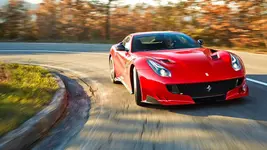
F12berlinetta [Official] Ferrari Unveils Hardcore F12tdf Limited Edition Model With 780PS


The Ferrari F12berlinetta (Type F152) is a front mid-engine, rear-wheel-drive grand tourer produced by Ferrari. Production: 2012-2017. Predecessor: Ferrari 599. Successor: Ferrari 812 Superfast.
2015 Ferrari F12tdF review
Because the F12's 730bhp wasn't enough: Ferrari's limited-run F12tdf comes with more power, less weight and a radical rear-wheel steer system


OUR VERDICT
Ferrari F12 Berlinetta

6b03090c5970452fff5ff80186b48f39.jpg

Can Maranello evoke past greats with its latest front-engined V12?
  • FIRST DRIVE
    2015 Ferrari F12tdF review

    Because the F12's 730bhp wasn't enough: Ferrari's limited-run F12tdf comes with more power, less weight and a radical rear-wheel steer system
by Matt Prior
9 November 2015
Follow @@matty_prior

What is it?:
Un mostro? Ferrari’s F12 is not a car that ever struck me as wanting for power. It really doesn’t feel like it needs more nor, at least without significant modification, should it be given it. But here we are: the Ferrari F12tdf, a special version of the F12, limited in production but unlimited in ambition.

It’s called tdf to reference the old Tour de France road race, which Ferraris won quite a few times, but only ‘F12tdf’ in name and not actually ‘F12 Tour de France’. The two-wheeled, pedal-powered Tour de France owns the Tour de France moniker, so only the Tour de France can actually say Tour de France. Follow?

Anyway, the tdf it is, and it gets lots more power than an F12, and, thankfully, plenty of other modifications to go with it. Ferrari’s special 12-cylinder car programme has in the past provided us with the 599 GTO, of which 599 were made.

Ferrari suggests the 799 tdfs that will roll away from Maranello will be just as extreme, providing a front-engined Ferrari V12 with hitherto unmatched levels of agility. There are several ways you can make a car feel more agile, and Ferrari has done all of them.

One is adding more poke: so the tdf gets 770bhp instead of 730bhp, thanks mostly to an easier-breathing inlet on the 6.3-litre engine and race-derived mechanical rather than hydraulic tappets, which are noisier but lighter and allow a higher rev limit – some 8900rpm.

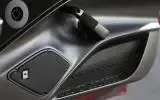
Another method is to reduce weight, so the tdf is 110kg lighter than the F12, thanks to the removal of much of the interior (Alcantara and carbonfibre replaces leather and aluminium), and the replacement of much of the aluminium bits on the outside with carbonfibre.

But the easiest way to introduce agility to a car is simply to fit it with massive front tyres. At the start of the development process, Ferrari did just that - fitting 315-section F12 rear wheels to the front, and then even slick tyres to the front, to see what the result was like.

Hilarious but perilously unstable is the short of it, which meant Ferrari couldn’t just leave it like that. And here its marketing men rather like to use an aerospace analogy: in the same way that a modern fighter jet is designed to be inherently unstable so that it’s incredibly agile, so too was the tdf.

And where a modern fighter uses electronic control systems to make it flyable, Ferrari uses active rear steering to make the F12 tdf driveable again. They call the system a ‘virtual short wheelbase’, or ‘passo corto virtuale’ to be precise, although it’s not strictly accurate in either language – it’s the wider front tyres, 285 section rather than 255s, that increase the agility and make the car feel like it’s shorter.

The ZF rear steer system, which weighs around 5kg, can add up to a degree of toe in or out thanks to electromechanical actuators acting on a toe link, and almost always turns in the same direction as the fronts (except at manoeuvring speeds), is used to put stability back in.

In effect that lengthens rather than shortens the wheelbase again, but semantics aside, the aerospace analogy isn’t unfounded. Either way, Ferrari likes the system so much it’ll use it again in future. So significant are these things that beyond them the changes are mere details.

The aerodynamics are improved – the car’s a little longer as a result, while the rear track is wider because of the active toe changes. Gear ratios are 5-6% shorter, enough to reduce the 0-62mph time to 2.9sec, and spring rates are stiffer, by 20% – a difference you’ll feel “within a metre”.

The price, if you’ve been invited to buy a tdf – and you’ll own at least five other Ferraris and be known by the company “very well” if you have – is £339,000.

What's it like?:
Intriguing. And if that isn’t the word as immediately positive as you’d expect about a car from a manufacturer that can do scarcely little wrong at the moment, I share your surprise.

Ferrari admits that its special V12 models aren’t simple to jump into and drive quickly – they’re not like the standard mid-engined V8s – and the tdf takes some learning before you feel completely comfortable with it on a circuit. I’ll come back to that.

Because on the road, of course, dynamic extremes aren’t such a bother. Yes, you do notice the firmness of the ride and the fact that if you flick the dampers to ‘bumpy road’ mode there’s seemingly less of a difference than in a standard Ferrari. It’s always firm: not crashy, but you know what’s beneath you.

The tdf retains the F12’s two-turn lock-to-lock steering rack, but because of the wider front tyres and stiffer suspension, it feels more connected and responsive than a regular F12. So in many ways it’s easier to drive; out in the hillside roads around Maranello the tdf steers with ease and precision; it’s a big car but one that’s easy to place.

And it has an utterly magnificent drivetrain. Untroubled by turbochargers yet still developing 80% of the engine’s torque from 2000rpm, its response is fantastic, it makes a glorious noise like an F1 car of old and the seven-speed dual-clutch automatic gearbox has had a few tweaks to clean up and shorten the shift times.

At the top end of the rev range the response is on occasion too sharp – even Ferrari’s test drivers think as much – but such is the significance of the tdf name and the programme that the engineers and marketers want the tdf to feel like there’s some racing car in it. Quite a few racing drivers would be delighted to find their race cars had a powertrain as strong and responsive as this. It is phenomenal.

It’s on a circuit, though, nearer the car’s limits, where the idiosyncrasies of the tdf’s handling, and the response of the engine, come further into consideration.

In most front-engined, rear-driven cars you know what you’re going to get on a track. You have to settle the nose on approach to a bend, probably trail the brakes slightly to reduce understeer, which in turn can unsettle the rear, and then you drive through nicely under power, applying just the amount you want in order to adjust the attitude of the car. An Aston Martin V12 Vantage, for example, is as simple as they get.

The tdf isn’t quite like that. Partly that’s because there’s not really any understeer to drive around in the first place. The additional front tyre width makes it feel hyper-agile, so in faster corners it darts for the apex, but then, when you expect the rear to become unsettled because of the speed with which the nose has dived into a bend, the active rear steer intervenes and makes the back end more stable, keeping the rear trimmed to the same apex as the fronts at a speed a car without the system fitted just couldn’t match.

Mind you, with any significant application of throttle – and more or less any throttle application is significant in a car with this power and response – it will still light up the rears, at which point the increased speed at which you’re travelling, the electric response of the engine and whatever the rear is up to conspire to make it feel not altogether natural.

With more familiarity you learn to anticipate the tdf’s characteristics, drive with lighter, more fingertippy touches and smaller inputs, and then it becomes a deeply rewarding thing. But it’s not a car – like the docile 488 GTB is – that you can just enjoy easily.

And I’d want more than the few laps we were allowed to know whether it was more rewarding than a thoroughly well-sorted and conventionally set-up car. No question, though, it’s incredibly impressive – and not just as a technology showcase.

Should I buy one?:
If any of that sounds down on the tdf, it’s not meant to: there is loads to love here. The cabin, the noise, the performance, the responses right up to the limit are all exceptional. It’s just unusual at times and, given that it’s meant to be challenging and that an owner will have at least five other Ferraris to choose from – let alone other cars – depth and unusualness is a characteristic the tdf can easily afford to have.

Besides, thinking about it, I wonder: would I have a TdF over a Lamborghini Aventador SV, a car we like deeply? Undoubtedly. Over a McLaren 675LT, which we thought was a five-star car? It’s a very close-run thing. Certainly I’d want many, many more goes in the tdf before I would say for sure. And let’s face it, that’s kind of the point of Ferraris like this.

Ferrari F12tdf

Location:
Maranello, Italy On sale Now Price: £339,000 Engine V12, 6262, petrol; Power 770bhp at 8500rpm; Torque 520lb ft at 6250rpm; Gearbox Seven-speed dual-clutch auto; Kerb weight 1415kg (dry); Top speed 211mph; 0-60mph 2.9sec; Economy 18.3mpg (combined); CO2/tax band 360g/km, 37%

Ferrari F12tdf Review (2017) | Autocar
 

Attachments

A review already? While I still maintain there's some disconnect between the front and everything aft of the A-pillar, it is starting to look better, especially in pics where it's hustling about in the Italian countryside.

I got some thinking to do...
a5a83ec0cbd1e08997efd58231ab887f.webp
 
I still don't find the design of the car very elegant for a Ferrari... looks more like a tuner proposal to me, especially the rear part and a little the front. Does not suit a V12 GT well in my opinion, makes it too close to a Vette. In that respect, the 599 GTO was much better.
The technical package seems great though !
 
Ferrari F12tdf review - first drive in the ferocious 769bhp supercar
JETHRO BOVINGDON
9 NOV 2015
bb32c0459e6d4127990f7e2ec555ba77.webp


VERDICT:
It could just be the purest expression of Ferrari right now
EVO RATING: ~4.5 Stars

PRICE:
£339,000

The iconic Tour de France name is resurrected for an extreme version of the F12. Faster, lighter and packed with new technology, it’s a mouth-watering proposition. So can it live up to the huge expectation?

What is it?
Pure automotive pornography. Sorry if that sounds crude but the Ferrari F12tdf exudes a desirability and aggression that might make it the most desirable car on sale today. It’s got the glamour and inherent balance of a big front-engined rear drive machine, the breathless excitement of a normally aspirated V12 and so many cuts, slashes and aero devices that it reeks of motorsport and technology. Ferrari will produce 799 of the F12tdf at £339,000.

Lighter, more powerful and showcasing a new four-wheel steering system but unencumbered by weighty hybrid technology or turbocharging, it should be the purest expression of Ferrari right now.

Technical highlights
The F12tdf ups the ante considerably over the standard F12 in terms of drivetrain performance, aerodynamics, lightweight materials and solutions and, of course, chassis dynamics. The basics statistics are that power from the 6.3-litre V12 is up to 769bhp at 8500rpm (from 730bhp) and 520lb ft at 6750rpm (from 509lb ft), the 7-speed dual clutch transmission cuts shift time by 30-percent on upshifts and 40-percent on downshifts and the gear ratios themselves are shorter by 6-percent. Ferrari claim the tdf reaches 62mph from rest in 2.9-seconds and 124mph in 7.1-seconds. The top speed is ‘over 211mph’.


5a38ce55a949bfc1b71af936e0f30473.webp


The drivetrain looks set to be extraordinary then, as the standard F12 is already relentlessly fast and endowed with stunningly sharp responses. However, those gains are enhanced still further by a 110kg weight saving, meaning that the tdf weighs in at 1415kg dry (although that number is with ‘optional lightweight’ equipment). As you’d expect carbon fibre is the key here. It’s used for the front and rear bumpers, the ‘Aerobridge Evo’ device on the front wings and the underbody aero and is used extensively for the interior, too.


The chassis and aerodynamic work is perhaps even more impressive. Ferrari has increased the front tyre size from 255-section to 275-section (it runs the new Pirelli P Zero Corsa) but then claims to have mitigated the increased ‘oversteer on the limit’ that the extra front grip could create with the new ‘Virtual Short Wheelbase’ four-wheel steering system. In fact this is a bit of a misnomer. The ‘short wheelbase’ feel has been realised by increasing the front end grip and working on the mechanical grip and agility in general.

The four-wheel steering system is used to control the newfound responsiveness, the rear wheels steering in the same direction as the fronts for stability, not in the counter direction for agility. Perhaps it should be called Virtual Long Wheelbase. Either way Ferrari claim this creates a car with the outright response of the old 599 GTO but with a much more predictable, exploitable feel that should suit all levels of driver ability. Of course the 3rdgeneration magnetic dampers are retuned, the springs are around 20-percent stiffer and the tdf benefits from new Extreme Design brake calipers from theLaFerrari.


29c26c3cbc19b0cfc8b01c4d56674bc6.webp


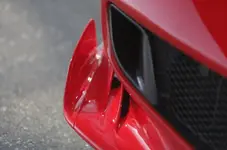
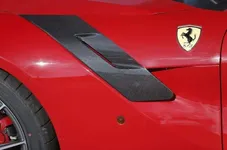
In terms of aerodynamics the tdf’s pretty extreme styling is functional as well as deliciously aggressive. Downforce is up by a claimed 87-percent to 230kg at 124mph. You can see many of the aero upgrades – from the redesigned front splitter with dive planes to the more extreme Aerobridge treatment channeling air from the bonnet down the sides of the car and the new active rear diffuser that can be stalled to reduce drag -– but the lengths to which Ferrari has gone are illustrated by the more steeply raked rear screen, altered to increase the extended rear spoiler’s working area. In simple terms Ferrari has thrown everything at the F12tdf, just as you’d hope and expect.

What’s it like to drive
The launch programme for the F12tdf was limited. It consisted of 4 fast laps of Fiorano and then around 2 hours on the roads nearby. With the demands of photography that 2 hours quickly dwindles! I know, there are tiny harps crying out in sympathy… but I just want to give you a picture of the time because the tdf is a complicated car and I still don’t feel like I’ve got all the answers.

Initially on the circuit it feels sharp-edged, unnatural and very, very edgy. Partly that’s because when you have only 4 laps you want to immediately get up to a good pace and tend to overdrive in order to do so. But mostly it’s because the tdf has extreme front-end grip, instant response and seems to leave little room for error. So before you can think the car has pointed itself at the apex, the rear of the car is moving into what feels like a big oversteer moment and you find yourself sawing at the wheel to keep everything under control. Dial back the pace and instead of stabbing in oversteer corrections you find yourself struggling to just steer a smooth arc around any given corner – turning each instead into a giant 50 pence piece. Far from flattering your mistakes, the tdf almost seems to revel in magnifying them.


fb3aecfee6e0eac7285b1f622aaa5a12.webp


With time this nervousness subsides… never quite disappearing but you slowly tune into the car’s rate of response, start to drive very much with your fingertips and the tdf begins to feel smooth and balanced rather than serrated and angry. However, the extra front and rear grip and the much greater body control create a very different feel and balance to the normal F12. It’s not an indulgent car, doesn’t want to play big, big oversteery slides. Instead it’s neat and precise but with this edge, this spikiness never too far away. It demands respect and thought. You don’t just drive the tdf on instinct but instead find yourself trying to figure out the best way to get it through each corner… On track at least I never quite felt on top of the car. Never fully immersed in the unfolding action.

Of course the drivetrain is mesmerising. What an engine! For me the throttle response is a little too sharp if the manettino is wound around to Race, CT Off or ESC Off, but in every other way it’s a magnificent experience. The deep, insistent torque and then the frenzied, savage way it winds around to the 8900rpm limiter is just unmatched.

You’ll read lots about new generation turbocharged engines in the 488, in the new 911 and many other cars in the weeks and months to come and some people will try to tell you that forced induction is so good now that it hardly matters… They’re lying to you and the F12tdf is proof positive that for excitement, response and the sorts of noises that make you want to jump for joy, nothing beats a big normally aspirated engine. Nothing. Married to the scintillating dual-clutch transmission it’s a joyous, almost terrifyingly potent package.

Out on the road the F12tdf does feel extreme, perhaps more so than we’d even expected. The ride is composed, almost supple on smooth surfaces but on lumpy, narrow roads it feels much more aggressive than even something like the 458 Speciale. It seems that by creating such immense steering response and eliminating any trace of understeer Ferrari has to be sure that the F12tdf is in control of its weight for every millisecond, demanding a pretty uncompromising set-up.

The result is that the car isn’t as fluid we’ve become used to from Ferrari. It requires time to understand and recalibration of your senses to tune into the messages present as it changes direction… They’re bubbling away in the steering and through the seat and of high quality
0f19c9f479bdc177b6a3970c2d2abf44.webp
, but such is the speed of what’s going on it’s easy to miss them and then the tdf can seem wildy fast and effective but unwilling to fully communicate with the driver. And such is the car’s potential you need to be fully in the loop or confidence can quickly dwindle.


cf8d40fd2939a78756aeab45428c2f0f.webp


As you can tell, the F12tdf is a fascinating but not instantly intuitive car to drive quickly. It’s also a car that requires you to adapt to its responses, to learn to trust in the four-wheel steering system and to respect that 769bhp going through rear tyres without an engine pressing above them requires finely considered deployment. It has masses of grip, staggering reflexes, superb traction and immense control but what lies beyond is never too far from your mind. It’s a challenge but one with real rewards… Put it this way, we really want to drive it again to try to unpeel more and more layers of its ability.

Rivals?
The drivetrain is out of this world. A Lamborghini Aventador LP700-4 isn’t even close. The chassis is incredibly capable but doesn’t feel as transparent as aMcLaren 675 LT… But are those the right benchmarks? It really is a unique proposition.

Anything else I need to know?
The pasta at the Montana restaurant nestled beside Fiorano tastes nearly as good as an F12tdf sounds at 8500rpm.
http://www.evo.co.uk/ferrari/f12tdf...-first-drive-in-the-ferocious-769bhp-supercar

http://www.evo.co.uk/ferrari/f12tdf
 
First drive: Ferrari’s new F12tdf, the 770bhp hyper-V12

Jason Barlow
9 Nov 2015

The F12tdf? Isn’t that what Kimi Raikkonen was donutting on the Mugello main straight just a couple of days ago?

Yep. We suspect he enjoyed it. And we know Sebastian Vettel definitely did, because TG.com just bumped into him at Ferrari’sFiorano test track.

Effectively a nastier version of Ferrari’s front-engined V12 flagship, the F12tdf’s big party trick is its four-wheel steering that, the engineers say, works in-phase with the front axle to dramatically improve high-speed stability and agility.

Vettel is no stranger to these things, of course, but at 1415kg dry, the F12tdf is roughly double the weight of his SF15-T, this year’s F1 car.

“Its high speed stability and balance are incredible,” he tells us, grinning. “It’s incredibly fast, but it’s the way it feels through turn seven here [Fiorano’s infamously fast sweeping right/left] that is so mind-blowing…”

Is he right?

We couldn’t have put it better ourselves. Besides, Vettel has a highly sensitive quadruple-F1-world-championship-winning-bottom, so who are we to argue?

The F12tdf might be named after the 1950s 250 GT special that won the famous French road race three years running (1956/’57 and ’58) as well as the Targa Florio and other much-missed beardy classic events, but this new car is Ferrari on revolutionary ultra-fast forward.

On which basis we’d say the name was something of a misnomer, but apparently Piero Ferrari himself decided it was appropriate and we don’t want to upset the dude. (But it’s not a turbodiesel, OK?)


So what’s the deal?

Given that the 488 GTB pumps out 661bhp and has easily enough real-world performance to seriously harass the LaFerrari hypercar, the F12tdf is on an intriguingly different mission. It’s exploring some pretty far-out thinking, taking Ferrari into territory in which it’s actively challenging itself as well as its clients.

OK, so Honda had four-wheel steer on the Prelude back in the mid-1980s, and Porsche’s current 911 GT3 has an active rear axle. But following the deliberately tricky and frankly almost bipolar599 GTO, the F12tdf sees Ferrari dabbling again in an area inspired by state-of-the-art avionics in pursuit of electronically enhanced super-manoeuvrability.

“We’re at the frontier of new automotive technology,” Ferrari’s chief test driver Raffaele de Simone tells us. “It requires a clever driver to get the best out of it, not in terms of pure ‘feel’, but in being able to get the maximum out of the car. You cannot just jump in the F12tdf and go straight to the limit. You have to learn about what it can do. And you have to drive it in a very linear and precise way.”

Like Kimi, then?

Not like Kimi. At least not to begin with. Following a hot lap with Raffa, TG.com dived in and immediately started swearing very loudly. First impressions are of a car even more ballistically fast than the regular F12, but with sublime body control, phenomenal grip, and an electrifyingly pointy front end.

You can definitely feel the active rear axle – Ferrari calls it ‘passo corto virtuale’ or ‘virtual short wheelbase’ – do its thing, and initially it’s distinctly weird, to the point of being rather unsettling.

In ‘Race’ mode, the F12tdf is just amazingly fast and stable. Switch the guardians off, though, and it can be spikey until you’ve got your hand properly in.

This is a car that wants to perform a Jedi mind trick on you. Either that, or you have to learn to use the force…

Thank you, Obi-Wan. Can we have a reminder of the rest of the car please?

The engine is the F12’s 6.2-litre V12, whose entirely unshabby 730bhp power output has been hiked to 770bhp. It can now rev to 8900rpm, and shovels out 520 torques at 6750rpm.

The dual-clutch ’box has new tdf-specific ratios; upshifts are 30 per cent faster, downshifts 40 per cent quicker. It accelerates to 62mph in 2.9 seconds (sub-3.0secs is when elite supercars get to join the SAS), 124mph in 7.9 seconds, and it’ll keep going until 211mph.

The brakes are from the LaFerrari, all manner of new aero-voodoo gives it 87 per cent more downforce, and the body has been reworked more profoundly than mere photos might suggest. Compare the rear side window with the standard F12, for example, and check out the redesigned rear screen. It has more rake, and effectively acts as a spoiler.

There are dive planes, end plates, a bigger rear spoiler, and the carbon aero bridge on the front wings ‘flick boosts’ the air along the car. Amazing stuff.


And inside?
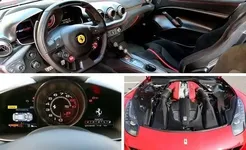
It’s not totally stripped for action, but there’s exposed carbon, and the seats are great. And apart from some low-rent exposed screw heads, it’s beautifully well made.

There’s nothing like sitting behind the wheel of a big, front-engined V12 Ferrari GT to make you feel good about life. Even if you’ve only got the key for four hours.

How does it feel on the road?

Crazy good. It takes Herculean self-discipline not to travel at warp factor 10 everywhere, so addictive is the performance rush and so huge-sounding is the V12.

Significantly, the tdf ties the F12’s body down more effectively than the regular car, and the way it changes direction on the twisty up- and downhill roads we know so well, 40 minutes from Maranello, is deeply impressive for a car this size, weight and configuration. It’s also beautifully damped, so you can carry silly speeds over horrible road surfaces.

The front tyres – bespoke Pirelli P-Zeroes – have grown in size from 255 to 275 section, and although the actual steering is the same as the F12’s, the rear-steer, chassis electronics and e-diff enable you to pile in and out of corners in a way that should be impossible according to all established laws of physics.

It has the neutrality, poise and agility of a smaller, lighter, mid-engined car, with all the thunder and colossal force of a large, normally aspirated V12. All in all, a technical tour de force.

Problems?

The usual. Firstly, the F12tdf costs £339,000. But even that’s academic, because all 799 have been sold.

As usual, Ferrari can vet its clients, so the lucky recipients will already have at least five Ferraris in the garage. But they won’t have one quite like this.

We’re not convinced every one of them will fall completely in love with the tdf, such is the slightly quixotic nature of its character, and it definitely needs more effort the faster you go. But it also rewards that effort in spectacular style.
http://www.topgear.com/car-reviews/tdf/first-drive
 
This is my favorite Ferrari, V12, naturually aspirated, and stupid good looks. Easy choice over the 488 GTB.

M
 
I still don't find the design of the car very elegant for a Ferrari... looks more like a tuner proposal to me, especially the rear part and a little the front. Does not suit a V12 GT well in my opinion

It's not a GT though, the F12 is that. This is a straight up race car. 800 hp man.
 
It's not a GT though, the F12 is that. This is a straight up race car. 800 hp man.

OK, got the point. But then, let's put a fixed wing on the rear like a GT3 racer if you want to push to concept till the end ! As it is, for me it seats between two chairs : too extreme looking for a street car, on the verge of bad tuning / compromised for a pure track car (all track cars have got wings, see the XX cars from Ferrari). In my eyes, a GT3 RS is more cohesive than this.

Anyway, everybody will have its own taste for cars ;-)
 
outside of the battle between the F12tdf vs. the 599GTO that "rages" in my own mind, the F12tdf has me so much more excited than the release of the 488GTB.

To view this content we will need your consent to set third party cookies.
For more detailed information, see our cookies page.
 
I need some high res photos of this car, we are almost at 2016, why can't the websites release HD quality images?
 
I think this Ferrari has finally replaced the LFA as my favorite front engine super car.
 
I think this Ferrari has finally replaced the LFA as my favorite front engine super car.

Wow! That's a bold statement, not to take away praise from this car as I love these last 2 gens of front-engined V12 machines from Maranello, especially their special edition iterations. But, even though LFA's exterior is starting to look a bit dated to me, I love every inch of that car as there's an inherent specialness to it...that V10 engine, the interior, that sound. The way things are going, I don't think we'll see a car like that again.

I need some high res photos of this car, we are almost at 2016, why can't the websites release HD quality images?

Hope this helps, all credits to the photographer, of course...
 
Wow! That's a bold statement, not to take away praise from this car as I love these last 2 gens of front-engined V12 machines from Maranello, especially their special edition iterations. But, even though LFA's exterior is starting to look a bit dated to me, I love every inch of that car as there's an inherent specialness to it...that V10 engine, the interior, that sound. The way things are going, I don't think we'll see a car like that again.
LOL yeap, I know it was a bold statement, that is why I read all the reviews, watched all the videos and have a thought about it for a few days before finally making up my mind. The specialness of the LFA is beyond reproach, I have seen the car up close several times, and studied it in detail. Every surface, every panel gap and every detail of the car is made to perfection. It looks unlike anything else and it sounds like heaven.

But this F12 tdF takes the idea of Front engine rear wheel drive super car to the absolute limit in every possible way that the LFA is being left behind.

Both cars are equally special but the F12 tdF is the ultimate of what this type of car can achieve.
 
LOL yeap, I know it was a bold statement, that is why I read all the reviews, watched all the videos and have a thought about it for a few days before finally making up my mind. The specialness of the LFA is beyond reproach, I have seen the car up close several times, and studied it in detail. Every surface, every panel gap and every detail of the car is made to perfection. It looks unlike anything else and it sounds like heaven.

But this F12 tdF takes the idea of Front engine rear wheel drive super car to the absolute limit in every possible way that the LFA is being left behind.

Lucky, on my car-related bucket list, seeing an LFA in person and sitting in one is definitely high on there. I figure that goal is "somewhat achievable." Whereas driving an LFA, while on the list, I'd classify as "much less achievable." Not to take away from this thread's topic, but the F12, F12TdF, 599GTO are on the list. (I've sat yet not driven a 599GTB).
 
2016 Ferrari F12tdf
Ferrari's virtual short wheelbase creates a kick-ass car in the real world.

FIRST DRIVE REVIEW
To build its latest red-blooded creation, Ferrari first ruined a perfectly good car. In transforming the sure-footed F12berlinetta grand tourer into the fast-and-loose, apex-hounding F12tdf, Ferrari engineers deconstructed the stability that’s inherent in the F12’s long wheelbase, its substantial weight, and its high polar moment of inertia relative to mid-engined cars. The front tires grew in width from 255 millimeters to 285 millimeters, an aggressive alignment boosted turn-in and lateral grip, and—with no change to the rear tire width—a fickle, oversteering monster was born. One Ferrari chassis engineer described the team’s work bluntly: “First, we screwed up the car.”

With the chassis suitably squirrelly, engineers applied the brand’s first use of rear-wheel steering to dial in just enough stability to make the car manageable and predictable. Ferrari calls the resulting package Passo Corto Virtuale, or virtual short wheelbase, and it shrinks the F12tdf’s 107.1-inch wheelbase and 3600-pound curb weight to Miata-like sensations. Okay, maybe the F12tdf doesn’t drive quite that small and nimble, but it more than compensates with the uncanny precision that $490,000 buys.

Virtual Short Wheelbase, Real-World Awesome
The F12tdf worms its way into your psyche with delicate, light steering that is direct, immediate, and unforgiving. Spin the steering wheel too fast or too far and the rear responds just the same, rotating too fast or too far. Get it right, though, and the car darts where you look with the rear tires faithfully following the front end in a tight, tidy arc. It’s ironic that the steering feels like the most special of the F12tdf’s specialties, because while Ferrari massaged the F12’s engine, transmission, suspension, brakes, and aerodynamics for the F12tdf program, the hydraulically assisted steering system is the one component left unchanged.

The electric motors that steer the rear wheels at up to two degrees in either direction come from ZF, but Ferrari engineers performed all of the software calibration to ensure the system works in harmony with the electronically controlled limited-slip differential, the magnetorheological shocks, the traction control, and the stability control. As you click the steering-wheel-mounted manettino drive-mode selector from Sport mode to Race to CT Off (traction control off), the car’s agility swells. Neutral is the wrong word, though, because neutral implies a car that can be provoked to understeer as readily as it oversteers. The F12tdf’s front tires only plow when you do something truly stupid.

Modern rear-wheel-steering systems, including those in the big-dog Porsche 911s, typically countersteer relative to the front wheels at low speeds to improve agility and steer in the same direction for greater stability at elevated velocities. Ferrari claims its adaptation doesn’t need to countersteer the rear wheels; the natural behavior of the car is sufficiently agile. Instead, the Italians need only the enhanced stability to keep the tail from overtaking the front of the car in corners.

Ferrari’s previous track special, the aptly named 458 Speciale, can turn any driver into a hero with its beautiful balance and unflappable cool. That mid-engined car’s reactions will flatter you into believing your every move is a flawless execution of vehicle-dynamics theory. The F12tdf is far less forgiving. It demands more focus, more skill, and more respect. In return, it delivers honest fun that is both uncommon and uncanny in a car with this much power and this much grip.

6.3-liter V-12, because the drama of unleashing all 769 horsepower is man’s greatest tribute to the internal-combustion engine. At full throttle, it bellows like a thousand angelic trumpets ushering you into car-guy heaven as the revs wind up like a crotch rocket’s.

The F12tdf musters an additional 39 horsepower and 11 lb-ft of torque over the standard F12 with the help of a new air-filter box, revised intake plumbing, and a larger throttle body. Solid lifters replace hydraulic tappets. The resulting weight reduction allows Ferrari to add more valve lift to the intake-cam profile and to raise the rev limiter from 8700 rpm to 8900 rpm. Variable-length intake runners use telescoping trumpets within the intake plenum to shrink or stretch the runner length for optimized airflow. In the F12tdf, Ferrari uses just two distinct positions—short and long—but future cars may take advantage of the fact that the position of the trumpets is continuously variable between the boundary conditions.

Shorter gear ratios throughout the seven-speed dual-clutch automatic transaxle are augmented with quicker shift times. We project a 2.8-second blast to 60 mph on the way to a 10.8-second assault on the quarter-mile. The always-on nature of the big-displacement, naturally aspirated 12-cylinder engine demands a delicate right foot on corner exit, but the pedal obliges with long, linear travel. When it’s time to reverse thrust, a brake pedal with just as much fidelity activates a carbon-ceramic braking system borrowed from the LaFerrari hypercar.

Lighter, But Still Luxurious
Ferrari intends the F12tdf to be a car that owners will drive to the track, at the track, and back home from the track. But in readying the F12 for regular track service, the suspension has lost some suppleness. Even with the dampers set to their more compliant mode, the F12tdf skims over humps in the road like a skipped rock. In city driving, the F1 dual-clutch transmission isn’t as velvety as Porsche’s or McLaren’s gearboxes, particularly in off-throttle downshifts. Overall, though, the F12tdf remains a civilized road car. While lighter microsuede replaces leather and carpets have been removed altogether, Ferrari still fits a radio, navigation, and air conditioning.

Ferrari stripped a total of 243 pounds from the F12. A chunk of that weight comes from reducing the amount of glass on the car by tapering the rear window and shrinking the rear-quarter windows until the transparent section is no larger than an iPhone. Carbon fiber is now used for the door skins inside and out, plus the front and rear fascias. And while the rest of the body panels are still aluminum, the roof and the A-pillars are the only pieces that carry over from the F12. The bevy of dive planes, spats, and spoilers increase downforce to more than 500 pounds at 124 mph. While they’re added for functional purposes, the cooling and aerodynamic changes also create something visually striking. The righteous louvered fenders bulging around the rear tires are both an homage to classic Ferraris and a carnal suggestion of what the car is capable of. Ferrari may have taken one step backward to start work on the F12tdf, but its finished product is miles ahead of the F12 in driving excitement.

1af63687a8549c35e3fa372dc81ef6fc.webp

http://www.caranddriver.com/reviews/2016-ferrari-f12tdf-first-drive-review
 

Attachments

Ferrari F12 tdf (2015) review
Published: 11 November 2015
By Chris Chilton

► 799 to be built, all are sold
769bhp V12, rear-steer tech
► £100k more than a regular F12


Not Ferrari’s first diesel, the F12 tdf is the fastest road car from Maranello this side of aLaFerrari. But is it a case of tech over taste?

Okay, let’s deal with that name. TDF? WTF?
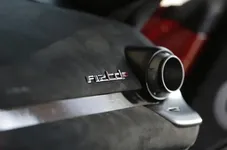
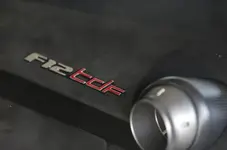
It stands for Tour de France, and was the name of a famous motor race in the days when there was more grease in a driver’s hair than his car’s axle. The car’s called tdf because the people who run the famous bike race won’t let Ferrari call it the Tour de France. And besides, saving nine letters saves precious grams – or it would if this F12 wore any identifying badges.

It hardly needs them. No one’s going to confuse this for any other F12. Unless it’s been attacked by Mansory…
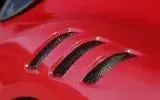
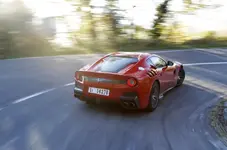
We’ll leave it to you to make up your mind about how near to (or far over) the limit of taste Ferrari has gone with the tdf, but you have to admire the amount of work that’s gone into it. The side profile is completely unique, thanks to a shorter rear quarter window and different rear screen rake. Throw in the iconic three GTO vents and you’ve got a fascinating mix of iconic styling references and modern supercar technology.

And what’s the tech angle this time?
About 1 degree, since you ask. That’s the change in toe angle at the rear wheels the new four-wheel steering system can provide. Ferrari calls it the Virtual Short Wheelbase system, but actually the four-wheel steering only ever turns the rear wheels in the same direction as the fronts beyond parking speeds, because the aim is to promote stability, which seems more like virtual long wheelbase to us.

And it feels…
Pretty strange for a while. The standard F12 is a lairy beast, huge fun, but definitely partial to a bit of oversteer. The tdf has far more front-end bite so the VSW tech is meant to keep the rear from chucking the towel in. It doesn’t eliminate the oversteer – that’s still there if you push – but it’s much more tied down than the regular car.

Unlike something like the 488 with its Side-Slip Control technology, or even the regular F12, it takes some mental recalibration to work out how to get the best from the tdf. With the traction control switched out at Fiorano and driving the tdf as I would a normal F12 I found myself clumsily overcorrecting small oversteer slides on the quicker corners for my first couple of laps.

The trick seems to be to relax and reduce your inputs, and I’m sure, just as we’re now accustomed to the hyper-quick Ferrari steering racks that felt so alien when the 458 was launched, owners will tune in to the tdf’s different character with some miles under their belts. And if you’re still struggling on track, stick to Race mode, which subtly kills any slip, totally avoiding the issue, and letting you concentrate on nailing the quickest lap possible.

What else do I need to know?
That unleashing full power in second or third gear is enough to make even the most curmudgeonly car hater let out an involuntary whoop! of delight. Or possibly terror. A combination of 115kg less kerb weight (for around 1520kg at the kerb), shorter gear ratios and a V12 pumped up from 730bhp to an absurd 769bhp help the tdf to 62mph in 2.9sec (3.2sec std F12) and 124mph in 7.9sec (8.5sec). It sounds outrageously good, simultaneously sweet but sharp edged, and the twin talents of instant (occasionally too insant) throttle response and an 8900rpm redline remind that, impressive as the 488 GTB’s new turbo engine is, Ferrari’s V12 is the far more satisfying, soulful motor.

Verdict
You can’t because all 799 are sold, but hypothetically, would you pay £100k over anF12 Berlinetta for the tdf? That’s an awful lot of money and the answer depends largely on whether you prefer the more demure styling of the stock machine or prefer keeping it precise on track for the best possible lap time. Dynamically, for us, there’s a perfect car somewhere between the two F12s. We love the tdf’s monster straightline performance and incredible front-end response and bite, but would happily sacrifice the odd tenth at Fiorano for the F12 Berlinetta’s more intuitive on-and-beyond-limit behaviour.

My money would buy the brilliant and comparatively bargain-priced Berlinetta, but away from the Ferrari test track and the make-believe magazine world of £340k supercars oversteering everywhere, I think that the peope who have actually made a choice between the two and splurged for the tdf are going to be very, very happy indeed.

12f0f3fc57645323d6fe24ce04895076.webp

http://www.carmagazine.co.uk/car-reviews/ferrari/ferrari-f12-tdf-2015-review/
 

Attachments

errr..so may great photos.. but all in tiny resolutions. Full HD photos for people with a proper computer monitor, not photos for smart phones and tablets!!!
 

Ferrari

Ferrari S.p.A. is an Italian luxury sports car manufacturer based in Maranello, Italy. Founded in 1939 by Enzo Ferrari (1898-1988), the company built its first car in 1940, adopted its current name in 1945, and began to produce its current line of road cars in 1947. Ferrari became a public company in 1960, and from 1963 to 2014 it was a subsidiary of Fiat S.p.A. It was spun off from Fiat's successor entity, Fiat Chrysler Automobiles, in 2016.
Official website: Ferrari

Trending content

Latest posts


Back
Top