hoffmeister_fan
Kraftwagen König
- Messages
- 11,307
The Ferrari F12tdf Is a 770 Horsepower Throwback to the Supercar Glory Days
The newest special edition Ferrari isn't friendly. It's a challenge. As it should be.
by TRAVIS OKULSKI
photography by DEAN SMITH

Ferrari is inherently intimidating. Arriving in Maranello is unlike the experience of arriving in any other home of auto manufacturing. A legend goes along with the brand, the legend of a man who was far larger than life and still demands respect today. So much so that Enzo Ferrari's office at Fiorano has been left unchanged since his death in 1988, just in case he comes back. You don't get the feeling McLaren will do something like that for Ron Dennis.
And while the brand itself may be intimidating, Ferrari's cars are friendlier than ever. The precarious knife edge that used to take bad drivers and stab them is gone, replaced by vastly more accessible cars that appeal to a wider group of clients. The knife has become distinctly more butter than stiletto.
Well, the $490,000 F12tdf is a switchblade.
"You need skill to extract the maximum," Raffaele De Simone, Ferrari's chief test driver, tells me. "It's not easy to drive at the limit, you need to learn it." That's something that hasn't been said about a supercar in quite a long time, and it's refreshing to hear that a car with nearly 800 horsepower isn't a shrinking violet.

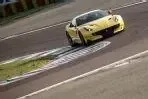
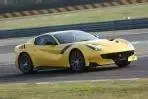
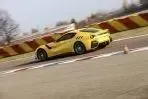
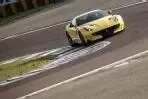
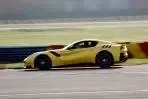
On track at Fiorano, De Simone's words immediately ring true. This is not a car for the timid. The tdf is unapologetically, ballistically fast. Scarily fast. Incomprehensibly fast. It hits 60 from a standstill in 2.9 seconds and it nearly revs too quickly for the tach to keep up. Gears come and go, and within the eight seconds it takes a respectable family sedan to reach 60, you're doing 125. It recalibrates your brain.
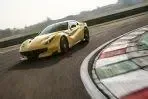
With the tdf in Race on the Manettino, the car is totally stable and safe, the latest edition of Supercars for Dummies. Switch the traction control off and the car starts to come alive. Enter a corner and the enormous 285-section tires bite hard. The tail moves around while the rear-wheel steering, a Ferrari first, tries to keep you stable. With CT Off, the electronics will still intervene enough to inflate your ego at times. You can slightly drift without the danger of crashing. Get the tdf too sideways and it shuts down, a sort of reminder that it could have let you spin and crash but was benevolent enough not to. Thank you, dear tdf.

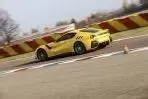
It's not friendly with all the systems off. You have to be on DefCon 5 with every application of the throttle. The tdf breaks away suddenly, and when you go to catch it, you have to be judicious with the amount of correction you apply. Combine the huge amount of front end grip with an ultra-quick steering rack that it's very easy to over-correct and spin.De Simone tells me that you need to be incredibly delicate—we're talking ant walking on a pudding skin delicate—with the steering and to romp on the brakes as hard as you dare. Unsurprisingly, his method works.

That sort of unapologetic attitude with ESC off is more than welcome. The car doesn't step in at all to help. It will reward those that are talented and will not hesitate to show every single one of your faults to anyone and everyone.
See, the tdf—which is an allusion to the old Tour de France Ferraris even though we can't actually call it a Tour de France since the bicycle race owns the trademark—is intended to be the highest performance production-based Ferrari ever. And in order to meet that target, the engineers gave the tdf an extra dose of everything. It has 770 horsepower from its 6.3-liter V12, weighs 220 pounds less than the stock F12, and runs a 1:21 around Ferrari's private Fiorano race track—a full two seconds faster than the F12 with its paltry, almost Dodge-like 730 horsepower.

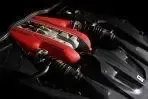
The engine revs to 8900 rpm, so high that the hydraulic lifters have been replaced with lighter mechanical tappets, and it has a variable intake that isn't on the F12. The result is an engine that has 80 percent of its maximum 520 pound-feet of torque available from 2500 rpm and sounds like a banshee when you let it run to redline. Ferrari says it's the most extreme V12 it's made that isn't in a super-limited-production hypercar like the LaFerrari.
Then there's the latest iteration of Ferrari's dual-clutch gearbox upshifts 30 percent quicker and downshifts 40 percent quicker than in the regular F12. Those are improvements over shifts that were already lightning eye blink-fast, so we can't perceive the increase in speed as much as the increase in aggression—it isn't as smooth as the shifts in the F12. It also has shorter gearing for increased acceleration, but top speed remains the same at more than 210 mph.

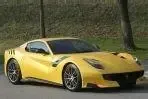
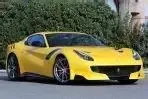
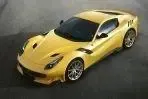
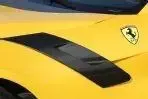
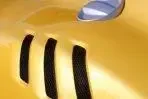
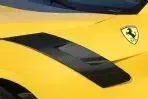
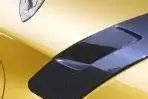
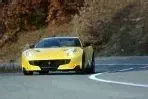
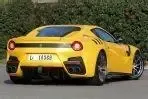
At a quick glance, you might think that the tdf is just an F12 with a bodykit. It's actually an F12 that has had major plastic surgery. Essentially every panel is new, other than the greenhouse and a part of the roof. There's a preponderance of carbon fiber to get the weight down to nearly 3100 pounds, and the bodywork has been redesigned with an emphasis on producing real downforce. At 125 mph, it creates 500 pounds of downforce, something that De Simone says you need to trust in fast corners. That's combined with a diffuser that can actually stall at speed to reduce drag, call it the tdf's version of F1 DRS.
The tdf is also Ferrari's first application of rear-wheel steering, or Passo Corto Virtuale, which means virtual short wheelbase. It sources the controller from ZF, the same people who do the rear-steer tech on Porsches, but the software on the tdf is Ferrari. It's being used to counteract the inherent instability that the massive front grip creates on turn in. Basically, Ferrari wanted an insanely quick turn in, so they put huge rubber up front. Then they found that the car became an oversteering loon, so they had to compensate to make it possible to drive the car without spinning. Rear-steer is the solution.

The idea is that this is a car for the gentleman driver. It's supposed to live on the road with an occasional visit to the track, not the other way around. But it's no Bentley. On the roads outside of Maranello where the tdf was tuned, you find this isn't a coddling experience and that the bumpy-road setting for the dampers will only smooth out the smallest of imperfections.

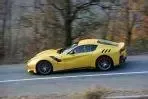
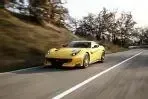
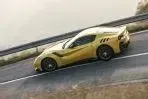
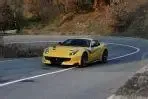
It's still a large car, but it's agile and devastatingly fast on a tight Italian b-road. You can hang the tail out on hairpins, have confidence the brakes will get you stopped before dropping off a cliff, and make it up a hill faster than you think is possible. Not as fast as a local in a beat-up delivery van (since those are always the fastest vehicles on Italian roads), but pretty damn close.
But that's with aids on. Turn them all the way off, and you're right back on that tricky edge we found on the track. Do you trust yourself enough to be there on a public road?

The F12tdf is the sort of car that a beginner can get in and drive, but they can't thrash. The learning curve here is much steeper than in a car like a 488 GTB—it takes time to understand how to get the most out of the tdf. That's what makes the tdf appealing to the buyers, who Ferrari requires must own at least five Ferraris before they can purchase it.
That this isn't a friendly car continues to instill Ferrari with some of that intimidating mystique that the brand has earned since it was founded. A supercar with 770 horsepower shouldn't be easy to drive. The driver shouldn't expect to immediately be an expert. It should be a challenge. The F12tdf is that challenge.

http://www.roadandtrack.com/new-cars/first-drives/reviews/a27340/ferrari-f12tdf-first-drive/
The newest special edition Ferrari isn't friendly. It's a challenge. As it should be.
by TRAVIS OKULSKI
photography by DEAN SMITH
Ferrari is inherently intimidating. Arriving in Maranello is unlike the experience of arriving in any other home of auto manufacturing. A legend goes along with the brand, the legend of a man who was far larger than life and still demands respect today. So much so that Enzo Ferrari's office at Fiorano has been left unchanged since his death in 1988, just in case he comes back. You don't get the feeling McLaren will do something like that for Ron Dennis.
And while the brand itself may be intimidating, Ferrari's cars are friendlier than ever. The precarious knife edge that used to take bad drivers and stab them is gone, replaced by vastly more accessible cars that appeal to a wider group of clients. The knife has become distinctly more butter than stiletto.
Well, the $490,000 F12tdf is a switchblade.
"You need skill to extract the maximum," Raffaele De Simone, Ferrari's chief test driver, tells me. "It's not easy to drive at the limit, you need to learn it." That's something that hasn't been said about a supercar in quite a long time, and it's refreshing to hear that a car with nearly 800 horsepower isn't a shrinking violet.
On track at Fiorano, De Simone's words immediately ring true. This is not a car for the timid. The tdf is unapologetically, ballistically fast. Scarily fast. Incomprehensibly fast. It hits 60 from a standstill in 2.9 seconds and it nearly revs too quickly for the tach to keep up. Gears come and go, and within the eight seconds it takes a respectable family sedan to reach 60, you're doing 125. It recalibrates your brain.
With the tdf in Race on the Manettino, the car is totally stable and safe, the latest edition of Supercars for Dummies. Switch the traction control off and the car starts to come alive. Enter a corner and the enormous 285-section tires bite hard. The tail moves around while the rear-wheel steering, a Ferrari first, tries to keep you stable. With CT Off, the electronics will still intervene enough to inflate your ego at times. You can slightly drift without the danger of crashing. Get the tdf too sideways and it shuts down, a sort of reminder that it could have let you spin and crash but was benevolent enough not to. Thank you, dear tdf.
It's not friendly with all the systems off. You have to be on DefCon 5 with every application of the throttle. The tdf breaks away suddenly, and when you go to catch it, you have to be judicious with the amount of correction you apply. Combine the huge amount of front end grip with an ultra-quick steering rack that it's very easy to over-correct and spin.De Simone tells me that you need to be incredibly delicate—we're talking ant walking on a pudding skin delicate—with the steering and to romp on the brakes as hard as you dare. Unsurprisingly, his method works.
That sort of unapologetic attitude with ESC off is more than welcome. The car doesn't step in at all to help. It will reward those that are talented and will not hesitate to show every single one of your faults to anyone and everyone.
See, the tdf—which is an allusion to the old Tour de France Ferraris even though we can't actually call it a Tour de France since the bicycle race owns the trademark—is intended to be the highest performance production-based Ferrari ever. And in order to meet that target, the engineers gave the tdf an extra dose of everything. It has 770 horsepower from its 6.3-liter V12, weighs 220 pounds less than the stock F12, and runs a 1:21 around Ferrari's private Fiorano race track—a full two seconds faster than the F12 with its paltry, almost Dodge-like 730 horsepower.
The engine revs to 8900 rpm, so high that the hydraulic lifters have been replaced with lighter mechanical tappets, and it has a variable intake that isn't on the F12. The result is an engine that has 80 percent of its maximum 520 pound-feet of torque available from 2500 rpm and sounds like a banshee when you let it run to redline. Ferrari says it's the most extreme V12 it's made that isn't in a super-limited-production hypercar like the LaFerrari.
Then there's the latest iteration of Ferrari's dual-clutch gearbox upshifts 30 percent quicker and downshifts 40 percent quicker than in the regular F12. Those are improvements over shifts that were already lightning eye blink-fast, so we can't perceive the increase in speed as much as the increase in aggression—it isn't as smooth as the shifts in the F12. It also has shorter gearing for increased acceleration, but top speed remains the same at more than 210 mph.
At a quick glance, you might think that the tdf is just an F12 with a bodykit. It's actually an F12 that has had major plastic surgery. Essentially every panel is new, other than the greenhouse and a part of the roof. There's a preponderance of carbon fiber to get the weight down to nearly 3100 pounds, and the bodywork has been redesigned with an emphasis on producing real downforce. At 125 mph, it creates 500 pounds of downforce, something that De Simone says you need to trust in fast corners. That's combined with a diffuser that can actually stall at speed to reduce drag, call it the tdf's version of F1 DRS.
The tdf is also Ferrari's first application of rear-wheel steering, or Passo Corto Virtuale, which means virtual short wheelbase. It sources the controller from ZF, the same people who do the rear-steer tech on Porsches, but the software on the tdf is Ferrari. It's being used to counteract the inherent instability that the massive front grip creates on turn in. Basically, Ferrari wanted an insanely quick turn in, so they put huge rubber up front. Then they found that the car became an oversteering loon, so they had to compensate to make it possible to drive the car without spinning. Rear-steer is the solution.
The idea is that this is a car for the gentleman driver. It's supposed to live on the road with an occasional visit to the track, not the other way around. But it's no Bentley. On the roads outside of Maranello where the tdf was tuned, you find this isn't a coddling experience and that the bumpy-road setting for the dampers will only smooth out the smallest of imperfections.
It's still a large car, but it's agile and devastatingly fast on a tight Italian b-road. You can hang the tail out on hairpins, have confidence the brakes will get you stopped before dropping off a cliff, and make it up a hill faster than you think is possible. Not as fast as a local in a beat-up delivery van (since those are always the fastest vehicles on Italian roads), but pretty damn close.
But that's with aids on. Turn them all the way off, and you're right back on that tricky edge we found on the track. Do you trust yourself enough to be there on a public road?
The F12tdf is the sort of car that a beginner can get in and drive, but they can't thrash. The learning curve here is much steeper than in a car like a 488 GTB—it takes time to understand how to get the most out of the tdf. That's what makes the tdf appealing to the buyers, who Ferrari requires must own at least five Ferraris before they can purchase it.
That this isn't a friendly car continues to instill Ferrari with some of that intimidating mystique that the brand has earned since it was founded. A supercar with 770 horsepower shouldn't be easy to drive. The driver shouldn't expect to immediately be an expert. It should be a challenge. The F12tdf is that challenge.
http://www.roadandtrack.com/new-cars/first-drives/reviews/a27340/ferrari-f12tdf-first-drive/