http://488gtb.ferrari.com
This 3902 cc power unit is the Prancing Horse’s most high performance engine ever with zero turbo lag and a unique, seductive soundtrack.
It delivers 670 cv at 8,000 rpm with a specific power output of 172 cv/l, a new record for a road-going Ferrari,
maximum torque of 760 Nm in seventh gear and a
throttle response time of just 0.8 seconds at 2000 rpm in third gear. Consequently, the 488 GTB sprints from
0-100 km/h in 3 seconds flat and
from 0-200 km/h in just 8.3.
These superb performance figures are the result of a focus on achieving maximum efficiency across the board. In terms of combustion, this means new
specially-shaped high-tumble intake ports combined with 200-bar direct fuel injection. The new V8 also has an ion-sensing system which measures ionising currents to control ignition timing and adaptively predict misfires, as well as a multi-spark function.
Mechanical efficiency is guaranteed by an oil pump that supplies oil either at high pressure or low pressure. Cylinder heads with roller finger followers reduce the
power absorbed by the valvetrain by 10 per cent at low revs thanks to reduced friction. The use of flat-plane crankshaft architecture guarantees maximum compactness, lower mass and helps improve the engine’s internal fluid-dynamics.
Numerous components contribute to the powertrain’s exceptional response times. The turbos are on ball-bearing-mounted shafts to reduce friction and the compressor wheels are in TiAl, a low-density titanium-aluminium alloy, which, thanks to its lower inertia, ensures maximum spool-up speed. In addition,
twin-scroll technology directs the exhaust gases from each cylinder through separate scrolls and increases the efficiency of the exhaust pulses for maximum power.
As the revs rise,
the V8’s soundtrack increases in volume and clarity, in line with the increase in power. Pivotal to the sound in the cabin are the
exhaust headers with longer, equal-length tubing and the flat-plane crankshaft. The soundtrack was further enhanced by an in-depth study of the harmonics and tonality at different engine speeds.
Aerodynamic solutions derived from Maranello’s experience on the track
augment downforce without increasing drag, resulting in an
efficiency figure of 1.67, a record for a road-homologated Ferrari. Downforce is 50 per cent higher than on the previous model despite drag being reduced.
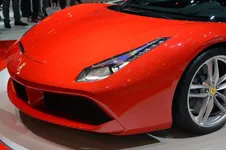
The front of the car is dominated by the
central Aero Pillar and an F1-inspired double spoiler which boost the efficiency of both the radiator and downforce generation.
The 488 GTB has an innovative aerodynamic underbody that incorporates
vortex generators, special curved aerodynamic appendages which accelerate the air thereby reducing pressure. The result is that the car’s underbody is “sucked” down to the ground and downforce is higher but drag is not. This contributes to
overall downforce generation of 325 kg at 250 km/h.
The large rear diffuser has curved fences which optimise the expansion of the huge amount of air channelled under the car. It also features
variable flap geometry controlled by a CPU, integrated with other vehicle control systems, which adjusts the balance between increased downforce (flaps closed) and drag reduction (flaps open).
The Ferrari-patented blown spoiler is a new solution. Air enters an intake at the base of the rear screen and exits via the bumper. This guarantees
increased downforce and avoids having to extend the height of the rear spoiler and thus helps keep drag low.
The base bleed air intakes on the car’s sides are divided by a central flap. The flow over the upper part of the flap, which is also used for the engine air intake, is deflected and exits from the tail area to
reduce the drag caused by the low-pressure wake directly behind the car. The flow from the lower part of the flap goes to the intercoolers to cool the intake charge.
To turn the 488 GTB’s extreme power into unadulterated driving pleasure regardless of conditions, Ferrari drew on the vehicle dynamics experience it has built up in competition and through its laboratory cars on the various circuits worldwide.
Subsystem and electronic control development focused principally on maximum responsiveness to the accelerator and total control with
response times (0.06 seconds) comparable to those of a track car.
The gearbox features specific ratios to make the most of the engine’s incredible torque.
Variable Torque Management delivers increasing amounts of torque up through the gears. As a direct result of these solutions, the 488 delivers track-style gear-shifting: it takes just 6 seconds to go from standstill in first to the limiter in fourth gear.
The evolved version of Ferrari’s
Side Slip Control System, SSC2, is more precise yet less invasive, analysing various parameters to
boost longitudinal acceleration out of corners by 12 per cent (in the Race and CT Off Manettino positions). Aside from just integrating with the car’s F1-Trac and E-Diff, the SSC2 now also controls the active dampers, rendering the car’s dynamic behaviour during complex manoeuvres even flatter and more stable.
The 488 GTB’s excellent dynamics are due in part also to the
SCM 3 magnetorheological damping system which has a faster ECU to modify the magnetic field in the dampers, as well as three new sensors on the car body. This all translates into a feeling of greater body control with better bump absorption.
The latest evolution of the ESP guarantees even more efficient ABS intervention in low-grip situations.
Thanks to the new
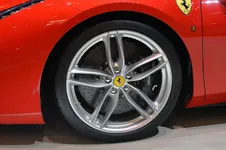
Brembo Extreme Design braking system, the 488 GTB’s
stopping distances are 9 per cent shorter than the previous model. Derived from the LaFerrari, the brakes also have new callipers that allow optimal cooling under extreme driving. They also feature new materials that ensure they reach optimal operating temperature faster and are more durable.
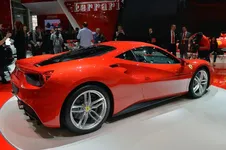
Designed by the Ferrari Styling Centre, the 488 GTB features
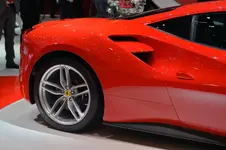
very sculptural flanks which are the key to its character.
Its large signature air intake scallop is a nod to the original 308 GTB and is divided into two sections by a splitter.
The front is characterised by the
dual grille opening which channels air into the two radiators. There is also a double front spoiler which, on close inspection, looks very like those of the F1 single-seaters. At the centre
two pylons are combined with a deflector which channels air towards the flat underbody. The bonnet has pronounced, raised central section and two side channels. These channels have the dual function of making the car look more sporty and channelling the air from the two vents in the bumper which have been skilfully hidden from sight in the front view to keep the lines clean.
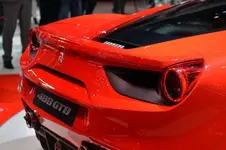
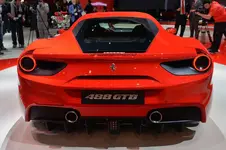
The tail is dominated by the blown spoiler and the large air vents which help improve the car’s aerodynamics.
The new exhaust tailpipes have been repositioned to accommodate the greater height required for the diffuser. The overall result exudes a sense of power and performance.
A
new colour, Rosso Corsa Metallizzato, was developed to underscore this model’s supremely sporty character as well as its unique elegance and exclusivity. Seen at close quarters, it has a surprising depth and glossiness achieved by using
a triple-layer formulation in which millions of micro-particles are suspended in the paint.
ENGINE:
Type V8 - 90° Turbo – Dry Sump
Total displacement 3.902 cm3
Bore and stroke 86,5 x 83 mm (3.4 x 3.3 in)
Maximum power * 492 kW (670 CV) at 8000 rpm
Maximum torque * 760 Nm at 3000 rpm in VII gear
Specific output 172 cv/l
Compression ratio 9.4:1
DIMENSIONS AND WEIGHT:
Length 4568 mm (179.8 in)
Width 1952 mm (76.9 in)
Height 1213 mm (47.8 in)
Wheelbase 2650 mm (104.3 in)
Front track 1679 mm (66.1 in)
Rear track 1647 mm (64.8 in)
Kerb weight * 1475 kg (3252 lb)
Dry weight * 1370 kg (3020 lb)
Weight distribution 46.5% Front – 53.5% Rear
Boot capacity 230 l (8.12 cu ft)
Fuel tank capacity 78 l
* With optional equipement
TIRES: (MICHELIN PSS @ GENEVA M/S 2015)
Front 245/35 ZR20 J9.0
Rear 305/30 ZR20 J11.0
BRAKES:
Front 15.7 x 8.8 x 1.4 in
Rear 14.2 x 9.2 x 1.3 in
TRANSMISSION / GEARBOX:
7 gears F1 dual clutch transmission
ELECTRONICS CONTROL:
E-Diff3, F1-Trac, High Performance ABS with Ferrari Pre-Fill, FrS SCM-E, SSC
PERFORMANCE:
Maximum speed > 330 km/h (205 mph)
0-100 km/h (0 – 62 mph) 3,0 s
0-200 km/h (0 – 124 mph) 8,3 s
0 – 400 m (0 – 437 yd) 10,45 s
0 – 1000 m (0 – 1093 yd) 18,7 s
Dry weight/power ratio 2,04 kg/cv (6,13 lb/kW)
Fiorano lap time 1’23”00
FUEL CONSUMPTION / CO2 EMISSIONS:
Consumption * 11.4 l/100 km
CO2 emissions * 260 g/km
* Combined cycle with HELE system (ECE+EUDC)
http://www.autoblog.com/photos/ferrari-488-gtb-geneva-2015/
Now that we have Hi-Res pics, I think it looks good, but the switch from N/a to Turbo is ????







 . Ferrari I'm proud of you.


