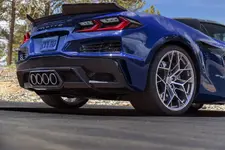
Corvette (C8) New Chevy Corvette with 1,000-plus horsepower and record top speed


The Chevrolet Corvette (C8) is the eighth generation of the Corvette sports car manufactured by American automobile manufacturer Chevrolet. It is the first rear mid-engine Corvette since the model's introduction in 1953, differing from the traditional front mid-engine design started in 1963. The C8 was announced in April 2019, and the coupe made its official debut on July 18, 2019, in Tustin, California.
chevrolet-corvette-zr1-convertible-101.jpg

#corvette #zr1 #corvettezr1 #chevy #chevrolet #chevroletcorvette #chevyzr1

2025 Chevrolet Corvette ZR1: The Fastest, Most Powerful Corvette Ever
The King of the Hill returns

DETROIT – Chevrolet has unleashed the unthinkable in the Corvette ZR1. The King of the Hill returns with the most powerful V8 ever produced in America from an auto manufacturer, mind-bending specs and iconic design to challenge the world’s best supercars in both coupe and convertible variants.
  • Corvette ZR1 features a 5.5L, twin-turbocharged DOHC flat-plane crank V8 engine dubbed the LT7.
  • The LT7 engine produces 1,064 horsepower at 7,000 rpm and 828 lb-ft of torque at 6,000 rpm, per SAE guidelines — the most power ever from a factory Corvette and the most powerful V8 ever produced in America from an auto manufacturer.
  • Corvette ZR1 boasts a GM-estimated top speed of over 215 mph on the racetrack and will dispatch the quarter mile with a GM-estimated sub-10-second time1.
  • Purposeful carbon fiber aero package creates over 1,200 pounds of downforce at top speed.
  • ZR1 revives one of the most iconic styles in Corvette history: the split rear window.
“The team that revolutionized Corvette with a mid-engine architecture took on another challenge: take ZR1 to the next level,” said Scott Bell, vice president, Chevrolet. “Corvette ZR1 is about pushing the envelope with raw power and cutting-edge innovation. From Stingray, to Z06, E-Ray, and now ZR1, the Corvette family continues to elevate with each new iteration — and challenge the best in the world.”

Pushing the boundaries of Engine Development
ZR1’s 5.5L LT7 twin-turbocharged DOHC V8 engine starts with the same architecture as Z06’s LT6, the most powerful naturally aspirated production V8 engine ever, and takes it to the next level with twin turbochargers — the first time ever for a factory Corvette.
Dubbed the “Gemini V8” architecture, the LT6 program was only the beginning as engineers dual-pathed a goal: to create massive power, capability and character from naturally aspirated and turbocharged flat plane crankshaft twin engines. With these goals in mind, engineers did not create an LT6 with turbochargers, but instead changed and optimized virtually every system for a boosted application.
Corvette ZR1’s 5.5L, twin-turbo DOHC flat-plane crank LT7 engine is the result of engineering prowess and pushing the boundaries of what the engine architecture can do. Thoughtful planning produced the best performance from forced induction, married with the 5.5L flat-plane engine architecture.

Unique to the 5.5L LT7 twin-turbo V8:
  • Head castings with unique ports and a larger combustion chamber
  • Valve train timing and lift profile optimized for forced induction with higher exhaust temp enabling exhaust valves
  • Completely new intake system tuned for twin turbochargers
  • CNC machined combustion chamber, exhaust and intake ports specific to the LT7
  • Dual, ported shroud, ball bearing, mono-scroll (76 mm) turbochargers integrated with the exhaust manifold to reduce the volume and distance from the exhaust valve to the turbine wheel for quick response with electronic wastegates
  • Intelligent anti-lag engine calibration techniques specifically for ZR1 that adapt and react to driving style
The LT7 engine also builds upon this engine architecture with:
  • Added block and head machining to support turbo cooling and oiling
  • Counterweight changes to account for a unique piston, and unique connecting rod for the crank train
  • A secondary port fuel injection system added to deliver the needed additional fuel to support the engine’s massive output
To support the dramatic increase in power from the LT7 engine, engineers made numerous changes to the Corvette ZR1’s eight-speed dual-clutch transmission, including:
  • Inner and outer input shaft upgrades
  • Increased gear capacity with strength increased via shot peening for all gears
  • Final drive refinements
  • Oil management to support increased vehicle longitudinal and lateral capability
  • Increased control valves to accommodate the higher required clutch clamp load for LT7
The LT7 engine is purpose-built to accomplish its four-figure horsepower mission with no compromises in componentry and maintains the rev-happy character that is the heart of the Gemini V8 engine family. It will be hand-assembled by the master engine builders at the Performance Build Center, part of the Bowling Green Assembly Plant in Kentucky.

Enabling speed with ease
Purposeful aerodynamics provide the most downforce ever from a Corvette with over 1,200 pounds at top speed.

The Corvette ZR1 offers speed on tap like no Corvette before it. Two distinct setups, complete with Magnetic Ride dampers, accomplish this. The standard Corvette ZR1 chassis arrives with a sleeker body with lower drag and a small spoiler with customer-adjustable short and tall wickers. It also includes a standard carbon-fiber front splitter, rocker moldings, side intake with integrated brake cooling, and front underwing with stall gurney deflectors. Michelin Pilot Sport 4S tires wrap 20-inch front, and 21-inch rear wheels. The standard chassis blends the best of on-road comfort and track capability with this setup.
Corvette ZR1 dispatches the world’s toughest tracks with ease, not only with the power from the 5.5L LT7 engine, but also due to additional, specific aerodynamic and cooling changes found throughout the car. These include:
  • Flow-through hood: Air enters the front grille, flows through the intercooler heat exchanger and exits the hood to increase front downforce and cool charged air temperatures.
  • Carbon fiber side profile air ducts: Clean, cool air is funneled through ducts, which are cleanly integrated into the signature wishbone bezel behind the cabin doors to cool the rear brakes through an intricately designed system that doesn’t impact rear wheel travel
  • Unique fresh air intake ducts: Carbon fiber inlets located on top of the coupe rear hatch ingest air to cool the turbo compressor inlet air temperatures
Corvette ZR1’s optional ZTK performance package unlocks a true track weapon. Notably, the ZTK package adds an aggressive, high-downforce rear wing, front dive planes, and a tall hood Gurney lip – all constructed from woven carbon fiber. Underneath, underbody strakes replace the standard front underwing stall Gurney to increase front downforce. The suspension tuning included in the ZTK package incorporates stiffer springs and adds Michelin Pilot Sport Cup 2 R tires. Amid testing and development, the ZR1 tackled some the world’s most demanding racetracks, including the Nürburgring, Road Atlanta, and Virginia International Raceway.
Carbon Aero, featuring all aerodynamic equipment from the ZTK package, is available on the standard ZR1 chassis as well.
“We went into the ZR1 program with lofty goals, but even our first development tests on-track showed the teams were already exceeding them,” said Tadge Juechter, executive chief engineer, Corvette. “As we worked to develop this car, we continued to leap past expectations, and we knew we had a special Corvette on our hands.”
Controlling ZR1’s high performance is a new brake system. The brake package uses a revolutionary carbon ceramic rotor manufacturing technology to yield increased durability and reduced brake component temperatures. Front rotors measure 15.7 inches (400mm) in diameter and rear rotors 15.4 inches (390mm) in diameter — the front rotors are the largest ever equipped on Corvette. In just 24.5 seconds, the Corvette ZR1 goes from 80-200 mph and back to 80 mph — 22% quicker than the C7 Corvette ZR1, and 53% quicker than the C6 Corvette ZR1.

Designed for the split window’s return
For ZR1, function and form quickly took hold to create an instant icon — an icon worthy of the historic split window’s return.
“We didn’t approach this decision lightly, we know this is a beloved element from Corvette’s history,” said Phil Zak, executive design director, Chevrolet. “Not only does this element provide function, but we were able to integrate passionate design into the form and do it in a way that paid homage to Corvette’s history. ZR1 felt like the right time to bring the split-window back.”
Last seen on the C2-generation Corvette, and quietly previewed on the Corvette Z06 GT3.R race car, the split-window style capitalizes on the design statement that is Corvette ZR1. While serving as a statement piece, this carbon fiber “spine” between the two rear windows, available in exposed weave or body color, provides increased heat extraction from the engine compartment, working in parallel with numerous other cooling elements throughout ZR1.
The teams worked to elevate the striking design first revealed with the eighth-generation Corvette Stingray and accentuate lines that evoke the car’s sense of motion — but the design’s function also helps it perform. Teams looked at every component of Corvette ZR1 to ensure cooling and aerodynamics remained top of mind, and any change accomplished the car’s mission: performance.
Additional changes include:
  • A carbon fiber roof to reduce mass and lower the center of gravity for both coupe and convertible
  • Unique aluminum wheel design available in four finishes, including Edge Blue — an homage to ZR1’s signature color cue
  • Optional new carbon-fiber wheel design, exclusive to ZR1, to further reduce mass
  • LT7 engine intake finished in Edge Blue — delivering an engine that looks as good as it performs
  • Optional new carbon-fiber wheel design, exclusive to ZR1, to reduce unsprung mass by 42.8 pounds
The Corvette ZR1’s cockpit dials up the attention to detail, notably with unique ZR1 badging found on an interior plaque, the sill plates and steering wheel. A new finishing stitch pattern for the doors, specific to ZR1, is available on the 3LZ trim. A boost gauge is also present, denoting the first factory turbocharged Corvette in the nameplate’s history.
Providing further choice to customers, the Corvette ZR1 will provide a roster of customization between exterior and interior colors. Shared with the 2025 Corvette lineup, new colors such as Competition Yellow, Hysteria Purple and Sebring Orange headline updates. The latter recalls a fan-favorite hue from the previous C7-generation Corvette ZR1.
Inside, a new Habanero interior is available, as is a Blue Stitch option. Various full-length racing stripes, brake caliper colors, including an exclusive blue for the calipers, seat belt colors and more will also be available.

King of the Hill coming next year
Corvette ZR1 will enter production in 2025 and will be built at General Motors’ Bowling Green Assembly Plant in Kentucky. It joins Corvette Stingray, Corvette Z06 and Corvette E-Ray to continue elevating the Corvette family. Further details on price and availability will be shared closer to production.

Cross flags closers:
  • On its first lap at the Milford Proving Ground's MRC test track, the new ZR1 clocked a faster peak speed than the production C7 ZR1.
  • Engineers clocked a sub-10-second quarter-mile time on the Corvette ZR1’s first launch.
  • All four test drivers clocked over 200 mph peak speed on their very first laps at the Nürburgring with ease.
  • LT7 produces more power than two LS7 engines, the legendary 7.0L V-8 from the sixth-generation Corvette Z06 – akin to one LS7 engine per bank.

CHEVROLET CORVETTE ZR1 SPECIFICATIONS

ENGINE

Type:LT7 Twin-Turbocharged 5.5L DOHC VVT DI
Bore & stroke (in. / mm):4.104 x 3.150 / 104.25 x 80
Block Material:A319 cast aluminum with cast-in iron cylinder liners and four-bolt main bearing caps
Oiling System:Seven-stage dry sump (8-qt. capacity) with oil-spray piston cooling
Oil Type:Dexos R 5W50 synthetic
Cylinder Head Material:A356 T6 cast aluminum
Combustion Chamber Volume:59.92cc
Compression Ratio:9.8:1
Valvetrain:Dual overhead camshafts (four valves per cylinder) with mechanical finger-follower valvetrain and dual-coil valve springs; dual-independent camshaft phasing
Valve Size (in. / mm):1.77 / 45 titanium (intake) & 1.37 / 35 sodium filled Nimonic (exhaust)
Fuel Delivery:PDI (DI - Max pressure: 5,076 psi (35 Mpa / 350 bar) & Port Fuel Injection)
Firing Order:1-4-3-8-7-6-5-2
Throttle Body:Twin 65mm single bore (electronic)
Charging:Twin 76 mono-scroll ported shroud ball bearing turbos (67mm MAR compressor), E-Waste gates
Charge Cooling:Dual engine-mounted water to air charge coolers
ECU:GM E68 (32-bit processing)
Horsepower (hp / kW):1,064 / 873 @ 7,000 rpm
Torque (lb.-ft. / Nm):828 / 1123 @ 6,000 rpm

TRANSMISSION & AXLE
Type:M1K 8-speed dual clutch (DCT)

CHASSIS & SUSPENSION
Front Suspension:Short/long arm (SLA) double wishbone, forged aluminum upper and cast aluminum L-shape lower control arms; monotube shock absorbers; Magnetic Selective Ride Control 4.0. Specific calibration with available ZTK package. Adjustable front lift with memory is available
Rear Suspension:Short/long arm (SLA) double wishbone, forged aluminum upper and cast aluminum L-shape lower control arms; direct-acting stabilizer bar; monotube shock absorbers; Magnetic Selective Ride Control 4.0. Specific calibration with available ZTK package
Steering Type:Variable-ratio rack-and-pinion with electric power assist; includes Active Steer Stops
Steering ratio:15.7:1
Turning Circle (ft. / m):38 / 11.1
Brake Type:Front and rear eBoost-assisted carbon ceramic discs with six-piston/monobloc front calipers and four-piston/monobloc rear calipers
Brake Rotor Size (in. / mm):Front: 15.7 x 1.5 / 400 x 38
Rear: 15.4 x 1.3 / 390 x 34
Wheel Size:Front: 20-inch x 10-inch (w/5 x 120mm bolt pattern)
Rear: 21-inch x 13-inch (w/5 x 130mm bolt pattern)
Tire Size:Front: 275/30ZR20
Rear: 345/25ZR21

EXTERIOR DIMENSIONS
Wheelbase (in. / mm):107 / 2723
Overall Length (in. / mm):185.9 / 4722
Overall Width without mirrors (in. / mm):79.7 / 2025
Overall Height (in. / mm):48.6 / 1234
Track (in. / mm):Front: 66.3 / 1685
Rear: 66.1 / 1678

INTERIOR DIMENSIONS
Headroom (in. / mm):37.9 / 963
Legroom (in. / mm):42.8 / 1087
Shoulder Room (in. / mm):54.4 / 1382
Hip Room (in. / mm):52 / 1321

WEIGHTS & CAPACITIES
Dry Weight (lb. / kg):3670 / 1665 (coupe)
3758 / 1705 (convertible)
Cargo Volume (cu. ft. / L)1:9.1 / 258
1Cargo and load capacity limited by weight and distribution.

FUEL TANK CAPACITY (approx.)
18.5 gal. / 70 liters

GM

To view this content we will need your consent to set third party cookies.
For more detailed information, see our cookies page.
 

Attachments

We have no data to back that up. But the data we have says from 60-160 they’re nearly identical. However, as a 296 owner, I can tell you my real world tests are slower than C&D. However, my 765 has real world tested by me with quicker 60-160 than this ZR1 test. That 0-60 though is crazy.
Are the c8s comfortable compared to other sports cars? Like your 296 and 765
 
It is unfortunate that we have no data yet on the accel of the non-aero car apart from Chevy's claimed quarter mile times, which place the non aero car trapping 152 (vs 150 w/ ZTK package) but with a slower quarter mile time due to PS4S's instead of Cup 2Rs. It stand to reason though that the car without the door sized wing on the back won't suffer as much of a drag penalty. To be fair, GM is still claiming a 225 mph top speed with the full aero, so maybe it's a more slippery wing than it appears.

I watched a development video where they said the drag penalty was minimal and eliminated any need for active aero. I don’t have the official figures. 2 MPH in the 1/4 is minimal.
 
Are the c8s comfortable compared to other sports cars? Like your 296 and 765

I’ve owned a lot of sports cars. I’d say the seat comfort is very good. And the competition sports seats are heated and cooled! The cabin is snug. Especially compared to a Ferrari which is very open. And seats bolsters aren’t great, they pinch me in a weird mid back place without offering a lot of lateral support. The suspension in the Z06 feels much more expensive and sophisticated than the base C8 stingray but it’s not comfortable in track or race mode over bad roads. Touring mode is good, though, but muffles the exhaust. The Ferrari has the best solution with bumpy road mode in which the 296 is properly comfortable by even luxury car means (suspension wise). The 296 carbon back sports seats look phenomenal but they aren’t very supportive or comfortable. The 765 chassis solution also works, decoupling the suspension and power train set up’s. I always drive with the 765 in comfort, where it’s similar to Z06 in sport or 296 in RACE without bumpy road. 765 in sport or race suspension set up is only for the finest roads. 765 seats are the best of the lot (I have the P1 bucket seats) offering tremendous support with a perfect seats position and acceptable comfort.

I’ve also owned a BMW i8, Acura NSX, Ferrari 458 and speciale, 992 Turbo S and 992 GT3. Varying degrees of comfort to all of them and I’d say Z06 feels towards the middle.
 
I’ve owned a lot of sports cars. I’d say the seat comfort is very good. And the competition sports seats are heated and cooled! The cabin is snug. Especially compared to a Ferrari which is very open. And seats bolsters aren’t great, they pinch me in a weird mid back place without offering a lot of lateral support. The suspension in the Z06 feels much more expensive and sophisticated than the base C8 stingray but it’s not comfortable in track or race mode over bad roads. Touring mode is good, though, but muffles the exhaust. The Ferrari has the best solution with bumpy road mode in which the 296 is properly comfortable by even luxury car means (suspension wise). The 296 carbon back sports seats look phenomenal but they aren’t very supportive or comfortable. The 765 chassis solution also works, decoupling the suspension and power train set up’s. I always drive with the 765 in comfort, where it’s similar to Z06 in sport or 296 in RACE without bumpy road. 765 in sport or race suspension set up is only for the finest roads. 765 seats are the best of the lot (I have the P1 bucket seats) offering tremendous support with a perfect seats position and acceptable comfort.

I’ve also owned a BMW i8, Acura NSX, Ferrari 458 and speciale, 992 Turbo S and 992 GT3. Varying degrees of comfort to all of them and I’d say Z06 feels towards the middle.
Very interesting (y)

Out of curiosity, which one of these sportscars had softest and hardest suspension?
 
I’ve owned a lot of sports cars. I’d say the seat comfort is very good. And the competition sports seats are heated and cooled! The cabin is snug. Especially compared to a Ferrari which is very open. And seats bolsters aren’t great, they pinch me in a weird mid back place without offering a lot of lateral support. The suspension in the Z06 feels much more expensive and sophisticated than the base C8 stingray but it’s not comfortable in track or race mode over bad roads. Touring mode is good, though, but muffles the exhaust. The Ferrari has the best solution with bumpy road mode in which the 296 is properly comfortable by even luxury car means (suspension wise). The 296 carbon back sports seats look phenomenal but they aren’t very supportive or comfortable. The 765 chassis solution also works, decoupling the suspension and power train set up’s. I always drive with the 765 in comfort, where it’s similar to Z06 in sport or 296 in RACE without bumpy road. 765 in sport or race suspension set up is only for the finest roads. 765 seats are the best of the lot (I have the P1 bucket seats) offering tremendous support with a perfect seats position and acceptable comfort.

I’ve also owned a BMW i8, Acura NSX, Ferrari 458 and speciale, 992 Turbo S and 992 GT3. Varying degrees of comfort to all of them and I’d say Z06 feels towards the middle.
Thanks . What about the road noise?
 
Almost exactly the same as the 296
Yes they are quite close but the Corvette is a smidge quicker in the lower speed range up to 1/4 mile.

The braking performance of the 296 blows the ZR1 out of the water it is stupendous.

Specifications

2022 Ferrari 296GTB
Vehicle Type: mid-engine, mid-motor, rear-wheel-drive, 2-passenger, 2-door coupe
PRICE
Base/As Tested: $317,986/$538,399
Options: Assetto Fiorano package, $41,956; carbon-fiber wheels, $33,748; Assetto Fiorano livery, $23,301; Canna di Fucile paint, $12,487; carbon-fiber rear diffuser, $11,812; specific design racing seats, $10,124; carbon-fiber under-door cover, $8606; carbon-fiber engine cover, $7931; carbon-fiber dashboard stripe inserts, $7593; carbon-fiber trunk cover, $6750; premium stereo, $6243; black Alcantara carpet, $5906; carbon under-windshield insert, $5400; Michelin Pilot Sport Cup 2 R tires, $5062; carbon-fiber dashboard inserts, $5062; carbon-fiber steering wheel with paddles and LEDs, $5062; carbon-fiber upper-tunnel trim, $4050; interior inserts in special leather, $2531; racing-seat lifter, $2531; Scuderia Ferrari shields, $1856; titanium wheel bolts, $1687; black ceramic exhaust pipes, $1687; wireless device charging, $1687; yellow brake calipers, $1519; front parking sensors, $1519; auto-dimming exterior mirrors, $1350; colored floor mats with logo, $1350; carbon-fiber key fob, $844; special stitching, $759; advanced front driving camera, $0; Apple CarPlay, $0
ENGINE
twin-turbocharged and intercooled DOHC 24-valve V-6, aluminum block and heads direct fuel injection
Displacement: 183 in3, 2992 cm3
Power: 654 hp @ 8000 rpm
Torque: 546 lb-ft @ 6250 rpm
POWERTRAIN
twin-turbocharged and intercooled DOHC 24-valve 3.0-liter V-6, 654 hp, 546 lb-ft + AC motor, 165 hp, 232 lb-ft (combined output: 819 hp, 546 lb-ft; 6.0-kWh lithium-ion battery pack; 3.3-kW onboard charger)
Transmission: 8-speed dual-clutch automatic
CHASSIS
Suspension, F/R: ind; unequal-length control arms; coil springs; anti-roll bar/ind; 2 diagonal links, 2 lateral links, and a toe-control link per side; coil springs; anti-roll bar
Brakes, F/R: 15.7 x 1.5-in vented cross-drilled carbon-ceramic disc; 6-piston fixed caliper/14.2 x 1.3-in vented cross-drilled carbon-ceramic disc; 4-piston fixed caliper
Tires: Michelin Pilot Sport Cup 2 R
F: 245-35ZR-20 (95Y) K2
R: 305/35ZR-20 (107Y) K2
DIMENSIONS
Wheelbase: 102.4 in
Length: 179.7 in
Width: 77.1 in
Height: 46.7 in
Trunk Volume: 7 ft3
Curb Weight: 3532 lb
C/D TEST RESULTS
60 mph: 2.4 sec
100 mph: 4.7 sec
1/4-Mile: 9.7 sec @ 150 mph
130 mph: 7.3 sec
150 mph: 9.7 sec
Results above omit 1-ft rollout of 0.2 sec.
Rolling Start, 5–60 mph: 3.0 sec
Top Gear, 30–50 mph: 1.9 sec
Top Gear, 50–70 mph: 2.1 sec
Top Speed (mfr's claim): 205 mph
Braking, 70–0 mph: 130 ft
Braking, 100–0 mph: 245 ft
Roadholding, 300-ft Skidpad: 1.12 g
EPA FUEL ECONOMY
Combined/City/Highway: 18/16/22 mpg
Combined Gasoline + Electricity: 47 MPGe
 
To put the performance numbers of the ZR1 into perspective, it is matching the almighty AWD 1600PS Bugatti Chiron SS to 60mph, but only 0.4sec slower to 100mph.

BUT.......as the speeds rise, the Chiron SS is in a league of its own. It is 9 sec faster to 200mph than the ZR1 (14.8sec vs 23.8sec).

Specifications

2022 Bugatti Chiron Super Sport
Vehicle Type: mid-engine, all-wheel-drive, 2-passenger, 2-door coupe
PRICE
Base/As Tested: $3,825,000/$4,301,450
Options: Blue Royal Carbon paint, $222,500; sunroofs, $62,000; black anodized interior trim, $56,000; Lake Blue signature line, $18,600; Noctume rear light trim, $15,000; black coated exhaust deflector, $15,000; rear wing Super Sport logo in Le Patron, $12,500; black coated rear wing mechanics; $12,500; Blue Royal Carbon engine cover, $12,500; comfort seats, $12,500; Noctume horseshoe, $7500; horseshoe logo in Argent, $6200; brake calipers painted Grenade, $6200; Matte Noctume engine cover parts, $5000; headrest logo in Grigio, $3100; Lake Blue rearview mirror; $3100; Lake Blue hidden delights, $2500; Lake Blue seatbelts; $2500; Noctume wheel caps; $1250
ENGINE
quad-turbocharged and intercooled DOHC 64-valve W-16, aluminum block and heads, port fuel injection
Displacement: 488 in3, 7993 cm3
Power: 1578 hp @ 7100 rpm
Torque: 1180 lb-ft @ 2250 rpm
TRANSMISSION
7-speed dual-clutch automatic
CHASSIS
Suspension, F/R: control arms/multilink
Brakes, F/R: 16.5-in vented, cross-drilled, carbon-ceramic disc/15.7-in vented, cross-drilled, carbon-ceramic disc
Tires: Michelin Pilot Sport Cup 2
F: 285/30ZR-20 (99Y) BG2
R: 355/25ZR-21 (107Y) BG2

DIMENSIONS
Wheelbase: 106.7 in
Length: 186.3 in
Width: 80.2 in
Height: 47.7 in
Passenger Volume: 54 ft3
Cargo Volume: 2 ft3
Curb Weight: 4587 lb
C/D TEST RESULTS
60 mph: 2.2 sec
100 mph: 4.1 sec
130 mph: 6.1 sec
150 mph: 8.0 sec
1/4-Mile: 9.1 sec @ 161 mph
170 mph: 10.1 sec
200 mph: 14.8 sec
Results above omit 1-ft rollout of 0.2 sec.
Rolling Start, 5–60 mph: 3.2 sec
Top Gear, 30–50 mph: 2.4 sec
Top Gear, 50–70 mph: 2.3 sec
Top Speed (mfr's claim): 273 mph
Braking, 70–0 mph: 159 ft
Braking, 100–0 mph: 306 ft
Roadholding, 300-ft Skidpad: 1.05 g
EPA FUEL ECONOMY
Combined/City/Highway: 9/8/11 mpg
 
Car and driver test if you add rollout back and convert to km/h you get 2.5/6.7/10.7 to 100/200/250 km/h. Just crazy. That’s what was claimed for the Veyron SS back in the day which for me is always my hyper car benchmark.

For reference my best 765 run is 2.8/6.9/10.6 seconds to 100/200/250 and my best 296 run (albeit early) is 2.75/7.3 seconds to 100/200.

My zo6 is a convertible but best there is 3.0/9.8 seconds too 100/200 km/h.
 
I watched a development video where they said the drag penalty was minimal and eliminated any need for active aero. I don’t have the official figures. 2 MPH in the 1/4 is minimal.
I think the statement was relative to the Z06's high wing iirc, since the ZR1 wing should produce similar drag with more downforce. Still fairly slippery, especially as wings of that size go, and probably doesn't impact quarter mile times by more than a 10th. Definitely makes up for its drag penalty on the racetrack with downforce, probably only noticeable in longer/faster drag races.
 

Chevrolet

Chevrolet is an American automobile division of the manufacturer General Motors (GM). In North America, Chevrolet produces and sells a wide range of vehicles, from subcompact automobiles to medium-duty commercial trucks. Due to the prominence and name recognition of Chevrolet as one of General Motors' global marques, "Chevrolet" or its affectionate nickname 'Chevy' or is used at times as a synonym for General Motors or its products, one example being the GM LS1 engine, commonly known by the name or a variant thereof of its progenitor, the Chevrolet small-block engine.
Official website: Chevrolet

Back
Top