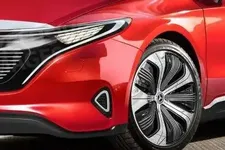
Mercedes-Benz flips the switch: Generation EQ – mobility revisited


Status
This thread is archived
New comments cannot be posted and votes cannot be cast
Interesting information on future Mercedes electric strategy here:

http://www.popularmechanics.com/cars/hybrid-electric/a23203/mercedes-benz-win-ev/

The most intriguing part of the story is about Maybach future. Its good to know Mercedes Benz is considering options that may bring stand alone models also.

Last but certainly not least, Daimler has Maybach as its ultimate luxury brand, a badge the automaker intends to use a lot more in the future. The 6-Concept might be a 738-horsepower electric statue of excess, but in the near future, Maybach's lineup is more likely to expand with several models using the S-Class as their base. And V12s, plus all the bells and whistles you can think of.
 
Foundation of Mercedes-Benz Energy Americas, LLC: Mercedes-Benz Energy Storages enter the U.S.
05140bd56a6133ee7ac7ad0cf6503920._.webp


Stuttgart/Sunnyvale – Daimler AG is expanding its stationary energy storage business to the U.S. market. After this years’ founding of the German Mercedes-Benz Energy GmbH, a completely new subsidiary responsible for the development and global sale of Mercedes-Benz brand stationary energy storage, Daimler marks a further step towards growing the market. The newly established Mercedes-Benz Energy Americas, LLC is assuming the development and sale of stationary energy systems for residential, commercial and utility applications for the North-American market. Boris von Bormann, U.S. solar industry expert, has been selected as the CEO for the branch. System production will remain the core expertise of Daimler’s wholly owned subsidiary, Deutsche ACCUMOTIVE GmbH & Co. KG. Working in collaboration with Mercedes-Benz Research & Development North America in Sunnyvale, California, Mercedes-Benz Energy Americas will bring initial product offerings to the United States starting early 2017.

Stuttgart/Sunnyvale - With the growing electrification of transportation, demand for lithium-ion batteries is constantly rising. The stationary energy storage sector presents even more opportunities for growth. Daimler AG entered the stationary battery storage business in 2015 with its subsidiary Deutsche ACCUMOTIVE GmbH & Co. KG, responsible for the development and production of highly complex drive batteries for hybrid and electric vehicles of the Mercedes-Benz and smart brands. Especially with the establishment of the German Mercedes-Benz Energy GmbH, in charge of the development and sale of stationary energy systems, Daimler AG has been continuously expanding its activities in this growth segment this year. With the foundation of the U.S.-based branch, Mercedes-Benz Energy Americas LLC, the company is consistently continuing its expansion and marks another step within the corporate strategy "CASE". “By founding Mercedes-Benz Energy Americas, we are once again underscoring our ambition to be a technological and market leader in the field of highly efficient storage systems on a global scale”, says Marc Thomas, CEO of Mercedes-Benz Energy GmbH in Germany. “At the same time, we are making an active contribution to the process of transition towards sustainable energy generation and continuing the success story of German-based battery production.”

The energy storage concept devised by Daimler Business Innovation provides for a variety of applications. The scalability of the systems allow for industrial application of lithium-ion batteries for network stabilization and smoothing of peak shaving for energy producers, as well as private households, for example in conjunction with photovoltaic installations. Developed for the demanding use in the vehicle, the Mercedes-Benz energy storage units meet the highest safety and quality requirements. They are based on the same technology that Daimler has already used thousandfold in electric and hybrid vehicles since 2012.

Mercedes-Benz energy storage products will enter the North-American market early 2017, starting with the launch of a modular residential product. Each battery module has an energy content of 2.5 kWh that can be combined up to 20 kWh and used in various applications such as back-up power and solar self-consumption. These will be sold through various channel partners. The systems will be followed by larger energy storage systems for commercial and industrial customers. Mercedes-Benz Energy Americas will be working directly with a very diverse customer base to offer tailored solutions starting later in 2017. “ Mercedes Benz Energy is uniquely positioned to not only offer solutions to the energy and storage market that will help utilities, businesses and home-owners to save costs and solve needs, however also combine the advantages of electric vehicles and energy solutions into one holistic platform”, says Boris von Bormann, CEO Mercedes-Benz Energy Americas, LLC.

Mercedes-Benz creates electric mobility ecosystem for products and services: EQ – the new brand for electric mobility

At the Paris Motor Show, Mercedes-Benz unveiled its new product brand for electric mobility: EQ. The EQ portfolio will encompass all future battery-electric cars as well as the associated products and services from Mercedes‑Benz. The concept vehicle EQ provides a concrete preview of a completely new generation of vehicles from Mercedes‑Benz. With a range of up to 500 kilometers and the typical Mercedes strengths such as safety, comfort, functionality and connectivity, the show car is forerunner of a new era. The product brand EQ is an elementary part of the corporate strategy for future mobility bundled under the term CASE. The goal is clear: by 2025, Mercedes‑Benz Cars aims to have over ten all-electric vehicles in its portfolio. To meet the growing demand for high-quality high-voltage batteries, Daimler is investing a total of one billion euros in the expansion of its global battery production network, with no less than 500 million euros flowing into the construction of a second battery factory at the ACCUMOTIVE site in Kamenz, Saxony. Established in 2009, Deutsche ACCUMOTIVE GmbH und Co. KG develops and produces highly complex drive batteries for hybrid and electric vehicles of the brands Mercedes-Benz and smart on the basis of lithium-ion technology. Moreover it is responsible for the production of Mercedes-Benz energy storage products.

About CASE

CASE – these letters will shape the future of Mercedes-Benz Cars. They stand for the strategic pillars of connectivity (Connected), autonomous driving (Autonomous), flexible use (Shared & Services) and electric drive systems (Electric), which will be intelligently combined by the company. Already today, Mercedes-Benz Cars plays a leading role in all four areas. All activities in the area of connectivity are focused on the digital brand Mercedes me, which gives customers access to an extensive and personalized range of services by app, website or straight from their car. On the way to autonomous driving, Mercedes‑Benz has for years been a key driver of development and has repeatedly set the benchmark. To this end, the Mercedes engineers use so-called sensor fusion. The data from different sensors, such as cameras, ultrasound and radar, are intelligently combined and analyzed. With car2go the inventor of the automobile is also a pioneer when it comes to sharing. With around two million users, the company is today the world's biggest provider of free-floating car-sharing. As far as the electrification of the powertrain is concerned, Mercedes‑Benz is pursuing an integrated approach. Under the EQ brand, it is developing an ecosystem including not just the actual vehicle, but also a comprehensive offering around electric mobility. This extends from intelligent services to energy storage units for private and commercial customers as well as charging technologies, such as inductive charging, to sustainable recycling. To enable all four pillars to develop its full effectiveness, the relevant activities are being brought together in an independent entity.

Source: Daimler
 
Some pics to go with the article above. :)

energiespeicher-aktuelles_v3_1280x745-1280x745.webp
energiespeicher_title_v2_1280x685-1280x685-1280x685.webp
energiespeicher-business_title_1280x686-1280x686.webp
energiespeicher-unternehmen_titel_v2_1280x686-1280x685.webp


https://www.mercedes-benz.com/en/mercedes-benz-energy/
 
Daimler reveals plan to invest €10 billion in electric cars
10 EVs based on the same architecture will be launched by 2025.

At the Paris Motor Show last month, Mercedes signaled its EV intentions with the Generation EQ concept taking the shape of an all-electric crossover with a 310-mile range. That was just a taste of things to come as now parent company Daimler through the voice of R&D boss Thomas Weber has disclosed it will spend a whopping €10 billion (about $10.6B) to engineer a whole family of EVs. The plan is to roll out as much as 10 electric cars based on the same platform by 2025 when Mercedes estimates sales of its EVs will account for 15 to 25 percent of total deliveries.

The reveal was made by Weber in an interview with German daily Stuttgarter Zeitung for today’s issue in which he specifies three of the EVs are going to be sold by Smart. Thanks to the expected advancements in battery technology, the future Smart-branded cars will be able to cover as much as 700 kilometers (435 miles) on a single charge.

Leading the way will be a production version of the aforementioned Generation EQ concept slated to be built in Bremen, Germany. Mercedes hasn’t released details about the crossover’s exact market launch, but it does say it will be introduced by the end of the decade. The electrified high-riding model will be part of the company’s newly established EQ product brand and further down the line it might spawn a luxed-up Maybach version.

Thomas Weber has made the promise that all models part of the EQ brand will be differentiated from Daimler’s conventionally-powered cars in terms of design, but will borrow as many components as possible to reduce costs. As far as specs are concerned, some of the cars will hit 62 mph (100 kph) from a standstill in less than five seconds and will cover 500 km (311 miles) in the real world.

Weber also talked briefly about the S-Class facelift and revealed the S500 plug-in hybrid version due next spring will be able to cover 50 km (31 miles) running solely on electric power, which will be an increase of 18 km (11 miles) compared to the current model.

Source: motor1
 
Mercedes-Benz will roll out an EQ Model each year

85473157f4511f708d13be3fba01178a.webp

Although the first model from Mercedes-Benz’s EQ sub-brand won’t hit the market until 2019, the German company intends on following it up with a new electric model every year.

Speaking with Car and Driver, Mercedes vice president of sales and product management, Matthias Luhrs said that the brand will ultimately accommodate a full family of models though, interestingly, not all will share the same underpinnings.

Instead, Luhrs says, some will share their platforms with existing ICE Mercedes-Benz models. However, beyond all being completely electric, the models will share interior and exterior styling unique to the EQ brand.

All up, Luhrs says that the brand plans on having 10 all-electric vehicles in its range in the next “eight or nine years”.

With such a large range of EVs planned, Mercedes-Benz will also have to work out a charging solution available around the world to keep the models on the road. At this stage, the brand is refusing to speak about what it is working on but according to Luhrs, it could involve a collaboration with another firm.

“Obviously, in this industry, everyone, including Tesla, is still learning, and so everybody is still talking to everybody. It’s too early to say that this has already been decided and we’re only talking to this supplier or that,” he said.

Source: Carscoops
 
This is what Mercedes is bringing to CES
Future mobility, autonomous driving, connectivity, artificial intelligence, and healthy living are the

The auto show season seems to have moved forwards a couple of weeks. It used to start at the Detroit motor show, but an increasing number of automakers are choosing to display their wares and ideas at the Consumer Electronics Show in Las Vegas in early January.

Mercedes-Benz is one such automaker and pitches up at CES 2017 with a display centered around its corporate “future mobility” strategy, CASE. That stands for Connected, Autonomous, Shared & Service, and Electric Drive.

Those tenets are showcased in the Generation EQ concept, first shown at the Paris motor show. Mercedes claims its next-generation battery pack delivers a range of 310 miles (500 kilometers), and it features advanced self-driving capabilities and OLED control screens.

The Vision Van concept will also be on display. Alongside the expected electric powertrain and autonomous driving hardware, the load area is fitted out with a package monitoring system and delivery drones. It gives a sneeky peak at the next-generation Sprinter, too.

There will also be sections on how healthy living can be combined with mobility in future, artificial intelligence, and how Mercedes cars could be linked to smart homes.

“Our notion of mobility will change more dramatically in the next five to ten years than in the preceding 50,” said Ola Kallenius, Daimler board member for research and development. “Our CASE strategy will help us to shape the future of mobility. The objective is to make the car a platform for future mobility concepts and a space that offers a digital experience. The car of the future must be networked, autonomous, emissions-free, and deliver the possibility of shared mobility.”

Both BMW and Toyota will unveil new technology concepts at CES while the new, all-electric version of the Chrysler Pacifica minivan will make its debut there, Fiat Chrysler feeling it’s a more appropriate venue than Detroit.

Source: motor1
 
The Generation EQ on American public roads for the first time. :)

bay1.jpg


bay4.jpg


Mercedes-Benz Concept EQ erstmals auf US-Straße - Mercedes-Benz Passion Blog / Mercedes Benz, smart, Maybach, AMG
 
What to expect at CES. :)

mb-ces-en.webp


Mercedes-Benz at the CES 2017
Live Stream from Las Vegas

In 2017 Mercedes-Benz will again start the trade show year with an appearance at the Consumer Electronics Show (CES). The company is set to present its latest technological developments at its 600 square meters stand between 5 and 8 January.

A special highlight will be the Inspiration Talks with experts of Mercedes-Benz and other companies - moderated by Guy Kawasaki, Tech-Evangelist and Mercedes-Benz brand ambassador. You can experience the talks on January 5 and 6 right here on this page. To give you the chance to participate in the talks actively, we offer the possibility to hand in questions to the experts via Facebook starting on December 30, 2016:

Mercedes-Benz on Facebook

CzvJVatUAAA377E.webp


The Inspiration Talks - Overview
5 January 2017, 11 a.m. PST* (20:00 CET**):
Topic: Connected – The Car as the Ultimate Health Device
Experts: Ola Källenius, Member of the Board of Management, Daimler AG Group Research & Mercedes-Benz Cars Development; David Agus, Professor of Medicine and Engineering at University of Southern California

5 January 2017, 12 noon PST (21:00 CET):
Topic: Electric Intelligence – Opportunities and Limitations
Experts: Axel Harries, Head of CASE/EVA, Daimler AG; Roger Atkins, Managing Director Electric Vehicles Outlook Ltd.

5 January 2017, 1 p.m. PST (22:00 CET):
Topic: Autonomous Driving – It’s all about the Maps
Experts: Ola Källenius, Member of the Board of Management, Daimler AG Group Research & Mercedes-Benz Cars Development; Edzard Overbeek, CEO HERE

5 January 2017, 2 p.m. PST (23:00 CET):
Topic: Shared Mobility meets Mobility Services
Experts: Volker Mornhinweg, Head of Mercedes-Benz Vans, Mercedes-Benz
Andreas Raptopoulos, co-founder, CEO Matternet

6 January 2017, 11 a.m. PST (20:00 CET):
Topic: Join the Electric Revolution
Experts: Ola Källenius Member of the Board of Management, Daimler AG Group Research & Mercedes-Benz Cars Development; Roger Atkins, Managing Director Electric Vehicles Outlook Ltd.

6 January 2017, 12 noon PST (21:00 CET):
Topic: Artificial Intelligence - Chances and Challenges
Experts: Sajjad Khan, Vice President Digital Vehicle & Mobility, Daimler AG; Jen-Hsun Huang, NVIDIA co-founder, President & CEO

6 January 2017, 1 p.m. PST (22:00 CET):
Topic: From Owning to Sharing: a New Business Model?
Experts: Ola Källenius, Member of the Board of Management, Daimler AG Group Research & Mercedes-Benz Cars Development; Saeed Amidi, founder and CEO of Plug and Play Tech Center

6 January 2017, 2 p.m. PST (23:00 CET):
Topic: Autonomous Driving – More than Hype?
Experts: Michael Hafner, Head of Automated Driving and Active Safety, Daimler AG; Robert Scoble, American blogger, technical evangelist and author

*Pacific Standard Time **Central European Time
 
Inside Mercedes' Silicon Valley research center
A tour of the automaker’s future, and sometimes weird, innovations.

064827ca565ad68e145f61a32d84f9f1._.webp


0101-mb-2-1.webp


The German automaker is trying to see what happens when you let a computer learn how to write, space and spell on its own. The experiment could help researchers build an artificial brain for a car that could independently deduce and react to what's happening on the road. It might seem like these things are unrelated, but a typewriter cranking out sentences and a car automatically braking to miss an object in the road are both using the learn-and-react system of AI to get a job done. All that deep learning is one building blocks of autonomous systems.

f50c0eef2912e1a3af273287908f6a03.webp


Another important aspect of self-driving cars is that the computers needed to keep them on the road not only have to learn and react but actually see what's going on. Most automakers use Lidar to scan the surrounding world with lasers to create a vast pixel map. The amount of data created by all those pinpoints is staggering. Mercedes thinks it's solved the problem of trying to crunch all that information by joining blocks of pixels to create single objects. So instead of an automobile trying to decipher 500,000 pixels, the car has to figure out the location of only 1,000 object-specific rectangles called "Stixels." Each Stixel can be a person, car or object and is assigned a color based on how close it is to the vehicle.

0101-mb-6-1.webp
0101-mb-11-1.webp
0101-mb-12-1.webp
0101-mb-13-1.webp


Experiments like this are part of the company's new CASE (Connected, Autonomous Driving, Shared usage and Electric drive) strategy. Mercedes wants to build its own future instead of teaming up with a tech company. When you're beholden to another entity, you're stuck with whatever it decides to add to its platform. So Mercedes has its Silicon Valley facility working hard on a variety of initiatives.

During a recent tour of the R&D headquarters, I saw the shiniest result of those initiatives and latest CASE project, the EQ concept vehicle it unveiled at the Paris Auto show. The electric car has autonomous features, replaced the dash with a giant display and shed all of its mirrors in favor of tiny cameras. While the vehicle looks like it's a prop from a reboot of Tron, it's actually the launching pad of the EQ line of vehicles and home-energy storage.

Sadly, the concept vehicle on display will never appear in showrooms. Instead, it's a marketing tool for the launch of the EQ brand of vehicles and mobility initiatives that will start appearing in three years. It's a new category within Mercedes similar to Smart, its small-car subsidiary. But while the new business venture is a ways off, the automaker is already adding connected features to its current and upcoming lineup of Mercedes-Benz vehicles.

It has an iOS and Apple Watch companion app for locking the doors. In the next year, it'll add Google Home support. Drivers will be able to interact with thesearch giant's Home assistant with the sound of their voice while driving. The integration will also learn a person's habits and will offer to turn on or off devices based on the car's location via AI. Don't worry if you're already part of the Alexa or HomeKit ecosystem — both of those platforms are being investigated.

But it's not just the cars Mercedes sells to individuals that are being upgraded. The automaker is working on speeding up deliveries from services like UPS, FedEX and DHL. In a garage a few miles from the main building, a team of researchers is building a carpetlike covering for the shelves and floor of a delivery van that can weigh a package no matter where it is.

I was initially unsure why the weight of each box was important. That was until they explained that the system can pinpoint the location of any item in the truck based on its mass and can have nearby LEDs light up when the driver needs to find said package.

According to Mercedes, tests of the system with local delivery drivers have increased efficiency 35 percent. The drivers no longer have to hunt for a box that slid around the back of the truck during a sharp turn; the system just knows where everything is.

It's research like this that could help the automaker maintain the pace needed to compete in the increasingly accelerating automotive tech landscape. It's a legacy brand that's seen cars changing quicker in the past few years than in the previous 90. It's done a good job keeping up, but pressure from Tesla, Google and established automakers means Mercedes has to be more nimble and think outside horsepower and tires. Even if it means experiments with mechanical typewriters and fairy tales.

Inside Mercedes' Silicon Valley research center

0101-mb-14-1.webp
0101-mb-15-1.webp
0101-mb-25-1.webp
 
The first live talk from CES, about Mercedes "fit & healthy" is to start in about 30 hours. :)

To view this content we will need your consent to set third party cookies.
For more detailed information, see our cookies page.

Tune in January 5, 11 a.m. PST / 7 p.m. GMT when Ola Källenius and Mercedes-Benz fit & healthy testimonial David Agus discuss Connectivity and focus on health in our first CES 2017 inspiration talk hosted by Guy Kawasaki.
 
The stream from CES just started. :)

To view this content we will need your consent to set third party cookies.
For more detailed information, see our cookies page.
 
AI Car to arrive within twelve months? (y)

mercedes-benz-nvidia-ai-key-web.webp


Mercedes-Benz and NVIDIA Announce Partnership for AI Car Technology

Mercedes-Benz and NVIDIA today at the International Consumer Electronics Show in Las Vegas announced a partnership to bring an NVIDIA AI-powered car to market.

The news broke during the Mercedes Benz Inspiration talk at CES 2017 featuring NVIDIA founder and CEO Jen-Hsun Huang and Mercedes-Benz Vice President of Digital Vehicle and Mobility, Sajjad Khan.

The collaboration began three years ago, Jen-Hsun explained. “When our teams came together there was instant chemistry, and we share a common vision about how AI can change your driving experience, and make it more enjoyable.”

MBNV1-web-672x406.webp

Mercedes-Benz Vice President of Digital Vehicle and Mobility, Sajjad Khan and NVIDIA founder and CEO Jen-Hsun Huang aka "Jensen".

“At this point it is very clear that AI is going to be the future of computing. This is an endeavor that we started three years ago that we will put on the road next year – unbelievable,” Jen-Hsun said.

“I am very proud of saying that within 12 months we are rolling out a product with NVIDIA,” Khan added.

Deep Collaboration
The work is part of an ongoing collaboration focused on deep learning and artificial intelligence.

“This breakthrough called deep learning happened several years ago, and it has completely revolutionized computing from the way you speak to your phone now to the way you take photos and upload to the cloud and how it automatically tags and hosts it for you,” Jen-Hsun said.

“We have teams co-located with each other,” Khan said. “We have an office in Sunnyvale. Jen-Hsun has a team in Stuttgart.”

“Mercedes-Benz and NVIDIA share a common vision of the AI car. At this point it is clear AI will revolutionize the future of automobiles,” Jen-Hsun said.

https://blogs.nvidia.com/blog/2017/01/06/mercedes-benz-nvidia-ai/
 
New Mercedes EQA to lead brand's small car boom

d86c4792b6cc26e97edcb1a62503d2f4.jpg


d6f5e4af009aef7517f2cf846c52058a.jpg

The success of Mercedes’ A-Class, B-Class, CLA and GLA models has prompted a bold expansion plan with 3 new models due before 2020
Mercedes has confirmed its compact car line-up will expand from five to eight models by 2020. Auto Express understands that the three new arrivals – revealed in our exclusive images – will comprise a saloon version of the next-generation A-Class, an all-new GLB crossover plus an electric hatchback, possibly called the EQA, launched under the new Mercedes-EQ sub-brand.

Mercedes chairman Dr. Dieter Zetsche made the announcement on the range expansion on the eve of the Detroit Motor Show. The brand’s current compact car line-up consists of the A-Class, CLA, CLA Shooting Brake, GLA and B-Class.

High-performance Mercedes-AMG variants of those vehicles are not considered as standalone models, so the range expansion will come from elsewhere.

Bosses remained tight-lipped on the exact identity of the three new models, but the most significant new addition is believed to be a VW e-Golf rival badged the EQA. Auto Express spoke to Mercedes’ vice president for marketing, Dr. Jens Theimer, at the Detroit show, who told us: “We will see EQ cars in every segment, from compact cars to big [SUV] segments.”

Mercedes has invested over 10billion Euros (£8.7billion) into the development of 10 new electric vehicles under the EQ sub-brand that will launch between 2019 and 2025. The manufacturer has also registered every suitable EQ-prefix to cover its range of upcoming models. The first to arrive will be a production version of the Generation EQ concept that Mercedes launched at last year’s Paris Motor Show; a smaller EV hatchback is likely to follow.

Underpinning the EQA will be a version of Mercedes’ new scalable platform, which is able to house an electric motor on each axle to provide permanent four-wheel drive. In a bid to reduce costs and bring the car in at a more accessible price point, however, only one electric motor is likely to be used; a minimum range of 310 miles is expected.

Our image shows how the finished EQA could look. It’s set to take design cues from the next-generation A-Class, due next year, but adopt the family look of the EQ range previewed by the Generation EQ concept.

autoexpress.co.uk
 

Attachments

Uber and Daimler Join Forces on Self-Driving Cars

uber-daimler.webp


January 31, 2017 Posted by Travis Kalanick

I’m excited to announce an agreement with Daimler, one of the world’s top auto manufacturers with more than a century of experience designing some of the world’s best and most iconic vehicles. In the coming years, Daimler has planned to introduce and operate their own self-driving cars on Uber’s ridesharing network.

We are incredibly excited by the potential for self-driving cars to further our mission of bringing reliable transportation to everyone, everywhere. They will also help to reduce traffic accidents, which today kill many people a year; free up the huge amount of space currently used to park the world’s billion-plus cars; and cut congestion, which is choking our cities.

Of course, we can’t do it alone. Auto manufacturers like Daimler are crucial to our strategy because Uber has no experience making cars—and in fact, making cars is really hard. This became very clear to me after I visited an auto manufacturing plant and saw how much effort goes into designing, testing and building cars.

That’s why instead of building them ourselves, we want to partner with the best auto manufacturers in the world. We can combine Uber’s global ridesharing network with the world-class vehicles of companies like Daimler, so that Uber riders can have a great experience getting around their cities.

I’ve been personally impressed with Daimler—whose company mantra is “The Best or Nothing”—and with the leadership of Dieter Zetsche, who had a friendly debate with me about the future of mobility and the auto industry last year in Berlin. Dieter said then that Daimler and Uber could be “frenemies”—in fact, we turned out to be great partners.

By opening up the Uber platform to Daimler, we can get to the future faster than going it alone. It’s a future in which our cities and roads will be safer, cleaner and more accessible, and we couldn’t be more excited about what’s next.

https://newsroom.uber.com/uber-daimler-self-driving-cars/
 
Daimler to operate self-driving cars on Uber’s network

09df656486a289b456525b00faca71a4.webp


Daimler and Uber have announced a partnership that will see the automaker introduce its own self-driving cars for use on Uber’s ride sharing service. The team-up is the second alliance Uber has struck with a car maker in pursuit of its goal of delivering self-driving service to users, the first of which was struck with Volvo and resulted in the XC90 self-driving test car that serves as Uber’s latest prototype.

This is different from Uber’s arrangement with Volvo, however, in that Daimler will own and operate its vehicles itself, while taking advantage of Uber’s technology and ride-sharing network services. Uber tells TechCrunch this is the first time it’s announcing its role as an “open self-driving vehicle platform,” wherein car makers can bring their own vehicles to the network to operate them. It’s a little like what Tesla intends to offer for drivers of its own cars, but targeted at automaker fleets and open to all car makers.

In a blog post announcing the news, Uber CEO and founder Travis Kalanick noted that his company realized early that the potential of self-driving cars in terms of safety is huge, but that it wouldn’t be able to do everything itself, which has resulted in its decision to seek out automaker partners like Daimler.

Kalanick points out a debate between himself and Daimler Chairman Dr. Dieter Zetsche that occurred during a Future of Transportation talk hosted by publisher Axel Springer in Berlin last year (embedded below) in his announcement, noting that while the two disagreed in some respects, he was “personally impressed” with the German carmaker.

To view this content we will need your consent to set third party cookies.
For more detailed information, see our cookies page.

This is a big announcement, and a significant change in strategy for Uber from its work with Volvo, which involved co-development of autonomous driving tech and vehicles operated by Uber itself. Effectively Uber is going to be offering a way for OEMs to provide ride sharing services without having to build or acquire their own network or service offering to do so, as companies including Ford, GM and others are currently attempting to do.

Even if many automakers continue to pursue the creation of their own ride-sharing services with autonomous vehicles, it’s likely Uber will remain an attractive third-party option for them to explore. It’s a smart move that emphasizes Uber’s expertise and advantages in demand prediction and routing, while downplaying the areas where it would be hard pressed to excel, including in automotive manufacturing.

Like many automakers, Daimler has stated that it aims to launch a self-driving car by 2020, so that’s the earliest we’re likely to see this partnership actually result in vehicles on the road, barring any earlier prototype testing.

https://techcrunch.com/2017/01/31/daimler-will-build-self-driving-cars-for-uber/
 
Beautiful. I guess that difference between concept and production version wouldn't be big.
In my opinion something similar to GLE coupe case - concept/production difference.
 
Status
This thread is archived
New comments cannot be posted and votes cannot be cast

Mercedes-Benz

Mercedes-Benz Group AG is headquartered in Stuttgart, Germany. Established in 1926, Mercedes-Benz Group produces consumer luxury vehicles and light commercial vehicles badged as Mercedes-Benz, Mercedes-AMG, and Mercedes-Maybach. Its origin lies in Daimler-Motoren-Gesellschaft's 1901 Mercedes and Carl Benz's 1886 Benz Patent-Motorwagen, which is widely regarded as the first internal combustion engine in a self-propelled automobile. The slogan for the brand is "the best or nothing".
Official website: Mercedes-Benz (Global), Mercedes-Benz (USA)

Trending content


Back
Top