Murciélago 2011 Lamborghini 834/"Jota"/"Aventador" (Murcielago replacement) Spy pics & Info


The Lamborghini Murciélago is a sports car produced by Lamborghini. Predecessor: Lamborghini Diablo. Successor: Lamborghini Aventador. Production: 2001-2010.
I am very interested in the shift quality of the new single clutch, independent shifting rod, transmission. It weighs barely half of what a equivalent double clutch transmission would weigh. While independent shifting shafts in transmissions are nothing new, I wonder how it will work for such a powerful engine, specifically the shift quality at low speeds and low throttle. The independent shifting rods must be calibrated perfectly in order to provide good shift quality at low speed and low throttle.

Quite true, but if it's not as smooth as DCT then regardless of it's weight and shift time advantage there will still be a place in the market for DCT.
 
So I've read some comments elsewhere regarding the ISR transmission...one of topic that was brought up often was how durable this set-up is on car that has 700 hp and 500+ lb-ft of twist. If anyone would like to address this.....

The engine is very impressive but it's the transmsission that's got me all excited. :D


This newly developed transmission to work along side the new engine is an ISR (Independent Shifting Rods) transmission, which basically means it works shifting rods to pre select the next gear in the same way as the dual clutch selects another clutch to the next gear. So it's a 7-speed, single clutch transmission with according to Lamborghini an exceptionally quick shift times that is up to 50% quicker than most dual clutch transmissions. Not only is it exceptionally quick but it's incredibly light too, only 70kg for the entire transmission and a total 303kg when combined with the engine as well.


Only three transmission settings, Strada, Sport and Corsa, with Corsa mode incorporating a launch control function.

Footie, you got a source for this because I've actually scoured the press release and could not find the number of gears, settings, etc.

Quite true, but if it's not as smooth as DCT then regardless of it's weight and shift time advantage there will still be a place in the market for DCT.

I agree, ISR is made for a pure sports car, ie Murcielago successor. Whereas a DCT is made for more GTs, sport-sedans, etc. Through years of refinement, if an ISR-like transmission can approach or beat the seemingly seamless shift quality of a DCT, then this would be win-win, especially on econo-cars! What with the weight-savings contributing to better MPG.

After reading about this set-up, I'm really excited about this car. In terms of tech, I've always felt that Lambo followed Ferrari, but here, Lambo is definitely forging ahead, no doubt with the Germans provinding techinical/financial aide. But who cares? We get more choices! (even though we may not be able to afford them)
 
New 6.5 liter V12 comes with total output of 515 kW (700 PS) and 690 Nm of torque Re

Finally, some hard facts right from Lamborghini.

The Italian supercar-maker has announced details on its new V12 power plant which is expected to debut in the upcoming Murcielago replacement recently speculated to be named Aventador.

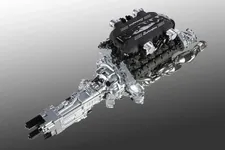
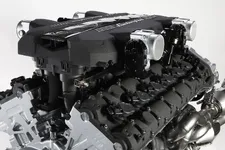
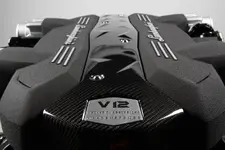
The new engine is a naturally aspirated 6.5 liter V12, known internally as the L539, with a total output of 515 kW (700 PS) at 8,250 rpm and 690 Nm of torque available at an engine speed of 5,500 rpm.

The new V12 was developed by Lamborghini at its Sant'Agata Bolognese facility. It comes with a classic cylinder bank of 60 degrees and is compact - measuring 665 millimeters tall, 848 mm wide and 784 mm in length. It has a bore diameter of 95 mm and a cylinder stroke of 76.5 mm. The nitride-hardened crankshaft weighs just 24.6 kg while the engine weighs a total of 234 kg.

The 6.5 liter V12 also comes with two mufflers in a single casing - one low-volume and the other high for that pitch-perfect Lambo sound.

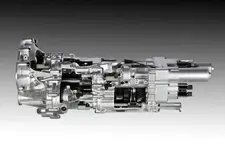
Also newly developed to accompany this engine is the ISR (Independent Shifting Rods) transmission. A 7-speed, single clutch gearbox with exceptionally quick shift times due to the independent shifting rods - Lamborghini claims almost 50 percent less than a standard dual-clutch gearbox. The independent shift rods work similar in concept to a dual-clutch - as one rod is disengaging the current gear, the second rod is already engaging the next one.

Weight reduction is a theme here too, as the new gearbox weighs in at just 70 kg.

The transmission comes with three driver settings - Strada, Sport and Corsa mode - with Corsa mode made for high-performance driving that also includes a launch control function.


Read more: Lamborghini reveals new V12 Engine with 700 horsepower [videos]
 

Attachments

  • 789611826572554063.webp
  • 5196805621295806340.webp
  • 15279813121310198133.webp
  • 402049664816273613.webp
What EVO has to report on the Murcielago replacement - Source: Lamborghini Murcielago replacement - engine and gearbox details | evo


Lamborghini Murcielago replacement - details
By Harry Metcalfe

With the production of Lamborghini’s Murcielago now finished (see evo’s story here), Lamborghini is getting ready to introduce its replacement. It’s speculatively known as the LP700-4 and will be shown at the 2011 Geneva motor show early next year.

And last week Lamborghini gave evo a sneak preview of the new car’s all-new powertrain. From what we saw, it looks like it’s going to be spectacular: an all-new, 690bhp V12 engine, with power reaching the road via a revolutionary seven-speed paddle-shift gearbox. This means, for the first time ever, Lamborghini’s flagship model will not be available with a manual transmission.

All-new, 6.5-litre V12 engine
The only fixed parameters given to Lamborghini’s engine design team was that the new car had to remain V12-powered, with an angle between the two banks of cylinders of 60 degrees and a request for the overall height of the engine to be reduced in order to help improve the handling. The end result of this development process is a completely new, 6498cc V12 engine producing 690bhp at 8250rpm and delivering a heady 509lb ft of torque at 5500rpm.

First off, the sheer size of this engine is amazing. Launching a brand new, 6.5-litre normally aspirated engine is almost unheard of these days, but Lamborghini boss Stephan Winkelmann explained to evo that he felt it was essential for the new car to have such a large displacement engine if it was to remain true to the DNA of Lamborghini super sports cars. ‘A Lamborghini engine needed to be able to supply massive power over a huge range of revs as this is a major part of the unique Lamborghini driving experience’, he said.

Despite being similar in capacity to the outgoing V12 (which was 6495.7cc in size), this is a completely new engine known internally as the ‘L539’. For starters, the cylinder bore has increased from 88mm to 95mm while the stroke has reduced from 89mm to 76.4mm. This allows the new engine to rev even quicker than before as piston speed is reduced for any given revs (compared to the old unit) and, thanks to that big increase in bore size, both the inlet and exhaust valve diameters can be increased too. This allows for much better engine breathing. The compression ratio has also been increased to 11.8:1, a remarkable figure for such a large engine.

Next, the new engine is a ‘dry sump’ design meaning the engine oil is contained in a separate reservoir from where it is pumped around the engine before being scavenged again at the base of the engine and then returned to the main reservoir. The engine is physically smaller now, as the block is shorter because of the smaller stroke and the facts there’s no sump at the base of the engine. The dry sump system also means the oil supply around the engine is more reliable during periods of high cornering G or heavy braking; the reason why most race cars have this system of lubrication.

Overall then, the new engine weighs in at 235kg (down from 253kg) and measures just 784mm in height, allowing it to sit some 60mm lower in the chassis than the Murcielago’s V12. This should aid handling as the roll height and centre of gravity will be reduced accordingly.

All new seven-speed gearbox
This new Murceilago replacement gets a completely new seven-speed gearbox which Lamborghini refer to as being an ‘ISR’ transmission, standing for ‘Independent Shifting Rods’, here’s how it works.

On a conventional gearbox, second gear sits next to third gear on a shaft running through the gearbox, and as you move the gearstick from second to third, a selector fork moves a sleeve from one gear to the other, allowing the next gear to come into play.

On this new gearbox, though, the gears are engaged independently. So in the same example of changing from second to third, the third gear selector can be partway through the process of bringing the gear into play as the second gear selector is taking second gear out of drive. This means the speed of change can be shortened dramatically, Lamborghini is saying changing gear via a paddle on this new gearbox will take just 50milliseconds, some 40 per cent faster than on the very latest e-gear equipped Lamborghini Gallardo.

Another requirement was for this gearbox to carry all the hydraulic valves and piping internally within its casing, so reducing the overall size of the gearbox dramatically.

Fitting a dual-clutch transmission to this new car was dismissed very early on - this type of gearbox would weigh a lot more than the new single clutch gearbox does, as well as being physically bigger too, so packaging would have been much trickier.

Winkelmann doesn’t like the feel a modern DSG gives either, preferring the more aggressive action of the new gearbox, saying it gives the driver a more emotional link with the mechanicals of the car than a dual-clutch transmission gearbox ever could.

The car has an updated four-wheel drive system. And Lamborghini is making great play of a new master ECU that controls the requirements of the engine, gearbox and all-wheel drive transmission all in real time, rather than each component having it’s own ECU.

More details of this new Lamborghini LP700-4 (including its full name, which has been rumoured to be Jota or Aventador) will be released in the near future. But from what we’ve seen so far, it looks like the Murcielago replacement should be very special indeed.

7c0e9aa117f7d41577e76091db46cb03.webp
6999f618f79d9429c61a519c8d09110f.webp


So, the venerable Bizzarrini-roots V12 is no more. Long live the new V12! What's interesting for me is that the top-line Lambo supercar will continue the tradition of the atypical mid-engine placement of the engine behind the gearbox like that in the current Murcielago. From the centrally positioned gearbox, two shafts emerge - one to the front axle, the other to the rear - with the rearward shaft terminating just behind the engine. This, arguably, makes the top-flight Lambo more rear-engined than proper mid-engined.
 
To view this content we will need your consent to set third party cookies.
For more detailed information, see our cookies page.

To view this content we will need your consent to set third party cookies.
For more detailed information, see our cookies page.

To view this content we will need your consent to set third party cookies.
For more detailed information, see our cookies page.
 
Love this type engine stuff....its actually a "beautiful" looking engine.


M
 
Autocar First Drive & Final Development Stage


^Notice the indent on the roof.


The all-new Lamborghini Murciélago replacement won’t be launched until next March. But Lambo asked Steve Sutcliffe to join them in a secret sign-off test at Nardo in Italy. Cue a mad 210mph in the dark…

A garage door opens, writes Sutcliffe, and at that instant all conversation ceases. Before us, wearing heavy disguise that consists mostly of matt black duct tape atop four monumentally huge wheels and tyres, sits the future of Lamborghini – the very first prototype for the all-new V12 supercar that will replace the legendary Murciélago.

This is the car that will define what Lamborghini means to the rest of the world for at least the next 10 years. And it’s a car, or at least the prototype of a car, that I’ll be driving in less than half an hour’s time.

12 March 2009 1.04am

It has taken me two days of fairly grim travelling to get here – ‘here’ being the Nardo test track in southern Italy. At this stage Lamborghini isn’t allowed to give too much away. We know the tub is made entirely from carbonfibre and that the suspension is of single-seater-style pushrod design, both firsts for any Lamborghini.

What we don’t know – and what Maurizio won’t yet tell us — is what the car weighs. “If a Murciélago weighs nearly 1700kg with a conventional backbone chassis,” says Lamborghini’s main man, Maurizio Reggiani, “and you already know the new car has a carbonfibre tub because I just told you it does, how much do think the damned thing weighs?”


12 March 2009 1.25am

I press the big starter button on the console and the all-new Lamborghini erupts into life, much like every other Lamborghini erupts into life: with an enormous burst of revs, like it or not. But immediately I notice several new characteristics.

The sound from the engine and exhaust is smoother and less grainy than in a Murciélago, somehow. And the response from the crank when I blip the throttle is massively more immediate. Before it has even moved, this car feels both more refined and less physically intimidating than of old – less, dare I say it, like a rough old diamond from the good old days and more like a normal kind of supercar. One you’d half expect to see from the more extreme edges of a company like Volkswagen.

And that’s before you so much as mention the cabin, or the driving position, both of which are hugely more resolved than in the Murciélago.


12 March 2009 1.28am

The moment it moves, the new Lambo feels every bit as advanced dynamically as it does aesthetically inside. The ride is calm and controlled in a way that a Murciélago owner simply wouldn’t recognise. It glides quietly over ground that the old car shimmies and thumps across.
Best of all, you no longer get the impression that you are sitting at the front of a very long, triangular machine whose tail contains a bite so venomous that there is no known cure beyond a certain threshold.
Instead, the new car feels fundamentally better balanced, as if it has a much lower, broader centre of gravity; as if it won’t tear your arms off and then kick you in the unmentionables if you do the wrong thing with the throttle at the wrong moment in a corner. And all this, remember, from the very first prototype.


16 September 2010 12.10am

Scroll forwards 18 months and here we are again, in the middle of the night at Nardo, staring at not one but three different prototypes. Car One is the original test mule I drove last year, Car Two is a ‘mid-program’ prototype and Car Three is pretty much what will be unveiled next March, give or take its duct tape and matt black paint.

I climb inside Car Three and discover that the cabin has a much more polished feel to it this time. It looks impossibly high end and has a discernible air of quality to the way its switchgear, door handles and buttons operate.
It may not be fully signed off yet, but this car feels more like the finished article than any Murciélago ever did. And it feels faster – much faster – than the old timer as I rumble down towards the high-speed bowl and open the taps wide for the very first time.

The kick of acceleration is genuinely outrageous in second gear, as is the speed and severity of the gearchange as the new gearbox slices up through its seven forward gears.

At 200mph the front end also begins to bounce slightly, so at 210mph I back off, even though the car is still accelerating. Something didn’t feel quite right beyond 200mph on that first run. It turns out that the pushrod suspension was nudging its bump stops due to the cornering load, causing them to act as part of the suspension, hence the bouncing. But this will be eradicated, says Maurizio, before the car goes on sale next year.

16 September 2010 10.20am

Despite this minor glitch (which is what pre-production testing is designed to uncover, after all), the new car proves itself beyond all doubt around the handling circuit the morning after the night before. I drive a Murciélago SV first, then all three versions of the new car. Again, the differences in balance, feel, steering precision and speed are shockingly obvious.
The SV, all of a sudden, feels clunky and old beside the new car, and nowhere near as stable under brakes or during turn-in. The new car’s basic dynamic ability is so much greater, in fact, that it laps the circuit several seconds quicker in the end. And it feels massively better sorted into the bargain. Which means job done, all thing being equal and considered.


16 September 2010 11.55am

Time to go, to take the bus back to the airport – with a head full of questions answered and a notebook full of stuff that I’m not allowed to write about here. One thing I can tell you right here and now, though, is that the new V12 Lamborghini – whatever it ends up being called – is a thundering good car. One with the heart and soul of a traditional Lamborghini but the build integrity – and pure dynamic excellence – of the most advanced supercars money can buy.

Quite a cocktail, in other words, as long as you’ve got the balls – and the bank account – to go with it. Business as usual, then, only better made, lighter and faster than ever.

Steve Sutcliffe

Driven: Lambo's new Murciélago - Autocar.co.uk
 
Oh no! Lamborghini is going the slow, BMW way with the release of this Jota.

First Sutcliffe drives a prototype, then we will see the lower right corner of the front bumper, then we will learn the horsepower of this damn thing, the a part of the right rear fender, then some other useless piece of info and after two long years, the car won't be at the showroom floor.

I'm getting tired of this...
 
Oh no! Lamborghini is going the slow, BMW way with the release of this Jota.

First Sutcliffe drives a prototype, then we will see the lower right corner of the front bumper, then we will learn the horsepower of this damn thing, the a part of the right rear fender, then some other useless piece of info and after two long years, the car won't be at the showroom floor.

I'm getting tired of this...
hahaha sad but true.

from those who have seen it, the third last pic is a good indication of what the car will look like.
 
The magazine exclusive testdrive wars : EVO vs Autocar

EVO : Exclusive testdrive of the 1M Coupe by Chris Harris.

Autocar : Exclusive testdrive of the new Lamborghini Murciélago replacement by Steve Sutcliffe

Autocar the clear winner. :D
 
Starting to be VERY curious about the interior. footie, do you know anything about it?.
 
I wonder if it'll continue having the active rear airvents like the Murci, or will they ditch it as to save weight from having those motors.....
 
The 'first exclusive drive' articles are being to be posted on the websites of various publications.

Apart from the speed at which it shifts, no one has anything really positive to say about the shift quality of the ISR transmission................
 

Lamborghini

Automobili Lamborghini S.p.A. is an Italian manufacturer of luxury sports cars and SUVs based in Sant'Agata Bolognese. It was founded in 1963 by Ferruccio Lamborghini (1916-1993) to compete with Ferrari. The company is owned by the Volkswagen Group through its subsidiary Audi.
Official website: Lamborghini

Trending content


Back
Top