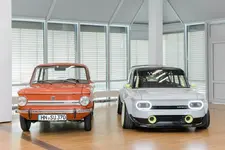
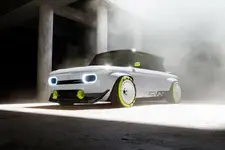
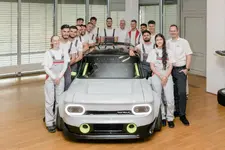
Family Day debut: To mark the 150th anniversary at the Audi site in Neckarsulm, twelve apprentices at the Four Rings electrified an iconic classic car. On July 8, trainees from the automotive mechatronics, bodywork, and vehicle construction mechanics and painting courses proudly unveiled the "EP4”. The "E" stands for electric drive, and the "P4" for the NSU Prinz 4, a model produced in Neckarsulm by NSU Motorenwerke from 1961 to 1973.
- To mark the 150th anniversary at Audi's Neckarsulm site, twelve apprentices electrified a classic car made in Neckarsulm
- An NSU Prinz 4L built in 1971 received a powertrain using components from the Audi e-tron and the Audi Q7 TFSI e quattro1
- Audi Board Member for Human Resources Xavier Ros: "Projects like this show that our company has a strong future thanks to our young talent."
But it was a long roadfrom the project launch in January to the big reveal at the Family Day. In numerous team meetings, trainees, trainers, and project managers exchanged views on the project‘s status, challenges, and next steps. The first task was to create a solid foundation for the conversion. Mizgar Doman Hassan, an apprentice bodywork and vehicle construction mechanic, recalls: "When we got the car, its body had several rust spots. These areas were the first thing we fixed."
The drive: electrifying and emission-free
While the budding body and paint specialists tackled the classic car’s chassis and outer skin, the future automotive mechanics got to work on the powertrain, battery, and suspension.
The rear of the “prince,” where a two-cylinder gasoline engine with 30 hp (22 kW) once resided, is now home to a 240 hp (176 kW) electric motor. It comes from a 2020 Audi e-tron and gets its power from a battery from the plug-in hybrid Audi Q7 TFSI e quattro1.
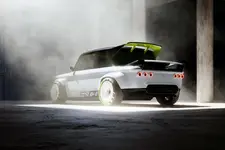
The battery sits under the front hood, where the NSU Prinz once had its fuel tank. The electrified machine breathes cooling air through a wide air intake at the bottom of the bumper, while heat can escape through a large opening in the front hood. The tailgate also improves cooling and can be fixed in a half-open position. Thus, it reveals the electric power plant and is reminiscent of historic racing cars based on the sporty NSU Prinz 1000. Where a row of open carburetor funnels gave onlookers clues about the sporting intentions of these cars back then, the EP4 now displays its electric motor.
read on
Audi MediaCenter