- Messages
- 1,089
- Name
- Danail
The Mercedes-Benz S-Class: Highlights
Tradition: The designation “S-Class” was officially introduced in 1972, but the line of ancestors can be traced back unbroken to 1951. Before the Second World War, luxury-segment models had always been an important part of the model range of Mercedes-Benz and its predecessor brands since the start of the 20th century.
The "S": When the model range was expanded to include the 170 S model from the ancestral line of the
E-Class, then Chairman of the Board of Management Wilhelm Haspel shaped the new model designation in 1949 with the S, explaining that the letter stands for “Super” or "Special". Since the 220 S launched in 1956, the designation has been used continuously in the Mercedes-Benz luxury segment.
Perfection in every detail: With every generation of its luxury class cars, Mercedes-Benz gives answers to the wishes and requirements of the respective eras. Every generation of the S-Class and its predecessors made its mark on the automotive development of its time with individual strengths.
Luxury and comfort: Even on long journeys, it is hardly possible to travel more pleasantly than in an S-Class. The car simply enchants – as an overall design and with each of its outstanding features.
Design: Serenity, innovation, sportiness, progressiveness – these are the key attributes that the designers expressively incorporate into the S-Class. Both in the exterior and interior.
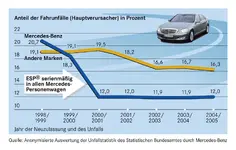
Technology trendsetter: The S-Class including its preceding model series has again and again introduced ground-breaking innovations such as the safety body (1959), the anti-lock braking system ABS (1978), the airbag (1981) and the Electronic Stability Programme ESP® (1995) into automotive construction – technologies which are used in (nearly) every new car today.
Spectacular motorsport successes: The 220 SE and the 300 SE models from the “Fintail” W 111/W 112 model series celebrated numerous wins in rallies and road races, such as in the 1960 Monte Carlo Rally and the 1960 Acropolis Rally, the 1961 Algiers/Central Africa Rally, the 1962 Tour d’Europe and Liège–Sofia–Liège Rally and – four times in succession – in the Argentinian Grand Prix for touring cars from 1961 to 1964.
Powerful luxury: The 300 SEL 6.3 from the W 109 luxury model series with its performance on a par with a sports car is regarded as the archetype of the luxurious and comfortable high-performance saloon and thus founded a highly successful tradition which continues to this day.
AMG success story: The spectacular class victory in the 24 Hours of Spa-Francorchamps race with the 300 SEL 6.8 AMG made what was then a young brand from Affalterbach famous overnight and marked the start of a unique development.
Pure performance: S-Class Performance saloons come from Affalterbach. Mercedes-AMG fears no challenge. This was documented for the first time in the history of the S-Class in 1999 by the 220 model series with the S 55 AMG (5.5-litre V8 engine and 265 kW/360 hp output) and, of course, in 2003 with the S 65 AMG (twelve-cylinder engine, 450 kW/612 hp and a full 1,000 newton metres torque).
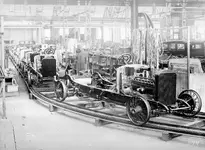
Sales success: Starting with the model 220 (W 187) from 1951 to the new generation of the 222 model series, a total of around 4 million S-Class saloons have been produced. If you count the coupés and cabriolets as well, the figure is as much as 4.29 million vehicles. Added to that there are a good 25,000 vehicles from the period before 1945.
Record numbers: In just under twelve years, more than 818,000 saloons of the 126 model series launched in 1979 were produced in all. More than 74,000 SEC Coupés derived from the saloon of the 126 model series were built.
Model with highest production figures: A total of 150,593 examples of the Mercedes-Benz 280 SE (116 model series) were produced between 1972 and 1980. There is a good chance that no single S-Class model will ever reach higher production figures – above all because the model range is constantly being expanded and the life-cycles of individual models are becoming shorter, for example as a result of new engines.
China, currently the world’s largest individual market: For ten percent of Chinese buyers of an S-Class, it is the very first car they have ever owned – at an average age of 40 years. Not a bad start to life behind the wheel.
The tradition of the Mercedes-Benz S-Class
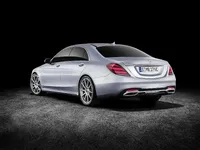
What makes a vehicle the epitome of the automobile in its time? The Mercedes-Benz S-Class and its predecessors have been answering this question since the early years of the brand’s history. The tradition of luxury models from Mercedes-Benz has continued uninterrupted since 1951, but executive and luxury class saloons had already been firmly established in the model range long before the Second World War. The latest generation in this unique tradition is the new 223 model series Mercedes-Benz S-Class. It will be launched on the market in autumn 2020.
The Mercedes-Benz S-Class follows a long and rich tradition that goes back to the beginnings of the Mercedes brand at the start of the 20th century. Luxury, comfort and safety: long before the official introduction of the S-Class designation in 1972, cars in the executive and luxury class have been the main emphasis in the product portfolio of the Stuttgart-based brand.
With every generation of its flagship models, Mercedes-Benz gives convincing answers to the wishes and requirements of the time. Every single model in the history of the S-Class makes its mark on the automotive development of its time with individual strengths, and is therefore also a reflection of its era. To summarise the importance of this development heritage, a Mercedes-Benz S-Class has always been the epitome of the automobile – as have its preceding model series.
Outstanding in the sum of all its qualities
Thanks to innovative technology, outstanding comfort and trailblazing safety systems, every generation of the flagship model from Mercedes-Benz sets the example for automotive development throughout the entire industry. Many technical features that Mercedes-Benz offers in the S-Class for the first time in a regular production model are subsequently not only used in other Mercedes-Benz model series, but also adopted by other vehicle manufacturers.
This leadership role is a constant in both the past and present of Mercedes-Benz. There is probably no other model with which the brand is more strongly identified than with the S-Class. In the sum of its attributes it is the lodestar for the Mercedes-Benz brand and the entire automotive world.
The world’s bestselling car in the luxury class
The S-Class is the embodiment of luxury class travel in a Mercedes-Benz: it is the automotive essence of a lifestyle marked by the highest expectations in terms of mobility and individuality, and stands for achievement and good taste. It is not without reason that the S-Class, including the Mercedes-AMG Performance models, is considered as the best car in the world time and time again.
Since 1951 alone, when production of luxury saloons first recommenced after the end of the Second World War, Mercedes-Benz has sold just under 4 million luxury class saloons worldwide. This makes the S-Class and its predecessors the most successful model series in this segment. The 223 model series will take up this success story from September 2020.
The roots of the S-Class
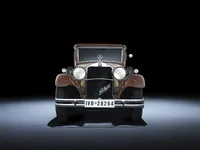
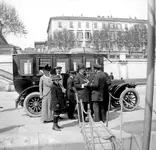
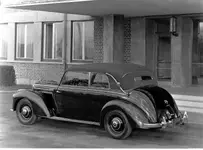
The unique tradition of the Mercedes-Benz S-Class did not start with the Model 220 (W 187) in 1951, but has roots that go much further back – right to the origins of the Mercedes brand at the start of the 20th century. One early and very telling example is the Mercedes-Simplex 60 HP presented in 1903. The brand’s top model at the time is a particularly spectacular exhibit in the Mercedes-Benz Classic collection: it is the elegant and luxurious touring car once owned by Emil Jellinek, who not only left his mark on and decisively influenced the early years of the Mercedes brand by giving it its name.
In the following years the product ranges of the Mercedes and Benz brands always included several executive and luxury class models. Even though open touring cars were by far the most frequent body shape during this time, the more powerful models in particular were also available as luxurious saloons for the ultimate travelling comfort.
This picture changed in the mid-1920s. In the light of increasing motorisation and traffic density, with which the development of the road network was unable to keep up, safe handling, a comfortable interior and the best possible protection from wind, rain and dust became increasingly important. Saloons and Pullman saloons gradually took over from the open touring cars. Important models in the executive and luxury class in this era included the supercharged, six-cylinder Mercedes 15/70/100 HP and 24/100/140 HP cars that were launched at the end of 1924.
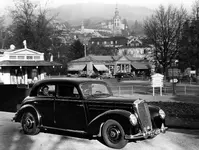
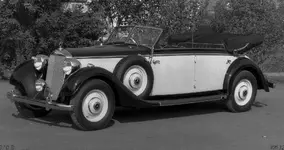
In 1926 Daimler-Benz AG emerged as a result of the merger between the previously separate companies founded by Carl Benz and Gottlieb Daimler, and in 1928 the model range saw the addition of the Nürburg 460 (W 08) as the first Mercedes-Benz production car with an eight-cylinder engine. With continuous improvements thereafter, it remained in the model range until 1939, last known as the Model 500. From 1926 the entry-level segment in the Mercedes-Benz executive class was the six-cylinder 12/55 HP, which evolved to the launch of the Mercedes-Benz Mannheim 370 (W 10) in 1931. In 1933 this was followed by the Mercedes-Benz 290 (W 18) as a fundamentally new design, which was replaced by the Model 320 (W 142) in 1937.
Mercedes-Benz S-Class and preceding series since 1951
The Mercedes-Benz S-Class has an unrivalled tradition. Because cars in the luxury class have been the mainstay of the product portfolio since the beginnings of the Mercedes brand at the start of the 20th century. Mercedes-Benz dominated the executive and luxury class segment right from the start, and has left its mark on automobile development in every era like no other brand.There has been a continuous history since 1951.
For customers who, beyond the representative character of the S-Class, need an exceptional representative vehicle, the brand has a corresponding offer at the ready in every era. In the post-war period, for example, the Mercedes-Benz 300 (W 186, W 189) and the 600 (W 100) initially dominated the luxury class in a very special way. These high-quality cars demonstrated what was technically possible at their time and were positioned above the S-Class in the product portfolio. Since 2014 this heritage has been successfully continued by the Mercedes-Maybach S-Class and has raised the bar another bit higher in terms of comfort, luxury and prestige.
From the W 187 to the “Ponton” (1951 to 1959)
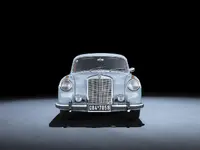
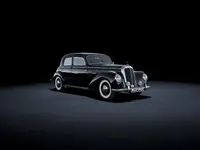
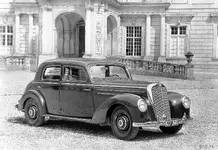
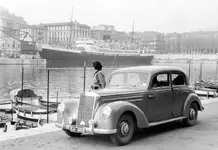
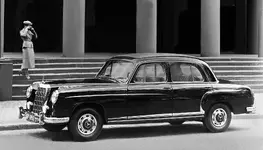
The direct line of S-Class succession began in the post-war period with the Model 220 (W 187), with which Mercedes-Benz reoccupied the luxury class segment in 1951 – six years after the end of the Second World War and following the first phase of reconstruction. In 1954 this was followed by a completely new model with the same model designation. The new Model 220, also called the 220 a (W 180) internally, was the first Mercedes-Benz six-cylinder model with a self-supporting design. Its modern and spacious "Ponton" body provided a previously unknown level of comfort. With the introduction of the revised and more powerful Model 220 S in 1956, the letter “S” became a permanent feature in the nomenclature of the Mercedes-Benz luxury class, and emphasised the special status of the six-cylinder “Ponton” model. 1958 saw the debut of the 220 SE (W 128), an even more powerful variant of the luxury class model thanks to petrol injection. As in the new variant of the prestigious Mercedes-Benz 300 Saloon (known in-house as the 300 d, W 189) introduced one year before, this output and efficiency-boosting technology took the form of manifold injection.
From the “Fintail” to the high-performance saloon (1959 to 1972)
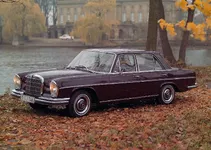
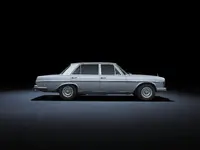
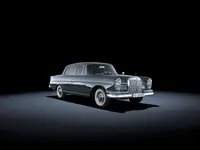
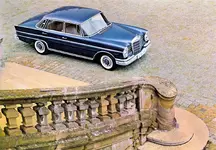
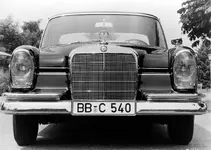
The “Fintail” models 220, 220 S and 220 SE (W 111) introduced in 1959 received their nickname from the discreet fintails that embellished the rear wings – officially these were known as “guide rods” in view of their function as a parking aid. The new luxury class generation was a very special milestone in automotive history, as this was the first time the safety body with crumple zones and a rigid passenger cell invented by Béla Barényi was incorporated into a series production model. Presented in 1961, the 300 SE (W 112) as the top-of-the-range model in the series featured an air suspension system and the automatic transmission developed by Mercedes-Benz as standard equipment. In 1963 the long-wheelbase version of this model founded a new tradition in the luxury class saloon portfolio of Mercedes-Benz: the 100-millimetre longer wheelbase offered passengers in the rear significantly more legroom and travelling comfort. The 108 and 109-series saloons that replaced the “Fintail” models in 1965 impressed with their timeless, elegant design and generously dimensioned window areas. Alongside the models with a conventional steel suspension – internally assigned to the 108 series – there were air suspension variants (109 series) which were also available with a 100 mm longer wheelbase right from the start. The 300 SEL 6.3 presented in 1968 was a particular highlight. The top-of-the-range model in the series was equipped with the powerful V8 engine from the high-end Mercedes-Benz 600 Saloon, and together with outstanding comfort and luxurious appointments it delivered sports car-like performance.
Automotive trendsetters: the 116 and 126 model series (1972 to 1991)
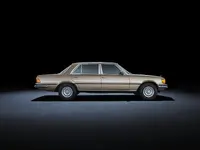
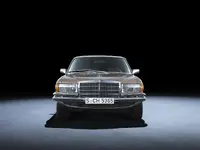
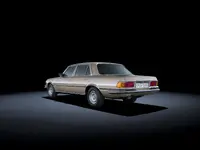
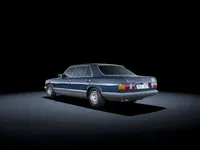
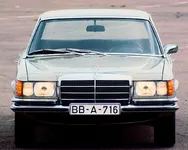
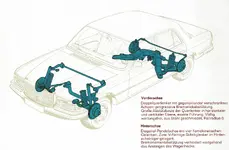
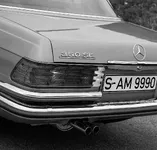
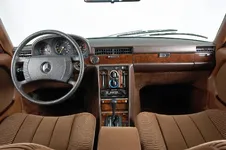
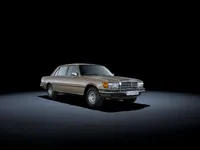
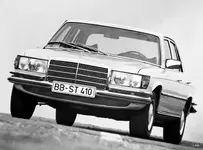
The successor 116 model series, introduced in 1972, was the first to officially carry the “S-Class” name. With it Mercedes-Benz expressed what had been a part of the luxury saloon range with an “S” in the model designation for decades. The new designation went hand in hand with a host of innovations that set new standards in terms of safety and comfort. The comprehensive safety concept included elements, such as a collision-protected fuel tank, a four-spoke safety steering wheel, dirt-repellent side windows, large headlamps, prominent direction indicators and dirt-repelling, ribbed rear lights. 1977 saw the start of the diesel era in the luxury class with the 300 SD, though initially only on the North American markets. The luxury diesel was also the first series production car with a turbodiesel engine. From 1978 the S-Class became the world’s first series production car to be available with the anti-lock braking system (ABS), which ensured steerability even under emergency braking. A world sensation at the time, this trailblazing innovation is now a standard feature in all vehicle classes. The S-Class underlined its status as the measure of automotive engineering, and made its model designation a generic term for high-end cars.
The technology transfer from the S-Class to the other Mercedes-Benz model series and to the products of competitors as the automotive state of the art was systematically continued over the subsequent period, and made the S-Class a true trendsetter. The 126 series introduced in 1979 was the automotive engineering debut for the airbag in 1981, and it is now a central element in automotive safety. Other features of this S-Class generation were its aerodynamically optimised contours and the systematic weight reduction for lower pollutant emissions, e.g. using new light-alloy V8 engines. The 126 series also made its mark with respect to design: it was the first Mercedes-Benz passenger car to dispense with traditional chrome bumpers, replacing them with deformable plastic bumpers that could withstand low-speed parking impacts undamaged. Initially perceived by some as plain and lacking in appeal when it first appeared, the design of the 126 model series was soon seen as timeless and elegant.
The height of luxury: the 140 and 220 model series (1991 to 2005)
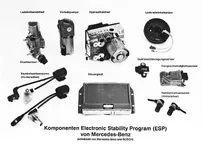
In 1991 the 140 model series S-Class was launched as the new top-of-the-range Mercedes-Benz. Its developers set their sights on maximum comfort, achieved partly with generous dimensions and double-glazed windows for optimum noise insulation. This was the first time a series production Mercedes-Benz car was equipped with a V12 engine, in the flagship 600 SE and 600 SEL models. The power range began with the 300 SD Turbodiesel, which now also made the luxury class diesel available on markets outside North America. This generation of the S-Class also introduced a trailblazing safety innovation into automotive engineering: the Electronic Stability Program (ESP®), which became standard equipment for the V12 models in 1995 and optional for the V8 models. In the following year Brake Assist BAS was also added.
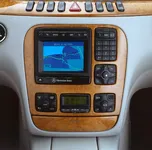
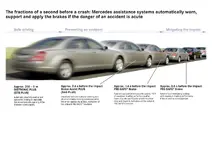
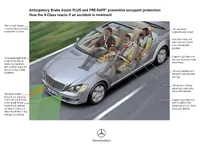
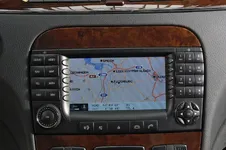
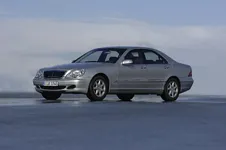
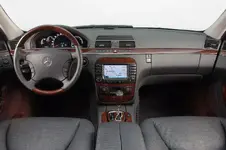
From 1998, the exterior of the 220 model series S-Class focussed more on understatement. Among the key development aims were further weight reduction and an additional increase in safety and comfort. Despite dispensing with the heavy double-glazing, the new model generation offered further improved comfort thanks to elements including the new, electronically controlled AIRMATIC air suspension, the COMAND control and display system and innovative Active Distance Assist DISTRONIC. The Active Body Control (ABC) suspension available from 1999 reduced body roll tendencies and allowed a previously unprecedented level of handling refinement. The interior design, which was for the first time closely coordinated with the exterior, ensured a high-class ambience in the S-Class. Customers with sporty ambitions were catered for by the S 55 AMG: for the first time an AMG model officially appeared on the S-Class price list. In autumn 2002 the regular top-of-the-range model without the AMG badge, the S 600, benefited from a power increase and, for the first time, reached the magic output threshold of 368 kW (500 hp). At the same time a further trailblazing innovation celebrated its debut in the 220 model series: the PRE-SAFE® preventive occupant protection system. By virtue of this system, the vehicle autonomously initiates measures to protect the occupants as well as possible when a collision threatens. As part of the model facelift, Mercedes-Benz also offered the S-Class with the intelligent 4MATIC all-wheel drive system for the first time.
Pioneering innovations: the 221 model series (2005 to 2013)
The 221 model generation presented in 2005 combined an expressive exterior with a luxurious interior. The controller of the further improved COMAND system allowed rapid and intuitive operation of the increasingly complex functions and menus. The pioneering technical innovations included Active Night View Assist and the further improved Active Distance Assist DISTRONIC PLUS with Brake Assist Plus, which were extended to become PRE-SAFE® Brake with autonomous partial braking in 2006. Further assistance systems such as Blind Spot Assist, Lane Keeping Assist and Speed Limit Assist further relieved driver stress, bringing the Mercedes-Benz S-Class another step closer to the vision of safe, accident-free driving. This generation of the S-Class also set new standards in driver fitness safety.
The upgraded generation of the 221 series appeared in 2009. The S 400 HYBRID was the first car in the luxury class with hybrid drive, and the first series production car with a lithium-ion battery. Masterpieces of efficiency were introduced in 2010, in the form of the S 350 BlueTEC as a diesel variant and the S 350 and S 500 BlueEFFICIENCY with economical yet powerful direct-injection petrol engines. In early 2011, Mercedes-Benz for the first time introduced a highly efficient four-cylinder engine into the S-Class in the S 250 CDI. Its diesel power unit allowed fuel consumption figures at the level of a compact car, with commensurate performance and ride comfort. This generation of the S-Class was also highly successful: all in all, almost 550,000 221-series saloons rolled off the production lines in Sindelfingen up to May 2013.
S-Class to the future: the 222 model series (2013 to 2020)
From 2013 Mercedes-Benz took the many generations of evolutionary continuity in the executive and luxury class into the future with the 222 model series S-Class. This set new technical standards, e.g. being the first car in the world to dispense entirely with light bulbs and use only LED lights for both the exterior and interior. Particularly high efficiency was ensured by modern drive units which also included hybrid technology.
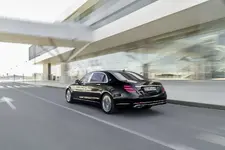
The key areas of development in the 222 model series are “Intelligent Drive”, “Efficient Technology” and “Essence of Luxury”. The S-Class has especially become the modern guiding star in automotive development thanks to the Intelligent Drive system. This is the name under which the Stuttgart-based brand bundles all its interconnected safety and driver assistance systems. Intelligent Drive makes driving even safer and more comfortable than before. It also includes assistance systems that make driving easier and allow semi-autonomous driving. Back in August 2013, on the historic Bertha-Benz route from Mannheim to Pforzheim, the S 500 INTELLIGENT DRIVE research vehicle demonstrated what the future of autonomous driving might look like thanks to such networked technologies: its systems were able to cope with the highly complex requirements of an autonomous journey along country roads and through city traffic. The S-Class saloons were joined by a coupé in 2014 and a cabriolet in 2015. The Mercedes-Maybach S-Class premiered in 2014 and the Mercedes-Maybach S 600 Pullman followed in 2015.
A further, major step towards autonomous driving was taken by the next development stage of Intelligent Drive in the facelifted model variant of the 222 model series, presented in the summer of 2017: Active Distance Assist DISTRONIC and Active Steering Assist now support the driver even more conveniently when keeping a safety distance and steering. For example, the S-Class automatically adjusts its speed on bends or when approaching junctions and roundabouts. This is possible because further improved camera and radar systems monitor the surroundings, and for the first time also incorporate map and navigation data into the calculation of the driving response. Via the display in the instrument cluster and the head-up display, the driver is at all times kept informed about the assistance functions that are currently active. The innovative Mercedes-Benz Intelligent Drive system boasts a modular structure. Standard equipment in the 222 model series S-Class from model year 2017 includes Active Brake Assist, Cross-Wind Assist, ATTENTION ASSIST, Traffic Sign Assist, the occupant protection system PRE-SAFE® and the new PRE-SAFE® Sound.
Innovations and facts: Mercedes-Benz S-Class and preceding model series
The Mercedes-Benz S-Class and the preceding model series have always stood for innovative automotive engineering. Again and again, they introduced new features on the market that subsequently became widespread to crucially shape the entire vehicle development sector. This overview illustrates the special characteristics of each model series.
Mercedes-Simplex 60 HP (1903 to 1905)
Mercedes-Benz Nürburg (W 08, 1928 to 1933)
Mercedes-Benz 320 (W 142, 1937 to 1942)
Mercedes-Benz 220 (W 187, 1951 to 1954)
Mercedes-Benz 219/220/220 S/220 SE (W 105/W 180/W 128, 1954 to 1959)
Mercedes-Benz 220 to 300 SE/long-wheelbase 300 SE (W 111/W 112, 1959 to 1965)
Mercedes-Benz 250 S to 300 SEL 6.3 (W 108/W 109, 1965 to 1972).
116 model series Mercedes-Benz S-Class (1972 to 1980)
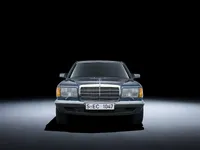
126 model series Mercedes-Benz S-Class (1979 to 1991)
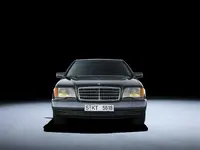
140 model series Mercedes-Benz S-Class (1991 to 1998)
220 model series Mercedes-Benz S-Class (1998 to 2005)
221 model series Mercedes-Benz S-Class (2005 to 2013)
222 model series Mercedes-Benz S-Class (2013 to 2020)
The Mercedes-Benz S-Class has always elicited an extraordinary response from the worldwide press. Moreover, quotes from contemporary articles on all the models in the line of ancestors lend a touch of colour that assigns them to their different eras.
The Mercedes-Simplex in the press
“Allgemeine Automobil-Zeitung”, issue 51-52/1902, on the Mercedes-Simplex at the Paris Motor Show:
“We have previously cited a French source describing this year’s Paris Motor Show as the ‘Mercedes Show’. The Mercedes model does indeed provide the main theme in the grand symphony of countless automotive designs which interpret this leitmotif with varying degrees of ingenuity. The English have already added an expression to their vocabulary to describe this revaluation of all automotive values along Daimler lines, aptly referring to this phenomenon as ‘Daimlerfication’. The honeycomb radiator, which also influences the lines of the vehicle in some respects, was virtually unknown at the last Paris Motor Show, but has since become ‘de rigueur’ for most French construction engineers. Among the many visitors to the Paris Motor Show on 12 December was the King of Belgium, who proved to have a good knowledge of all things automotive. He viewed every stand, his tour of the exposition also taking in the Mercedes cars. His interest in this brand is understandable, as the king had a 40 HP Mercedes in use and recently ordered the very latest 60 HP Mercedes model in Cannstatt. During the visit to the Mercedes stand, engineer Maybach was introduced to the king, and a highly animated discussion on purely technical matters ensued between the two. An engaging picture: the imposing figure of the king and Maybach’s more modest demeanour. But this was actually a meeting of kings: Leopold, King of Belgium, and Maybach, king of the design engineers. With Maybach as a ‘star attraction’ of the show in his own right.”
“Allgemeine Automobil-Zeitung”, issue 3/1903, on the 1903 Mercedes models:
“Even the French competition admits that the Mercedes car marks the pinnacle of the international automotive world today. […] We showed in our first "Show" report just how rife the tendency to emulate this leader has become. But there are also firms who are copying the Mercedes in terms of its design, rather than its mechanical side. […] The Mercedes carburettor marks a major change. […] The new carburettor is smaller than its predecessor and is intended to enable a reduction in the engine speed such that, when the engine is running at minimum revs in neutral, it is possible to stand near the car without hearing a sound. […]”
“Allgemeine Automobil-Zeitung” (AAZ), issue 28/1903, on victory for the Mercedes-Simplex 60 HP in the 1903 Gordon Bennett race:
“Although the 60 HP Mercedes models were known to be capable of setting a formidable pace, it was also clear that they lagged behind the French cars in terms of absolute speed. But speed alone was not the decisive factor on this stretch with its countless bends and sharp corners. A much more important ingredient for swift progress was the elasticity of the engine, which the Mercedes vehicles are known to possess in abundance. The driver behind the wheel of this 60 HP car is not required to devote great attention to the lever for changing the speeds, being able to vary the vehicle’s pace with great delicacy by leaving the fourth speed engaged and operating only the levers for gas intake and pre-ignition. The speed of the 60 HP vehicles can be increased in this manner from the pace of a trotting horse to 120 km per hour." In the same issue, the AAZ cites the "Neue Wiener Tagblatt": "The English and the Americans were on the course weeks before, and were familiar with every milestone, every bend in the road and every tree. […] In contrast, the representatives of Germany arrived only shortly before the race and had no knowledge of the course at all; they trusted in the quality of their cars, and they were also the only competitors who, rather than wrapping their racing vehicles up in cotton wool for the trip to the racing venue, actually drove the cars intended for the race from Cannstatt to Paris, from Paris to Havre, crossed the Channel and then continued their journey by racing car through Wales to the Irish Sea. And in Ireland these vehicles, with a gruelling trip behind them, saw off what can only described as the quintessence of international automotive engineering … Praise and honour be to the brilliant Maybach, the construction engineer behind the Mercedes cars!”
The Mercedes-Benz Nürburg 460 and 500 (W 08) in the press
“Allgemeine Automobil-Zeitung”, Vienna edition, No. 23/1928, on the Mercedes-Benz Nürburg 460:
“Given the traditional principle of Mercedes-Benz only to build high-quality cars to the utmost perfection, it goes without saying that this vehicle was only presented once its design had been subjected to the severest testing. As a final trial by fire, the new model completed an uninterrupted day-and-night endurance trial with driver changes on the world’s most rigorous test track, the Nürburgring circuit. The general assumption that a production car is unable to withstand an uninterrupted trial covering more than 10,000 km at Nürburgring was strikingly proved wrong with the first test drive of the new eight-cylinder model. It covered 20,000 km in twelve driving days with an average speed of over 64 km/h, at times reaching speeds of up to 110 km, with flying colours and set a new record for reliability. By virtue of this extraordinary achievement, the new eight-cylinder model has been given the name "Nürburg model" (4.6 litres, 18/80 hp, Model 460).”
“Auto Revue”, No. 10/1929, on the Mercedes-Benz Nürburg 460:
“The feeling of pleasure and driving safety in this car is enhanced by the careful weight distribution, which very rarely shows any tendency to skid. I was unable to ascertain any driver fatigue resulting from the weight of the vehicle. The wide track, good suspension and light, comfortable steering, as well as the absolutely reassuring feeling of not losing control even at the very highest speeds, will give rise to hardly any signs of fatigue even on longer tours.”
“Motor und Sport”, Germany, No. 37/1933, on the Mercedes-Benz Nürburg 500:
“It really is one of the most spacious seven-seaters (wheelbase 3.67 m), extraordinarily comfortable and with a rare level of high-quality appointments. The suspension is very soft, while the engine and all other drive units operate quietly and without any vibrations. The high level of refinement for which Sindelfingen bodies are known is ideally suited to the high technical quality of this car. [...] At any rate, the ‘Nürburg’ is a car in which long distances can be covered in extraordinary physical comfort, and which allows high average mileage with a high safety factor thanks to the balanced performance of the engine and the good transmission system.”
The Mercedes-Benz 320 (W 142) in the press:
“Allgemeine Automobil-Zeitung” (AAZ), Germany, No. 33/1937, on the Mercedes-Benz 320:
“In this car one is tempted to speak less about its technical characteristics than about the direct comfort and convenience it offers its occupants. This is mainly due to the fact that the technical aspects of this car inherently operate so inconspicuously that it is easy to forget the extent of the high-quality design and technical work that is necessary to produce such success. [...] The engine is exemplary in its quietness, flexibility and smoothness; unflustered, it continues to run smoothly even when drivers give vent to their nervousness via his right foot. [...] The general appointments of the vehicle meet the highest expectations. The seats leave nothing to be desired in terms of practicality and comfort.”
“Automobil Revue”, Germany, No. 2/1938, on the Mercedes-Benz 320:
“The Daimler-Benz A. G. bodies produced in Sindelfingen are top-class examples of international bodybuilding and represent the finest German craftsmanship combined with sound and refined tastefulness. The beauty and elegance of the external appearance go hand in hand with the ultimate comfort in the interior, with a high level of travelling comfort and with the implacable principle of quality in all major and minor aspects, contributing to the overall picture of this exemplary vehicle.”
“The Autocar”, England, in its 18 February 1938 edition, on the Mercedes-Benz 320:
“The road behaviour is refined as regards smoothness and quietness of the engine, and very comfortable riding is given. Also this car shows up well from two opposed viewpoints in that it is quiet, flexible and smooth to the degree of silkiness for town and leisurely driving, yet notably free from effort at maintained high speed. [...] The interior is very well finished, and leather upholstery is used, whilst in external appearance this car is undeniably distinctive and handsome.”
The Mercedes-Benz 220 (W 187) in the press
“Das Auto, Motor und Sport”, Germany, No. 23/1951, on the Mercedes-Benz 220:
“With the Model 220 it has for the first time proved possible to combine above-average driving safety, a sports car-like temperament and the comfort and solid good taste of a luxury car in a nonetheless relatively economical car for day-to-day use.”
“Motor-Rundschau”, Germany, No. 22/1951, on the Mercedes-Benz 220:
“Following the wishes of many Mercedes fans, the Mercedes Benz Model 220 is basically the 170 S, but with a 2.2-litre, six-cylinder 80 hp high-performance engine that allows high average speeds, even in the mountains, to be achieved safely given this car’s high level of handling safety. The result is a touring car with the spirit of a sports car. On the motorway, speeds well above 100 km/h are not perceived as particularly fast, so safe and smooth are the road-holding and power delivery.”
“ADAC-Motorwelt”, Germany, November 1951, on the Mercedes-Benz 220:
“Taken all in all, the driving characteristics of the 220 are not only well above the conventional average, we even dare to assert that anywhere in the world, there are only very few vehicle models possessing such well-rounded driving characteristics as this car.”
“Automobil Revue”, Switzerland, No. 5/1952, on the Mercedes-Benz 220:
“It is undoubtedly more than it seems. Its owners have the benefit of a fast, safe, comfortable and economical vehicle, the sum of whose qualities is only equalled by very few touring cars in this class and only exceeded by more expensive ones.”
The “Ponton” six-cylinder models (W 180/W 128) in the press
“Das Auto, Motor und Sport”, Germany, No. 19/1954, on the Mercedes-Benz 220:
“The absolute handling safety even at very high speeds is among the most striking attributes of this car. Even on very poor road surfaces, it shows no tendency whatever to drift off-course, and precisely negotiates the most horrible bends without the need for any special corrective steering action, and without any perceptible body roll. [...] Apart from its elasticity, the engine of the 220 exhibits exemplary balance and smooth running, with only a slight shudder noticeable when idling.”
“Motor Rundschau”, Germany, No. 21/1954, on the Mercedes-Benz 220:
“The Mercedes-Benz Model 220 is a top-class product in European car engineering. Although we are very careful about our use of superlatives, they are unavoidable in this case and with reference to the now very mature, high-performance engine with its smooth and flexible temperament [...].”
“Automobil Revue”, Switzerland, No. 9/1955, on the Mercedes-Benz 220:
“The Model 220 a has become a top-class European car with a distinctive character, the embodiment of general and technical advances. Yet even for the casual observer, and while maintaining a standard of quality that is now no longer the norm everywhere, it offers a rare combination of generous appointments, moderate exterior dimensions, outstanding handling safety and a comfortable suspension, an appealing exterior, a high level of equipment and economical operation. Getting to know the 220 a has further increased our respect for its world-famous creator, especially in view of the very reasonable price.”
“Das Auto, Motor und Sport”, Germany, No. 4/1959, on the Mercedes-Benz 220 SE:
“Weighing no less than 1,400 kilograms (fully fuelled, with radio), the car responds so directly to the accelerator that at least for a conventional, normal car, a new standard has to be applied. Together with the smooth running that is simply only achievable with 6 cylinders and upwards, we experienced a level of refinement that was once only the privilege of cars with genuinely large engines.”
The six-cylinder “Fintail” models (W 111/W 112) in the press
“Autocar”, England, 6 November 1959, on the Mercedes-Benz 220 SE:
“In summary the 220 SE has outstanding road manners, undoubtedly allied to the firm’s long experience in racing. In addition, it permits the achievement of high and sustained cruising speeds with very good economy. The interior is planned to carry five people and their luggage over long distances, in a manner matched by few other cars, irrespective of their country of origin.”
“Sports Cars”, England, December 1959, on the Mercedes-Benz 220 S and 220 SE:
“’Fabelhaft’ is the German word for fabulous and this about sums up the new 220 Mercedes. It sets a new standard for the industry, a standard that few manufacturers will be able to equal.”
“Auto, Motor und Sport”, Germany, No. 19/1963, on the Mercedes-Benz 300 SE:
“The 300 SE is also something of an advertisement for Daimler-Benz, in which all the technical refinements the company has to offer are combined: air suspension, automatic transmission, power steering. […] There are not many cars in the world in which you can travel as comfortably and safely as in the 300 SE.”
The W 108/W 109 model series in the press
“auto, motor und sport”, Germany, No. 2/1966, on the Mercedes-Benz 250 SE:
“The lightfootedness, quietness and smoothness of its driving behaviour, the handling safety at high speeds and on bends, the outstanding interior appointments and the quality and careful design even of minor features speak for themselves, and place the 250 SE well near the top amongst the cars of the world.”
“auto, motor und sport”, Germany, No. 6/1968, on the Mercedes-Benz 300 SEL 6.3:
“We collected one of the carefully kept first examples, which did not yet bear the designation ‘6.3’. The absence of this designation no doubt surprised a few Porsche 911 and 911 S drivers – otherwise kings of the autobahn – who were left in the wake of the harmless and distinguished-looking Mercedes. Should any of them be reading these lines right now: there is no need to complain to the factory about their cars’ lack of performance.”
The 116 model series S-Class in the press
“auto, motor und sport”, Germany, No. 2/1973, on the Mercedes-Benz 350 SE:
“The pleasure of driving a Mercedes 350 SE is unfortunately an expensive pleasure, and can therefore only be enjoyed by a minority. This is regrettable, because for this large amount of money you not only receive prestige and a status symbol, but above all a wealth of benefits one would really like to see in any car: a high level of handling and accident safety, perfected bodyshell technology, outstanding comfort, high power reserves, effortless performance and an exemplary standard of finish. And all these laudable things convincingly come together to form an overall picture that makes one thing clear: one of the most perfect cars in the world.”
“Car”, England, June 1975, on the Mercedes-Benz 450 SEL 6.9:
“A car of such speed and weight must have demonstrably good roadholding and handling, and this one is no disappointment in anything from a hairpin to a three-figure bend: the suspension soaks up the bumps, the transmission is wonderfully smooth and admirably easy to control (either by a sensitive accelerator foot or a hasty hand at the lever), and the steering is servo-assisted in a way that highlights the nearly neutral responses of the vehicle.”
“Automobil Revue”, Switzerland, 15 May 1975, on the Mercedes-Benz 450 SEL 6.9:
“It is very gratifying that just at this time, a car has appeared that offers the very highest driving enjoyment for the aficionado – and at any speed. The 6.9 is not only testimony to the optimism for the future expressed by its creators, but also of their courage to stand by their convictions.”
The 126 model series S-Class in the press
“auto, motor und sport”, Germany, No. 22/1979, on the 126 model series S-Class:
“When driving, it quickly becomes obvious that quietness is one of the major civil duties at Daimler-Benz. Even in the six-cylinder models, the noise generated by the mechanical systems remains discreetly in the background – and it is amazing how thoroughly the Mercedes developers have banished wind noises.”
“Road & Track”, USA, February 1980, on the S-Class series 126:
“Hurrying back through the woods over a rather bumpy stretch of road, I was reminded of how well a Mercedes rides and handles. A live-axle car could be made to do the latter, but not without scrambling your brains. The W 126 does a marvellous job at both tasks and stops quickly too.”
“Frankfurter Allgemeine Zeitung”, Germany, 24 May 1986, on the Mercedes-Benz 300 SE:
“The 300 SE makes its way like a ship on a set course. The springs and dampers swallow road bumps with the greatest serenity. No other car turns steel and rubber into more comfort. The large steering wheel allows you to position the car carefully on a bend, or you can simply throw it into bends with abandon. It will do anything you like. The suspension has unusually high safety reserves.”
The 140 model series S-Class in the press
“auto, motor und sport”, Germany, No. 7/1991, on the Mercedes-Benz 600 SEL:
“Given the inside dimensions, not much needs to be said about interior spaciousness: it is quite frankly wasteful, and in the rear more than the front, because the generous headroom in the rear is particularly suitable for evoking the impression of a mobile living room. […] It would not be wrong to call this the best car in the world – and especially in the case of Mercedes, less would also have been too little.”
“auto, motor und sport”, Germany, No. 12/1991, on the Mercedes-Benz 300 SE:
“The size and weight of the new S-Class has almost become a political controversy. But to give the truth its due, when you drive it, you feel it less than expected. Instead it is surprising how nimbly and effortlessly this mighty car can be driven even on narrow and winding country roads.”
“Road & Track”, USA, December 1991, on the Mercedes-Benz 500 SEL:
“At a 70 mph cruise, the 500 SEL has the honor of being the quietest car we have ever tested – a mere 64 dBA. Helping in the serenity department is double-pane side glass, with dehumidified air sealed between the panes. It’s said to prevent fogging as well as absorb noise, and no, Mercedes assures us, it isn’t bulletproof, a question some ask when they see its thickness.”
“mot”, Germany, No. 13/1991, on the Mercedes-Benz 400 SEL:
“With the new S-Class, Mercedes is once again asserting its claim to have invented the motor car and to build the best cars in the world. And in view of the 400 SEL, one cannot avoid admitting that this claim is probably justified.”
The 220 model series S-Class in the press
“Frankfurter Allgemeine Zeitung”, Germany, 13 October 1998, on the 220 model series S-Class:
“The still quite sizeable saloons, despite a lower weight and reduced dimensions, exhibit a manoeuvrability and agility that we have never previously encountered in this vehicle class. At the same time the suspension ensures such a precise wheel location and response to steering movements as one would normally only obtain with seriously compromised comfort. The air suspension as standard equipment for all variants practically turns the Mercedes saloon into a flying carpet that detects turbulence before it occurs. Every S-Class should have one of the once very popular signs in the rear window: The boss drives himself here.”
“auto, motor und sport”, Germany, No. 25/1998, on the Mercedes-Benz S 320:
“It is also Airmatic and ADS that give the large saloon its very controllable and agile handling without significant body roll. They are supported in this by the precise, speed-sensitive power steering which allows the almost two-tonne saloon to be controlled like a compact car.”
"Road & Track", USA, January 1999, on the Mercedes-Benz S 500:
“In the meantime [until the S 600 arrives], the S 500 is quite a worthy flagship: quick, quiet, stable and yet commendably nimble. Whereas the previous S Class miraculously shrank the faster it was driven, in a sense this new on is already preshrunk; its excellent chassis dynamics evident at any speed, its comfort undiminished from that of the car it replaces.”
“Auto Zeitung”, Germany, No. 4/2003, in a comparative test between the Mercedes-Benz S 600 and BMW 760 Li:
“It is hard to believe that an engine like this could meet its match, but the turbocharged Mercedes V12 puts the BMW engine to shame. The sheer vehemence of 800 newton metres and 500 hp allows even better performance figures at low engine speeds, with the same, high refinement. Two turbochargers generate such smooth, gigantic power that even when driving at very fast speeds, the five-speed automatic transmission only rarely needs to change gear. This V12 is quite simply sensational.”
The 221 model series S-Class in the press
“Autorevue”, Austria, November 2005, on the Mercedes-Benz S 500:
“Lightweight construction, four rather than three valves per cylinder and variably adjustable shifting camshafts combine [in the V8 engine] to generate 530 newton metres of maximum torque, after just under six seconds, and precisely accompanied by the 7-speed automatic transmission, the speedometer needle passes the 130 km/h mark, the 100 km/h mark having already been reached after 5.4 seconds – a 911 Carrera is only four tenths faster – yet everything stays calm, orderly and unruffled: The air suspension serenely copes with any irregularities and sheds the centrifugal forces, sometimes gently (Comfort mode), sometimes forcefully (Sport mode, 20 millimetres less spring travel).”
“auto, motor und sport”, No. 3/2009, on the Mercedes-Benz S 600:
“The [well-balanced handling] suits the matter-of-factness with which an S 600 gives rein to its 830 newton metres of torque. A remote hissing noise accompanies it in the overtaking lane, quiet enough to perceive wind noise and the breathing of the dynamic seats as intrusive: meanwhile it rockets from 0 to 100 km/h in 4.5 seconds, and needs just 15.1 seconds to reach the 200 km/h mark.”
“Road & Track”, USA, March 2009, on the Mercedes-Benz S 400 Hybrid:
“Here in the U.K. and Europe, diesels are our favored means of extracting the maximum economy from cars, but hybrids such as this one are valid where diesel isn’t available or liked. Furthermore, this is just the first of a series of hybrids that we’ll see coming from the company that revolutionized personal transport way back in the 19th century.”
“Car”, USA, September 2010, on the Mercedes-Benz S 63 AMG:
“With seven gears and peak torque available from 2.000 rpm, the S 63 is effortlessly fast in the manner big luxury cars should be. Wring it out and it’s a maniac, with a rich, cultured soundtrack in accompaniment. AMG’s tweaking of Active Body Control brings added agility combined with real comfort, though the S 63’s size and lifeless steering eventually curb your enthusiasm.”
“auto, motor und sport”, Germany, No. 12/2011, on the Mercedes-Benz S 250 CDI:
“The new S 250 CDI really does stand the luxury car scene on its head. No other car offers the same level of comfortable travel with such a low energy consumption as this Mercedes. Moreover, the buyer by no means needs to make reluctant concessions when it comes to driving refinement, as the twin-turbocharged, four-cylinder engine delivers more than adequate performance and noise insulation is practically perfect.”
The 222 model series S-Class in the press
“Auto Zeitung”, Germany, issue 26/2013, on the Mercedes-Benz S 500 4MATIC in a comparative test:
“The benchmark in this regard [safety equipment] is set by the S-Class. The brand from Stuttgart has the most comprehensive range of technologies for accident prevention and passenger protection on offer. Mercedes is the only one to already have an emergency brake assistant and road sign recognition, amongst other things, as standard.”
“Autorevue”, Austria, issue 10/2013, on the Mercedes-Benz S 500:
“The doors now swing heavier, the seams in the leather seem more hand-stitched, the silver around the air vents appears more aluminium.”
“Auto Bild”, Germany, issue 49/2013, on the Mercedes-Benz S 500:
“It is good to know there are still constants in our fast-moving time. For example, this one: when a new S-Class comes out, the question ‘is this the perfect car?’ naturally arises. Asking it is practically the law in automotive journalism.”
“Autorevue Premium”, Austria, 2015, on the Mercedes-Maybach S 500:
“In terms of noise it makes no difference how fast we are travelling. The background noise in the interior is no different at 130 than it is at 160 or 190 km/h and above. Of course, this also applies, indeed above all, to the rear seats. Mercedes says that, despite the large windows, this is the quietest production saloon in the world. It couldn’t be better.”
“Auto Zeitung”, Germany, issue 12/2013, on the Mercedes-Benz S 500 with long wheelbase:
“That this is a long version of the S 500 is initially not apparent. The additional 132 millimetres of length are distributed harmoniously across the body totalling 5,246 millimetres.”
“auto, motor und sport”, Germany, issue 12/2014, on the 222 model series Mercedes-Benz S-Class:
“With safety-optimised assistance systems, economical hybrid drives and outstanding comfort, the new S-Class sets standards.”
“Autorevue”, Austria, issue 11/2013, on the Mercedes-Benz S 63 AMG:
“The centrepiece of the further consolidation of elevated automotive existence is, in this case, the twin-turbo engine, from which an extra 30 kW, or 41 hp, have been squeezed out compared to the predecessor.”
“Car”, Great Britain, 18 April 2017, on the facelifted 222 model series Mercedes-Benz S-Class:
“The S-Class has always been a pioneer in the tech world, often premiering tech that goes on to become mainstream elsewhere. Don’t believe us? You have Mercedes to thank for introducing the production car to anti-lock braking, seatbelt pretensioners, electronic stability control and more... This one is about to usher in a whole raft of tech - and the brand’s new generation of straight six engines.”
“Motor Authority”, USA, 20 April 2017, on the occasion of the 222 model series S-Class facelift:
“The current S-Class has been a huge hit for Mercedes-Benz. Over 300,000 examples have been sold since the car went on sale in 2013, and that’s the figure for sedans only.”
“auto, motor und sport”, Germany, issue 16/2017, on the Mercedes-Benz S 560 4MATIC (combined fuel consumption: 2.6-2.5 l/100 km, combined CO₂ emissions: 59-57 g/km, combined electrical consumption: 20.2-20.0 kWh/100 km): “The COMAND system comes as standard, as does the AIRMATIC chassis. This ensures sleek rolling off and soft suspension comfort, which the facelifted S-Class seemingly does a better job at than the previous version. And it is quiet in the car – so quiet that at a low volume the slightest oscillations of David Lindley’s violin bow can be heard.”
“Autocar”, Great Britain, 19 September 2017, on the Mercedes-Benz S 350 d with long wheelbase (combined fuel consumption: 6.0-5.9 l/100 km, combined CO₂ emissions: 160-156 g/km):
“The best mass-produced luxury saloon in the world just got better.”
“Autorevue”, Austria, issue 11/2017, on the Mercedes-Benz S 400 d 4MATIC with long wheelbase (combined fuel consumption: 6.3-6.2 l/100 km, combined CO₂ emissions: 166-162 g/km):
“The driving experience is truly (S-)class – crisply pressed, top quality.”









Tradition: The designation “S-Class” was officially introduced in 1972, but the line of ancestors can be traced back unbroken to 1951. Before the Second World War, luxury-segment models had always been an important part of the model range of Mercedes-Benz and its predecessor brands since the start of the 20th century.
The "S": When the model range was expanded to include the 170 S model from the ancestral line of the
E-Class, then Chairman of the Board of Management Wilhelm Haspel shaped the new model designation in 1949 with the S, explaining that the letter stands for “Super” or "Special". Since the 220 S launched in 1956, the designation has been used continuously in the Mercedes-Benz luxury segment.
Perfection in every detail: With every generation of its luxury class cars, Mercedes-Benz gives answers to the wishes and requirements of the respective eras. Every generation of the S-Class and its predecessors made its mark on the automotive development of its time with individual strengths.
Luxury and comfort: Even on long journeys, it is hardly possible to travel more pleasantly than in an S-Class. The car simply enchants – as an overall design and with each of its outstanding features.
Design: Serenity, innovation, sportiness, progressiveness – these are the key attributes that the designers expressively incorporate into the S-Class. Both in the exterior and interior.
Technology trendsetter: The S-Class including its preceding model series has again and again introduced ground-breaking innovations such as the safety body (1959), the anti-lock braking system ABS (1978), the airbag (1981) and the Electronic Stability Programme ESP® (1995) into automotive construction – technologies which are used in (nearly) every new car today.
Spectacular motorsport successes: The 220 SE and the 300 SE models from the “Fintail” W 111/W 112 model series celebrated numerous wins in rallies and road races, such as in the 1960 Monte Carlo Rally and the 1960 Acropolis Rally, the 1961 Algiers/Central Africa Rally, the 1962 Tour d’Europe and Liège–Sofia–Liège Rally and – four times in succession – in the Argentinian Grand Prix for touring cars from 1961 to 1964.
Powerful luxury: The 300 SEL 6.3 from the W 109 luxury model series with its performance on a par with a sports car is regarded as the archetype of the luxurious and comfortable high-performance saloon and thus founded a highly successful tradition which continues to this day.
AMG success story: The spectacular class victory in the 24 Hours of Spa-Francorchamps race with the 300 SEL 6.8 AMG made what was then a young brand from Affalterbach famous overnight and marked the start of a unique development.
Pure performance: S-Class Performance saloons come from Affalterbach. Mercedes-AMG fears no challenge. This was documented for the first time in the history of the S-Class in 1999 by the 220 model series with the S 55 AMG (5.5-litre V8 engine and 265 kW/360 hp output) and, of course, in 2003 with the S 65 AMG (twelve-cylinder engine, 450 kW/612 hp and a full 1,000 newton metres torque).
Sales success: Starting with the model 220 (W 187) from 1951 to the new generation of the 222 model series, a total of around 4 million S-Class saloons have been produced. If you count the coupés and cabriolets as well, the figure is as much as 4.29 million vehicles. Added to that there are a good 25,000 vehicles from the period before 1945.
Record numbers: In just under twelve years, more than 818,000 saloons of the 126 model series launched in 1979 were produced in all. More than 74,000 SEC Coupés derived from the saloon of the 126 model series were built.
Model with highest production figures: A total of 150,593 examples of the Mercedes-Benz 280 SE (116 model series) were produced between 1972 and 1980. There is a good chance that no single S-Class model will ever reach higher production figures – above all because the model range is constantly being expanded and the life-cycles of individual models are becoming shorter, for example as a result of new engines.
China, currently the world’s largest individual market: For ten percent of Chinese buyers of an S-Class, it is the very first car they have ever owned – at an average age of 40 years. Not a bad start to life behind the wheel.
The tradition of the Mercedes-Benz S-Class
What makes a vehicle the epitome of the automobile in its time? The Mercedes-Benz S-Class and its predecessors have been answering this question since the early years of the brand’s history. The tradition of luxury models from Mercedes-Benz has continued uninterrupted since 1951, but executive and luxury class saloons had already been firmly established in the model range long before the Second World War. The latest generation in this unique tradition is the new 223 model series Mercedes-Benz S-Class. It will be launched on the market in autumn 2020.
The Mercedes-Benz S-Class follows a long and rich tradition that goes back to the beginnings of the Mercedes brand at the start of the 20th century. Luxury, comfort and safety: long before the official introduction of the S-Class designation in 1972, cars in the executive and luxury class have been the main emphasis in the product portfolio of the Stuttgart-based brand.
With every generation of its flagship models, Mercedes-Benz gives convincing answers to the wishes and requirements of the time. Every single model in the history of the S-Class makes its mark on the automotive development of its time with individual strengths, and is therefore also a reflection of its era. To summarise the importance of this development heritage, a Mercedes-Benz S-Class has always been the epitome of the automobile – as have its preceding model series.
Outstanding in the sum of all its qualities
Thanks to innovative technology, outstanding comfort and trailblazing safety systems, every generation of the flagship model from Mercedes-Benz sets the example for automotive development throughout the entire industry. Many technical features that Mercedes-Benz offers in the S-Class for the first time in a regular production model are subsequently not only used in other Mercedes-Benz model series, but also adopted by other vehicle manufacturers.
This leadership role is a constant in both the past and present of Mercedes-Benz. There is probably no other model with which the brand is more strongly identified than with the S-Class. In the sum of its attributes it is the lodestar for the Mercedes-Benz brand and the entire automotive world.
The world’s bestselling car in the luxury class
The S-Class is the embodiment of luxury class travel in a Mercedes-Benz: it is the automotive essence of a lifestyle marked by the highest expectations in terms of mobility and individuality, and stands for achievement and good taste. It is not without reason that the S-Class, including the Mercedes-AMG Performance models, is considered as the best car in the world time and time again.
Since 1951 alone, when production of luxury saloons first recommenced after the end of the Second World War, Mercedes-Benz has sold just under 4 million luxury class saloons worldwide. This makes the S-Class and its predecessors the most successful model series in this segment. The 223 model series will take up this success story from September 2020.
The roots of the S-Class
The unique tradition of the Mercedes-Benz S-Class did not start with the Model 220 (W 187) in 1951, but has roots that go much further back – right to the origins of the Mercedes brand at the start of the 20th century. One early and very telling example is the Mercedes-Simplex 60 HP presented in 1903. The brand’s top model at the time is a particularly spectacular exhibit in the Mercedes-Benz Classic collection: it is the elegant and luxurious touring car once owned by Emil Jellinek, who not only left his mark on and decisively influenced the early years of the Mercedes brand by giving it its name.
In the following years the product ranges of the Mercedes and Benz brands always included several executive and luxury class models. Even though open touring cars were by far the most frequent body shape during this time, the more powerful models in particular were also available as luxurious saloons for the ultimate travelling comfort.
This picture changed in the mid-1920s. In the light of increasing motorisation and traffic density, with which the development of the road network was unable to keep up, safe handling, a comfortable interior and the best possible protection from wind, rain and dust became increasingly important. Saloons and Pullman saloons gradually took over from the open touring cars. Important models in the executive and luxury class in this era included the supercharged, six-cylinder Mercedes 15/70/100 HP and 24/100/140 HP cars that were launched at the end of 1924.
In 1926 Daimler-Benz AG emerged as a result of the merger between the previously separate companies founded by Carl Benz and Gottlieb Daimler, and in 1928 the model range saw the addition of the Nürburg 460 (W 08) as the first Mercedes-Benz production car with an eight-cylinder engine. With continuous improvements thereafter, it remained in the model range until 1939, last known as the Model 500. From 1926 the entry-level segment in the Mercedes-Benz executive class was the six-cylinder 12/55 HP, which evolved to the launch of the Mercedes-Benz Mannheim 370 (W 10) in 1931. In 1933 this was followed by the Mercedes-Benz 290 (W 18) as a fundamentally new design, which was replaced by the Model 320 (W 142) in 1937.
Mercedes-Benz S-Class and preceding series since 1951
The Mercedes-Benz S-Class has an unrivalled tradition. Because cars in the luxury class have been the mainstay of the product portfolio since the beginnings of the Mercedes brand at the start of the 20th century. Mercedes-Benz dominated the executive and luxury class segment right from the start, and has left its mark on automobile development in every era like no other brand.There has been a continuous history since 1951.
For customers who, beyond the representative character of the S-Class, need an exceptional representative vehicle, the brand has a corresponding offer at the ready in every era. In the post-war period, for example, the Mercedes-Benz 300 (W 186, W 189) and the 600 (W 100) initially dominated the luxury class in a very special way. These high-quality cars demonstrated what was technically possible at their time and were positioned above the S-Class in the product portfolio. Since 2014 this heritage has been successfully continued by the Mercedes-Maybach S-Class and has raised the bar another bit higher in terms of comfort, luxury and prestige.
From the W 187 to the “Ponton” (1951 to 1959)
The direct line of S-Class succession began in the post-war period with the Model 220 (W 187), with which Mercedes-Benz reoccupied the luxury class segment in 1951 – six years after the end of the Second World War and following the first phase of reconstruction. In 1954 this was followed by a completely new model with the same model designation. The new Model 220, also called the 220 a (W 180) internally, was the first Mercedes-Benz six-cylinder model with a self-supporting design. Its modern and spacious "Ponton" body provided a previously unknown level of comfort. With the introduction of the revised and more powerful Model 220 S in 1956, the letter “S” became a permanent feature in the nomenclature of the Mercedes-Benz luxury class, and emphasised the special status of the six-cylinder “Ponton” model. 1958 saw the debut of the 220 SE (W 128), an even more powerful variant of the luxury class model thanks to petrol injection. As in the new variant of the prestigious Mercedes-Benz 300 Saloon (known in-house as the 300 d, W 189) introduced one year before, this output and efficiency-boosting technology took the form of manifold injection.
From the “Fintail” to the high-performance saloon (1959 to 1972)
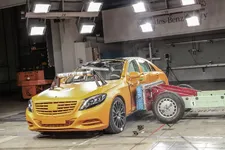
The “Fintail” models 220, 220 S and 220 SE (W 111) introduced in 1959 received their nickname from the discreet fintails that embellished the rear wings – officially these were known as “guide rods” in view of their function as a parking aid. The new luxury class generation was a very special milestone in automotive history, as this was the first time the safety body with crumple zones and a rigid passenger cell invented by Béla Barényi was incorporated into a series production model. Presented in 1961, the 300 SE (W 112) as the top-of-the-range model in the series featured an air suspension system and the automatic transmission developed by Mercedes-Benz as standard equipment. In 1963 the long-wheelbase version of this model founded a new tradition in the luxury class saloon portfolio of Mercedes-Benz: the 100-millimetre longer wheelbase offered passengers in the rear significantly more legroom and travelling comfort. The 108 and 109-series saloons that replaced the “Fintail” models in 1965 impressed with their timeless, elegant design and generously dimensioned window areas. Alongside the models with a conventional steel suspension – internally assigned to the 108 series – there were air suspension variants (109 series) which were also available with a 100 mm longer wheelbase right from the start. The 300 SEL 6.3 presented in 1968 was a particular highlight. The top-of-the-range model in the series was equipped with the powerful V8 engine from the high-end Mercedes-Benz 600 Saloon, and together with outstanding comfort and luxurious appointments it delivered sports car-like performance.
Automotive trendsetters: the 116 and 126 model series (1972 to 1991)
The successor 116 model series, introduced in 1972, was the first to officially carry the “S-Class” name. With it Mercedes-Benz expressed what had been a part of the luxury saloon range with an “S” in the model designation for decades. The new designation went hand in hand with a host of innovations that set new standards in terms of safety and comfort. The comprehensive safety concept included elements, such as a collision-protected fuel tank, a four-spoke safety steering wheel, dirt-repellent side windows, large headlamps, prominent direction indicators and dirt-repelling, ribbed rear lights. 1977 saw the start of the diesel era in the luxury class with the 300 SD, though initially only on the North American markets. The luxury diesel was also the first series production car with a turbodiesel engine. From 1978 the S-Class became the world’s first series production car to be available with the anti-lock braking system (ABS), which ensured steerability even under emergency braking. A world sensation at the time, this trailblazing innovation is now a standard feature in all vehicle classes. The S-Class underlined its status as the measure of automotive engineering, and made its model designation a generic term for high-end cars.
The technology transfer from the S-Class to the other Mercedes-Benz model series and to the products of competitors as the automotive state of the art was systematically continued over the subsequent period, and made the S-Class a true trendsetter. The 126 series introduced in 1979 was the automotive engineering debut for the airbag in 1981, and it is now a central element in automotive safety. Other features of this S-Class generation were its aerodynamically optimised contours and the systematic weight reduction for lower pollutant emissions, e.g. using new light-alloy V8 engines. The 126 series also made its mark with respect to design: it was the first Mercedes-Benz passenger car to dispense with traditional chrome bumpers, replacing them with deformable plastic bumpers that could withstand low-speed parking impacts undamaged. Initially perceived by some as plain and lacking in appeal when it first appeared, the design of the 126 model series was soon seen as timeless and elegant.
The height of luxury: the 140 and 220 model series (1991 to 2005)
In 1991 the 140 model series S-Class was launched as the new top-of-the-range Mercedes-Benz. Its developers set their sights on maximum comfort, achieved partly with generous dimensions and double-glazed windows for optimum noise insulation. This was the first time a series production Mercedes-Benz car was equipped with a V12 engine, in the flagship 600 SE and 600 SEL models. The power range began with the 300 SD Turbodiesel, which now also made the luxury class diesel available on markets outside North America. This generation of the S-Class also introduced a trailblazing safety innovation into automotive engineering: the Electronic Stability Program (ESP®), which became standard equipment for the V12 models in 1995 and optional for the V8 models. In the following year Brake Assist BAS was also added.
From 1998, the exterior of the 220 model series S-Class focussed more on understatement. Among the key development aims were further weight reduction and an additional increase in safety and comfort. Despite dispensing with the heavy double-glazing, the new model generation offered further improved comfort thanks to elements including the new, electronically controlled AIRMATIC air suspension, the COMAND control and display system and innovative Active Distance Assist DISTRONIC. The Active Body Control (ABC) suspension available from 1999 reduced body roll tendencies and allowed a previously unprecedented level of handling refinement. The interior design, which was for the first time closely coordinated with the exterior, ensured a high-class ambience in the S-Class. Customers with sporty ambitions were catered for by the S 55 AMG: for the first time an AMG model officially appeared on the S-Class price list. In autumn 2002 the regular top-of-the-range model without the AMG badge, the S 600, benefited from a power increase and, for the first time, reached the magic output threshold of 368 kW (500 hp). At the same time a further trailblazing innovation celebrated its debut in the 220 model series: the PRE-SAFE® preventive occupant protection system. By virtue of this system, the vehicle autonomously initiates measures to protect the occupants as well as possible when a collision threatens. As part of the model facelift, Mercedes-Benz also offered the S-Class with the intelligent 4MATIC all-wheel drive system for the first time.
Pioneering innovations: the 221 model series (2005 to 2013)
The 221 model generation presented in 2005 combined an expressive exterior with a luxurious interior. The controller of the further improved COMAND system allowed rapid and intuitive operation of the increasingly complex functions and menus. The pioneering technical innovations included Active Night View Assist and the further improved Active Distance Assist DISTRONIC PLUS with Brake Assist Plus, which were extended to become PRE-SAFE® Brake with autonomous partial braking in 2006. Further assistance systems such as Blind Spot Assist, Lane Keeping Assist and Speed Limit Assist further relieved driver stress, bringing the Mercedes-Benz S-Class another step closer to the vision of safe, accident-free driving. This generation of the S-Class also set new standards in driver fitness safety.
The upgraded generation of the 221 series appeared in 2009. The S 400 HYBRID was the first car in the luxury class with hybrid drive, and the first series production car with a lithium-ion battery. Masterpieces of efficiency were introduced in 2010, in the form of the S 350 BlueTEC as a diesel variant and the S 350 and S 500 BlueEFFICIENCY with economical yet powerful direct-injection petrol engines. In early 2011, Mercedes-Benz for the first time introduced a highly efficient four-cylinder engine into the S-Class in the S 250 CDI. Its diesel power unit allowed fuel consumption figures at the level of a compact car, with commensurate performance and ride comfort. This generation of the S-Class was also highly successful: all in all, almost 550,000 221-series saloons rolled off the production lines in Sindelfingen up to May 2013.
S-Class to the future: the 222 model series (2013 to 2020)
From 2013 Mercedes-Benz took the many generations of evolutionary continuity in the executive and luxury class into the future with the 222 model series S-Class. This set new technical standards, e.g. being the first car in the world to dispense entirely with light bulbs and use only LED lights for both the exterior and interior. Particularly high efficiency was ensured by modern drive units which also included hybrid technology.
The key areas of development in the 222 model series are “Intelligent Drive”, “Efficient Technology” and “Essence of Luxury”. The S-Class has especially become the modern guiding star in automotive development thanks to the Intelligent Drive system. This is the name under which the Stuttgart-based brand bundles all its interconnected safety and driver assistance systems. Intelligent Drive makes driving even safer and more comfortable than before. It also includes assistance systems that make driving easier and allow semi-autonomous driving. Back in August 2013, on the historic Bertha-Benz route from Mannheim to Pforzheim, the S 500 INTELLIGENT DRIVE research vehicle demonstrated what the future of autonomous driving might look like thanks to such networked technologies: its systems were able to cope with the highly complex requirements of an autonomous journey along country roads and through city traffic. The S-Class saloons were joined by a coupé in 2014 and a cabriolet in 2015. The Mercedes-Maybach S-Class premiered in 2014 and the Mercedes-Maybach S 600 Pullman followed in 2015.
A further, major step towards autonomous driving was taken by the next development stage of Intelligent Drive in the facelifted model variant of the 222 model series, presented in the summer of 2017: Active Distance Assist DISTRONIC and Active Steering Assist now support the driver even more conveniently when keeping a safety distance and steering. For example, the S-Class automatically adjusts its speed on bends or when approaching junctions and roundabouts. This is possible because further improved camera and radar systems monitor the surroundings, and for the first time also incorporate map and navigation data into the calculation of the driving response. Via the display in the instrument cluster and the head-up display, the driver is at all times kept informed about the assistance functions that are currently active. The innovative Mercedes-Benz Intelligent Drive system boasts a modular structure. Standard equipment in the 222 model series S-Class from model year 2017 includes Active Brake Assist, Cross-Wind Assist, ATTENTION ASSIST, Traffic Sign Assist, the occupant protection system PRE-SAFE® and the new PRE-SAFE® Sound.
Innovations and facts: Mercedes-Benz S-Class and preceding model series
The Mercedes-Benz S-Class and the preceding model series have always stood for innovative automotive engineering. Again and again, they introduced new features on the market that subsequently became widespread to crucially shape the entire vehicle development sector. This overview illustrates the special characteristics of each model series.
Mercedes-Simplex 60 HP (1903 to 1905)
- Modern high-performance engine: large-capacity four-cylinder with overhead intake valves
- Highly efficient honeycomb radiator
- Long wheelbase and low centre of gravity
Mercedes-Benz Nürburg (W 08, 1928 to 1933)
- First series-production Mercedes-Benz car with an eight-cylinder engine
- Luxurious and spacious Pullman body
- Overdrive transmission as an optional extra (from 1931, in conjunction with added displacement)
Mercedes-Benz 320 (W 142, 1937 to 1942)
- Smooth-running six-cylinder engine
- Fully-synchronised four-speed manual transmission, from 1939 with overdrive
- Very wide choice of bodies: Saloon, Pullman Saloon (from 1939 with external luggage boot), Streamline Saloon, various Cabriolet versions
Mercedes-Benz 220 (W 187, 1951 to 1954)
- Cutting-edge six-cylinder engine with overhead camshaft
- Conical-pin safety door lock to prevent doors from bursting open
- Heater with fan as special equipment
- Production numbers (Saloon): 16,066
Mercedes-Benz 219/220/220 S/220 SE (W 105/W 180/W 128, 1954 to 1959)
- Self-supporting bodyshell
- Improved spaciousness and comfort with modern Pontoon shape
- Front suspension subframe
- Single-link swing axle with low pivot point
- Brake drums with “turbocooling”
- Heater and fan as standard, separately controlled for driver and front passenger
- “Hydrak” hydraulically automated clutch as special equipment (from 1957)
- Mechanically controlled manifold petrol injection (220 SE, from 1958)
- Production numbers (Saloon): 111,021
- Model with highest production figures: 220 S (55,268 vehicles)
Mercedes-Benz 220 to 300 SE/long-wheelbase 300 SE (W 111/W 112, 1959 to 1965)
- Passenger safety cell with crumple zones (front and rear)
- Padded steering wheel and “injury-reducing vehicle interior”
- Conical-pin door locks with two safety detents
- Disc brakes (300 SE, from 1961)
- Dual-circuit braking system (from 1963)
- Four-speed automatic transmission as standard (300 SE) or optional equipment (from 1961)
- Air suspension (300 SE, from 1961)
- Long-wheelbase version available (300 SE, from 1963)
- Central locking as optional equipment (long-wheelbase 300 SE)
- Production numbers (Saloon): 344,417
- Model with highest production figures: 220 S (161,119 vehicles)
Mercedes-Benz 250 S to 300 SEL 6.3 (W 108/W 109, 1965 to 1972).
- Safety steering system (from 1967)
- Hydropneumatic compensating spring at the rear axle
- Air suspension (300 SEL, 300 SEL 6.3, 300 SEL 3.5)
- Top-of-the-range model 300 SEL 6.3 with 184 kW (250 hp) V8 engine and performance at sports car level (from 1968)
- Production numbers (Saloon): 383,341
- Model with highest production figures: 280 S (93,666 vehicles)
116 model series Mercedes-Benz S-Class (1972 to 1980)
- Officially designated the “S-Class” for the first time
- Integral safety concept
- Four-spoke safety steering wheel
- Fuel tank over the rear axle to provide protection in the event of a collision
- Safety door handles
- Large headlamps and turn indicators
- Dirt-resistant rear lights
- Dirt-resistant side windows
- Anti-lock braking system ABS as optional equipment (from 1978)
- Cruise control as optional equipment (from 1975)
- Double wishbone front axle
- Coupled-link axle with anti-squat control (450 SE, 450 SEL, 450 SEL 6.9)
- Automatic transmission with torque converter as optional equipment (standard for 450 SE, 450 SEL, 450 SEL 6.9)
- Hydropneumatic suspension with level control (450 SEL 6.9, from 1975)
- First luxury-class saloon with a diesel engine, first production car with a turbocharged diesel engine (300 SD, from 1978)
- Production numbers (Saloon): 473,035
- Model with highest production figures: 280 SE (150,593 vehicles)
126 model series Mercedes-Benz S-Class (1979 to 1991)
- Bodyshell structure with forked member, the first series production vehicle worldwide to meet the frontal offset crash criteria
- Low drag coefficient of Cd= 0.36
- New V8 engines with light-alloy block
- Closed-loop catalytic converter as optional equipment (from 1985), then standard equipment (from 1986)
- Electrically adjustable steering column as optional equipment (from 1985)
- Driver airbag and belt tensioner for front passenger as optional equipment (from 1981)
- Front passenger airbag as optional equipment (from 1988)
- Automatic locking differential as optional equipment for six-cylinder models (from 1985)
- ASR acceleration skid control as optional equipment for V8 models (from 1985)
- To this day, the most successful Mercedes-Benz saloon in the executive and luxury class
- Production numbers (Saloon): 818,036
- Model with highest production figures: 280 SE (133,955 vehicles)
140 model series Mercedes-Benz S-Class (1991 to 1998)
- Low drag coefficient of Cd= 0.31
- Systematically geared towards recyclability
- Complete absence of chlorofluorocarbons (CFCs)
- Petrol engines with four-valve technology and adjustable intake camshafts
- First Mercedes-Benz production car with a twelve-cylinder engine, the brand’s most powerful car engine at this point (600 SE, 600 SEL)
- Luxury-class 300 SD diesel available to global markets for the first time
- Five-speed automatic transmission with electronic control (standard for V8 and V12 models, from 1995)
- Speed-sensitive power steering with speed-dependent steering torque
- Double-glazed side windows for maximum noise insulation
- Automatic air conditioning with activated charcoal filter and CO/NOX-sensitive sensors as standard equipment (S 600, or optional)
- Electrically folding exterior mirrors
- Power closing for doors and boot lid as optional equipment
- Headlamps with variable-focus reflectors
- Electronic CAN bus network
- Belt system with automatic height adjustment
- Side airbags for driver and front passenger (from 1996)
- ADS Adaptive Damping System as optional equipment
- Electronic Stability Program (ESP®) as standard equipment (S 600, from 1995) or optional equipment (S 420, S 500, from 1995)
- BAS Brake Assist System (from 1996)
- PARKTRONIC electronic parking aid as standard equipment (S 600, from 1995) or optional equipment (from 1995)
- APS Auto Pilot System navigation system as optional equipment (from 1995)
- LINGUATRONIC voice control system as optional equipment (from 1996)
- TELE-AID emergency call system as optional equipment (from 1997)
- Xenon headlamps with dynamic headlamp range control as optional equipment (from 1996)
- Production numbers (Saloon): 406,717
- Model with highest production figures: 300 SE/S 320 (98,095 vehicles)
220 model series Mercedes-Benz S-Class (1998 to 2005)
- Lightweight body with weight-reducing material mix (high-strength steel, light alloys, plastics)
- Aluminium crash boxes in the front and rear end structures
- Drag coefficient of Cd= 0.27
- Automatic cylinder shutoff as standard equipment (S 600) or optional equipment (S 500)
- Electronically controlled 7G-TRONIC seven-speed automatic transmission (S 430, S 500, from 2004)
- AIRMATIC air suspension with electronically controlled ADS Adaptive Damping System
- ABC Active Body Control as optional equipment (standard equipment in the S 600)
- Turn signal repeaters integrated into the exterior mirrors
- Automatic full beam
- COMAND control and display system with dynamic navigation system as optional equipment
- Windowbags
- Side airbags in the rear
- Front passenger airbag with two-stage gas generator
- Seat belt tensioners and belt force limiters in the rear
- Laminated glass side windows
- Multi-zone automatic air conditioning with individual control for each seat depending on the angle of the sun
- Luxury seats with ventilation and dynamic multicontour backrest as optional equipment
- Active Distance Assist DISTRONIC as optional equipment
- KEYLESS GO keyless access and drive authorisation system as optional equipment
- Bi-xenon headlamps with dynamic headlamp range control as optional equipment (from 2002, standard equipment for S 600)
- PRE-SAFE® preventive occupant protection system (from 2002).
- First S-Class AMG model in official model range (S 55 AMG, 265 kW/360 hp, from 1999; with a compressor from 2002, 368 kW/500 hp and 700 newton metres of torque)
- S 65 AMG with 450 kW (612 hp) and 1,000 newton metres of torque (from 2003)
- V8 diesel engine with light-alloy block (S 400 CDI, from 2000)
- 4MATIC all-wheel drive as optional equipment (S 350, S 430, S 500, from 2002)
- Production numbers (Saloon): 484,697
- Model with highest production figures: Long-wheelbase S 500 (108,823 vehicles)
221 model series Mercedes-Benz S-Class (2005 to 2013)
- Drag coefficient of Cd= 0.26
- First car with an environmental certificate
- Electronically controlled 7G-TRONIC seven-speed automatic transmission and DIRECT SELECT steering wheel gearshift
- ABC Active Body Control with cross-wind stabilisation as optional equipment (standard equipment in the S 600)
- ADAPTIVE BRAKE braking system
- Adaptive brake lights
- Brake Assist Plus as optional equipment
- Improved Active Distance Assist DISTRONIC PLUS (with braking to standstill) as optional equipment
- PRE-SAFE® Brake with autonomous partial braking (from 2006) and autonomous emergency braking (from 2009) as optional equipment
- Improved COMAND system with Controller on the centre tunnel
- SPLITVIEW display as optional equipment (from 2009)
- Parking Assist as optional equipment
- Panoramic tilting/sliding roof as optional equipment
- Active Night View Assist as optional equipment
- Blind Spot Assist as optional equipment (from 2007, from 2010 as Active Blind Spot Assist)
- Lane Keeping Assist as optional equipment (from 2009, from 2010 as Active Lane Keeping Assist)
- Adaptive Highbeam Assist as optional equipment (from 2009)
- Speed Limit Assist as optional equipment (from 2009)
- First luxury-class car with hybrid drive and lithium-ion battery (S 400 HYBRID, from 2009)
- First S-Class with a four-cylinder engine (S 250 CDI, from 2010)
- New xenon headlamps with 20 percent higher colour temperature (5000 kelvin) for daylight-like light (2010)
- Production numbers (Saloon): 547,698
- Model with highest production figures: Long-wheelbase S 500 (96,032 vehicles).
222 model series Mercedes-Benz S-Class (2013 to 2020)
- “Intelligent Drive” with new assistance systemsand significantly enhanced functions:
- DISTRONIC PLUS with Steering Assist and Stop&Go Pilot makes it easier to keep the vehicle in lane and masters partially autonomous driving in queues of traffic.
- Braking assistance system BAS PLUS with Cross-Traffic Assist can help prevent rear-end collisions and collisions with crossing traffic. Active Lane Keeping Assist can prevent the vehicle from unintentionally leaving the lane.
- Data generated by stereo cameras and the radar system helps detect objects on adjacent lanes.
- Adaptive Highbeam Assist Plus allows the high beam to remain switched on without dazzling other drivers by masking out other vehicles in the high-beam light cone.
- The evolved Night Vision Assist Plus with thermal imaging camera can automatically switch the speedometer display to a crisp night-vision image that highlights the sources of danger and flashes identified pedestrians as part of a spotlight function.
- Within an enhanced speed range ATTENTION ASSIST is capable of warning in the event that drivers are not paying attention or getting tired.
- From 2017 driver assistance systems, such as Active Distance Assist DISTRONIC and Active Steering Assist support drivers even more conveniently in keeping the distance and steering. The speed is automatically adapted when cornering or approaching junctions. The Mercedes-Benz S-Class facelift takes another leap towards autonomous driving.
- In autumn 2013, the S 500 INTELLIGENT DRIVE research vehicle on the basis of the 222 model series featuring close-to-series-production technology autonomously covered Bertha Benz’s historic route from Mannheim to Pforzheim. This S-Class, internally known as “Bertha”, has formed part of the Mercedes-Benz Classic vehicle collection since 2016.
- Enhanced PRE-SAFE® with new functions (PRE-SAFE® Brake with pedestrian detection, PRE-SAFE® PLUS and PRE-SAFE® IMPULSE) can contribute to preventing accidents in urban environments, mitigate hazardous situations caused by following vehicles and enhance the seat belts’ protective function. From 2017 the new PRE-SAFE® Sound became standard in S-Class facelift models.
- Enhanced safety system for passengers in the rear thanks to buckle feed mechanism, beltbag (both optional in “PRE-SAFE® rear package”) and Cushionbag (in optional Executive seat).
- Body with third-generation aluminium hybrid bodyshell with 50 percent higher light-alloy design quality rating (torsional rigidity in relation to weight and vehicle size) compared with the predecessor model series.
- First car in the world entirely without bulbs, instead featuring almost 500 LEDs in the interior and exterior. The multi-level brake light control functionality represents a world-first. From 2017 MULTIBEAM LED headlamps enable extremely fast and accurate low-beam adaptations to the current traffic situation. ULTRA RANGE high beam generates the maximum legally permitted light intensity.
- Thanks to ROAD SURFACE SCAN the S-Class is the first vehicle in the world capable of identifying potholes in advance. MAGIC BODY CONTROL adapts the chassis and suspension accordingly (optional for models with an eight-cylinder engine). Continuously operating ADS PLUS adaptive damping system and evolved, fully bearing AIRMATIC air suspension represented standard features.
- For the first time in the S-Class’s history the saloon with a long wheelbase lies at the core of the development process. It was used as the blueprint for the version with a short wheelbase. Accordingly, there were many innovations to aid passenger comfort and safety in the rear of the vehicle.
- Display and operating concept with features including two high-resolution TFT colour display with 8:3 ratio, touch-sensitive phone keyboard and LINGUATRONIC voice control with Speech Dialog system. From 2017 the high-resolution displays were merged to one widescreen cockpit under a shared lens. The steering wheel features touch-sensitive Touch Control buttons.
- Air conditioning with optional AIR‑BALANCE Package: fragrancing (global innovation), ionisation and even more powerful filtration. THERMOTRONIC automatic climate control in the rear offers two additional zones to boost comfort. Electrical armrest heating as part of Heat Comfort package is new in this model series.
- Systems, such as ENERGIZING massage function applying the hot-stone principle (global innovation) and active seat ventilation with reversing fans increase seating comfort. Five different seat variants are available for the rear. From September 2017 ENERGIZING comfort control merges different systems in the vehicle to enable individual set-ups to boost well-being.
- New multimedia generation featuring intuitive control and an illustration of functions in visuals and animations as well as individual entertainment in the rear. Optionally available audio systems that were developed in collaboration with Burmester. From 2017 enhanced messaging options for passengers in the front and rear.
- In 2014, the S 500 Plug-In HYBRID (325 kW system output) is the first series-production plug-in hybrid by Mercedes-Benz. It can cover up to 33 (combined fuel consumption: 2.6-2.5 l/100 km, combined CO₂ emissions: 59-57 g/km, combined electrical consumption: 20.2-20.0 kWh/100 km) kilometres without generating any local emissions. 2017 saw the presentation of the S 560 e featuring an electric motor that was jointly developed with Bosch to match the 9G‑TRONIC plug-in hybrid transmission.
- As of 2014, the Mercedes-Maybach S-Class chauffeur-driven limousine topped the 222 model series with a wheelbase that had been extended by 200 millimetres (3365 millimetres). The Mercedes-Maybach S 600 Pullman with a wheelbase of 4,418 millimetres was introduced at the 2015 Geneva Motor Show.
- Premiere of new and highly efficient engines in the S-Class facelift in 2017: six-cylinder in-line diesel and petrol engines and a V8 Bi-Turbo with cylinder shut-off. Simultaneously world premiere of pioneering technologies, such as an integrated starter alternator on 48‑volt basis and an electrically powered auxiliary compressor.
- Production anniversary: the 500,000th 222 model series S-Class rolled off the production line at the Mercedes-Benz plant in Sindelfingen in November 2019.
- Victory at “Best Cars”: in its last production year, the 222 model series Mercedes-Benz S-Class won the “Best Cars 2020” readers’ choice award in the luxury class presented by “auto motor und sport” specialist magazine.
The Mercedes-Benz S-Class has always elicited an extraordinary response from the worldwide press. Moreover, quotes from contemporary articles on all the models in the line of ancestors lend a touch of colour that assigns them to their different eras.
The Mercedes-Simplex in the press
“Allgemeine Automobil-Zeitung”, issue 51-52/1902, on the Mercedes-Simplex at the Paris Motor Show:
“We have previously cited a French source describing this year’s Paris Motor Show as the ‘Mercedes Show’. The Mercedes model does indeed provide the main theme in the grand symphony of countless automotive designs which interpret this leitmotif with varying degrees of ingenuity. The English have already added an expression to their vocabulary to describe this revaluation of all automotive values along Daimler lines, aptly referring to this phenomenon as ‘Daimlerfication’. The honeycomb radiator, which also influences the lines of the vehicle in some respects, was virtually unknown at the last Paris Motor Show, but has since become ‘de rigueur’ for most French construction engineers. Among the many visitors to the Paris Motor Show on 12 December was the King of Belgium, who proved to have a good knowledge of all things automotive. He viewed every stand, his tour of the exposition also taking in the Mercedes cars. His interest in this brand is understandable, as the king had a 40 HP Mercedes in use and recently ordered the very latest 60 HP Mercedes model in Cannstatt. During the visit to the Mercedes stand, engineer Maybach was introduced to the king, and a highly animated discussion on purely technical matters ensued between the two. An engaging picture: the imposing figure of the king and Maybach’s more modest demeanour. But this was actually a meeting of kings: Leopold, King of Belgium, and Maybach, king of the design engineers. With Maybach as a ‘star attraction’ of the show in his own right.”
“Allgemeine Automobil-Zeitung”, issue 3/1903, on the 1903 Mercedes models:
“Even the French competition admits that the Mercedes car marks the pinnacle of the international automotive world today. […] We showed in our first "Show" report just how rife the tendency to emulate this leader has become. But there are also firms who are copying the Mercedes in terms of its design, rather than its mechanical side. […] The Mercedes carburettor marks a major change. […] The new carburettor is smaller than its predecessor and is intended to enable a reduction in the engine speed such that, when the engine is running at minimum revs in neutral, it is possible to stand near the car without hearing a sound. […]”
“Allgemeine Automobil-Zeitung” (AAZ), issue 28/1903, on victory for the Mercedes-Simplex 60 HP in the 1903 Gordon Bennett race:
“Although the 60 HP Mercedes models were known to be capable of setting a formidable pace, it was also clear that they lagged behind the French cars in terms of absolute speed. But speed alone was not the decisive factor on this stretch with its countless bends and sharp corners. A much more important ingredient for swift progress was the elasticity of the engine, which the Mercedes vehicles are known to possess in abundance. The driver behind the wheel of this 60 HP car is not required to devote great attention to the lever for changing the speeds, being able to vary the vehicle’s pace with great delicacy by leaving the fourth speed engaged and operating only the levers for gas intake and pre-ignition. The speed of the 60 HP vehicles can be increased in this manner from the pace of a trotting horse to 120 km per hour." In the same issue, the AAZ cites the "Neue Wiener Tagblatt": "The English and the Americans were on the course weeks before, and were familiar with every milestone, every bend in the road and every tree. […] In contrast, the representatives of Germany arrived only shortly before the race and had no knowledge of the course at all; they trusted in the quality of their cars, and they were also the only competitors who, rather than wrapping their racing vehicles up in cotton wool for the trip to the racing venue, actually drove the cars intended for the race from Cannstatt to Paris, from Paris to Havre, crossed the Channel and then continued their journey by racing car through Wales to the Irish Sea. And in Ireland these vehicles, with a gruelling trip behind them, saw off what can only described as the quintessence of international automotive engineering … Praise and honour be to the brilliant Maybach, the construction engineer behind the Mercedes cars!”
The Mercedes-Benz Nürburg 460 and 500 (W 08) in the press
“Allgemeine Automobil-Zeitung”, Vienna edition, No. 23/1928, on the Mercedes-Benz Nürburg 460:
“Given the traditional principle of Mercedes-Benz only to build high-quality cars to the utmost perfection, it goes without saying that this vehicle was only presented once its design had been subjected to the severest testing. As a final trial by fire, the new model completed an uninterrupted day-and-night endurance trial with driver changes on the world’s most rigorous test track, the Nürburgring circuit. The general assumption that a production car is unable to withstand an uninterrupted trial covering more than 10,000 km at Nürburgring was strikingly proved wrong with the first test drive of the new eight-cylinder model. It covered 20,000 km in twelve driving days with an average speed of over 64 km/h, at times reaching speeds of up to 110 km, with flying colours and set a new record for reliability. By virtue of this extraordinary achievement, the new eight-cylinder model has been given the name "Nürburg model" (4.6 litres, 18/80 hp, Model 460).”
“Auto Revue”, No. 10/1929, on the Mercedes-Benz Nürburg 460:
“The feeling of pleasure and driving safety in this car is enhanced by the careful weight distribution, which very rarely shows any tendency to skid. I was unable to ascertain any driver fatigue resulting from the weight of the vehicle. The wide track, good suspension and light, comfortable steering, as well as the absolutely reassuring feeling of not losing control even at the very highest speeds, will give rise to hardly any signs of fatigue even on longer tours.”
“Motor und Sport”, Germany, No. 37/1933, on the Mercedes-Benz Nürburg 500:
“It really is one of the most spacious seven-seaters (wheelbase 3.67 m), extraordinarily comfortable and with a rare level of high-quality appointments. The suspension is very soft, while the engine and all other drive units operate quietly and without any vibrations. The high level of refinement for which Sindelfingen bodies are known is ideally suited to the high technical quality of this car. [...] At any rate, the ‘Nürburg’ is a car in which long distances can be covered in extraordinary physical comfort, and which allows high average mileage with a high safety factor thanks to the balanced performance of the engine and the good transmission system.”
The Mercedes-Benz 320 (W 142) in the press:
“Allgemeine Automobil-Zeitung” (AAZ), Germany, No. 33/1937, on the Mercedes-Benz 320:
“In this car one is tempted to speak less about its technical characteristics than about the direct comfort and convenience it offers its occupants. This is mainly due to the fact that the technical aspects of this car inherently operate so inconspicuously that it is easy to forget the extent of the high-quality design and technical work that is necessary to produce such success. [...] The engine is exemplary in its quietness, flexibility and smoothness; unflustered, it continues to run smoothly even when drivers give vent to their nervousness via his right foot. [...] The general appointments of the vehicle meet the highest expectations. The seats leave nothing to be desired in terms of practicality and comfort.”
“Automobil Revue”, Germany, No. 2/1938, on the Mercedes-Benz 320:
“The Daimler-Benz A. G. bodies produced in Sindelfingen are top-class examples of international bodybuilding and represent the finest German craftsmanship combined with sound and refined tastefulness. The beauty and elegance of the external appearance go hand in hand with the ultimate comfort in the interior, with a high level of travelling comfort and with the implacable principle of quality in all major and minor aspects, contributing to the overall picture of this exemplary vehicle.”
“The Autocar”, England, in its 18 February 1938 edition, on the Mercedes-Benz 320:
“The road behaviour is refined as regards smoothness and quietness of the engine, and very comfortable riding is given. Also this car shows up well from two opposed viewpoints in that it is quiet, flexible and smooth to the degree of silkiness for town and leisurely driving, yet notably free from effort at maintained high speed. [...] The interior is very well finished, and leather upholstery is used, whilst in external appearance this car is undeniably distinctive and handsome.”
The Mercedes-Benz 220 (W 187) in the press
“Das Auto, Motor und Sport”, Germany, No. 23/1951, on the Mercedes-Benz 220:
“With the Model 220 it has for the first time proved possible to combine above-average driving safety, a sports car-like temperament and the comfort and solid good taste of a luxury car in a nonetheless relatively economical car for day-to-day use.”
“Motor-Rundschau”, Germany, No. 22/1951, on the Mercedes-Benz 220:
“Following the wishes of many Mercedes fans, the Mercedes Benz Model 220 is basically the 170 S, but with a 2.2-litre, six-cylinder 80 hp high-performance engine that allows high average speeds, even in the mountains, to be achieved safely given this car’s high level of handling safety. The result is a touring car with the spirit of a sports car. On the motorway, speeds well above 100 km/h are not perceived as particularly fast, so safe and smooth are the road-holding and power delivery.”
“ADAC-Motorwelt”, Germany, November 1951, on the Mercedes-Benz 220:
“Taken all in all, the driving characteristics of the 220 are not only well above the conventional average, we even dare to assert that anywhere in the world, there are only very few vehicle models possessing such well-rounded driving characteristics as this car.”
“Automobil Revue”, Switzerland, No. 5/1952, on the Mercedes-Benz 220:
“It is undoubtedly more than it seems. Its owners have the benefit of a fast, safe, comfortable and economical vehicle, the sum of whose qualities is only equalled by very few touring cars in this class and only exceeded by more expensive ones.”
The “Ponton” six-cylinder models (W 180/W 128) in the press
“Das Auto, Motor und Sport”, Germany, No. 19/1954, on the Mercedes-Benz 220:
“The absolute handling safety even at very high speeds is among the most striking attributes of this car. Even on very poor road surfaces, it shows no tendency whatever to drift off-course, and precisely negotiates the most horrible bends without the need for any special corrective steering action, and without any perceptible body roll. [...] Apart from its elasticity, the engine of the 220 exhibits exemplary balance and smooth running, with only a slight shudder noticeable when idling.”
“Motor Rundschau”, Germany, No. 21/1954, on the Mercedes-Benz 220:
“The Mercedes-Benz Model 220 is a top-class product in European car engineering. Although we are very careful about our use of superlatives, they are unavoidable in this case and with reference to the now very mature, high-performance engine with its smooth and flexible temperament [...].”
“Automobil Revue”, Switzerland, No. 9/1955, on the Mercedes-Benz 220:
“The Model 220 a has become a top-class European car with a distinctive character, the embodiment of general and technical advances. Yet even for the casual observer, and while maintaining a standard of quality that is now no longer the norm everywhere, it offers a rare combination of generous appointments, moderate exterior dimensions, outstanding handling safety and a comfortable suspension, an appealing exterior, a high level of equipment and economical operation. Getting to know the 220 a has further increased our respect for its world-famous creator, especially in view of the very reasonable price.”
“Das Auto, Motor und Sport”, Germany, No. 4/1959, on the Mercedes-Benz 220 SE:
“Weighing no less than 1,400 kilograms (fully fuelled, with radio), the car responds so directly to the accelerator that at least for a conventional, normal car, a new standard has to be applied. Together with the smooth running that is simply only achievable with 6 cylinders and upwards, we experienced a level of refinement that was once only the privilege of cars with genuinely large engines.”
The six-cylinder “Fintail” models (W 111/W 112) in the press
“Autocar”, England, 6 November 1959, on the Mercedes-Benz 220 SE:
“In summary the 220 SE has outstanding road manners, undoubtedly allied to the firm’s long experience in racing. In addition, it permits the achievement of high and sustained cruising speeds with very good economy. The interior is planned to carry five people and their luggage over long distances, in a manner matched by few other cars, irrespective of their country of origin.”
“Sports Cars”, England, December 1959, on the Mercedes-Benz 220 S and 220 SE:
“’Fabelhaft’ is the German word for fabulous and this about sums up the new 220 Mercedes. It sets a new standard for the industry, a standard that few manufacturers will be able to equal.”
“Auto, Motor und Sport”, Germany, No. 19/1963, on the Mercedes-Benz 300 SE:
“The 300 SE is also something of an advertisement for Daimler-Benz, in which all the technical refinements the company has to offer are combined: air suspension, automatic transmission, power steering. […] There are not many cars in the world in which you can travel as comfortably and safely as in the 300 SE.”
The W 108/W 109 model series in the press
“auto, motor und sport”, Germany, No. 2/1966, on the Mercedes-Benz 250 SE:
“The lightfootedness, quietness and smoothness of its driving behaviour, the handling safety at high speeds and on bends, the outstanding interior appointments and the quality and careful design even of minor features speak for themselves, and place the 250 SE well near the top amongst the cars of the world.”
“auto, motor und sport”, Germany, No. 6/1968, on the Mercedes-Benz 300 SEL 6.3:
“We collected one of the carefully kept first examples, which did not yet bear the designation ‘6.3’. The absence of this designation no doubt surprised a few Porsche 911 and 911 S drivers – otherwise kings of the autobahn – who were left in the wake of the harmless and distinguished-looking Mercedes. Should any of them be reading these lines right now: there is no need to complain to the factory about their cars’ lack of performance.”
The 116 model series S-Class in the press
“auto, motor und sport”, Germany, No. 2/1973, on the Mercedes-Benz 350 SE:
“The pleasure of driving a Mercedes 350 SE is unfortunately an expensive pleasure, and can therefore only be enjoyed by a minority. This is regrettable, because for this large amount of money you not only receive prestige and a status symbol, but above all a wealth of benefits one would really like to see in any car: a high level of handling and accident safety, perfected bodyshell technology, outstanding comfort, high power reserves, effortless performance and an exemplary standard of finish. And all these laudable things convincingly come together to form an overall picture that makes one thing clear: one of the most perfect cars in the world.”
“Car”, England, June 1975, on the Mercedes-Benz 450 SEL 6.9:
“A car of such speed and weight must have demonstrably good roadholding and handling, and this one is no disappointment in anything from a hairpin to a three-figure bend: the suspension soaks up the bumps, the transmission is wonderfully smooth and admirably easy to control (either by a sensitive accelerator foot or a hasty hand at the lever), and the steering is servo-assisted in a way that highlights the nearly neutral responses of the vehicle.”
“Automobil Revue”, Switzerland, 15 May 1975, on the Mercedes-Benz 450 SEL 6.9:
“It is very gratifying that just at this time, a car has appeared that offers the very highest driving enjoyment for the aficionado – and at any speed. The 6.9 is not only testimony to the optimism for the future expressed by its creators, but also of their courage to stand by their convictions.”
The 126 model series S-Class in the press
“auto, motor und sport”, Germany, No. 22/1979, on the 126 model series S-Class:
“When driving, it quickly becomes obvious that quietness is one of the major civil duties at Daimler-Benz. Even in the six-cylinder models, the noise generated by the mechanical systems remains discreetly in the background – and it is amazing how thoroughly the Mercedes developers have banished wind noises.”
“Road & Track”, USA, February 1980, on the S-Class series 126:
“Hurrying back through the woods over a rather bumpy stretch of road, I was reminded of how well a Mercedes rides and handles. A live-axle car could be made to do the latter, but not without scrambling your brains. The W 126 does a marvellous job at both tasks and stops quickly too.”
“Frankfurter Allgemeine Zeitung”, Germany, 24 May 1986, on the Mercedes-Benz 300 SE:
“The 300 SE makes its way like a ship on a set course. The springs and dampers swallow road bumps with the greatest serenity. No other car turns steel and rubber into more comfort. The large steering wheel allows you to position the car carefully on a bend, or you can simply throw it into bends with abandon. It will do anything you like. The suspension has unusually high safety reserves.”
The 140 model series S-Class in the press
“auto, motor und sport”, Germany, No. 7/1991, on the Mercedes-Benz 600 SEL:
“Given the inside dimensions, not much needs to be said about interior spaciousness: it is quite frankly wasteful, and in the rear more than the front, because the generous headroom in the rear is particularly suitable for evoking the impression of a mobile living room. […] It would not be wrong to call this the best car in the world – and especially in the case of Mercedes, less would also have been too little.”
“auto, motor und sport”, Germany, No. 12/1991, on the Mercedes-Benz 300 SE:
“The size and weight of the new S-Class has almost become a political controversy. But to give the truth its due, when you drive it, you feel it less than expected. Instead it is surprising how nimbly and effortlessly this mighty car can be driven even on narrow and winding country roads.”
“Road & Track”, USA, December 1991, on the Mercedes-Benz 500 SEL:
“At a 70 mph cruise, the 500 SEL has the honor of being the quietest car we have ever tested – a mere 64 dBA. Helping in the serenity department is double-pane side glass, with dehumidified air sealed between the panes. It’s said to prevent fogging as well as absorb noise, and no, Mercedes assures us, it isn’t bulletproof, a question some ask when they see its thickness.”
“mot”, Germany, No. 13/1991, on the Mercedes-Benz 400 SEL:
“With the new S-Class, Mercedes is once again asserting its claim to have invented the motor car and to build the best cars in the world. And in view of the 400 SEL, one cannot avoid admitting that this claim is probably justified.”
The 220 model series S-Class in the press
“Frankfurter Allgemeine Zeitung”, Germany, 13 October 1998, on the 220 model series S-Class:
“The still quite sizeable saloons, despite a lower weight and reduced dimensions, exhibit a manoeuvrability and agility that we have never previously encountered in this vehicle class. At the same time the suspension ensures such a precise wheel location and response to steering movements as one would normally only obtain with seriously compromised comfort. The air suspension as standard equipment for all variants practically turns the Mercedes saloon into a flying carpet that detects turbulence before it occurs. Every S-Class should have one of the once very popular signs in the rear window: The boss drives himself here.”
“auto, motor und sport”, Germany, No. 25/1998, on the Mercedes-Benz S 320:
“It is also Airmatic and ADS that give the large saloon its very controllable and agile handling without significant body roll. They are supported in this by the precise, speed-sensitive power steering which allows the almost two-tonne saloon to be controlled like a compact car.”
"Road & Track", USA, January 1999, on the Mercedes-Benz S 500:
“In the meantime [until the S 600 arrives], the S 500 is quite a worthy flagship: quick, quiet, stable and yet commendably nimble. Whereas the previous S Class miraculously shrank the faster it was driven, in a sense this new on is already preshrunk; its excellent chassis dynamics evident at any speed, its comfort undiminished from that of the car it replaces.”
“Auto Zeitung”, Germany, No. 4/2003, in a comparative test between the Mercedes-Benz S 600 and BMW 760 Li:
“It is hard to believe that an engine like this could meet its match, but the turbocharged Mercedes V12 puts the BMW engine to shame. The sheer vehemence of 800 newton metres and 500 hp allows even better performance figures at low engine speeds, with the same, high refinement. Two turbochargers generate such smooth, gigantic power that even when driving at very fast speeds, the five-speed automatic transmission only rarely needs to change gear. This V12 is quite simply sensational.”
The 221 model series S-Class in the press
“Autorevue”, Austria, November 2005, on the Mercedes-Benz S 500:
“Lightweight construction, four rather than three valves per cylinder and variably adjustable shifting camshafts combine [in the V8 engine] to generate 530 newton metres of maximum torque, after just under six seconds, and precisely accompanied by the 7-speed automatic transmission, the speedometer needle passes the 130 km/h mark, the 100 km/h mark having already been reached after 5.4 seconds – a 911 Carrera is only four tenths faster – yet everything stays calm, orderly and unruffled: The air suspension serenely copes with any irregularities and sheds the centrifugal forces, sometimes gently (Comfort mode), sometimes forcefully (Sport mode, 20 millimetres less spring travel).”
“auto, motor und sport”, No. 3/2009, on the Mercedes-Benz S 600:
“The [well-balanced handling] suits the matter-of-factness with which an S 600 gives rein to its 830 newton metres of torque. A remote hissing noise accompanies it in the overtaking lane, quiet enough to perceive wind noise and the breathing of the dynamic seats as intrusive: meanwhile it rockets from 0 to 100 km/h in 4.5 seconds, and needs just 15.1 seconds to reach the 200 km/h mark.”
“Road & Track”, USA, March 2009, on the Mercedes-Benz S 400 Hybrid:
“Here in the U.K. and Europe, diesels are our favored means of extracting the maximum economy from cars, but hybrids such as this one are valid where diesel isn’t available or liked. Furthermore, this is just the first of a series of hybrids that we’ll see coming from the company that revolutionized personal transport way back in the 19th century.”
“Car”, USA, September 2010, on the Mercedes-Benz S 63 AMG:
“With seven gears and peak torque available from 2.000 rpm, the S 63 is effortlessly fast in the manner big luxury cars should be. Wring it out and it’s a maniac, with a rich, cultured soundtrack in accompaniment. AMG’s tweaking of Active Body Control brings added agility combined with real comfort, though the S 63’s size and lifeless steering eventually curb your enthusiasm.”
“auto, motor und sport”, Germany, No. 12/2011, on the Mercedes-Benz S 250 CDI:
“The new S 250 CDI really does stand the luxury car scene on its head. No other car offers the same level of comfortable travel with such a low energy consumption as this Mercedes. Moreover, the buyer by no means needs to make reluctant concessions when it comes to driving refinement, as the twin-turbocharged, four-cylinder engine delivers more than adequate performance and noise insulation is practically perfect.”
The 222 model series S-Class in the press
“Auto Zeitung”, Germany, issue 26/2013, on the Mercedes-Benz S 500 4MATIC in a comparative test:
“The benchmark in this regard [safety equipment] is set by the S-Class. The brand from Stuttgart has the most comprehensive range of technologies for accident prevention and passenger protection on offer. Mercedes is the only one to already have an emergency brake assistant and road sign recognition, amongst other things, as standard.”
“Autorevue”, Austria, issue 10/2013, on the Mercedes-Benz S 500:
“The doors now swing heavier, the seams in the leather seem more hand-stitched, the silver around the air vents appears more aluminium.”
“Auto Bild”, Germany, issue 49/2013, on the Mercedes-Benz S 500:
“It is good to know there are still constants in our fast-moving time. For example, this one: when a new S-Class comes out, the question ‘is this the perfect car?’ naturally arises. Asking it is practically the law in automotive journalism.”
“Autorevue Premium”, Austria, 2015, on the Mercedes-Maybach S 500:
“In terms of noise it makes no difference how fast we are travelling. The background noise in the interior is no different at 130 than it is at 160 or 190 km/h and above. Of course, this also applies, indeed above all, to the rear seats. Mercedes says that, despite the large windows, this is the quietest production saloon in the world. It couldn’t be better.”
“Auto Zeitung”, Germany, issue 12/2013, on the Mercedes-Benz S 500 with long wheelbase:
“That this is a long version of the S 500 is initially not apparent. The additional 132 millimetres of length are distributed harmoniously across the body totalling 5,246 millimetres.”
“auto, motor und sport”, Germany, issue 12/2014, on the 222 model series Mercedes-Benz S-Class:
“With safety-optimised assistance systems, economical hybrid drives and outstanding comfort, the new S-Class sets standards.”
“Autorevue”, Austria, issue 11/2013, on the Mercedes-Benz S 63 AMG:
“The centrepiece of the further consolidation of elevated automotive existence is, in this case, the twin-turbo engine, from which an extra 30 kW, or 41 hp, have been squeezed out compared to the predecessor.”
“Car”, Great Britain, 18 April 2017, on the facelifted 222 model series Mercedes-Benz S-Class:
“The S-Class has always been a pioneer in the tech world, often premiering tech that goes on to become mainstream elsewhere. Don’t believe us? You have Mercedes to thank for introducing the production car to anti-lock braking, seatbelt pretensioners, electronic stability control and more... This one is about to usher in a whole raft of tech - and the brand’s new generation of straight six engines.”
“Motor Authority”, USA, 20 April 2017, on the occasion of the 222 model series S-Class facelift:
“The current S-Class has been a huge hit for Mercedes-Benz. Over 300,000 examples have been sold since the car went on sale in 2013, and that’s the figure for sedans only.”
“auto, motor und sport”, Germany, issue 16/2017, on the Mercedes-Benz S 560 4MATIC (combined fuel consumption: 2.6-2.5 l/100 km, combined CO₂ emissions: 59-57 g/km, combined electrical consumption: 20.2-20.0 kWh/100 km): “The COMAND system comes as standard, as does the AIRMATIC chassis. This ensures sleek rolling off and soft suspension comfort, which the facelifted S-Class seemingly does a better job at than the previous version. And it is quiet in the car – so quiet that at a low volume the slightest oscillations of David Lindley’s violin bow can be heard.”
“Autocar”, Great Britain, 19 September 2017, on the Mercedes-Benz S 350 d with long wheelbase (combined fuel consumption: 6.0-5.9 l/100 km, combined CO₂ emissions: 160-156 g/km):
“The best mass-produced luxury saloon in the world just got better.”
“Autorevue”, Austria, issue 11/2017, on the Mercedes-Benz S 400 d 4MATIC with long wheelbase (combined fuel consumption: 6.3-6.2 l/100 km, combined CO₂ emissions: 166-162 g/km):
“The driving experience is truly (S-)class – crisply pressed, top quality.”