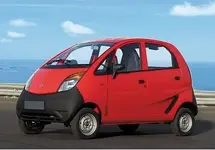
With a price tag of $2.500 (£1.300), Tata claims this is the cheapest car in the world.
Tata Nano - world's cheapest new car is unveiled in India
January 11, 2008 - Tata Nano - world's cheapest new car is unveiled in India - Times Online
It is 3 metres long, seats four comfortably or five at a squeeze, does 65mph and aims to revolutionise travel for millions. The “People’s Car” is also the cheapest in the world at 100,000 rupees (£1,300) – the same price as the DVD player in a Lexus.
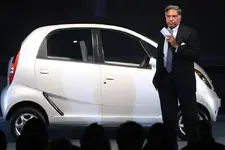
The Nano, from Tata, the Indian conglomerate bidding for Jaguar and Land Rover, was unveiled at the Delhi Auto Expo yesterday to music from 2001: A Space Odyssey. Ratan Tata, the company chairman, harked back to the first flight by the Wright Brothers and the Moon landing as he revealed the cute, snub-nosed hatchback that will allow millions in India’s emerging middle classes to buy a car for the first time.
“I hope this changes the way people travel in rural India. We are a country of a billion and most are denied connectivity,” he said. “This is a car that is affordable and provides all-weather transport for the family.”
The aluminium shell contains a rear-mounted 33bhp two-cylinder petrol engine and weighs about half a tonne. The standard version comes with the vital features: brakes, a four-gear manual transmission, seatbelts, locking, wind-down windows and a steering wheel. A small boot could store a duffel bag. It lacks a passenger-side mirror and has one windscreen wiper. The deluxe version will have air-conditioning while extras such as a radio and an airbag could be added.
The car is the culmination of five years’ research and input from across the world, including Italy and Germany. But it was designed and made in India, defying expectations that a company best known for its elephantine lorries could manufacture a cutting-edge passenger product.
Hormazd Sorbajee, editor of Autocar India, said: “As a concept it’s brilliant. It’s spacious and promises to be fuel efficient.”
A team of 500 engineers worked on the car, to be produced at a plant in West Bengal. In an effort to allay fears that something so cheap could not be safe, Mr Tata said that it had passed a full-frontal crash test in India and was designed to sustain further impact testing under European standards.
Tata cut costs by minimising components, particularly steel, and taking advantage of India’s low production costs. Because of its size, it uses less sheet metal, has a smaller and lighter engine than other cars, smaller tube-less tyres and a no-frills interior. The company has applied for 34 patents to cover its innovations. “We shrunk it, made the engine smaller and used fewer materials but we haven’t taken any shortcuts in term of safety or emissions,” Mr Tata said.
The car will be sold first in India from the second half of this year, with an initial annual production run of 250,000, but it is expected to be made available in Latin America, SouthEast Asia and Africa. It could find its way to Europe in a few years but enhancements to meet higher standards would raise the price considerably.
The Nano, at its most basic, is roughly half the price of the cheapest car available today. China’s QQ3Y Chery and India’s Maruti 800 are both about £2,550. The idea of millions of Nanos on the road alarms environmentalists. Rajendra Pachauri, the chief UN climate scientist, said last month that he was “having nightmares” about it.
Green campaigners point to India’s terrible road system and rising pollution levels. “Even if they claim it will be fuel efficient, the sheer numbers will undermine this,” Vivek Chattopadhyaya, an air pollution specialist at the Centre for Science and Environment in Delhi, said. “India’s infrastructure doesn’t have the capacity.” The centre estimates that the five million vehicles on Delhi roads today meet only a fifth of the capital’s transport needs. Most people travel by bus but could be convinced to buy a car at such a low price. Delhi, where air pollution levels are more than twice the safe limit, is already registering 1,000 new vehicles a day. As more cars hit the road, the average speed at peak times has fallen to 7mph, which should at least ease concerns about safety in case of accidents.
Shekhar Mehta, 27, from Ahmeda-bad, said: “It looks like a good city drive. The body doesn’t look too safe but it’s better than an autorickshaw.”
As Greenpeace activists outside the show held banners demanding “Cut CO2 emissions”, Mr Tata dismissed environmental concerns. He said that his car, which does 50 miles to the gallon, would conform to all emission standards in India and Europe. “We need to think of our masses. Should they be denied the right to an individual form of transport?” he asked.
Top speed 65mph (90 Km/h)
Engine rear-mounted 623cc, 33bhp multipoint fuel injection engine
Transmission continuous variable transmission
Fuel consumption 50mpg
Body sheet metal with crumple zones
Extras air conditioning and airbag optional. No radio, no power steering, one windscreen wiper.
This for £1,300 . . .
or one of these instead
For the same price in Auto Trader you could have a:
— 1993 Land Rover Discovery TDI S, 174,000 miles, 7 seats, towbar, alloy wheels, sunroof. Short MoT and tax
— 1983 Porsche 944 Lux 2.7 FH, 2dr Coupe, 116,000 miles, 10 months’ MoT, 5 months’ tax, MP3 CD player
— 1962 Triumph Herald 1200 Coupe, 70,000 miles, 2 doors, manual 4 speed, 3 owners, not much rust
— 1996 3-door Vauxhall Calibra 2.0i 16v (trade) with 159,359 miles and equipped with ABS, adjustable seats, alloy wheels, central locking and driver airbag
— 1998 Ford Mondeo 1.8i GLX, 5-door, 99,000 miles, two previous owners, ABS, adjustable seats, air conditioning, CD player and central locking
Pictures provided by Austin Rover Online
Tata Nano - world's cheapest new car is unveiled in India
January 11, 2008 - Tata Nano - world's cheapest new car is unveiled in India - Times Online
It is 3 metres long, seats four comfortably or five at a squeeze, does 65mph and aims to revolutionise travel for millions. The “People’s Car” is also the cheapest in the world at 100,000 rupees (£1,300) – the same price as the DVD player in a Lexus.
The Nano, from Tata, the Indian conglomerate bidding for Jaguar and Land Rover, was unveiled at the Delhi Auto Expo yesterday to music from 2001: A Space Odyssey. Ratan Tata, the company chairman, harked back to the first flight by the Wright Brothers and the Moon landing as he revealed the cute, snub-nosed hatchback that will allow millions in India’s emerging middle classes to buy a car for the first time.
“I hope this changes the way people travel in rural India. We are a country of a billion and most are denied connectivity,” he said. “This is a car that is affordable and provides all-weather transport for the family.”
The aluminium shell contains a rear-mounted 33bhp two-cylinder petrol engine and weighs about half a tonne. The standard version comes with the vital features: brakes, a four-gear manual transmission, seatbelts, locking, wind-down windows and a steering wheel. A small boot could store a duffel bag. It lacks a passenger-side mirror and has one windscreen wiper. The deluxe version will have air-conditioning while extras such as a radio and an airbag could be added.
The car is the culmination of five years’ research and input from across the world, including Italy and Germany. But it was designed and made in India, defying expectations that a company best known for its elephantine lorries could manufacture a cutting-edge passenger product.
Hormazd Sorbajee, editor of Autocar India, said: “As a concept it’s brilliant. It’s spacious and promises to be fuel efficient.”
A team of 500 engineers worked on the car, to be produced at a plant in West Bengal. In an effort to allay fears that something so cheap could not be safe, Mr Tata said that it had passed a full-frontal crash test in India and was designed to sustain further impact testing under European standards.
Tata cut costs by minimising components, particularly steel, and taking advantage of India’s low production costs. Because of its size, it uses less sheet metal, has a smaller and lighter engine than other cars, smaller tube-less tyres and a no-frills interior. The company has applied for 34 patents to cover its innovations. “We shrunk it, made the engine smaller and used fewer materials but we haven’t taken any shortcuts in term of safety or emissions,” Mr Tata said.
The car will be sold first in India from the second half of this year, with an initial annual production run of 250,000, but it is expected to be made available in Latin America, SouthEast Asia and Africa. It could find its way to Europe in a few years but enhancements to meet higher standards would raise the price considerably.
The Nano, at its most basic, is roughly half the price of the cheapest car available today. China’s QQ3Y Chery and India’s Maruti 800 are both about £2,550. The idea of millions of Nanos on the road alarms environmentalists. Rajendra Pachauri, the chief UN climate scientist, said last month that he was “having nightmares” about it.
Green campaigners point to India’s terrible road system and rising pollution levels. “Even if they claim it will be fuel efficient, the sheer numbers will undermine this,” Vivek Chattopadhyaya, an air pollution specialist at the Centre for Science and Environment in Delhi, said. “India’s infrastructure doesn’t have the capacity.” The centre estimates that the five million vehicles on Delhi roads today meet only a fifth of the capital’s transport needs. Most people travel by bus but could be convinced to buy a car at such a low price. Delhi, where air pollution levels are more than twice the safe limit, is already registering 1,000 new vehicles a day. As more cars hit the road, the average speed at peak times has fallen to 7mph, which should at least ease concerns about safety in case of accidents.
Shekhar Mehta, 27, from Ahmeda-bad, said: “It looks like a good city drive. The body doesn’t look too safe but it’s better than an autorickshaw.”
As Greenpeace activists outside the show held banners demanding “Cut CO2 emissions”, Mr Tata dismissed environmental concerns. He said that his car, which does 50 miles to the gallon, would conform to all emission standards in India and Europe. “We need to think of our masses. Should they be denied the right to an individual form of transport?” he asked.
Top speed 65mph (90 Km/h)
Engine rear-mounted 623cc, 33bhp multipoint fuel injection engine
Transmission continuous variable transmission
Fuel consumption 50mpg
Body sheet metal with crumple zones
Extras air conditioning and airbag optional. No radio, no power steering, one windscreen wiper.
This for £1,300 . . .
or one of these instead
For the same price in Auto Trader you could have a:
— 1993 Land Rover Discovery TDI S, 174,000 miles, 7 seats, towbar, alloy wheels, sunroof. Short MoT and tax
— 1983 Porsche 944 Lux 2.7 FH, 2dr Coupe, 116,000 miles, 10 months’ MoT, 5 months’ tax, MP3 CD player
— 1962 Triumph Herald 1200 Coupe, 70,000 miles, 2 doors, manual 4 speed, 3 owners, not much rust
— 1996 3-door Vauxhall Calibra 2.0i 16v (trade) with 159,359 miles and equipped with ABS, adjustable seats, alloy wheels, central locking and driver airbag
— 1998 Ford Mondeo 1.8i GLX, 5-door, 99,000 miles, two previous owners, ABS, adjustable seats, air conditioning, CD player and central locking
Pictures provided by Austin Rover Online









 Nobody speak like that of my Golf, okay?

 ...!
...!


