86 [Official] Toyota GT 86


The Toyota 86 and the Subaru BRZ are 2+2 sports cars jointly developed by Toyota and Subaru, manufactured at Subaru's Gunma assembly plant.
Motor Trend reviews the Scion FR-S

1da8dec48421ae248bc11dd22c6061bb.webp


"...The seats are very good, with supportive bolstering and comfy padding, and the driving position is excellent. The pedals are spaced well for rev-matching, and we found it easy to adjust for optimal reach to both steering wheel and pedals for several different body types.

But enough about the details. Many a sports car has looked perfect on paper, only to disappoint on pavement. The real test of the FR-S is how it drives. Twist the fairly ordinary-looking key and the flat-four fires up and settles into a low, thrumming idle. A couple quick jabs on the accelerator reveal that there's not too much of the classic, uneven Subaru exhaust note to be had, but that's fine with us -- this isn't a Subaru. Clutch effort is near-perfect and the take-up has good feel as we slot the shift lever into first and set off. The shifter feels solid, lacking the rubbery sensation we've come to expect from the manual transmission in, say, the WRX. The gear change is short and precise, requiring good effort but without feeling notchy, as it can feel in the STI.

Bringing the car up to speed, it's clear the engine is no powerhouse. That said, power is more than adequate, and the way the engine spins up feels smooth and quick, thanks, in part, to the "square" design, with an 86mm bore and stroke. In testing, we achieved a 6.2-second 0-to-60 mph time that puts it right in line with what we'd expected.

We pointed our FR-S towards some local Southern California back roads to see how its rear-drive chassis coped with the real-world conditions. From the first turn, the FR-S had us impressed with its quick turn-in and light, tossable feel. Steering is electric, as with so many cars today, but it's one of the best electric systems we've experienced. Effort is very much a Goldilocks middle ground between too heavy and too light, and precision is good. A famous conductor once said, 'The best percussionists are the ones you don't hear.' Truth is, the best steering systems are the ones you don't notice. The FR-S' steering just works, placing the car accurately and transmitting enough feel to let the driver know what's happening under-tire.

The FR-S is one of the most playful and enjoyable cars we've driven in quite a while. Throw the car into a tight 90-degree bend and after initial front-end push, the rear end will start coming around predictably and controllably. Countersteer and dial in a little throttle, and suddenly you're drift star Ken Gushi, sashaying down a stretch of switchbacks in perfect rhythm. The car stays tremendously flat in both corners and under braking, and the brakes feel more than up to the task, offering a very firm pedal that's easy to modulate, along with impressive fade resistance and stopping force.

During our testing, we recorded a 25.9-second figure-eight run at a 0.67 g average -- a full second quicker than the Fiat 500 Abarth we recently tested, a half-second quicker than the Honda Civic Si coupe, and even three-tenths of a second quicker than the Subaru BRZ.

The FR-S is about more than just performance numbers, though. The FR-S is about driving dynamics that are some of the best we've experienced, combined with an affordable price (it starts at just under $25,000) and a total package that can be used for both the weekday commute and the weekend track session. Scion nailed this one. Now, that's something to be ecstatic about."


0-60 6.2
0-100 16.8
QUARTER MILE 14.8 sec @ 94.3 mph
BRAKING, 60-0 MPH 118 ft
LATERAL ACCELERATION 0.93 g (avg)
MT FIGURE EIGHT 25.9 sec @ 0.67 g (avg)
1.8-MI ROAD COURSE LAP

Full test:
2013 Scion FR-S First Test - Motor Trend


MT Staff Impressions: 2013 Scion FR-S Is Quite the Hot Commodity

Written by: Motor Trend Staff on April 24 2012 9:01 PM

After driving a hot ride like the 2013 Scion FR-S, Motor Trend staffers always have plenty to say. MT editors can’t always fit staffers’ thoughts into road tests and comparisons, though, and that’s why we’re sharing notes from the logbook on the highly anticipated 2013 Scion FR-S.

In case you need a refresher, the 2013 Scion FR-S packs 200 horsepower from its 2.0-liter naturally aspirated boxer engine with torque rated 151 lb-ft. The engine is mated to a choice of Aisin six-speed transmissions: a manual or an automatic with paddle shifters. Of course, we tested the manual. Scion promised the FR-S’ light weight, rigidity, weight distribution, as well as its suspension design and tuning will give drivers “exceptionally balanced performance and handling,” but do MT staffers agree?

Associate road test editor Carlos Lago says yes. “Every component works in harmony. Everything provides this all-encompassing sense of balance and control. If communication is the key to a lasting relationship, the owners of these cars will be in love for a long time.” Lago particularly loved the shifter. “It’s close to the wheel and it welcomes aggressive shifts and relaxed ones.”

“This is the less-is-more approach to fun,” he continues. “No active handling, no virtual diffs, no extravagance; just a peppy engine, a Torsen diff, and a good transmission. It’s this simplicity that makes the FR-S so pure, so engaging.”

Because of the compact boxer engine’s low- and rear-mounted position, engineers lowered the FR-S’ seating position and roof height, giving it a center of gravity lower than many sports cars — something that executive editor Ron Kiino noted. “Love how low you feel to the ground. Makes everything seem a little faster.”

The FR-S’ suspension wears front MacPherson struts and a double-wishbone design for the rear, to which associate online editor Benson Kong gave a thumbs-up. “Tremendous front-end bite and all the years they’ve spent dialing the chassis and suspension in has paid off handsomely.” Kong also speaks positively about the seating position and engine note: “You’ll be regaling future generations with tales of the seating position and driving command…The engine and exhaust noises won’t knock the socks off racing aficionados but I think the soundtrack is decent for a boxer four-cylinder. It pops at the right frequencies.”

Associate editor Rory Jurnecka thinks the 2013 Scion FR-S could be trouble for the Mazda Miata, the benchmark for affordable sports cars. “Would I buy an FR-S over a Miata? Absolutely. It’s just that [much] more grown-up and easy to live with. It feels like a more serious car. Although it’s tough to match the Miata’s absolute precision and the top-down aspect is fun, nine times out of 10, I’d rather be driving the FR-S. The fact that it’s cheaper is just icing on the cake.”

MT Staff Impressions: 2013 Scion FR-S Is Quite the Hot Commodity - WOT on Motor Trend
 
2013 Scion FR-S vs. 1985 Toyota Corolla GT-S

That Toyota's 1985-'87 Corolla GT-S is a cultural icon and a destination car for an entire generation of enthusiasts appears, on its surface at least, to be a mere accident.

It is not.

Nor will it be for the 2013 Scion FR-S. Mechanically, the two cars share nothing. Spiritually, however, their similarities run deep.

There are powerful reasons the humble Toyota Corolla GT-S — or AE86 as it's known by enthusiasts — remains a highly coveted machine nearly 30 years after entering production. Those reasons have nothing to do with the car's speed, its amenities or its complexity. Rather, it's the 86's fundamentally sound design, low cost and massive potential that give it profound desirability as its third decade approaches.

It's these simple, potent core values on which Scion and Subaru intend to capitalize with the Scion FR-S/Subaru BRZ twins. Here, then, is a look at how Toyota got the simple sports car right the first time and how it intends to get it right again.

Pure From the Beginning
Shaking off the numerous distractions of modern automotive design is a big deal in 2012. In 1983, though, there were far fewer diversions — not to mention mandates — to avoid. The engineers didn't have to worry about airbags, ABS, stability control or a five-star crash test rating. It was a simpler time.

Even then, though, being rear-drive mattered. It was a time when economy cars were almost universally front-wheel drive. And the AE86 — despite its purist intentions — is at heart an economy car.

Being small, however, wasn't such a big deal 30 years ago. Back then the AE86's 94.5-inch wheelbase didn't stand out as small. But by today's standards the FR-S's 101.2-inch wheelbase is considered diminutive.

Look at them together and the 2013 Scion FR-S dwarfs the 1985 Toyota Corolla GT-S. In fact, it eclipses the 86 in every dimension except height. It's 1.2 inches longer and 5.9 inches wider but stands a full 2 inches shorter. The extra length and width, plus almost 30 years of technology and safety bloating, make the FR-S about 350 pounds heavier, too.

The Real World
Put both cars on the same road at the same time and the FR-S's extra size matters little — even on the tightest of roads. In fact, the biggest challenge in the FR-S, at least compared to the AE86, is visibility. It's hard for the Scion to compete with the Toyota's pencil-thin pillars and upright seating that makes it feel like it's all glass above chest level.

And relax, fanboys, the AE86 is not fast. Not by today's standards, anyway. And that's fine. Because neither is the 2013 Scion FR-S. Yet we find the modern Toyota (Scion) to be among the most engaging driver's cars available at any price. There's no greater marker of success in automotive design than making a slow car fun. That's precisely what the AE86 did in the '80s and what the FR-S does today.

Having fun, it turns out, isn't even remotely proportional to outright speed. It's this disproportionate ratio that gives these machines value. That and designs so filled with latent talent that they can easily be made into giant-killers.

And there are few more easily identifiable giant-killers than the AE86. From drifting to rallying to sheer staying power among those who know a good car when they see one, the AE86 is capable far beyond the sum of its parts.

Hammering
So it's unsurprising, then, that even this ultralow 27-year-old example can still make short work of a back road should duty call. We hustled it up the twistiest ribbon of pavement in Southern California and were quickly comfortable with its limits and abilities.

It's likely that the AE86's best trait is its direct steering. Despite a relatively slow ratio, the Corolla's hydraulically assisted rack offers a level of feel and response that's simply not common today — even on cars where it should be. Turn-in — thanks in part to this car's lowered stance and aggressive camber — is quick and honest. There's an intuitive nature about the way the AE86 corners that must have contributed significantly to the confidence we find in the 2013 Scion FR-S.

The AE86's throttle response, too, comes with a refreshing surge of cable-actuated candor. It's this simple functionality that proves we don't need multiple throttle calibrations in the FR-S for its response to always be right. There's value in consistency.

But the biggest and most important commonality between these cars is their chassis balance. As the limit of grip approaches, there's clear communication about its imminent arrival. And in the FR-S, driving beyond that limit isn't just OK; it's encouraged. We kept our borrowed AE86 well below its limit, but drove hard enough to recognize the potential for fun that lies beyond it.

Simple Then, Simple Now
In 1985, when Toyota began manufacturing the GT-S version of the Corolla, simple meant making certain compromises. Mustangs were simple. Camaros were simple. Trucks were simple. Simple, back then, meant having a solid rear axle. It was cheap, efficient, and with four links and coil springs, could be made to work well. Up front, struts were more than adequate.

Of course, utilizing an axle under the back of a Corolla had other advantages — one of which was leaving ample cargo space, which is important in a machine intended to serve only-car duties for most buyers. It might be a coupe, but it wasn't a wholly compromised coupe.

The car you see here utilizes suspension modifications typical of the breed. DG5 coilovers replace the stock parts, while TRD bushings remove slop from the system. Revolver negative roll center adjusters correct the front suspension geometry and allow aggressive negative camber. Revolver traction brackets allow the rear four-link suspension to function properly at this ride height.

Today's thinking is more focused both on performance and practicality. Sure, you're not going to easily stuff a bicycle in the back of a 2013 Scion FR-S like you could in a 1985 Toyota Corolla GT-S hatchback, but you can get four tires back there with the seats down. It's an ideal packaging compromise considering the FR-S's double-wishbone rear suspension. MacPherson struts — good enough for every Porsche 911 ever built — remain in the front.

Being simple today means making fewer performance compromises.

Elemental Powertrains
One of the best side effects of being light is that only modest power is required to provide adequate motivation. Both of these cars are modest power specialists. But that doesn't mean their engines are without soul.

Open the AE86's throttle fully and there's little in the way of grunt down low. Stay with it, however, and a 7,600-rpm swan song awaits. At high revs the little 1.6-liter inline four-cylinder sounds better than the FR-S's 2.0-liter flat-4, which, despite an honest engineering effort, manages only tepid aural character. At 112 horsepower and 97 pound-feet of torque, the minimalist 4A-GE power plant did exactly what it was designed to do: Wind up and move out.

This AE86 utilizes a high-compression 4A-GE mill from an AE92 Corolla — a common swap into the AE86. It's marginally more powerful thanks to a compression bump from 9.5:1 to 10.3:1. Also present are a TRD four-into-one header, 5Zigen 2.0-inch exhaust and an Injen cold-air intake.

What the Scion's boxer engine lacks in sound it makes up for in punch by cranking out 140 lb-ft of torque to the wheels from 4,500-6,500 rpm (see our 2013 Scion FR-S dyno test). It's rated at 200 hp and 151 lb-ft at the flywheel and although it's far from the strongest 2.0-liter four-cylinder on the market, its packaging endows the FR-S with undeniably enticing character.

Simple Virtue
Spend an afternoon on the right road swapping between these two cars and certain qualifying properties emerge. In the AE86 there's the typical old-car nuance — suspension noises, more than a few rattles and the undeniable sound of structural compromise. Heck, even the smell is old. But it matters little when you turn the wheel and this middle-aged coupe rotates with ease and balances with grace.

The 2013 Scion FR-S on the other hand is livelier and stronger. Even with a few extra pounds it's the more athletic of the two. It's marginally quicker, as well, but that doesn't really matter. What does matter is that it doesn't just retain the virtues Toyota instilled in a simple driver's car all those years ago — it builds on them.

And in today's market — fraught with the expensive and the overwrought — building on values like low cost, sound handling and massive potential can only be a good thing.


Edmunds full road test of the Scion FR-S. Seems to have a more playful setup than the BRZ.

Jason Kavanaugh said:
Just as it takes a village to raise a child, making a sports car like the 2013 Scion FR-S apparently requires an arduous collaboration between two automakers, a stubborn chief engineer and a whole lot of waiting.
This might be the sixteen-thousandth time you've seen the 2013 Scion FR-S show up on Inside Line. Endless spy photos and auto show teases have finally led to this, our first proper test of the Toyota's highly anticipated rear-wheel-drive coupe.
The birth of the 2013 Scion FR-S and 2013 Subaru BRZ twins may be overdue, but the end result is worth the wait.


A New Sports Car
Skip ahead to our test numbers if you must, but know this: the FR-S is more than the sum of its performance results. The tactility and control afforded by this chassis belies its modest sub-$25,000 price tag.

...To access the car's personality, press and hold the "VSC Off" button for about 3 seconds. This removes all nannies. Forget the VSC Sport setting. It's simply unnecessary in a car as communicative and predictable as this one. Indeed, the car's limits are ultimately capped not by its chassis but by its relatively skinny, plucked-from-Toyota's-shelf 215/45 Michelin Primacy HP low rolling resistance summer tires. In our testing the FR-S generated 0.88g on the skid pad and turned out a 67.3-mph slalom performance; results that trail those produced by the BRZ we tested. The reason is balance — the FR-S's slightly more tail-happy character makes the numbers less big.

It's exactly this character combined with the control this chassis lavishes upon the driver that makes the FR-S so much fun to drive. In steady state cornering the FR-S is neutral tending to mild understeer, but by working the weight transfer — and getting rowdy with the steering and throttle — it can be provoked into easily catchable powerslides. Though its ultimate cornering ability won't yank the wax from your ear canals, the breakaway is so progressive that you can use every iota of grip. It's a rare car that won't bite neophyte drivers, yet encourages and rewards those drivers who are willing to manipulate its cornering attitude.

But you don't have to fling the FR-S to enjoy it. The chassis is pinprick-precise, every steering input from the quick rack is rewarded by immediate, slack-free response. You think it; it does it. You won't find this kind of immediacy in a Hyundai Genesis Coupe or Ford Mustang. Meanwhile, there's enough compliance in the suspension to suit daily use. It's appropriately sporting-firm without jiggling every appendage.

In our testing the 2013 Scion FR-S halted from 60 mph in 117 feet, again a tire-limited exercise. The pedal has minimal idle stroke and a solid feel that softens just a bit when you give the brakes a good thrashing.

Between The Turns
The modest grunt from the 2.0-liter boxer four power plant relegates the countersteering hooliganism to low-speed corners. It's an engine that needs to be revved to deliver the goods — its urge flags a bit in the midrange and then pulls with relative enthusiasm to the 7,400-rpm fuel cut. The factory rating is 200 horsepower at 7,000 rpm and 151 lb-ft at 6,600 rpm.

This engine's 4-2-1 exhaust manifold eliminates the characteristic chuffling warble we've come to expect from Subaru boxer engines, so the engine note is something of an amalgam of a flat- and an inline-4. It's not particularly thrilling-sounding, despite the inclusion of a honkus that pipes induction noise to the cabin. But the FA20 is smoother than previous Subaru boxer engines and thrives on high revs, which is where it needs to be to get the most of the engine.

Sixty miles per hour is reached in 6.6 seconds (6.3 seconds with one foot of rollout like on a drag strip), and the quarter-mile in 14.8 seconds at 93.8 mph. Yes, this result is notably quicker and faster than the BRZ, which did those deeds in 7.3, 7.0, and 15.3 seconds at 92.1, respectively. What's going on?

The data reveals that the BRZ actually accelerated quicker initially, but at 19 mph the Subaru laid over a bit and the Scion powered ahead and never looked back. The explanation is equal parts launch technique and gearchange speed. The Scion's tire-spinning launch allowed it power through the 4000-rpm torque hole we observed in our dyno testing where the Subaru bogged down briefly. Plus, our BRZ tester was plagued with a finicky 1-2 gearchange which ate up precious time en route to 60 mph.

So is the 2013 Scion FR-S fast enough? Yes and no. It isn't slow, but it's so capable and communicative that it could easily exploit more power.

Function Over Form
When you drop into the driver seat it immediately feels well positioned deep into the chassis. There's enough room in the pedal box for easy heel-toe movements with size 11 shoes, the wheel is tidily sized and the gearchange lever moves through its gates fluidly. Crucially, there's enough headroom for your 6-foot, 1-inch all-torso author to don a helmet without it touching the headliner.

Few concessions to style adorn the simple and businesslike cabin. Manually adjusted grippy cloth seats provide ample support in full-attack maneuvers without compromising comfort for daily use. The steering wheel is devoid of buttons, the tachometer is granted a prominent central placement, and there's a basic three-knob climate control interface. While nothing about it screams "cheap," the interior is where the FR-S's price point is most apparent.

The backseat is perfect for people you don't like. It's cramped back there. Toyota says the car's 2+2 layout was the result not of a desire to increase its marketability but to provide just enough space to package a set of track tires and tools when you fold the backseat down.


Notes From the Chief Engineer
We also chatted with Chief Engineer Tetsuya Tada at an FR-S preview at Spring Mountain Raceway outside of Las Vegas, Nevada. In his personal stable is an AE86 rally car that he exercises in anger on a semi-regular basis. Yeah, he's the right guy to head this project.

Ease of modification played into the decision to adopt the rather expensive port- and direct-injection D-4S fuel system. Tada-san was insistent that the car produce 100 hp/liter from its 2.0-liter engine, and direct injection was required to achieve this goal. However, the chief engineer also wants the FR-S/BRZ to be a blank slate for the tuning community. Making a direct-injection system bend to tuners' will is difficult, but port injection is easy.

The suspension calibration of each car reflects the sensibilities of the two manufacturers: Subaru's customers are accustomed to AWD cars with a lot of stability, and so the BRZ is tuned accordingly. The FR-S's rear suspension is slightly stiffer for less understeer, while the front has a bit less spring rate and revised damper valving to improve steering feel. The remaining suspension components — stabilizer bars, bushing durometers, tires — are identical between the two cars.

Tetsuya defends the FR-S's front weight bias (55.4 percent of the FR-S's 2,745 pounds sits at the front axle according to our scales) as suiting the power level of the car better than a 50/50 weight distribution. If the car had 300 horsepower instead of 200, he says, then he'd prefer a less nose-heavy weight bias to facilitate traction.

Looking under the hood, the engine sits low but there's a curiously large gap between the rear plane of the engine and the firewall. This car doesn't need to package axles to the front wheels (there will never be an all-wheel-drive variant), so why not shove the engine to within a millimeter of the bulkhead, thereby reducing the car's polar moment of inertia to an absolute minimum?

Tada-san's explanation boils down to this: They had to make room for the steering rack. A front-mount rack location à la Mazda MX-5 was not an option since the boxer engine layout is inherently wide and blocks the way for a steering shaft. To accommodate a front-mounted rack the engine would have to be located where the pedal box currently resides. As such they instead employed a rear-mount rack location that places the rack between the engine and firewall, in the process pushing the engine forward somewhat.

Oh, and according to Tada-san, the twins will undergo continual updates on an annual basis, similar to the approach Nissan takes with the GT-R.

The Wait Is Almost Over
Scion says the FR-S will reach dealership floors on June 1st. That's not too long to wait for the most gratifying sports car to come along in years.

Full test with performance numbers:
2013 Scion FR-S Full Test
 
To view this content we will need your consent to set third party cookies.
For more detailed information, see our cookies page.
 
To view this content we will need your consent to set third party cookies.
For more detailed information, see our cookies page.
 
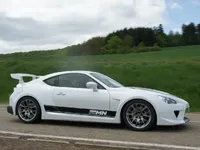
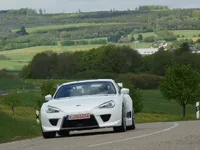
GRMM SPORTS FR Concept

Lenght / Width / Height (mm) : 4.350 / 1.855 / 1.250
Wheelbase (mm) : 2.570
Vehicle weight (kg) : 1.280
Tire size (front & rear): 245/40R18 & 265/35R18

Engine : Twin charged (turbocharger + supercharger) 2.0l H4 based on 4U-GSE
Power : 320 PS
Torque : 421 Nm
Transmission : 6 speed manual


64a3a459a40bba3742b6c1fbd0705947.webp

e62ab7c75933f8d7c2acf6cc6ae5bb11.webp

33aef1e1b873264c6b3f6e3645fd76a8.webp

11feb421e28b89015b32c418518b16bc.webp

b3b273fb00e9ce8b9f689a46978a3d3a.webp

a4dbe5c9f034d285e3aa73b5f1633bf7.webp

c1bf103faaaeace7872e6e6581f69cbe.webp

b1cd59bd2d4d9c8284d31acb56d44eaf.webp

b05a4a35c11a69ca970629ae5268005e.webp

5ff5a171636993d94d964e124bceb0d3.webp

0c95143eb700f7ccd24c4824d501b770.webp

6117538ee109296b460eea425c928990.webp

28093afd75ab571981148fd40f42d003.webp

60f5791a32fc093d2b55813913162408.webp

4426f9c3161c60f10c3aecb2ab2dc5c8.webp

bc25c1015cd1f5d5eb9398ffac0e2298.webp


Gazoo Racing
 

Attachments

Same here. The interior is tasteful. Race car flashing with commuter car. Race focued but yet cvilised.
 
On-road test by Car Enthusiast.

11 May 2012

Shane O' Donoghue said:
Overall rating:
ff6735e046a7d817e5e8bddfb40ccbf0.webp

It's been an age since Toyota had a decently sporty car in its line-up, so the GT86 is long overdue. Its rev-happy boxer engine and rear-wheel drive layout ensure that it's like nothing else on the market. Can it live up to the considerable hype?

In the Metal: 4/5
Each to their own when it comes to aesthetics, but we'd not describe the GT86 as a looker. It's undoubtedly striking and very interesting, but the rear end is fussy and the front a little, well, weak. The slim tyres don't help matters, though read on and you'll find that we do support their fitment. Despite all this, we do think the GT86 is a very cool car and there's nothing like it on the road - other than the Subaru version of course. Mind you, the detailing is sublime with the car's motif on the wings and even on the (86mm diameter...) twin tailpipes.

The interior won't split opinion as readily. It's neat and compact. The seating position is pleasurably low-slung (lower even than a Cayman's apparently) and the driving position is spot on. A simple tactile three-spoke steering wheel is complemented by the perfectly sized gearchange knob and lever. All surfaces are textured, adding a quality feel, though some of the plastics sound hollow if you tap them.

The seats are suitably supportive in all the right places, though if you're larger than average it's worth trying them out for size, as they're quite narrow. Medium-sized adults can be accommodated in the rear seats if the front occupants slide forward as far as they can (and they're not too tall themselves), while the boot swallows a useful enough 243 litres of luggage - and the rear seats fold down to fit in more.

Driving it: 5/5
Let's address the relative lack of torque from the engine first. Some people will not gel with the GT86 because of this, especially if they're used to a turbocharged or supercharged car already, but we'd urge those to give it time. It's only really an issue when you're on an unfamiliar road where you end up in a higher gear than is ideal - especially on an uphill section. It also means it's trickier to overtake slower traffic on short stretches of road. The engine is at its best when singing at over 5,000rpm, where it makes a suitably sporting noise - even if it is a little coarse at times. Keep it on the boil and the GT86 feels seriously fast.

Indeed, Toyota's new coupé seems to improve the harder you drive it. There's no slack in the steering at all, the brake pedal is firm and easy to modulate even under heavy braking and the linkage to the six-speed manual has a wonderfully mechanical feel to it. The compact nature of the car makes it easy to maximise its performance - even on minor roads - and it always feels nimble and light.

Turn-in is highly impressive. Understeer is non-existent unless you're very silly with your entry speed into a corner. Back off in that situation and the rear quickly comes into play. In default mode the electronics swiftly rein it back in, but even with stability control turned off it's a remarkably forgiving chassis, allowing the driver to indulge in sliding the car around without any real fear that it's going to spit you off into the undergrowth.

Modestly-proportioned and treaded tyres have a lot to do with this adjustability. Outright lap times may be bettered with wider rubber, but the aim of this car is fun. To that end the GT86 moves underneath you a lot, yet it's inherently well-balanced and stable. The only time you miss wider rubber (in the dry in any case) is under heavy braking. Although it floats over bumps nonchalantly there's no body roll, pitch or dive.

The GT86 has been endowed with a very special chassis. It's unashamedly targeted at real driving enthusiasts and enjoyment of it is accessible on the public road at regular speeds. What a gem.

What you get for your Money: 4/5
There's just a single specification for cars sold in the UK, so choose from one of the seven paint colours and whether you want a manual or automatic gearbox and that's it really. It's a generous level of equipment, despite the back-to-basics philosophy for the car, including dual-zone climate control, keyless start, cruise control, 17-inch alloys, a touch-screen infotainment system (satnav is extra) and Bluetooth. Leather seats are worth paying for, though the core seat is identical.

From the start of 2013 Toyota will offer TRD (Toyota Racing Development) accessory packs to customise the styling and beef up the brakes etc.

Somewhat surprisingly, the automatic version is more frugal and has a lower emissions rating. In the manual car we averaged over 26mpg over the course of nearly 100 miles on a very twisty (and deserted) mountain road.

Worth Noting
Tetsuya Tada, the GT86's Chief Engineer, was adamant from the outset of the project that the car would not have turbocharging, but there's no doubt that the chassis could handle a lot more power. Toyota remains coy about how this will be achieved, but we did hear talk of a supercharger kit that adds 50hp. No doubt it'll significantly beef up the torque curve too. Fingers crossed it makes it to the UK.

For the record, the automatic gearbox robs the GT86 of some of its appeal, but the chassis still shines through. It's a conventional transmission with a torque converter, though paddles behind the steering wheel allow you to override the calibration and it features gratuitous throttle blips.

Summary
From nowhere Toyota has launched one of the most exciting cars of the year. Its name draws heavily on an illustrious past and it manages to live up to that promise with a chassis that is every petrol-head's dream. It sits somewhere between the Lotus Elise and the Porsche Cayman. No doubt there will be more powerful versions in time, but for now we're content with how brilliant the GT86 is in its basic state.

http://www.carenthusiast.com/review...-GT86/First+drive+-+manual+and+automatic.html
 
Amazing! GT-86 beating a Porsche Cayman is quite an extraordinary feat.

They are both cut from the same cloth: boxer engines and low center of gravity in a driver focus package. Congrats to Toyota on having the car mentioned in the same sentence as the Cayman.
 

Toyota

Toyota Motor Corporation is a Japanese multinational automotive manufacturer headquartered in Toyota City, Aichi, Japan. It was founded by Kiichiro Toyoda and incorporated on August 28, 1937. As of 2022, the Toyota Motor Corporation produces vehicles under four brands: Daihatsu, Hino, Lexus and the namesake Toyota.
Official website: Toyota

Trending content


Back
Top