EQC (N293) [Official] Mercedes-Benz EQC


The Mercedes-Benz EQC (N293) is a battery electric compact luxury crossover SUV and the first member of the battery electric Mercedes EQ family. It is succeeded by the GLC with EQ Technology (X540). Production: 2019–2023
I haven't been sarcastic at all. There is no comparison between decreasing the power of an ICE engine and an EV motor. The ICE has exhaust gases treatment, which is quite expensive and is dependent on the power output. Also cars with IC engines have complex transmissions and ZF for example offers its 8 speed auto in versions depending on the torque bearing capacity and the price difference is also very substantial. The ICE has a lot of moving parts that interact with each other. Decreasing the power reduces the requirement for their durability and thus using much cheaper components, like: casted cranckshaft instead of forged, much cheaper turbo and so on. When you combine all this it results in big savings in production costs, that do allow the manufacture to offer this version for a smaller pricetag. With the EVs you don't have any of this. You can reduce the price with removing components - one motor and RWD instead of two and AWD, you can decrease the battery, which forms about 40-45% of the production and procurement cost, but simply reducing the power of the motors does not reduce the production costs significantly. So what's the point to make it with less power, when you can have the full version for the same production cost?
Most modern car manufacturers are producing the same size engine on a larger scale to reduce production costs and offer various power output versions. These different outputs are due to the use of changes in software tuning. Economies of scale of production will reduce the unit price whether its an ICE or EV, but the cost of each component is different and cannot really be compared. With relation to my post, I wasn't mentioning the costs for producing different ICE or EV powertrains. I was only pointing out that the EQC350 is a software detuned version of the EQC400. They using the same electric motors and same battery packs, only software tuning has been used to reduce the total outputs of the electric motors. This is a good move by Mercedes as it adds to economies of scale and reduces the need to manufacturer different electric motors for both versions
 
Most modern car manufacturers are producing the same size engine on a larger scale to reduce production costs and offer various power output versions. These different outputs are due to the use of changes in software tuning. Economies of scale of production will reduce the unit price whether its an ICE or EV, but the cost of each component is different and cannot really be compared. With relation to my post, I wasn't mentioning the costs for producing different ICE or EV powertrains. I was only pointing out that the EQC350 is a software detuned version of the EQC400. They using the same electric motors and same battery packs, only software tuning has been used to reduce the total outputs of the electric motors. This is a good move by Mercedes as it adds to economies of scale and reduces the need to manufacturer different electric motors for both versions
But why to reduce the hp?
 
But why to reduce the hp?
I agree with you, the HP reduction seems too much, big difference with 408PS and 286PS and not really justified, but I guess if they sell the EQC350 at 10K or more Euros less then it could be more popular and better value than the EQC400.
 
I agree with you, the HP reduction seems too much, big difference with 408PS and 286PS and not really justified, but I guess if they sell the EQC350 at 10K or more Euros less then it could be more popular and better value than the EQC400.
But why not just keep the hp and reduce the price? Then it would be really a better value.
 
Just the HP difference is a bit toomuch IMO.

Was probably insprired by the iX3. MB might offer a software upgrade to evenly split the difference between the EQC 400 and EQA 300 if there's enough demand for it? :)

EQC 400 4MATIC ... 408 PS
EQC 350 4MATIC ... 286 PS
EQA 300 FWD ......... 204 PS
EQV 300 FWD ......... 204 PS
 
Then who would by the 400 version ?
Its the same with petrol and diesel engines same motors they detune the motor or turbo and sell as a lower badged and lower priced car nothing new.Just the HP difference is a bit toomuch IMO.
Again and again - why do you compare EVs with ICE vehicles. The price of the motor in the EV makes for 5% of the production cost, while in ICE cars the engine and the transmission make for about 40%. 10% reduction in the production costs for an IC engine and transmission transforms in 4% better production cost of the whole vehicle, while reducing the cost of the elmotor with 10% makes for mere 0,5% improved production costs of the whole car. With ICE it's not only the power, there are many other changes that reduce the price as I already wrote.
 
Again and again - why do you compare EVs with ICE vehicles. The price of the motor in the EV makes for 5% of the production cost, while in ICE cars the engine and the transmission make for about 40%. 10% reduction in the production costs for an IC engine and transmission transforms in 4% better production cost of the whole vehicle, while reducing the cost of the elmotor with 10% makes for mere 0,5% improved production costs of the whole car. With ICE it's not only the power, there are many other changes that reduce the price as I already wrote.

He’s mentioning it because the thought process behind it is similar. Lexus, for example, at one point had the IS300 and IS350 sitting side by side with no differences from a drivetrain standpoint other than software. The engine, transmission, and differential were the exact same. So any ICE related cost savings were null.

And again, where were you crying about all of this when Tesla did the same thing as Mercedes with certain variants of the Model S?
 
To view this content we will need your consent to set third party cookies.
For more detailed information, see our cookies page.
 
I saw one today in the London city on the road a black one..Not sure why but I actually liked it looked quite nice.
 
1602537507467.webp


Electric car of extremes: Electric luxury goes off-road: Electric mobility develops a thirst for adventure

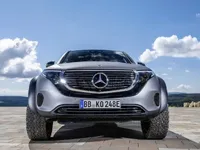
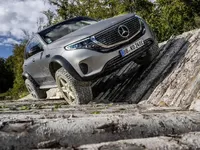
Stuttgart. Emotive appearance, sure-footed on rough terrain and with future-oriented technology: the EQC 4x4² shows that electrification at Mercedes-Benz already goes farther than the road network. A small team of dedicated developers has created this drivable technology platform on the basis of an EQC 400 4MATIC (combined power consumption: 21.3-20.2 kWh/100 km; combined CO2 emissions: 0 g/km)[1]. The technical highlights include the multi-link portal axles as well as the production of a powerful sound in the interior and exterior. The headlamps turn into "lampspeakers", because they also function as a loudspeaker at the same time.

The EQC 4x4² is an electric car of extremes. Mercedes-Benz wishes to test the limits with this vehicle, and show that e-mobility is not just urban, but also conceivable off-road. The one-off was developed by a cross-departmental team under development engineer Jürgen Eberle which has already put the E 400 All-Terrain 4x4² on its studded wheels. "Our aim is to combine modern luxury and sustainability with emotional appeal. The EQC 4x4² shows how enjoyable sustainable mobility can be. This is where electromobility high-tech and an intriguing customer experience are transferred to the mountains, thanks to MBUX and over-the-air updates. To put it succinctly, electric, progressive luxury goes offroad," says Markus Schäfer, member of the Board of Management of Daimler AG and Mercedes-Benz AG responsible for Daimler Group Research and Mercedes-Benz Cars COO. "This drivable study clearly shows that alongside a passion for e-mobility, we at Mercedes-Benz lay a strong claim to leadership in this sector and will heighten the emotional appeal of this even further in the future."

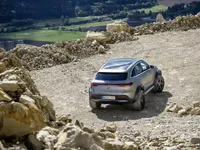
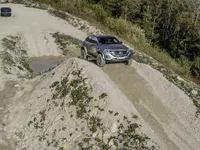
With the EQC 4x4² as a technology platform, Mercedes-Benz is demonstrating that love of adventure can be combined with lifestyle and sustainability. Its capabilities include driving through sand in desert regions and on beaches, on rocky terrain and through mountain streams. As well as great reliability and corresponding comfort, the mature genes of the standard model also allow trailer operation and installation of a roof-rack. A roof-tent and inflatable dinghy allow the remotest areas to be reached - and when making an early start, the other adventurers in the camp will not even be woken up.

At 293 millimetres, the EQC 4x4² rides more than twice as high as a production EQC (140 millimetres). Even a G-Class rides 58 millimetres lower. The fording depth is increased by 15 centimetres, to 40 centimetres. The tremendous ground clearance is made possible by the conversion to portal axles: unlike conventional axles, the wheels are not at the height of the axle centre, but are instead situated much lower down on the axle hubs owing to the portal gears. Or conversely, the entire vehicle moves up. The 4x4² suspension is attached to the same body mounting points as the standard suspension.

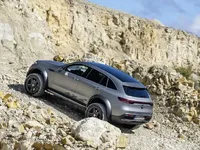
Just as impressive are the approach and departure angles – 31.8 degrees at the front and 33 degrees at the rear. By way of comparison, a conventional G-Class has an approach and departure angle of 28 degrees. The reprogrammed
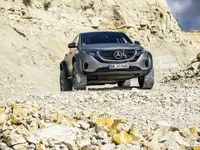
Off-Road drive programs take advantage of the high-performance logic of the current GLC models. For example, using targeted brake interventions, this enables an improved torque curve when starting on loose ground. In combination with the tyres in size 285/50 R 20, this results in an impressive sure-footedness in terrain. The striking visual appearance is rounded off by the matt metallic gun-metal grey car film and the black wheel arch flares.

Here are the key off-road data at a glance:

EQC 4x4² (study)EQC 400 4MATIC (standard)[2]
Approach angleDegrees31.820.6
Departure angleDegrees33.020.0
Breakover angleDegrees24.211.6
Ground clearancemm293140
Fording depthmm400250

More facts & figures:

  • The EQC 4x4² is around 20 cm higher than the standard version.
  • The wheel arch flares measure about 10 cm
  • Despite 20-inch wheels, the turning circle is small thanks to the modern axle kinematics with four-link front axle
  • Ground clearance and fording depth are increased by 15 centimetres compared to the standard EQC.
Another highlight of the EQC 4x4² is the sound experience with its own soundscape. The acoustic production comprises sounds that give the driver feedback on system availability and vehicle parking, as well as an interactive, emotionalising driving sound. It is influenced by various parameters such as the position of the accelerator pedal, speed or energy recovery rate. The technology uses intelligent sound design algorithms to calculate the sounds coming from the amplifier of the sound system in real time and the interior loudspeakers to reproduce them.

The production EQC uses the external noise generator (Acoustic Vehicle Alert System, AVAS) required by law to reproduce the sounds. The EQC 4x4² has a more powerful AVAS composed specifically for it and uses the headlamps as external speakers for this purpose. The reason being that the sound experts of Mercedes-Benz have made creative use of the available installation space in the headlamp housings – the "lampspeaker" was born.

The EQC 4x4² is already the third model of the 4x4² family from Mercedes-Benz. The G 500 4x4² was actually built in series production from September 2015. And in 2017, with the E 400 All-Terrain 4x4² study, Mercedes-Benz showed many an SUV its limitations when off-road.

[1] The power consumption was determined on the basis of Directive 692/2008/EC. The power consumption is dependent upon the vehicle configuration. Further information on the official fuel consumption and the official specific CO2 emissions of new passenger cars can be found in the "Leitfaden über den Kraftstoffverbrauch, die CO2-Emissionen und den Stromverbrauch neuer Personenkraftwagen" [Guide to fuel consumption, CO₂ emissions and power consumption of new passenger cars], which is available free of charge at all sales outlets and from Deutsche Automobil Treuhand GmbH at www.dat.de.

[2] Combined power consumption: 21.3-20.2 kWh/100 km; combined CO2 emissions: 0 g/km. The power consumption was determined on the basis of Commission Regulation 692/2008/EC. The power consumption is dependent upon the vehicle configuration. Further information on the official fuel consumption and the official specific CO2 emissions of new passenger cars can be found in the "Leitfaden über den Kraftstoffverbrauch, die CO2-Emissionen und den Stromverbrauch neuer Personenkraftwagen" [Guide to fuel consumption, CO₂ emissions and power consumption of new passenger cars], which is available free of charge at all sales outlets and from Deutsche Automobil Treuhand GmbH at www.dat.de.
20C0531_006.webp

20C0531_007.webp

20C0531_014.webp

20C0531_002.webp20C0531_003.webp20C0531_006.webp20C0531_007.webp20C0531_008.webp20C0531_010.webp20C0531_013.webp20C0531_014.webp

 
Elaborate cutaway model provides insight: Electric mobility becomes transparent

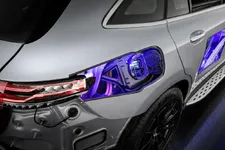
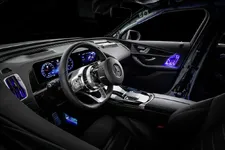
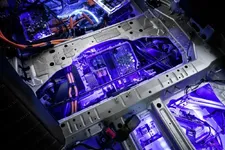
Stuttgart. With a transparent EQC 400 4MATIC (combined power consumption: 21.3-20.2 kWh/100 km; combined CO2 emissions: 0 g/km),[1] trainees of Mercedes-Benz render the innovative technology of the electric car visible. The left half of the vehicle was left in the original condition and the right half was fitted with cuts in the vehicle body and in the floor. This offers a view of otherwise concealed components such as the battery, for example. Cutaway models of individual components, a simulation of the charging process by means of LED chase lights and a virtual overlay of the high-voltage battery on a tablet PC complete the elaborate exhibit.

Some 40 trainees from the occupational groups vehicle mechatronics specialist, interior fitting specialist, construction mechanic and tool mechanic were involved in the project. The employees come from the Sindelfingen, Bremen and Rastatt locations. Including the interruption due to COVID-19, this team worked for about a year on building a transparent EQC from a donor vehicle and a body shell. At the same time, they created a host of cutaway models of individual components such as on-board charger, cockpit, bumpers or headlamps. They were integrated into the large showpiece. This practical work on an electric vehicle allowed important learning content to be imparted to this year's trainees.

Charging and discharging of the battery is simulated by means of LED chase lights along the charging peripherals of the vehicle. The original screens of the EQC were reprogrammed to allow displaying and playing of explanatory images and videos. In addition, an augmented reality (AR) application on a tablet PC allows virtual overlaying of the high-voltage on photos of the EQC.

Here are some facts and figures:

  • Approx. 15 metres of LED fibre optics are installed
  • Around 50 metres of wiring are installed to power the LEDs.
  • Over a 36-hour period, 3 trainees used up 8 grinding discs to cut 5 apertures in the bodywork. In addition, 23 woven abrasive belts were used up to deburr the cut edges.
  • The painting and polishing work took a total of around 50 hours.
  • Two Arduino microcontroller boards with 3 relay shields for control of the LED strips and locking, and the LED display on the charging socket. The programming code has a total of around 500 lines.
  • The trainees took 21 hours to turn the three light bands at the rear into one; a further 18 hours was needed to turn two tail lights into one using a Dremel and jigsaw.
  • Preparing the reversing camera took 10 hours.
  • All in all, the team came together in around 650 minutes of online conferences. Each morning another 20 minutes were spent on digital shopfloor management (working organisation)
  • Two "Next Unit of Computing" (NUC) mini-PCs by Intel with 2 video converters were used to reprogramme the monitors - the programme code has around 1500 lines.
[1] The power consumption was determined on the basis of Directive 692/2008/EC. The power consumption is dependent upon the vehicle configuration. Further information on the official fuel consumption and the official specific CO2 emissions of new passenger cars can be found in the "Leitfaden über den Kraftstoffverbrauch, die CO2-Emissionen und den Stromverbrauch neuer Personenkraftwagen" [Guide to fuel consumption, CO₂ emissions and power consumption of new passenger cars], which is available free of charge at all sales outlets and from Deutsche Automobil Treuhand GmbH at www.dat.de.
20C0588_005.webp

20C0588_004.webp

20C0588_001.webp

20C0588_001.webp20C0588_002.webp20C0588_003.webp20C0588_004.webp20C0588_005.webp20C0588_006.webp
 
MB Passion drove it. :)

View attachment 524717

THE EQC 4×4²: THE IDEAL ELECTRIC VEHICLE FOR OFF-ROAD?

Electrically driving off-road is possible and if so, how? The technology platform EQC 4x4 2 impressively shows that the new type of drive technology is not a contradiction in terms. The implementation of electrification at Mercedes-Benz is also progressing away from the road. So a small development team shows with the converted one-off what everything is possible electrically in the field. We drove with the technology showcase and were impressed with the capabilities.

View attachment 524718

Double the ground clearance like a standard EQC

The EQC 4x4 2, foiled in “Gunmetal metallic matt, is based on the normal EQC and has only been modified accordingly on the axles. The result is an extreme vehicle, both visually with fat around 10 cm wide fender flares, and technically - with a blatant chassis. The portal axes of the technology carrier allow enormous ground clearance.

With a ground clearance of 293 millimeters, the 4x4² is more than twice as high above the ground as a standard EQC (140 millimeters). Even a G-Class is 58 millimeters lower. Driving through impassable areas with scree or sand, as well as water crossings (fording depth 400 millimeters) are easily feasible and allow the most diverse possible uses of the electric off-road vehicle.

View attachment 524719

Finally a proper EQC look may be emerging.

View attachment 524720

Portal axles with independent suspension

The team around development engineer Jürgen Eberle (he and his colleagues built the E 400 All-Terrain 4x4 2 3 years ago ) decided on portal axles at the EQC. The 4x4² chassis is connected to the same mounting points on the body as the series chassis. No rigid axles, but all-round independent wheel suspension - with four-link front and rear axles. The Air Body Control air suspension is also used. In contrast to conventional axles, with the portal chassis, the center of the wheels is not at the height of the axle, but rather they are much lower down due to the portal gear. In this way it can be achieved that the whole vehicle comes a little further up.

View attachment 524721View attachment 524722

Off-road like a G-Class

The EQC 4x4² shows how much fun it is on every meter in off-road terrain. Are we missing an internal combustion engine? No, because the sovereign power of the two electric motors is just too convincing. The even and high torque curve is ideal for driving on unpaved surfaces. The EQC drives over practically all kinds of impassable areas with a simplicity that amazes. Anyone who already knows the excellent driving characteristics of a G-Class off-road will be a lot more impressed at this point. It goes up and down the steepest ramps in a playful way - because the EQC with its overhangs has a perfect approach angle of 31.8 degrees at the front and 33 degrees at the rear. For comparison: the G-Class mentioned only has a slope angle of 28 degrees!

View attachment 524723

View attachment 524724

Rocks, sand and water - this EQC can get through almost anywhere

The torsional flexibility of the portal axes is just as impressive. The EQC handles unevenness and depressions lightly thanks to its axle articulation. It enables the greatest possible progress. The large-tread tires, in the format 285/50 R20 in combination with the control electronics, offer additional safety on loose surfaces. The off-road driving programs of the 4x4 2 have been reprogrammed and are based on the GLC. Among other things, the accelerator pedal characteristic curve has been adapted in order to have a particularly smooth start with high torque of the electric drive train. This also turned out to be perfectly implemented during the off-road trip.

View attachment 524725

May be a good application for those BYD blade batteries Daimler is rumored to be interested in, which may reduce the fire risk should the underbody be pierced when offroading... They give the Han 605 km of range, and a 0-100 of around 3.9 secs.

The extreme EQC moved very evenly in the terrain. Movements on the accelerator pedal were implemented smoothly and harmoniously. A steady burst of gas was enough to climb a steep ramp, for example. The control system rarely had to intervene because one of the wheels was spinning on stone or sand.

To view this content we will need your consent to set third party cookies.
For more detailed information, see our cookies page.

https:///2020/10/mit-dem-elektroauto-ins-gelaende-ja-mit-diesem-ganz-speziellen-eqc/

I generally consider the EQC to be a stop-gap, heavily compromised exercise. But THIS thing is so funky that I've just got to love it.
 
I dig this, what a transformation this lifted up suspension does to the looks of the EQC. From a tame looking low SUV wagon and now a Monster truck.

1602582465897.webp


1602582508671.webp


1602582624619.webp
 

Mercedes-Benz

Mercedes-Benz Group AG is headquartered in Stuttgart, Germany. Established in 1926, Mercedes-Benz Group produces consumer luxury vehicles and light commercial vehicles badged as Mercedes-Benz, Mercedes-AMG, and Mercedes-Maybach. Its origin lies in Daimler-Motoren-Gesellschaft's 1901 Mercedes and Carl Benz's 1886 Benz Patent-Motorwagen, which is widely regarded as the first internal combustion engine in a self-propelled automobile. The slogan for the brand is "the best or nothing".
Official website: Mercedes-Benz (Global), Mercedes-Benz (USA)

Trending content


Back
Top