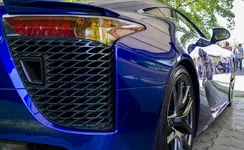
LFA [Official] Lexus LF-A Supercar (Production Version)


http://www.thetruthaboutcars.com/20...side-report-chapter-1-from-a-bar-to-bar-none/
The Making Of The Lexus LFA Supercar: Who, What, Where And Most Of All Why. An Inside Report, Chapter 1: From A Bar To Bar None

5e6480fc3b91d9119f172b6f3ff3c792.webp

The autoclave. A giant pressure cooker that limits the Lexus LFA production to one per day


Behind a nondescript garage door in the Motomachi plant in Toyota City is LFA Kobo, the LFA Works. Here, 170 men and women chase the holy grail of car making. Their mission: How to make a car super fast, super light, super safe, and affordable. They have mastered the first three. On the affordable they are still working. The holy grail is being chased in a supercar, the $375,000 Lexus LFA.

ba4c2cce6acc1b1924d5844bd0797271.webp


Until today, this door was closed to the media. One magazine, Japan’s Car Graphic, was lucky to be invited in 2010 when the workshop still geared up for work. After series production started in December of that year, access to the LFA Works was limited to a privileged few. To be admitted, serious amounts of money had to change hands. The buyer of a $375,000 LFA was offered a tour of the premises – strictly without camera. Today, this veil is about to lift. In a five day series, we will show how the LFA is made, who makes it, and most of all, why.

At the door, I am greeted by Haruhiko Tanahashi. Tanahashi is Chief Engineer of Toyota Motor Corporation’s Lexus Division, and he is the proud father of the LFA. Ever the proud father, he likes to talk about the birth of his child.

36b66b3e9be871f7e621f8386a5e5c3f.webp


It started in a bar.
The Lexus LFA was born where many great ideas come to life:
In a bar.

“My boss and I sat in a bar in Hokkaido,” remembers Tanahashi, “and I told my boss about the dream I had. I wanted to make the ultimate sports car.” At this point, bosses usually call for the check, or the submitter’s personnel file. Tetsuo Hattori, at the time the top vehicle engineer at TMC, replied “why not” – and ordered another round in celebration.

“February 10, 2000. – In Shibetsu, Hattori approves study of a real sports car.” So reads the first entry in Tanahashi’s diary that until this day chronicles the development of the LFA. In sparing sentences, kept on an Excel spreadsheet, Tanahashi follows the incubation, birth and first steps of his life dream.

After receiving a nod from his boss, Tanahashi did not waste time and did not want to risk a change of mind at his superiors. A month after the bar visit, the diary shows the first meeting of a quickly assembled working group.

2a7c58d073bcc0c585857698cab399fa.webp


“Baby sports cars are bad.”
On July 6th, Tanahashi is back in Shibetsu.

Shibetsu is where Toyota has its proving ground. Up at the northern end of Japan, and only 400 miles from the shores of Siberia, Shibetsu provides long cold winters and short, temperate summers. It also is far away from prying eyes.

“July 6, 2000. Evaluation drive in Shibetsu” says the diary. “Director says baby sports cars are bad.” This will be a grown-up sports car.

A year after the decision in the Hokkaido bar, the team arrives in Shibetsu with a first prototype for winter testing. The prototype is made from aluminum alloy, and aluminum alloy remains the chosen material all the way through 2005. Many more sports cars were driven across many tracks. First contact with a carbon-fiber monocoque car was made when the team tests a McLaren F1, but Tanahashi decides to stick with the aluminum he knows than to go with the carbon fiber he doesn’t.

7cc40219606e5136770776b7f272312d.webp

First concept of the LFA

In 2005, Tanahashi’s project was still under a tight cover. It also was a favorite target to be killed.

Every year, the project had a near-death experience. “Each fall, there is a big company review at TMC,” says Tanahashi and polishes his wire-rimmed glasses in thought. “Each year, we were about to be kicked off the cliff. Our sports car featured prominently on the list of projects to be killed.”

Hugely expensive and with no promise for profits, it was an inviting target no controller could resist.

The LFA remained alive because it always found a savior amongst Toyota’s top brass. “The timing was right,” says Tanahashi, “Toyota was on a steady rise and very successful.” A few years later, the project would have been stillborn.

0abd54a86c8fa9b17c0b5886103e9edf.webp

Workers fit carbon fiber fender to LFA

The carbon decision.
In the spring of 2005, Tanahashi was agonizing over a tough decision. The LF-A had been shown as a concept at the Detroit Motor Show where it had caused dropped jaws. The car had been on the Nürburgring in Germany with good results – and of course it was caught by paparazzi. In 2005, the car was not too far from final.

However, the car was made from aluminum alloy. To this day, carbon fiber reinforced polymer (CFRP) is used only sparingly, even on the world’s most expensive cars. The Bugatti Veyron comes standard with carbon fiber disc brakes, a few one-offs have carbon fiber body panels. A BMW M3 may have a carbon fiber roof, an Aston Martin DBS may sport a few carbon fiber parts. Tanahashi was not averse to using some CFRP for body panels, or maybe for the LF-A’s bathtub, but he wanted to otherwise stick with aluminum alloy.

4f12c3cb4ffc271cf7fd2f9f1064b887.webp


Then, Tanahashi hit a wall. The benchmark for the LF-A was the Nürburgring Nordschleife, that part of the Eifel racetrack in Germany that separates real sports cars from also-rans and dragsters. To get the car around the track faster, it had to shed weight, but Tanahashi was out of options. Making most of the car from CFRP promised a weight savings of 220 lbs, but CFRP was insanely expensive, and the change would have thrown the development of the car back by years. Most of all, CFRP was an unknown quantity.

In 2003, a development team at Toyota had begun research on CFRP. First results looked promising, but not much more. Trading the known entity of aluminum alloy for promises was a gamble Tanahashi was not willing to take. Then, something horrifying happened.
“Okamoto-san tapped me on the shoulder, and said, get over it, just go with carbon fiber,” Tanahashi recalls.

aee2fe8091a72f7dab7eb75107c5c06a.webp

The LFA consists of 65 percent carbon fiber and 35 percent aluminum

Kazuo Okamoto was R&D Chief at Toyota. He had another shock in store for Tanahashi:
“He did not just say to make most of the car out of CFRP. He said I should bring the whole CFRP production in-house.”

Toyota does the opposite of many global companies. At Toyota, the mantra is insourcing. “Our company culture is to bring all important functions in-house,” explains Tanahashi.
This worried him a lot. CFRP is a young art and science. Some of it literally is black art. Know-how is scarce. Specialist companies are bought just to get to that know-how. Yet, Tanahashi was told to develop it all in house, and yesterday.

His dream of a sports car was to be ready in a few years, and Toyota had barely done two years of research into CFRP. Tanahashi was not just back to square one. He found himself back to a square somewhere in minus 10 territory.

c4d66bed7e282e779a4d76dfb7f2cdd5.webp

Tanahashi shows the different grades of carbon fiber used in the LFA

Time is money.
Tanahashi did cast around for help. He discussed his predicament with engineers of Fuji Heavy Industries, and they basically told him that the plan was insane. “That engineer would normally budget 10 years just for the research,” reminisces Tanahashi. “We did it all in one year.”

“The ideal material for a car body is very strong and very light,” says Tanahashi, “but usually, these parameters are at odds with each other. If you want both strong and light, if you need high rigidity and low weight at the same time, then you have no other choice than CFRP.”
However, when you think you have the strength and weight conundrum solved by using carbon fiber to build your car, you quickly run into an especially nasty problem:
Money.

Carbon fiber composites are some of the most expensive materials used in car making. Not because the ingredients used in CFRP are particularly dear. It is because CFRP parts take an inordinately long time to produce. A stamping machine can produce a metal car part in seconds. A similar part made from CFRP can take a day. The autoclave, a giant pressure cooker in the LFA Works, is the only machine there that runs day and night, and nevertheless, it only has the capacity for one car per day.

28e5c4bfdfead7004837a8f85e4672d3.webp

The orange hood protects the oil cooler during assembly.

Time is money, and CFRP uses way too much time. Even a moderately sized car factory can churn out 1,000 cars per day. The factory does not have the time to wait all day for a part to be ready. Running 1,000 giant autoclaves and 1,000 expensive sets of dies and molds in parallel is likewise out of the question.

50f3228075388018ce2531895f26d45b.webp

Suiting up for the cleanroom

This becomes quickly obvious as we enter the heart of the CFRP manufacturing process. We stand in front of a clean room that is used to build the strongest parts of the LFA. Brain surgeons suit up in a more casual manner than our small group. We don coveralls, shoe booties, hats. This is not for our protection. The intricate parts that are produced behind the airtight doors are being protected from us. We get vacuumed for dust. While our small group suits up, let us use the time for a quick course on CFRP.

Stay tuned for tomorrow’s installment of The Making Of The Lexus LFA:

Tuesday, July 10: In The Clean Room. Where the LFA is made from the strongest and most expensive type of carbon fiber available.
Wednesday, July 11:
Call Me Names. How the LFA really got its name.
Thursday, July 12: Balance Of Power.
We watch the V10 engine go into the LFA.
Friday, July 13: Exam Week.
We examine Chief Engineer Tanahashi about how the LFA influences future cars, and what will come after the LFA.
 
What will come after the LFA ?
LFA II ? :geek:


How is it we always get to learn more and more about the LFA even though it is almost soldout has is coming ot an end of production ? Looks liek the LFA wants to stay alive forever.

Actually that is what makes me love the LFA even more than the F12 : all the effort and passion behind it. It makes it so special. Is a good Ferrari something special ? No, Ferrari in itself is already special compared to any car, so to make a "special" Ferrari is nearly impossible.
 
One thing I want to know, did the LFA's R&D team ever consult their F1 team with regard to using and manufacturing carbon fibre components on a vehicle?
 
One thing I want to know, did the LFA's R&D team ever consult their F1 team with regard to using and manufacturing carbon fibre components on a vehicle?

I think the carbon fiber weaving using looms is a Toyota patented method they developed during LFA R&D and does not come from their F1 racing program. The F1 racing program was heavily involved in the design and development of the V10 engine.
 
http://www.thetruthaboutcars.com/20...an-inside-report-chapter-2-in-the-clean-room/

The Making Of The Lexus LFA Supercar. An Inside Report, Chapter 2: In The Clean Room.


f280c9c61560141ee8b02f11cdbe16f0.webp

One of two circular looms on the planet. 12 layers of seamless carbon fiber are woven into what will be part T3-3RH, part A-pillar, part roof support

Yesterday, we heard how the LFA really was born (in a bar, where many good ideas are born and pitched,) and why it is made from carbon fiber. Now, we are in front of the cleanroom, and while our little group is suiting up, let’s use the time for a quick course on CFRP.

The basic principle of Carbon Fiber Reinforced Polymer, CFRP for short, is not new. It dates farther back than metal. CFRP is a composite, made from two completely different materials that are joined together to give a much stronger material. Straw and clay was such an early composite. Concrete is a more recent one. In the case of CFRP, carbon fibers are combined with epoxy, the polymer. Sometimes, the material is also called “carbon fiber reinforced plastic,” but the end product is far removed from what usually comes to mind when we think of plastic.

0bc910f11eda8513833482873335e641.webp

Chief engineer Tanahashi shows a pre-pregged carbon fiber mat

CFRP has an unsurpassed strength-to-stiffness-to-weight ratio. CFRP also comes at unsurpassed cost. It entered car making with race cars, where money is no object. As we enter the cleanroom through an air lock, it becomes evident why the stuff is so expensive.

e32d6d84e76cabc3ea71cf0d2df35591.webp


Basically, there are three different ways of making CFRP: Pre-preg, Resin Transfer Molding, (RTM), and Sheet Molding Compound (SMC), listed in the order of strength and expense. The LFA uses all three methods, depending on the required characteristics of the CFRP parts

c17d1a620a69cf3cbb7dc2ffee970f90.webp

This reporter is being vacuumed to protect the LFA’s carbon fiber from filth and grime

The strongest parts of the LFA are made in a clean room. Our hair is covered. We wear long white coveralls. Booties go over our shoes. Someone vacuums me from top to bottom.

53521ec6eedc214192f476188924bcb2.webp

Cleansed, we enter the cleanroom

We enter the cleanroom through an airlock, and we are in pre-preg central.

Pre-preg is the method to make the strongest type of carbon fiber available. “It is also the most expensive,” says Masahito Miyoshi, who leads me through a maze of machinery. Miyoshi -san is in charge of a by-product of the LFA, a mountain of paperwork. He also has the honorary title of the LFA’s ambassador.

c66e4ba3cd3d4bc8a2accbd68fb06457.webp


Working in the cleanroom is choice duty: The room is not just dust free. The temperature is kept at 22 degrees centigrade (72 F), the humidity at a constant 60 percent. A cool paradise compared to the hot and humid Japanese summer.

Pre-preg is not what some may think it is. Carbon fiber mats that were pre-impregnated with resin begin a metamorphosis into the LFA’s most critical parts.

56c1b0f24bde0f56afd629aaa7580518.webp

A plotter/cutter divides the pre-pregged carbon fiber into hundreds of parts

The carbon fiber mats are bought from a supplier and wait in a giant freezer until they are used. The mats have two layers of carbon fabric, the threads of the fabric layers are oriented at distinct angles.

The pre-pregged mats come to rest on a large cutting table the size of a small Japanese apartment. Vacuum sucks the mats into place. A computer-controlled plotter first draws parts numbers on the sheets. Then, the plotter withdraws its pen, brandishes a rotary cutter and in 20 minutes, the mat is dissected into a giant puzzle that will soon do duty in LFA number 424.

84bd06d3470227290dd1dbeea6fb575a.webp

The dash starts with this mold

A few steps down the air-conditioned cleanroom, workers produce a dashboard. Under the hawk-like eyes of a foreman and by gloved hand, the workers layer 335 pieces of pre-pregged puzzle into a mold the size of a, well, dashboard. Sometimes, they use an industrial-strength hairdryer to form the puzzle-piece into its desired shape, and to avoid any air bubbles between layers.

1e352a4a86b720e9d736aab0718c6edb.webp

335 pieces are assembled into a dashboard, a full day’s work

Like a colossal wedding cake, 13 layers of pre-preg are methodically assembled into what will be the dash panel. The layers are mated with urethane core. The cores have threaded aluminum inserts, later, they will be the counterparts for bolts.

5178ed0bf1312568d8a5519cfad1a481.webp

Each piece of backing foil is accounted for

Each of the 335 pieces of the dash is checked off from an evidence sheet. The sheet gets signed by the foreman, and then signed again by a quality controller with wasp-like yellow stripes on his hat. The backing foil of the puzzle-pieces gets pulled off and is discarded, but not without being recorded on the evidence sheet.

“If they forget the backing foil, nobody would see and notice,” explains Miyoshi. “Until perhaps in an accident.” Every piece of backing foil is immortalized on the evidence sheet before it is thrown away.

074f44eacf4057b2a94b774ef86dc8c9.webp

One works, four watch

It takes eight hours to hand-layer this dashboard. Once done, the finished wedding cake dash is covered with a special vacuum foil and baked for another eight hours

50536e3aac5a304931335a6dd468fb3b.webp

With pressure and heat, parts cure in the autoclave for eight hours

The baking happens in the autoclave next door. Picture it as a garage-sized pressure cooker. Pieces in the autoclave are covered with foil, then vacuum is applied that presses the layered piece into its mold. Two bars of pressure is applied to the autoclave, and at a constant temperature of 150 C, the parts are cooked to perfection.

099ab4dda6a2aea61d4f316a3647ad21.webp

The autoclave works two shifts per day

That autoclave is in high demand, and it is the only station in the genesis of the LFA where two shifts are working. During the day, a dashboard and other parts cure in the pressure vessel. At night, the side members of the LFA are being baked. This limits the production speed to one LFA per day, and the profitability of the venture is limited to forget about it. In the same time one CFRP dash is completed, a conventional machine spits out more than 1,000 plastic dash panels, far less rigid, far more weighty, but far less costly than the LFA part. Perfection has its price.

Crazy like a loom.

53d5289d3d3715aa4862b3abab418840.webp

This time, it’s for our protection

Barely out of our white garments, we don masks again. This time, it is for our protection.

Breathing microscopic carbon fibers could be hazardous to my health, I am told, as we approach a wondrous machine. It reminds me of the circular loom that was invented at Toyota in 1906, and became part of the foundation of Toyota’s later fortunes. The new circular loom weaves carbon fiber and could become an important part of Toyota’s future.

e959ddd674e29732b220b47e52f4fc2a.webp

Tanahashi explains how the loom works
 
The new loom is called a three-dimensional braider. Only two exist on this planet, I am told, the location of the other one remains undisclosed.

615fc95ed90f3d3a1bc3f2770bef533f.webp

Myoshi and Tamura inspect the (black) carbon sock over a (white) wax core

What looks like a long black sock goes back and forth six times while carbon fiber is spooled off 144 bobbins and braided over a core of wax that rests in a vacuum-sealed ABS pouch. Layer upon layer of carbon fiber is woven until the core is covered with 12 coats of fiber.

afd5faf929fc4cef51ce469310a4556f.webp

Tanahashi holds one of the world’s thinnest and strongest A-pillars

The finished sock-over-wax goes into a press between two molds, resin is added, heat and pressure are applied. Eight hours later, the wax is molten, and Chief Engineer Tanahashi can inspect part T3-3RH that will be part A-pillar, part roof support. The 12-layer seamless sock becomes an embodiment of supreme strength and luxurious lightness. It is one of the thinnest and yet strongest A-pillars in the business.

c2cfba618513cfae3605ea4ce42bc4fd.webp

The 3D weaver makes a seamless mat of carbon fiber …

Bumper and grind.
Next door is another marvelous machine. Normally, weaving is a two-dimensional affair. This machine weaves into the third dimension. It interlaces 32 layers of carbon fabric, with the layers on top of each other at varying angles, into a thick mat. Carbon fibers have been reinforced before by sewing them like a quilt. However, this can also weaken the quilt along its threads where the fabric is pierced by the sewing needle. The machine avoids this by weaving into the third dimension.

e001b5869ea9c62563edf78c513bd4e8.webp

… which ends up as this crashbox

With the addition of resin, the carbon quilt is transformed into a part that is held here by the LFA’s Deputy Chief Engineer, Chiharu Tamura.

“It is used for the front bumper stay,” says Tamura, who hopes that the part will never have to prove its true characteristics. “It is a crash box. The vertical fiber gives it its superb energy absorption characteristics during a crash.”

A crash box is amongst the most important automotive parts for crash energy absorption. Situated at the front of the car’s frame, a crash box waits to be hit during a crash. After impact, it is the job of the crash box to absorb and to dissipate crash energy before other body parts of machine or man are impacted.

323ecda873bcdad42eb7b8908bd193fd.webp

High speed camera picture of the crashbox in action. The inset shows its location

A conventional crash box crumples as if soda cans are squeezed by a giant hand. The LFA’s 3D woven crash box does not crumple. It crumbles. A black and white picture, shot by a high speed camera during a crash test, shows how the material behaves during a crash. The crash box fragments into millions of small particles, each particle requiring energy for its separation. This box can effectively bleed-off the energy of a crash until the force falls harmlessly to the ground as millions of black crumbs.

These days, a lot of the crash testing is performed in computers, and then, to be sure, it is performed again in reality. Modeling the behavior of metals is fairly straightforward. With CFRP, the engineer is overwhelmed by a multitude of constants that are the product of fiber quality, fiber orientation, fiber density, the resin used, the number of layers, the angles of layers, the manufacturing method, and many more. In their research, the LFA team first made small samples of materials, tested them, and then used their properties for the larger test. Nevertheless, “much more crash tests were performed with the LFA than with a regular car,” Tamura said. How many, he would not disclose.

9a9f2406f997142d3816b1abb4e2f09b.webp

Different types of CFRP are used for different loads

Not all carbon fiber is created equal.
The pillar/roof support that comes out of the circular loom, the crash box, and many other CFRP parts of the LFA are made by another process called Resin Transfer Molding or RTM. With RTM, dry fiber is laid into a mold, liquid resin is fed into the dry fiber, 130 centigrade of heat and 3 bar of pressure are applied, prompting the part to cure. The cured parts are then machined to perfection using ultrahigh-pressure abrasive water-jet cutters, thankfully, away from our eyes.
RTM is one step closer towards mass production, but it still is a long way removed. RTM saves the cumbersome hand lay-up of pre-preg. There is no massive autoclave. However, the part still has to remain in the mold for eight hours until the resin is hardened. Eight hours saved, but still eight hours to go.

There is a third process called Sheet Molding Compound or SMC, but Tanahashi and Tamura give it short shrift as we walk through the LFA Works. With SMC, chopped pieces of carbon fiber, each about one inch short, are mixed with resin to create a high-tech version of paper mache. This mix is applied to a sheet, it goes into a mold, where it is cured under heat and pressure. This is the lowest grade of CFRP used in the production of the LFA. It is used for parts that do not require a large amount of strength, such as side panels, fenders, or parts of the rear area of the LFA. These are the only CFRP parts that are entrusted to outside suppliers.

7a82572a1c36937d80207f87edbe3c2a.webp

A robot applies a rectangular bead of glue

A bond for life.
We follow Chief Engineer Tanahashi down a long corridor until we are faced by an unexpected apparatus: A robot.

Usually, most of the heavy work in car building is performed by robots. With the LFA, the robot has the job as a glue dispenser. Fed by a long hose, the robot applies carefully measured uniform amounts of epoxy resin adhesive to the many CFRP parts that make up the passenger cell of the LFA. The adhesive is not applied like the rounded bead we all know, but rather as a flat strip with square edges.

In a jig, the parts are fitted together for a one piece passenger cell. This jig is the only part that is kept from your eyes, I am not allowed to photograph it. Bonded together, the different parts of the passenger cell effectively become one, extremely light, but yet superbly stiff and strong.

9320e5b5809b6839d10806db359e1236.webp


Building the body of one LFA takes four days, we race through it in three hours. On the fourth day, there is what is called a body-in-white in the car making industry. Except that in the case of the LFA, it is a body-in-black. In a shiny, glossy black that we usually associate with carbon fiber.

When it is done, the people in the CFRP shop stick a picture of an LFA with a number to a whiteboard. 424 done, 76 to go.

Stay tuned for tomorrow’s installment of The Making Of The Lexus LFA, where we will follow the body to painting and assembly.

Monday, July 9: From A Bar To Bar None. How the LFA was born, and why it is made from carbon fiber.
Tuesday, July 10: In The Clean Room. Where the LFA is made from the strongest and most expensive type of carbon fiber available.
Wednesday, July 11: Call Me Names. How the LFA really got its name.

Thursday, July 12: Balance Of Power. We watch the V10 engine go into the LFA.

Friday, July 13: Exam Week. We examine Chief Engineer Tanahashi about how the LFA influences future cars, and what will come after the LFA.
 
http://www.thetruthaboutcars.com/20...car-an-inside-report-chapter-3-call-me-names/

The Making Of The Lexus LFA Supercar. An Inside Report, Chapter 3: Call Me Names


9cd071d718434d0cd0a4e44291a80f23.webp

LFA carbon fiber body

After a general introduction in the first chapter, the last chapter of this inside report showed us how the body-in-white of the LFA is hand-made layer by layer, and that it is actually a body-in-black. When finished, the body goes on a transfer cart and travels one third of a mile to the second stage of the LFA production, painting and final assembly. We take a bus.

a256b139cbf873d8fe84687474255870.webp

Tanahashi and entourage on their way to the assembly hall

In the bus, we talk about the name of the LFA. There are all kinds of apocryphal stories of how the name came about and what it stands for, that it means “Lexus Future Advance”, or whatever. Tanahashi say it is all nonsense, and as I listen to him talk, I know that I am finally hearing the true story.

d598e0ad278dbee6fd0ef67c0530b8c4.webp

Bodysnatcher

“Like all cars, the LFA started as an internal project, code 680,” Tanahashi says. Now you know what the 680 means in Tanahashi’s diary.

40c1f6e5481def2cae56bd70944ce90a.webp


At the Detroit Motor Show 2005, we showed a concept. We needed a name. At Lexus, concept cars for the motor show follow a strict name regime. LF for ‘Lexus future’, then a dash, followed by two letters. I racked my brain for a good two letter combination. I could not find one, and settled on A.”

The concept was shown as LF-A. Four years later, Tanahashi gave the name equally short shrift:

8269551e757fa5923c543ea923aca674.webp


“In 2009, we announced the car at the Tokyo motor show, and we needed a real name. Again, I had a hard time. I thought, why not simply remove the hyphen? The LFA was born.”

Many decisions in the car industry happen that way. Rich and deep symbolism often is an after-the-fact addition born from an insatiable quest for meaning.

29e5e82e4be51c873314dba7fc3d698f.webp

New meets old

The titanium muffler.
We are back at the LFA’s assembly building. Painting and assembly is a place where Toyota’s past meets Toyota’s future. This was an old press shop before the LFA moved in. The trusses and riveted girders of this 10,000 sqm hall remind more of the Brooklyn Bridge than of a breeding ground for yet to come car architectures. A large overhead crane, now retired, could, if reactivated, travel the full length of the hall. During the LFA’s prototype phase, birds had entered the building and left their signatures on cars and workers. Now, piano wires invite the birds to sit elsewhere.

A quarter of the hall is walled-off to house the LFA’s paint and assembly shop. Most of the LFA’s body, 65 percent to be exact, is made out of carbon fiber reinforced polymer, or CFRP, the remainder is made out of aluminum. Attempting to apply my newfound knowledge, I point at a shiny metal object, and am told that it is a muffler.

faea4905931c008be0bb28095c6f423d.webp

Titanium muffler

“It is made from titanium,” says Tanahashi.

The SR-71 Blackbird spy plane ($ 33 million MSRP) was made largely from titanium, the LFA uses the metal for a muffler. Titanium has the highest strength-to-weight ratio of any metals. Titanium is strong as steel, at approximately half the weight. The only heavy part of titanium is its heavy price: Titanium costs approximately 20 times as much as steel. To replace that muffler – not that you would ever have to, titanium is extremely corrosion resistant – would cost the price of a Corolla, I am told.

d73199713e42ea61743c9dd5652a4afa.webp


When the bonded body-in-black rolls into the assembly hall, it already has fasteners in place to which other parts are mounted. Lighter parts, such as wire harnesses, are attached with fasteners that are bonded to the surface of the CFRP body.

351cac6b02d105939a513ad2a89b118c.webp


While we are discussing fasteners, Tanahashi brings a cutaway piece of foam-cored carbon fiber. What he shows is testament to the compulsive attention to the minutest detail. In the LFA, through-fasteners don’t simply go through holes that are cut into the shell. They use special aluminum inserts that prevent the carbon fiber from being weakened by the pressure of a lug nut, or the chafing of a thread.

97e63471a01e2bc7d23a2477a4d5fc9a.webp

Fender being fitted to the non-monocoque LFA

“Definitely not a monocoque.”
At this point, a discussion ensues. I call the body of the LFA a monocoque, because this is what everybody seems to call it. Tanahashi and Tamura disagree. In a monocoque, the external skin supports the load of an object, I am told. An egg is a monocoque. The hen is not. In the LFA, the car’s structure is delivered by a rigid center cell with attached front and rear subframes. To that, removable body panels are applied, and I watch how they do it.

These panels act like a skin, for internal protection and outward beauty, but not for bearing the LFA’s load. When we discuss the architecture, Chief Engineer Tanahashi declares with deep conviction and utmost finality that this is “definitely not a monocoque.”

6c949fa7e9f6d77be3ac3c45b4ffefec.webp

Panels being fitted to the non-monocoque LFA

Asked what it is, Tanahashi describes it as a “body-kokkaku” which can loosely be translated as “body frame structure.” After a long discussion, we come to the conclusion that “space frame” probably comes closest, but not close enough for a tough Tanahashi, who thinks it is an old-fashioned term, “suitable for the birdcage of, say, a Maserati Tipo 61.” Once again, the LFA defies definition.
 
fcf0fb9008938d63de291dae7ddd6ae1.webp

Japanese laquerware.

Painting takes place in another cleanroom. The body panels are first wet-sanded and sealed with a gelcoat. Next comes a middle coat in one of four colors, depending on the final color. Then comes the top coat in the requested color, and finally, a clear oat. The layers are dried at 90 C for 20 minutes. Every coat is inspected under special bright lights.

1eb1b086116229b27dbf6d90f1cdb7d6.webp

Check of the paint

The LFA can be had in 30 colors. Strangely, the simplest ones, matte black and whitest white are the most difficult. Matte black cannot be polished and is tricky to handle. The paint specialists are glad that this much talked-about color is in low demand. Only 12 out of 500 LFA have been ordered in matte black.

c4ee5f2f9339577a8f8580798f88b020.webp

Still checking

The by far most popular color is whitest white. Its base coat is covered with a layer that shines in blue and white under fluorescent light, on top of that comes an enamel coat that in turn is covered by a clear coat. “Regular” pearl white is the second-most requested color, followed by regular black and red.

Whitest white is highly popular with the paint booth staff also. That color is so complex, “it creates overtime,” says Tanahashi.

c66693cd279911ec21f1c60c1f9a543a.webp

It’s a roof side rail garnish. (We asked.)

The Natural.
Assembly of the LFA takes four days, the second half of the supercar’s eight day metamorphosis from space-age twine to blissful bolide. In those four days, the car crawls down a slow, but deliberate assembly line. It is manual work, but it is the manual work of a symphony orchestra. Each grip, each part, each turn of a wrench has its set time and purpose. The orchestra has its sheet music: Placards at every station list what needs to be done when. One can feel the rhythm, even hear the distinct melody of the line.

f84f2d9a4909766e7e33a3949fedaa54.webp


The coach

The LFA’s 170 piece orchestra of course has its conductor. His name is Shigeru Yamanaka, and he cuts an imposing figure. Before he managed the LFA Works, Yamanaka was the coach of Toyota’s corporate baseball team.

Yamanaka will disappoint you if you are fishing for a story of him selecting only the very best and most highly skilled workers that are run through some astronaut-type selection process.
Instead, Yamanaka surprises us with refreshing honesty.

c4b1556cc5e630075899bb1c8e2d9f01.webp

100% dedication

Asked how he picks his team members, Yamanaka replies: “I request them from Human Resources.”

“I look for passion,” says Yamanaka. “I look for people who want to make special things. Skills I can train. Enthusiasm you are born with.”

Indeed, I see only two types of facial expressions as I walk down the line: Smiling faces. Or deeply concentrated ones. The LFA is made 65 percent from CFRP, 35 percent from aluminum alloy, and 100 percent from dedication.

adac112dfeb435475827753daa1a2962.webp

Assembly hall

PS: With all the innuendo and supposition about the Tiffany blue LFA, how could anyone miss the fact that the original project code was 680, the same number 680 that was on the license plate of the blue LFA?

It’s good they did. “It was one of those coincidences,” I am told.

Stay tuned for tomorrow’s installment of The Making Of The Lexus LFA. How long do you think this car will last?

Monday, July 9: From A Bar To Bar None.How the LFA was born, and why it is made from carbon fiber.

Tuesday, July 10: In The Clean Room. Where the LFA is made from the strongest and most expensive type of carbon fiber available.

Wednesday, July 11: Call Me Names. How the LFA really got its name.

Thursday, July 12: Balance Of Power. We watch the V10 engine go into the LFA.

Friday, July 13: Exam Week. We examine Chief Engineer Tanahashi about how the LFA influences future cars, and what will come after the LFA.
 
http://www.thetruthaboutcars.com/20...-an-inside-report-chapter-4-balance-of-power/

The Making Of The Lexus LFA Supercar. An Inside Report, Chapter 4: Balance Of Power

1e586774818c4f18581250a1633cdcbb.webp


In the preceding chapters, we followed the Lexus LFA from raw fiber to body, paint, and assembly. Today, the LFA gets its engine. Tomorrow, we’ll test it, and then, we’ll say good-bye to the LFA Workshop in Motomachi.

On its slow road to completion, the LFA travels down a main line, where it is met by components that come from smaller sidelines. One such subassembly is the LFA’s V10 engine. Covered by a thick sheet of plastic, it comes from Yamaha where it was built and assembled. The engine was a balancing act, in more ways than one.

a3d79fb7199857c1cfb3c12a81e689dc.webp

Slowly, the LFA nears final completion

The engine sits behind the front wheels. The transmission, or rather transaxle, sits in the rear, balancing out to an ideal 48:52 front/rear weight distribution. Engine and transaxle are connected by a torque tube for a balance of lightness and durability.

738661b4caf76e78ee24f61236a95902.webp

The engine arrives pre-assembled from Yamaha

Through generous use of aluminum, titanium, magnesium and brain matter, the LFA’s engine is light. How light? I am unsuccessful in prying the engine’s weight out of the otherwise very forthcoming engineers. It will remain a secret until someone weighs the thing.

177078d8dc7379483dbf9417d2d36afb.webp

Mating ritual

“It makes no sense to save all that weight with composites, only to waste it on a heavy engine,” says Tanahashi. The LFA’s V10 is as small as a traditional V8, it is as light as a conventional V6, and yet delivers the power of a V12. The engine is light, but at 560 hp and 480 Nm (354 lb ft) of torque it certainly is no lightweight.

b1edd4a9e99a2a2082df275da9bbf3f7.webp

Here comes the power

The torque band of some engines is so peaky that it can do double duty as a Jayne Mansfield look-alike. Dyno the LFA, and it will draw a diagram as flat as a Japanese beauty: 90 percent of the LFA’s peak torque is available from 3,700 rpm all the way to the rev limiter. In this case, flat definitely is the sexier choice.

Chain of custody.
Speaking of the dyno, every LFA goes on one, not just to check the engine or the brakes, but even for such prosaic exercises as checking the accuracy of the speedometer.

75e73d81c6fc6d9e1ad2e821a53911b1.webp

How much torque?

One instrument appears to be banned from the LFA’s philharmonic symphony. There is no staccato sound of the pneumatic torque wrench. It would be to imprecise, I hear. Instead, each bolt is torqued with a digital, however manual torque wrench. After each bolt, the worker stops and makes notation on a sheet.

40002d23c5cd05b4e75b94fb7a85d1fb.webp


Mountain of evidence
 
To my bafflement, I learn that the torque for every bolt in the LFA is recorded on what is called an “evidence sheet.” Not just the torque of every bolt. Everything that is touched, assembled, hand-laid, bonded, adjusted, or checked in the LFA receives an entry in an evidence sheet. The sheet is signed by the person that enters the data, and then it is signed again by a foreman.

79eaecbadafeea7cf3f489e65bfdcd8d.webp

50 years from now, the evidence will still be there: Miyoshi and Tanahashi are checking the files

Whenever one of the each of the 500 LFAs leaves Motomachi, administrator Mami Murofushi puts four heavy file boxes, filled with a collection of thousands of evidence sheets, on a shelf in an archive room a few steps away from the LFA Works. Aligned by build number, the file boxes will sit there at least for the next 50 years.

f26f0b07e25e92630aad4318d7a18c74.webp

FRP is forever.

Why will the evidence be kept for more than 50 years? For one thing, because the LFA likely will last longer than that. Honestly, Tanahashi does not know how long the LFA will last.

c9f258fc0a8d2085955509635b079037.webp


“I feel the material could live permanently,” says Tanahashi. “To be safe, let’s say semi-permanently.” Looking at a semi-eternal service life, Tanahashi is not worried about end of life issues. Some people are. They paint a picture of rust-resistant carbon fiber bodies that will pile up on landfills half a century after they can be made in an affordable way. Tanahashi has thought of that as well and says that if and when the time comes, the carbon fiber LFA can be “crushed and the material can be used for building reinforcement.”

61c5abe0f30a2214ff8b521c5cd52704.webp

A week’s work, lined up for inspection

7:14.64
With that in mind, we travel to another hall at the northeastern end of the Motomachi complex. This is where cars receive a very intrusive physical before they get delivered. A full week’s worth of LFA production, all seven of them, are lined up for inspection.

One of the LFAs awaiting a physical is a Nürburgring Package version. The package is a $70,000 extra, and only 50 are being sold. I would not have noticed it, would Tanahashi not have pointed it out. It is the white one on the right.

1812e7ce4ab75ef9dc308c2800632990.webp

Insert $70,000 right here

Those $70,000 buy you 11 additional horses. “That is the main difference,” says Tanahashi. The suspension has a different adjustment. There are little winglets on the side, and “slight changes inside of the engine room,” I hear.

Asked what those changes are, Tanahashi grins, he pops the hood and shows a silver oil filter, and a red-on black plaque that says “Handbuilt by Lexus LFA Works” instead of the regulation silvery oil filter and plaque. If I had to ask …

6bffe54fb9f66b967868b1d377873c6b.webp

Oil filter, special Nurburgring edition

“It is expensive, but it shaved 8 seconds off our Nürburgring lap time,” says Tanahashi, referring to the 7:14.64 Nordschleife lap time achieved on August 31, 2011.

Ignoring the lap times of three cars of dubious provenance, the LFA on regulation Bridgestone tires was the fastest production, street-legal car around the ring. For two weeks, it was. On September 14, a Dodge Viper ACR on Michelin Pilot Cup slicks came in two and a half seconds faster, and this is where things stand ever since.

I ask Tanahashi whether he will try again. He does not answer, and looks the other way.

Stay tuned for the final installment of The Making Of The Lexus LFA:

Monday, July 9: From A Bar To Bar None. How the LFA was born, and why it is made from carbon fiber.

Tuesday, July 10: In The Clean Room. Where the LFA is made from the strongest and most expensive type of carbon fiber available.

Wednesday, July 11: Call Me Names. How the LFA really got its name.

Thursday, July 12: Balance Of Power. We watch the V10 engine go into the LFA.

Friday, July 13: Exam Week. We examine Chief Engineer Tanahashi about how the LFA influences future cars, and what will come after the LFA.
 
2012 Lexus LFA Black Amethyst Debuts

Just the Facts:
  • Lexus showed off what it is calling the "first and only Black Amethyst" 2012 Lexus LFA on its Facebook page.
  • The unusual paint is a dark purple shade.
  • Lexus is apparently retiring the color from the LFA's exterior paint palette.

TORRANCE, California — Lexus showed off what it is calling the "first and only Black Amethyst" 2012 Lexus LFA on its Facebook page.

The LFA starts at $375,000 and offers about 30 paint choices, including unexpected ones such as lime green, sunset orange, lavender and "passionate pink," according to the Lexus LFA configurator. Most of the choices are variations on white and black. The Black Amethyst color is also listed as a choice.

It was not clear from the Facebook posting whether Lexus intends to retire Black Amethyst as a paint choice, just because a buyer has apparently selected it. The Facebook posting showed a gallery of pictures of the car, but offered no explanation on who ordered the car or how much the paint added to the bottom line.

Rolls-Royce and other high-end automakers frequently brag that they can customize exterior paint — even right down to a favorite shade of lipstick.

Inside Line says: Not sure we ever want to see a Lexus LFA done up in "passionate pink."


Looks good. There a similar color from Audi Exclusive for the R8 and it also looks good on it.
 

Lexus

Lexus is the luxury vehicle division of the Japanese automaker Toyota Motor Corporation. Founded in 1989, the Lexus brand is marketed in over 90 countries and territories worldwide and is Japan's largest-selling make of premium cars. Lexus is headquartered in Nagoya, Japan. Its operational centers are in Brussels, Belgium, and Plano, Texas, United States.
Official website: Lexus

Trending content


Back
Top