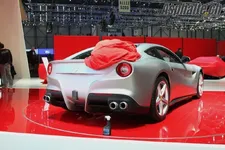
Meet the Ferrari F12 Berlinetta, the fastest and most powerful Ferrari road car yet
The 6262cc 65-degree V12 is the most powerful naturally-aspirated V12 yet. Maximum power is 740CV for a specific output of 118Cv per litre and 690 Nm of torque. 80 per cent of that torque figure is on tap from 2500 rpm, giving massive acceleration right the way up to the 8700 rpm red line.
Just like Ferrari's F1 engines, the V12 boasts very low levels of inertia to ensure that the engine revs rapidly. Development concentrated on a number of areas, including the compression ratio which has been increased to 13.5:1.
The lower crankcase was completely redesigned to help reduce the car's centre of gravity (the engine sits 30mm lower and further back in the chassis compared to the 599 GTB Fiorano).
The V12 feeds power to the rear wheels through the dual-clutch F1 transmission which gives instantaneous gear shifts. The transmission features close gear ratios developed specifically to suit the car's performance and is integrated with the electronic E-Diff to reduce overall weight. Internal friction losses have been reduced to a minimum and innovative technologies have been employed (such as the multi-spark ignition function which implements three successive sparks of different intensity and duration) to reduce fuel consumption by 30 per cent compared to the 599 GTB Fiorano despite the increase in power and torque.
Architecture
The F12 Berlinetta offers unprecedented levels of performance and driving pleasure. This was achieved by evolving the transaxle architecture employed on the 599 GTB Fiorano as follows
reducing weight, especially in the areas beyond the wheelbase
lowering and moving the centre of gravity back by intervening on all the car's systems
reducing the frontal section to improve aerodynamics
maintaining the cockpit and luggage space to ensure optimal levels of comfort for medium- and long-distance journeys
The final result is a car which:
is 70 kg lighter
has a 25mm lower centre of gravity
is shorter (47mm), lower (63mm) and less wide (20mm)
has a very short rear overhang (82mm)
has a longer front overhang {65mm} to house the cooling systems required for the performance of the V12
has a more rear-biased weight distribution (54 per cent, an increase of 1 per cent) compared to the previous model.
The car comfortably accommodates passengers up to 1.95 in height along with 320 litres of luggage, but with the additional flexibility of being able to connect the boot with the rear of the cockpit for a total storage space of 500 litres.
Aluminium Bodywork
The car employs a new concept of spaceframe chassis and body-in-white architecture employing different aluminium materials and technologies developed for aeronautical applications.
An example is the adoption of high-strength aluminium extrusions, which see extensive use in the aerospace industry, and innovative manufacturing processes, such as heat-forming for certain structures. This has resulted in a reduction in body work weight (50 kg less) and a 20 per cent improvement in structural rigidity compared to the 599 GTB Fiorano.
The new chassis also meets all future safety norms (including side intrusion and roof roll-over protection) and special attention was paid to improving production quality and to reducing maintenance times and costs, a direct benefit for clients.
Aerodynamics
The F12 Berlinetta achieves a very high level of aerodynamic efficiency (1.12, twice as efficient as the 599 GTB Fiorano) with a downforce figure of 123kg at 200 km/h. which represents an increase of 76 per cent (fundamental to the car's performance and handling dynamics for driving pleasure) without increasing drag (the Cd is 0.299).
The result is improved top speed and lower consumption, the latter further aided by the more compact vehicle architecture. These figures were achieved thanks to very detailed styling development, working hand-in-hand with the aerodynamics department to transform engineering requirements into key design cues.
No aerodynamic addenda, such as additional spoilers or wings, were required which would have increased drag or affected the car's aerodynamic balance, and a number of innovative elements were adopted alongside more traditional solutions.
The following features increase downforce:
Aero Bridge (maximises the amount of downforce generated by the bonnet)
Blown rear diffuser (the area of high pressure around the rear spoiler is used to alter the pressure inside the rear wheelarch to increase efficiency)
Faired-in underbody (combined with the low ride height this improves downforce and reduces drag)
The following feature reduces drag:
Active brake cooling (the front brakes are cooled by a system that opens the flaps on the basis of the operating temperatures, ensuring that drag is reduced when heavy use is not being made of the brakes)
Vehicle Dynamics
The Iatest-generation Magnetorheological damping system (SCM) sees the introduction of new 'dual-coil' technology and its respective software. This guarantees a greater speed and reaction force to both bumps and driver inputs and thus a faster-responding car.
This is just one advantage of Ferrari's integrated control system (SCM, F1- Trac, E-Diff 3, ESP Premium, high-performance ABS, F1-DCT gearbox software) which has been developed in combination with more traditional components, such as the multi-link rear suspension and twin front wishbones, and the car's layout (lower centre of gravity) to provide a unique handling experience.
The F12 Berlinetta is extremely quick on turn-in, allowing very high cornering speeds and levels of lateral g-force while, at the same time, using very little steering lock and keeping a very flat cornering stance. The car's dynamic performance is completed by impressive braking guaranteed by the state-of-the-art carbon-ceramic set-up (CCM3).
Exterior:
The F12 Berlinetta has low, sleek coupe lines with powerfully sculpted flanks whose contours curve and dip to channel the air flows from the bonnet. The two aerodynamic channels, created by reducing the volume between the wings and central bonnet bulge, pass below a bridge in the area between the front wheelarch and the bottom of the A-pillar, before flowing into scoops in the flanks, lifting and lightening the car's side volume.
The front of the car is dominated by an imposing grille that draws air into the engine bay to cool the V12. On either side of it are electronically- controlled guide vanes which help cool the brakes. This is an original, active aerodynamic solution as when closed they cut drag and when open guarantee optimal brake cooling.
The rear of F12 Berlinetta is characterised by a modern, functional reinterpretation of the Kamm tail which seamlessly integrates the two vertical fences of the rear diffuser. The resulting original T-shape also incorporates two full-LED circular tail-lights and the clearly F1-inspired rear fog light.
SOURCE: Meet the Ferrari F12 Berlinetta, the fastest and most powerful Ferrari road car yet - Ferrari F12 Berlinetta Car News
Posted by BalaGT on Mar 1 2012 2:02AM