You are using an out of date browser. It may not display this or other websites correctly.
You should upgrade or use an alternative browser.
You should upgrade or use an alternative browser.
488 [Official] Ferrari 488 GTB revealed with twin-turbo V8 engine
- Thread starter kingjr9000
- Start date
-
- Tags
- ferrari ferrari 488 gtb
The Ferrari 488 (Type F142M) is a mid-engine sports car produced by Ferrari. Production: 2015-2020. Predecessor: Ferrari 458. Successor: Ferrari F8.


- Messages
- 1,763
Harris!
autocar
autoexpress
autocar
autoexpress
- Messages
- 1,763
Autocar
2015 Ferrari 488 GTB review
Ferrari's replacement for the 458 Italia is here. It promises to be faster but, with a turbocharged engine, will it be as thrilling?

by Matt Prior
4 June 2015
What is it?:
The Ferrari 488 GTB, replacement for the 458 Italia. Before we drove it, it was presented to us via the medium of graphs. Lots of graphs, charts and illustrations. The message was that the 488 might be based ostensibly on the same architecture as that of its predecessor, but don’t think it’s a facelift.
It should be duly noted, then, that there are lots of new things on the 488 GTB. About 85% of its things, in fact. Chief among them is – gasp - a turbocharged engine. More graphs, and message number two: this is still very much a Ferrari motor. Duly noted? We’ll see.
The new engine is turbocharged because it’s smaller, leaner and more efficient this way. And, inevitably, more powerful. By a lot.
The unit, still with a flat-plane crankshaft, now displaces only 3.9 litres, rather than the 4.5-litres of its naturally breathing predecessor, but its two IHI turbos, each with dual scrolls and many, many friction-reducing parts (I’ve seen the diagrams), spool up exceptionally quickly. When boosting, they make 661bhp, although now between 6200rpm and 8000rpm rather than the 9000rpm of the 488’s predecessor.
What really makes this engine a Ferrari engine, we’re told (yes, yes, we’ll see), is that the torque is artificially reduced at lower revs in lower gears. Only in seventh is full torque – 561lb ft – available, at 3000rpm. It’d be faster if Ferrari let it all loose, all the time. But it would also sound a bit crummy, say its engineers. Unleash the full gamut of pounds-feet in every gear and the noise would be a constant burp rather than a Marenello-spec yelp.
I’m happy to believe everything else is Maranello-spec before I’ve even driven the car, because if you doubt the value of Ferrari’s limited-run project cars, the 488 GTB is the perfect case study. The steering rack is from the 458 Speciale, so a bit quicker than the regular 458 Italia’s. Ditto the adjustable dampers and the tyre sizes. Brakes are exactly the same as LaFerrari’s and the 488 GTB has a new generation of the Speciale’s Side Slip Control called, imaginatively, SSC2.
SSC2 not only acts via the electronically controlled limited slip differential like SSC1 did but now also softens or firms the dampers subtly to give you an even more carefully metered dose of opposite lock should you want to look like a hero and are bold enough to keep the throttle pinned in a 661bhp supercar.
What's it like?:
This is about to sound ridiculous, but keeping a 488 GTB’s throttle pinned is not a particularly frightening thing to do. Yes, this is a car with 34bhp more than a McLaren F1, which has an engine in its middle and which, when you turn stability control off, hands control of whether you continue forwards, sideways, or fall off backwards entirely over to you.
But on the experience we had at Maranello, all too briefly on Ferrari’s Fiorano test track and then in more depth out on Modenese hillside hairpins, the 488 GTB is among the most docile-handling mid-engined cars I’ve driven. It has an astonishingly forgiving chassis, with hardly a hint of understeer early in a corner, and extremely fast but communicative steering, and when it breaks traction, which it does gladly, it adopts a hopelessly easily controlled attitude and then regains grip cleanly and communicatively.
In part this is, I’ve no doubt, because Ferrari’s chassis engineers are among the best in the business. But I have also begun to wonder if it’s because the engine is turbocharged. I always thought that an instantly controllable, naturally aspirated engine, capable of giving, immediately, just the amount of power you asked for – and taking it away just as quickly – was key to exploiting the adjustability of a mid-engined car. You asked, you got. You un-asked, it was taken away, and so on the edge the car balanced.
But maybe, just maybe, a touch of lag and a healthy wedge of torque is actually more effective and easier. Maybe the on-throttle spool and the off-throttle hang softens the edges of the oversteer’s entry and exit. Certainly the slug of soft torque seems to make it easier to break away in the first instance.
So perhaps I need to unthink all I thought about turbos. Perhaps a turbocharged engine will liberate, not stifle, a Ferrari’s handling. Or perhaps it’s just that Ferrari’s chassis engineers are even cleverer than I thought.
Either way, if having an engine like this means getting a chassis like this, it’s a sacrifice I’m prepared to make. Sacrifice? I’m afraid so, for the greater good. A moment’s reflection, dear reader, and grief.
Yes, the new Ferrari engine is a Ferrari engine, but not quite as we know it. It still sounds extremely good. It still responds very well. And, Lord knows, it delivers. But it is just a wee bit less tingly and exciting than those that have come before it. If you like your engine in your car’s middle, the closest alternative that will still give you that instant hit, that breathtaking response, is Lamborghini’s Huracan. It’s fortunate, then, that the 488 GTB’s compensations are so intense elsewhere.
Should I buy one?:
If you’re in this market? You might as well. There are improvements beyond the chassis, too. To my eyes the 488 is less pretty than a 458 but you cannot argue with the genuine downforce developed both front and rear (graphs, my friends, graphs).
This is the first series-production Ferrari to have active aerodynamics, via a rear diffuser that will sometimes stall itself, lessening downforce but also drag. The gearbox software has been revised so that the seven-speed dual-clutch automatic gearbox, a thing of wonder before, is even more wonderful now. Those LaFerrari brakes are phenomenal and, it would seem, all but unburstable on this acquaintance.
And I should mention – because these things do matter - that the cabin is more habitable, with more storage cubbies, there is keyless start (though nowhere obvious to stow the fob) and the prices are only moderately increased?
The 488 GTB is, then, the archetypal supercar refined, honed, tweaked and… perfected? Not quite as perfect as the graphs would have you believe. But as close as it currently gets.
2015 Ferrari 488 GTB review
Ferrari's replacement for the 458 Italia is here. It promises to be faster but, with a turbocharged engine, will it be as thrilling?
by Matt Prior
4 June 2015
What is it?:
The Ferrari 488 GTB, replacement for the 458 Italia. Before we drove it, it was presented to us via the medium of graphs. Lots of graphs, charts and illustrations. The message was that the 488 might be based ostensibly on the same architecture as that of its predecessor, but don’t think it’s a facelift.
It should be duly noted, then, that there are lots of new things on the 488 GTB. About 85% of its things, in fact. Chief among them is – gasp - a turbocharged engine. More graphs, and message number two: this is still very much a Ferrari motor. Duly noted? We’ll see.
The new engine is turbocharged because it’s smaller, leaner and more efficient this way. And, inevitably, more powerful. By a lot.
The unit, still with a flat-plane crankshaft, now displaces only 3.9 litres, rather than the 4.5-litres of its naturally breathing predecessor, but its two IHI turbos, each with dual scrolls and many, many friction-reducing parts (I’ve seen the diagrams), spool up exceptionally quickly. When boosting, they make 661bhp, although now between 6200rpm and 8000rpm rather than the 9000rpm of the 488’s predecessor.
What really makes this engine a Ferrari engine, we’re told (yes, yes, we’ll see), is that the torque is artificially reduced at lower revs in lower gears. Only in seventh is full torque – 561lb ft – available, at 3000rpm. It’d be faster if Ferrari let it all loose, all the time. But it would also sound a bit crummy, say its engineers. Unleash the full gamut of pounds-feet in every gear and the noise would be a constant burp rather than a Marenello-spec yelp.
I’m happy to believe everything else is Maranello-spec before I’ve even driven the car, because if you doubt the value of Ferrari’s limited-run project cars, the 488 GTB is the perfect case study. The steering rack is from the 458 Speciale, so a bit quicker than the regular 458 Italia’s. Ditto the adjustable dampers and the tyre sizes. Brakes are exactly the same as LaFerrari’s and the 488 GTB has a new generation of the Speciale’s Side Slip Control called, imaginatively, SSC2.
SSC2 not only acts via the electronically controlled limited slip differential like SSC1 did but now also softens or firms the dampers subtly to give you an even more carefully metered dose of opposite lock should you want to look like a hero and are bold enough to keep the throttle pinned in a 661bhp supercar.
What's it like?:
This is about to sound ridiculous, but keeping a 488 GTB’s throttle pinned is not a particularly frightening thing to do. Yes, this is a car with 34bhp more than a McLaren F1, which has an engine in its middle and which, when you turn stability control off, hands control of whether you continue forwards, sideways, or fall off backwards entirely over to you.
But on the experience we had at Maranello, all too briefly on Ferrari’s Fiorano test track and then in more depth out on Modenese hillside hairpins, the 488 GTB is among the most docile-handling mid-engined cars I’ve driven. It has an astonishingly forgiving chassis, with hardly a hint of understeer early in a corner, and extremely fast but communicative steering, and when it breaks traction, which it does gladly, it adopts a hopelessly easily controlled attitude and then regains grip cleanly and communicatively.
In part this is, I’ve no doubt, because Ferrari’s chassis engineers are among the best in the business. But I have also begun to wonder if it’s because the engine is turbocharged. I always thought that an instantly controllable, naturally aspirated engine, capable of giving, immediately, just the amount of power you asked for – and taking it away just as quickly – was key to exploiting the adjustability of a mid-engined car. You asked, you got. You un-asked, it was taken away, and so on the edge the car balanced.
But maybe, just maybe, a touch of lag and a healthy wedge of torque is actually more effective and easier. Maybe the on-throttle spool and the off-throttle hang softens the edges of the oversteer’s entry and exit. Certainly the slug of soft torque seems to make it easier to break away in the first instance.
So perhaps I need to unthink all I thought about turbos. Perhaps a turbocharged engine will liberate, not stifle, a Ferrari’s handling. Or perhaps it’s just that Ferrari’s chassis engineers are even cleverer than I thought.
Either way, if having an engine like this means getting a chassis like this, it’s a sacrifice I’m prepared to make. Sacrifice? I’m afraid so, for the greater good. A moment’s reflection, dear reader, and grief.
Yes, the new Ferrari engine is a Ferrari engine, but not quite as we know it. It still sounds extremely good. It still responds very well. And, Lord knows, it delivers. But it is just a wee bit less tingly and exciting than those that have come before it. If you like your engine in your car’s middle, the closest alternative that will still give you that instant hit, that breathtaking response, is Lamborghini’s Huracan. It’s fortunate, then, that the 488 GTB’s compensations are so intense elsewhere.
Should I buy one?:
If you’re in this market? You might as well. There are improvements beyond the chassis, too. To my eyes the 488 is less pretty than a 458 but you cannot argue with the genuine downforce developed both front and rear (graphs, my friends, graphs).
This is the first series-production Ferrari to have active aerodynamics, via a rear diffuser that will sometimes stall itself, lessening downforce but also drag. The gearbox software has been revised so that the seven-speed dual-clutch automatic gearbox, a thing of wonder before, is even more wonderful now. Those LaFerrari brakes are phenomenal and, it would seem, all but unburstable on this acquaintance.
And I should mention – because these things do matter - that the cabin is more habitable, with more storage cubbies, there is keyless start (though nowhere obvious to stow the fob) and the prices are only moderately increased?
The 488 GTB is, then, the archetypal supercar refined, honed, tweaked and… perfected? Not quite as perfect as the graphs would have you believe. But as close as it currently gets.
- Messages
- 1,763
Evo
Ferrari 488 GTB review - good enough to topple the 458?
JETHRO BOVINGDON
4 JUN 2015

Image 1 of 20
VERDICT:
Can the 488 GTB summon the spirit of the F40 or has the switch to forced induction dulled the experience?
EVO RATING:
PRICE:
£183,974
FOR
Crazed performance, superb response despite switch to turbochargers, chassis balance
AGAINST
Engine feels less exciting than Speciale and GTB only truly comes alive at very high speeds
What is it?
The 488 GTB is a big deal for Ferrari. Not only because the 458 Italia and Speciale have been so successful but because it marks a change of philosophy.
Gone is the naturally aspirated 4.5-litre V8 and in its place is a downsized direct injection 3902cc twin-turbocharged flat plane crank V8. It’s more efficient but also massively more potent. Power is up from 562bhp in the Italia and 597bhp in the Speciale (both at 9000rpm) to 661bhp at 8000rpm, and torque
 jumps from 398lb ft at 6000rpm to as much as 560lb ft at 3000rpm. The 488 GTB costs from £183,974
Technical highlights
Ferrari know that adopting turbochargers is controversial and many of the engineers will quietly admit that if it wasn’t for CO2 pressures they’d never go down the forced induction route. However, to their credit they’ve left no stone unturned to create a very special engine
indeed.
The twin IHI turbochargers are twin-scroll units and are mounted on ball-bearing shafts to reduce friction by 30-percent. The compressor wheels are TiAL, a lightweight titanium-aluminium alloy that ensures faster spool-up speed by 50-percent compared to Iconel and, according to Ferrari, ‘zero lag’. They rate the engine response time at 0.8-seconds measured at 2000rpm in 3rd gear.


Like the California T the 488 GTB uses different torque maps for gears 1-3 then 4,5,6 and 7 – only giving the maximum 560lb ft in 7th. This gives the feel of an engine building and building to the 8000rpm power peak just as a normally aspirated engine would. It also means the 488 can use shorter gearing (only around 5-percent longer than an Italia) than rivals and it enhances traction. Ferrari are at pains to explain how the noise and ‘emotion’ of this new drivetrain had to match up to Ferrari standards.
Of course there’s much more. The new Side Slip Control 2 is refined still further and now uses the magnetic dampers as well as the e-diff and ESC to help maintain the perfect cornering slip angle, the 7-speed dual-clutch gearbox is 30-percent quicker on upshifts and 40-percent quicker on downshifts than an Italia (and a match for the Speciale) and the Michelin Super Sports now offer almost Cup 2 levels of dry grip but much better wet weather performance.
The manettino with Wet, Sport, Race, CT Off and ESC Off modes remains. Aero has been another area of improvement, vastly increasing downforce whilst reducing drag… As a technical exercise it’s mind-blowing.
What’s it like to drive?
The short answer to that is pretty simple. It’s brilliant. The GTB is outrageously fast. The figures say 0-62mph in 3-seconds, 0-124mph in 8.3-seconds and a top speed
of over 205mph but it feels even faster than that. Like the McLaren 650S it simply devours a road on a mighty wave of torque but retains a real sharp edge at the top end. The rush from 6-8000rpm, accompanied by a ferocious hissing from the turbos, is almost violent.
More impressive still is that the chassis not only copes with the power but actually allows you to exploit all of it whenever you so choose. Traction is staggering (the roads were dry for our test) and like the 458 Italia the GTB’s balance is so responsive and yet so calm that you feel free to really enjoy exploring its massive limits. The SSC2 works seamlessly and in CT Off mode you can play with the balance of the car at will and never feel like the fun is being shut down. Furthermore the ride is compliant and although there appears to be body roll when you look at the cornering photos, inside all feels controlled and flat.
As ever the steering is super quick but there’s enough weight and feel to ensure the GTB doesn’t feel darty or unnatural. In fact the whole car has an intuitive feel to it – with razor sharp responses but a calm stability. It really is very impressive. A step on from the Italia and nearly a match for the Speciale… There’s a shade more understeer and the car isn’t quite so predictable beyond the limit but we’re talking tiny margins here.

The engine is more of a puzzle. It offers frantic performance, superb response for a turbocharged car and it even sounds pretty good when you’re wringing it out. However, the sharpness and sense of drama is diminished slightly and the 488 sometimes has that McLaren 650S trait of only really feeling exciting at ridiculous speeds. On the track it’s fantastic but on the road there’s no question that it isn’t quite as immersive as before. It’s a leap on in terms of absolute performance but a slight regression in terms of involvement.
How does it compare?
Ferrari and McLaren – once so different – take a step closer with the launch of the 488 GTB. The Ferrari has better throttle response and the turbos wake up sooner and it’s more adjustable, too. I suspect it remains the more exciting car to drive. The Huracan is an interesting comparison, though. It’s big normally-aspirated V10 drivetrain is simply way more exciting, sharper and more intense, despite being down on power and torque. It’s going to make for a fascinating group test.
Anything else I need to know?
The 488 GTB laps Fiorano in 1:23, half a second quicker than the Speciale and 2 seconds up on a 458 Italia. The Enzo needed 1:24.9 to complete the same lap.
Ferrari 488 GTB review - good enough to topple the 458?
JETHRO BOVINGDON
4 JUN 2015
Image 1 of 20
VERDICT:
Can the 488 GTB summon the spirit of the F40 or has the switch to forced induction dulled the experience?
EVO RATING:
PRICE:
£183,974
FOR
Crazed performance, superb response despite switch to turbochargers, chassis balance
AGAINST
Engine feels less exciting than Speciale and GTB only truly comes alive at very high speeds
What is it?
The 488 GTB is a big deal for Ferrari. Not only because the 458 Italia and Speciale have been so successful but because it marks a change of philosophy.
Gone is the naturally aspirated 4.5-litre V8 and in its place is a downsized direct injection 3902cc twin-turbocharged flat plane crank V8. It’s more efficient but also massively more potent. Power is up from 562bhp in the Italia and 597bhp in the Speciale (both at 9000rpm) to 661bhp at 8000rpm, and torque
Technical highlights
Ferrari know that adopting turbochargers is controversial and many of the engineers will quietly admit that if it wasn’t for CO2 pressures they’d never go down the forced induction route. However, to their credit they’ve left no stone unturned to create a very special engine
The twin IHI turbochargers are twin-scroll units and are mounted on ball-bearing shafts to reduce friction by 30-percent. The compressor wheels are TiAL, a lightweight titanium-aluminium alloy that ensures faster spool-up speed by 50-percent compared to Iconel and, according to Ferrari, ‘zero lag’. They rate the engine response time at 0.8-seconds measured at 2000rpm in 3rd gear.
Like the California T the 488 GTB uses different torque maps for gears 1-3 then 4,5,6 and 7 – only giving the maximum 560lb ft in 7th. This gives the feel of an engine building and building to the 8000rpm power peak just as a normally aspirated engine would. It also means the 488 can use shorter gearing (only around 5-percent longer than an Italia) than rivals and it enhances traction. Ferrari are at pains to explain how the noise and ‘emotion’ of this new drivetrain had to match up to Ferrari standards.
Of course there’s much more. The new Side Slip Control 2 is refined still further and now uses the magnetic dampers as well as the e-diff and ESC to help maintain the perfect cornering slip angle, the 7-speed dual-clutch gearbox is 30-percent quicker on upshifts and 40-percent quicker on downshifts than an Italia (and a match for the Speciale) and the Michelin Super Sports now offer almost Cup 2 levels of dry grip but much better wet weather performance.
The manettino with Wet, Sport, Race, CT Off and ESC Off modes remains. Aero has been another area of improvement, vastly increasing downforce whilst reducing drag… As a technical exercise it’s mind-blowing.
What’s it like to drive?
The short answer to that is pretty simple. It’s brilliant. The GTB is outrageously fast. The figures say 0-62mph in 3-seconds, 0-124mph in 8.3-seconds and a top speed
More impressive still is that the chassis not only copes with the power but actually allows you to exploit all of it whenever you so choose. Traction is staggering (the roads were dry for our test) and like the 458 Italia the GTB’s balance is so responsive and yet so calm that you feel free to really enjoy exploring its massive limits. The SSC2 works seamlessly and in CT Off mode you can play with the balance of the car at will and never feel like the fun is being shut down. Furthermore the ride is compliant and although there appears to be body roll when you look at the cornering photos, inside all feels controlled and flat.
As ever the steering is super quick but there’s enough weight and feel to ensure the GTB doesn’t feel darty or unnatural. In fact the whole car has an intuitive feel to it – with razor sharp responses but a calm stability. It really is very impressive. A step on from the Italia and nearly a match for the Speciale… There’s a shade more understeer and the car isn’t quite so predictable beyond the limit but we’re talking tiny margins here.
The engine is more of a puzzle. It offers frantic performance, superb response for a turbocharged car and it even sounds pretty good when you’re wringing it out. However, the sharpness and sense of drama is diminished slightly and the 488 sometimes has that McLaren 650S trait of only really feeling exciting at ridiculous speeds. On the track it’s fantastic but on the road there’s no question that it isn’t quite as immersive as before. It’s a leap on in terms of absolute performance but a slight regression in terms of involvement.
How does it compare?
Ferrari and McLaren – once so different – take a step closer with the launch of the 488 GTB. The Ferrari has better throttle response and the turbos wake up sooner and it’s more adjustable, too. I suspect it remains the more exciting car to drive. The Huracan is an interesting comparison, though. It’s big normally-aspirated V10 drivetrain is simply way more exciting, sharper and more intense, despite being down on power and torque. It’s going to make for a fascinating group test.
Anything else I need to know?
The 488 GTB laps Fiorano in 1:23, half a second quicker than the Speciale and 2 seconds up on a 458 Italia. The Enzo needed 1:24.9 to complete the same lap.
- Messages
- 1,763
Top gear
First drive: Ferrari 488 GTB
The 458 replacement has landed, armed with a 661bhp turbo V8. Sam Philip holds on tight

What's this, then?
At the risk of sounding like the dramatic voiceover from an action movie trailer, this is a big moment in the history of fast cars.
The Ferrari 488 GTB is the replacement for the 458 Italia and potentially a very large nail in the coffin of natural aspiration.
Yes, the atmospheric V8 Ferrari is dead: Ferrari's mid-engined supercar has gone turbocharged.
Why?
Two reasons: power and economy. Though Maranello is officially exempt from average CO2 targets binding mass-market manufacturers, it must be seen to show willing - and short of bolting on a heavy, expensive hybrid module (or switching to diesel), turbocharging is the only realistic way to raise efficiency and lower emissions.
Perhaps more significantly, though, it's about keeping up in the power wars. With Ferrari targeting an increase of around 100bhp on the 458 Italia, Maranello's engineers admit it would have been all but impossible to squeeze so much more from the naturally aspirated V8, at least not without compromising reliability, thoroughly blowing the budget or embracing a much bigger, heavier engine.
Look at the bald figures, and it's difficult to argue. 2004's Ferrari F430 made 483bhp and 343lb ft from its 4.3-litre, naturally aspirated V8 engine. It'd do 0-62mph in 3.7 seconds and 0-124mph in 12.2, while officially returning 18mpg and 345g/km CO2.
The new 488 GTB? 661bhp - a near-180bhp jump in 11 years - and 560lb ft from its twin-turbo 3.9-litre V8. Vital stats? 3.0 seconds to 62mph and 8.3 to 124mph, along with 25mpg and a piffling 260g/km CO2. That, in strictly numerical terms, is serious progress.
That 661bhp headline equates to the highest specific power output of any road-going Ferrari, a meaty 169bhp per litre of displacement. If the Dodge Viper's V10 managed the same power density, it'd make 1400bhp.
But supercars aren't just about numbers. They're about, like, sensation and stuff.
Correct. Those who buy city cars, or motorway rep-mobiles, will accept fuzzy throttle response and a droney noise as a trade-off for a decent squirt of overtaking power and a half-price tax disc.
Not those in market for a screaming V8 supercar, as Ferrari is well aware. One of the trademarks of the 458's naturally aspirated eight was its whipcrack reactions up and down the rev range, spinning up and back with extraordinary, inertia-free alacrity. Maranello knows it needs to serve up a similarly engaging experience with its mid-engined turbo offering, so has thrown its full suite of engine tech at the 488's powerplant.
It's a new flat-plane crank V8 of no relation to the 458's, dry-sumped and, Ferrari claims, offering the quickest throttle response time of any blown sports car engine. If you're doing 2000rpm in third gear and stab the throttle, the 488 will give you maximum power in point-eight of a second. That, says Ferrari, is just a tenth shy of the 458's reactions, an engine never regarded as tardy, exactly.
Hang on. Isn't it the same engine as the California T?
The 3902cc V8 engine is from the same ‘F154' family as that of the new California T, but shares very little in the way of individual components with the Cali's wet-sumped motor.
There's a new crank and conrods; redesigned cylinder heads; new cams, intake system and cranktrain; bespoke intercoolers. A different, noisier exhaust too.
Even the turbos are all-new, the compressor wheels fashioned of an aerospace-grade, low-density titanium-aluminium alloy to reduce inertia, with Ferrari boldly promising ‘zero lag'.
Does it deliver?
We'll come to that in a sec. First you need to know about the aero.
If Ferrari let its engineers go crazy on the engine, the aerodynamics clearly represent a breakout at the asylum. There's plenty of F1-derived knowhow here - in fact, so strict are Formula One's bodywork regulations that there's arguably more aero cleverness here than on Seb Vettel's F2015. Only the roof panel has been carried over from the 458.
Up front is a double spoiler, the top section ramming air into the radiator while the larger, lower section generates downforce under the front of the car.
The underbody includes faintly ominous sounding vortex generators, which reduce pressure to create ground effect without adding drag. The result, says Ferrari, is a car with a lower drag coefficient than its predecessor, but one capable of generating 325kg of downwards lift a 155mph. That's proper downforce, 50 per cent more than the 458 generates.
Need more aero? Round the back there's a diffuser with computer-controlled active flaps, which open or close to reduce drag or increase downforce respectively.
And see that little hole at the base of the rear screen? That's the intake for the 488's 'blown spoiler' arrangement.
"We don't like to add aerodynamic devices on top of the form," explains Ferrari design chief Flavio Manzoni. So instead of a fat, 911 GT3 RS-style rear wing, the 488 instead rams air through this dinky intake where it passes over a hidden lip, pushing the 488's rear to the road. Subtle and very clever.
Got it. There's a lot of aero going on. Anything else?
The rest of the hardware should be familiar from the 458, though upgraded across the board.
The 488 retains Ferrari's trademark aluminium-intensive body structure - no McLaren 650S-style carbon-fibre monocoque here - and employs a seven-speed dual-clutch transmission, which limits torque in lower gears to maximise acceleration without simply spinning the rear wheels. Software tweaks allow for upshifts up to 30 per cent quicker, and downshifts up to 40 per cent quicker.
The now-familiar magnetorheological active dampers get a faster ECU, three new sensors and new piston rods promising better body control.
Under 20-inch alloys wrapped in bespoke Michelins lurk Brembo brakes from the LaFerrari, with stopping distances reduced some nine per cent over the 458.
Oh, and, there's an evolved version of 458's genius Side Slip Control (unofficial motto: Helping The Ham-Fisted Drift since 2009!), which promises to be 'more precise and yet less invasive'.
Out with it. What's it like to drive?
Fast. Very fast. Very, very fast.
The 488's acceleration is a step up from the 458 and even the Lambo Huracán, flinging you down the road with the shocking, brutal thrust of a fighter jet on take-off.
It's the sort of acceleration that pins you back into the seat, the sort of acceleration that causes a string of involuntary expletives to spew forth from your lips.
The sort of acceleration that, if you break attention for but a split-second, sees you arriving at a tight corner at least 40mph than expected, before hastily testing the capabilities of those Brembos.
Put it this way: if someone has an off in a 488, it's not going to be small. 0-62mph in three seconds dead? More than believable, that.
The surge of torque is utterly relentless, the power arriving in a continuous, unending deluge with barely a bhip between gears. So relentless is the power that I kept battering into the limiter just north of 8000rpm, expecting the rush never to run out.
The brutality of the acceleration reminds me of the Nismo GT-R, but with nothing like the turbo lag. The throttle response is all but instantaneous, the power linear and even and massive.
But does it feel like a proper Ferrari V8?
It doesn't feel like an old Ferrari V8, that's for sure. The turbo engine certainly doesn't gain and lose revs with the massless snap of the old naturally aspirated V8, which would drop from 8,000rpm to idle so quickly you wondered how the rev-counter needle could keep up. The new V8 is just a mite slower in its reactions.
That said, it's a nimble thing by the standards of turbo engines, and, in its own way, a mighty serious piece of industrial engineering. It's a different sort of power, this, broad-shouldered and all-consuming, an unstoppable wrecking-ball of speed.
Does it sound as good as the 458?
It sounds very, very different. Whereas, in the 458 Speciale, you felt you were stretching some sort of mad elastic band as the revs increased, the noise getting higher, tighter, more frenzied, the 488 sounds more linear, controlled, industrial.
Despite Ferrari's claims to have engineered a cacophony of different sounds through the 488's rev range (naturally, mind you - no speaker-based synthesising here), it doesn't have the baritone-to-soprano range of the old naturally aspirated V8, trading the 458's vocal range for a heftier, chest-filling boom. Certainly, it doesn't get all screaming and sparkly at the top end, just louder and angrier.
In fact, the 488 sounds, in part at least, like a modern F1 car with its pit-lane limiter on: a bass-heavy, air-bullying thump overlaid with a medley of whooshes, cracks and mechanical edge. Certainly there's far more to it than mere induction noise, and it's probably the best-sounding turbocharged production motor out there right now, but for me it doesn't have quite the fizz of that atmospheric V8.
It is, however, plenty loud and shouty enough to attract the attention of everyone outside your Monaco apartment, which is probably the major concern of most 488 buyers.
How does it handle?
Drive it sensibly, and the experience is very much like the 458. The steering is light yet direct, the sensation of a balanced and agile chassis, the 488 signalling clearly what its front and rear are up to.
Drive it hard, though, and you discover the 488 is seriously, seriously oversteery.
I'm not the sort of driver to jump in a 600bhp-plus, rear-drive supercar and start immediately drifting it on public roads (I know, what a square), but - with the manettino dialed back to ‘CT OFF' - even I was quickly achieving neat, controllable slides out of corners, hanging the tail out before flicking it back into line.
Partly that's thanks to the vast plateau of torque served up from the V8, which allows you to meter a dead-even, precise amount of power to the rear wheels.
But more - significantly more, if we're being honest - it's thanks to the utter genius of that second-gen Side Slip Control (SSC), which now monitors and adjusts the damping front and rear for even greater slip angles.
This is no now-stop-that-right-now safety net, shutting down the power as soon as it spots a hint of slip. Quite the opposite: it all but encourages you to engage in gorgeous, steady slides, allowing you to get sideways and somehow, imperceptibly, holding you there.
In the pre-match tech briefing, a Ferrari engineer showed us the equation used to calibrate SSC2. It covered an entire page of A4, and looked like something out of The Theory Of Everything. Point is, there's some very clever stuff going on, but as the driver you have no sensation of the electronics doing their thing, just that you've been transformed, overnight, into a Driving God.
And when you're not being a hammer-footed fool?
The 488 isn't an intimidating or difficult car to drive. It's happy to burble through traffic, throttle and brakes forgiving, all-round visibility better than in, say, the Lambo Huracán.
We tried it on some pretty harrowed Italian tarmac, and - with the dampers set to ‘bumpy road' mode at least - it retained a pretty impressive degree of comfort.
Ferrari says a lot of V8 owners use their car as a daily driver, so has worked hard to engineer a bit more space for human and stuff on board. Accordingly, the front boot is of a decent size, while there's room in the cockpit for, ooh, at least a dozen pencils.
But is it better than a 458?
Hmm. Ah. I've spent a long time thinking about this, and I reckon it comes down to a trade-off. Namely this: do you want more power, more speed and even better sideways? Or would you trade that in for the screaming, high-rev thrills of the old atmospheric V8?
This isn't a cop-out, but I think you could argue it either way. The 488 doesn't have quite the tingling effervescence of the 458, doesn't goad you to the redline in quite the same way, doesn't sing so lustily when you get there.
But the 488 feels new, and different, and stonkingly fast. It sounds unique, and offers up a dizzying, crushing surge of torque. It'll get round any track or down any road noticeably quicker than the 458 - the 488 is two seconds a lap faster around Ferrari's dinky Fiorano circuit - and probably use a bit less fuel doing so. Where do your priorities lie?
And let's be honest: the question of whether the 488 is better than its naturally aspirated predecessor is ultimately moot. Yes, turbocharged sports cars are different, but they are happening, and Ferrari's proven they won't all be characterless vacuum cleaners.
The era of natural aspiration is, like it or not, reaching its end. The 488 represents the very forefront of the turbo charge.
First drive: Ferrari 488 GTB
The 458 replacement has landed, armed with a 661bhp turbo V8. Sam Philip holds on tight
What's this, then?
At the risk of sounding like the dramatic voiceover from an action movie trailer, this is a big moment in the history of fast cars.
The Ferrari 488 GTB is the replacement for the 458 Italia and potentially a very large nail in the coffin of natural aspiration.
Yes, the atmospheric V8 Ferrari is dead: Ferrari's mid-engined supercar has gone turbocharged.
Why?
Two reasons: power and economy. Though Maranello is officially exempt from average CO2 targets binding mass-market manufacturers, it must be seen to show willing - and short of bolting on a heavy, expensive hybrid module (or switching to diesel), turbocharging is the only realistic way to raise efficiency and lower emissions.
Perhaps more significantly, though, it's about keeping up in the power wars. With Ferrari targeting an increase of around 100bhp on the 458 Italia, Maranello's engineers admit it would have been all but impossible to squeeze so much more from the naturally aspirated V8, at least not without compromising reliability, thoroughly blowing the budget or embracing a much bigger, heavier engine.
Look at the bald figures, and it's difficult to argue. 2004's Ferrari F430 made 483bhp and 343lb ft from its 4.3-litre, naturally aspirated V8 engine. It'd do 0-62mph in 3.7 seconds and 0-124mph in 12.2, while officially returning 18mpg and 345g/km CO2.
The new 488 GTB? 661bhp - a near-180bhp jump in 11 years - and 560lb ft from its twin-turbo 3.9-litre V8. Vital stats? 3.0 seconds to 62mph and 8.3 to 124mph, along with 25mpg and a piffling 260g/km CO2. That, in strictly numerical terms, is serious progress.
That 661bhp headline equates to the highest specific power output of any road-going Ferrari, a meaty 169bhp per litre of displacement. If the Dodge Viper's V10 managed the same power density, it'd make 1400bhp.
But supercars aren't just about numbers. They're about, like, sensation and stuff.
Correct. Those who buy city cars, or motorway rep-mobiles, will accept fuzzy throttle response and a droney noise as a trade-off for a decent squirt of overtaking power and a half-price tax disc.
Not those in market for a screaming V8 supercar, as Ferrari is well aware. One of the trademarks of the 458's naturally aspirated eight was its whipcrack reactions up and down the rev range, spinning up and back with extraordinary, inertia-free alacrity. Maranello knows it needs to serve up a similarly engaging experience with its mid-engined turbo offering, so has thrown its full suite of engine tech at the 488's powerplant.
It's a new flat-plane crank V8 of no relation to the 458's, dry-sumped and, Ferrari claims, offering the quickest throttle response time of any blown sports car engine. If you're doing 2000rpm in third gear and stab the throttle, the 488 will give you maximum power in point-eight of a second. That, says Ferrari, is just a tenth shy of the 458's reactions, an engine never regarded as tardy, exactly.
Hang on. Isn't it the same engine as the California T?
The 3902cc V8 engine is from the same ‘F154' family as that of the new California T, but shares very little in the way of individual components with the Cali's wet-sumped motor.
There's a new crank and conrods; redesigned cylinder heads; new cams, intake system and cranktrain; bespoke intercoolers. A different, noisier exhaust too.
Even the turbos are all-new, the compressor wheels fashioned of an aerospace-grade, low-density titanium-aluminium alloy to reduce inertia, with Ferrari boldly promising ‘zero lag'.
Does it deliver?
We'll come to that in a sec. First you need to know about the aero.
If Ferrari let its engineers go crazy on the engine, the aerodynamics clearly represent a breakout at the asylum. There's plenty of F1-derived knowhow here - in fact, so strict are Formula One's bodywork regulations that there's arguably more aero cleverness here than on Seb Vettel's F2015. Only the roof panel has been carried over from the 458.
Up front is a double spoiler, the top section ramming air into the radiator while the larger, lower section generates downforce under the front of the car.
The underbody includes faintly ominous sounding vortex generators, which reduce pressure to create ground effect without adding drag. The result, says Ferrari, is a car with a lower drag coefficient than its predecessor, but one capable of generating 325kg of downwards lift a 155mph. That's proper downforce, 50 per cent more than the 458 generates.
Need more aero? Round the back there's a diffuser with computer-controlled active flaps, which open or close to reduce drag or increase downforce respectively.
And see that little hole at the base of the rear screen? That's the intake for the 488's 'blown spoiler' arrangement.
"We don't like to add aerodynamic devices on top of the form," explains Ferrari design chief Flavio Manzoni. So instead of a fat, 911 GT3 RS-style rear wing, the 488 instead rams air through this dinky intake where it passes over a hidden lip, pushing the 488's rear to the road. Subtle and very clever.
Got it. There's a lot of aero going on. Anything else?
The rest of the hardware should be familiar from the 458, though upgraded across the board.
The 488 retains Ferrari's trademark aluminium-intensive body structure - no McLaren 650S-style carbon-fibre monocoque here - and employs a seven-speed dual-clutch transmission, which limits torque in lower gears to maximise acceleration without simply spinning the rear wheels. Software tweaks allow for upshifts up to 30 per cent quicker, and downshifts up to 40 per cent quicker.
The now-familiar magnetorheological active dampers get a faster ECU, three new sensors and new piston rods promising better body control.
Under 20-inch alloys wrapped in bespoke Michelins lurk Brembo brakes from the LaFerrari, with stopping distances reduced some nine per cent over the 458.
Oh, and, there's an evolved version of 458's genius Side Slip Control (unofficial motto: Helping The Ham-Fisted Drift since 2009!), which promises to be 'more precise and yet less invasive'.
Out with it. What's it like to drive?
Fast. Very fast. Very, very fast.
The 488's acceleration is a step up from the 458 and even the Lambo Huracán, flinging you down the road with the shocking, brutal thrust of a fighter jet on take-off.
It's the sort of acceleration that pins you back into the seat, the sort of acceleration that causes a string of involuntary expletives to spew forth from your lips.
The sort of acceleration that, if you break attention for but a split-second, sees you arriving at a tight corner at least 40mph than expected, before hastily testing the capabilities of those Brembos.
Put it this way: if someone has an off in a 488, it's not going to be small. 0-62mph in three seconds dead? More than believable, that.
The surge of torque is utterly relentless, the power arriving in a continuous, unending deluge with barely a bhip between gears. So relentless is the power that I kept battering into the limiter just north of 8000rpm, expecting the rush never to run out.
The brutality of the acceleration reminds me of the Nismo GT-R, but with nothing like the turbo lag. The throttle response is all but instantaneous, the power linear and even and massive.
But does it feel like a proper Ferrari V8?
It doesn't feel like an old Ferrari V8, that's for sure. The turbo engine certainly doesn't gain and lose revs with the massless snap of the old naturally aspirated V8, which would drop from 8,000rpm to idle so quickly you wondered how the rev-counter needle could keep up. The new V8 is just a mite slower in its reactions.
That said, it's a nimble thing by the standards of turbo engines, and, in its own way, a mighty serious piece of industrial engineering. It's a different sort of power, this, broad-shouldered and all-consuming, an unstoppable wrecking-ball of speed.
Does it sound as good as the 458?
It sounds very, very different. Whereas, in the 458 Speciale, you felt you were stretching some sort of mad elastic band as the revs increased, the noise getting higher, tighter, more frenzied, the 488 sounds more linear, controlled, industrial.
Despite Ferrari's claims to have engineered a cacophony of different sounds through the 488's rev range (naturally, mind you - no speaker-based synthesising here), it doesn't have the baritone-to-soprano range of the old naturally aspirated V8, trading the 458's vocal range for a heftier, chest-filling boom. Certainly, it doesn't get all screaming and sparkly at the top end, just louder and angrier.
In fact, the 488 sounds, in part at least, like a modern F1 car with its pit-lane limiter on: a bass-heavy, air-bullying thump overlaid with a medley of whooshes, cracks and mechanical edge. Certainly there's far more to it than mere induction noise, and it's probably the best-sounding turbocharged production motor out there right now, but for me it doesn't have quite the fizz of that atmospheric V8.
It is, however, plenty loud and shouty enough to attract the attention of everyone outside your Monaco apartment, which is probably the major concern of most 488 buyers.
How does it handle?
Drive it sensibly, and the experience is very much like the 458. The steering is light yet direct, the sensation of a balanced and agile chassis, the 488 signalling clearly what its front and rear are up to.
Drive it hard, though, and you discover the 488 is seriously, seriously oversteery.
I'm not the sort of driver to jump in a 600bhp-plus, rear-drive supercar and start immediately drifting it on public roads (I know, what a square), but - with the manettino dialed back to ‘CT OFF' - even I was quickly achieving neat, controllable slides out of corners, hanging the tail out before flicking it back into line.
Partly that's thanks to the vast plateau of torque served up from the V8, which allows you to meter a dead-even, precise amount of power to the rear wheels.
But more - significantly more, if we're being honest - it's thanks to the utter genius of that second-gen Side Slip Control (SSC), which now monitors and adjusts the damping front and rear for even greater slip angles.
This is no now-stop-that-right-now safety net, shutting down the power as soon as it spots a hint of slip. Quite the opposite: it all but encourages you to engage in gorgeous, steady slides, allowing you to get sideways and somehow, imperceptibly, holding you there.
In the pre-match tech briefing, a Ferrari engineer showed us the equation used to calibrate SSC2. It covered an entire page of A4, and looked like something out of The Theory Of Everything. Point is, there's some very clever stuff going on, but as the driver you have no sensation of the electronics doing their thing, just that you've been transformed, overnight, into a Driving God.
And when you're not being a hammer-footed fool?
The 488 isn't an intimidating or difficult car to drive. It's happy to burble through traffic, throttle and brakes forgiving, all-round visibility better than in, say, the Lambo Huracán.
We tried it on some pretty harrowed Italian tarmac, and - with the dampers set to ‘bumpy road' mode at least - it retained a pretty impressive degree of comfort.
Ferrari says a lot of V8 owners use their car as a daily driver, so has worked hard to engineer a bit more space for human and stuff on board. Accordingly, the front boot is of a decent size, while there's room in the cockpit for, ooh, at least a dozen pencils.
But is it better than a 458?
Hmm. Ah. I've spent a long time thinking about this, and I reckon it comes down to a trade-off. Namely this: do you want more power, more speed and even better sideways? Or would you trade that in for the screaming, high-rev thrills of the old atmospheric V8?
This isn't a cop-out, but I think you could argue it either way. The 488 doesn't have quite the tingling effervescence of the 458, doesn't goad you to the redline in quite the same way, doesn't sing so lustily when you get there.
But the 488 feels new, and different, and stonkingly fast. It sounds unique, and offers up a dizzying, crushing surge of torque. It'll get round any track or down any road noticeably quicker than the 458 - the 488 is two seconds a lap faster around Ferrari's dinky Fiorano circuit - and probably use a bit less fuel doing so. Where do your priorities lie?
And let's be honest: the question of whether the 488 is better than its naturally aspirated predecessor is ultimately moot. Yes, turbocharged sports cars are different, but they are happening, and Ferrari's proven they won't all be characterless vacuum cleaners.
The era of natural aspiration is, like it or not, reaching its end. The 488 represents the very forefront of the turbo charge.
- Messages
- 1,763
Car Mag
Ferrari 488 GTB (2015) review
Published: Yesterday 23:01
Ben Barry
Contributing editor, sideways merchant, tyre disintegrator
458 Italia, which is a bit of a big deal: the 458 remained top of its class some five years after launch.
The 488 is essentially a very thorough evolution of the 458, so you might expect Maranello to simply find another gear and power away from the opposition. But there’s one big sticking point: after years of naturally aspirated V8s that screamed to as high as 9000rpm, the GTB adopts a downsized and twin-turbocharged V8. And this, more than anything, will be crucial in how the new model is received.
This is Ferrari’s second attempt at turbocharging in the modern era – the California T was the first since 1987’s seminal F40 and while the folding hardtop’s engine is technically impressive, it can’t match the excitement of the old V8. There’ll be jitters at Maranello, and no mistake.
Let me guess: more power, more torque, lower C02, better mpg?
Exactly. The 458 Italia’s 4497cc V8 made 562bhp at 9000rpm, 398lb ft at 6000rpm, 24mpg and 275g/km (or 597bhp in ultimate Speciale guise, the rest of the figures remaining the same – with the optional stop/start HELE system). The 488 GTB’s smaller 3902cc twin-turbo V8 ramps that up to 661bhp at 8000rpm, 561lb ft at 3000rpm, with 25mpg and 260g/km. That’s a helluva big jump in performance. And the new car is claimed to be some 43kg lighter than the Italia, its kerbweight coming in at 1445kg.
So, everything improves, but note that the peak power is delivered 1000rpm lower than the Italia, and that the massive wodge of torque is on tap way down low. There is, however, a caveat here: Ferrari has cleverly engineered the engine to unleash the full 561lb ft at 3000rpm only in seventh gear, parcelling the torque out in lower gears to encourage drivers to chase the redline and, therefore, approximate the rush of good ol’ natural aspiration.
But it’s just the California engine dropped into the 488, right?
Well, the two units are closely related, but there are also some big differences: the California has 47cc less outright capacity, revs 500rpm lower at 7500rpm all-in and falls short in the performance stakes by a whopping 109bhp and not so whopping 4lb ft. The 488 GTB's V8 gets new con-rods, pistons, crank and cams, and new cylinder heads with thinner walls for larger cooling channels. New twin-scroll IHI turbos feature ball-bearing shafts to reduce friction, while the compressor wheels are lightweight titanium-aluminium alloy, reducing turbine inertia by 50%.
Ferrari says the engine responds to throttle inputs in 0.8sec, an improvement over the California T’s 1.1sec, but down from the 458 Italia’s 0.6sec.
What else is different compared with the 458 Italia?
While the basic silhouette remains – indeed, the roof and glasshouse are identical – there are some big alterations to the bodywork, particularly the LaFerrari-style front bumper, the twin bonnet vents, and larger twin side intakes ('base-bleed intakes', in Ferrari-speak), all of which cater to the turbocharged engine’s appetite for cooling air – indeed the rear track is 40mm wider to accommodate the turbos and intercoolers on either side of the V8. Along with a new aerodynamic underbody with vortex generators – two paths that start at the front axle line, and curve out behind the front wheels – downforce is said to increase by 50% to 325kg at 250km/h compared with the Italia.
The seven-speed dual-clutch gearbox is carried over from the Italia, but the ratios are ‘4-5%’ longer (though seventh is shorter than the California’s cruisey top gear) and the already fast shifts become faster yet again than the Italia – 30% faster upshifts, 40% faster downshifts; for reference, the Speciale was 20% and 44% faster than the Italia, respectively. Carbon-ceramic brakes are borrowed from LaFerrari, while the suspension is lightly evolved with a riff on the Speciale damper set-up.
Side-Slip Angle control returns, an advanced kind of stability-control sport setting, which integrates with the traction control and E-diff as before, but now also includes the adaptive dampers and is claimed to be less intrusive – a good thing, as the old system was better at managing the small slip angles you might generate while chasing a lap time on track, than allowing you to play through tighter, slower turns.
Inside, there are new satellite control clusters and instrument panel, plus new graphics and interface for infotainment system – the reality is it looks and feels much the same, despite the updates. Thankfully, the plasticky old key that looked more Fiat than Ferrari has finally – finally – been replaced.
What’s the new 2015 Ferrari 488 GTB like to drive?
Do you want the good news or the good news? Well, the good news is that the 488 GTB still essentially feels like the brilliant 458, and the switch to turbocharging has been carried out much more effectively than on the California.
Response is excellent, lag non-existent, and the mid-range is far, far stronger than the 458. Variable Torque Management means you don’t feel tempted to short-shift, but to wind the engine right out. The new V8 sounds great, with a gruff flat-plane crank idle, and a guttural mid-range underscored with a light whistle of boost. Both the sound and the delivery encourage you to chase high revs, which is very satisfying, and when you do that the delivery feels far fuller and richer than a straining high-rpm California.
The precision with which you could play with the 458 Italia’s rear end has also survived the switch to forced induction. I feared lag and mushy throttle response would make balancing the 488 GTB beyond the rear tyres’ limits a far trickier experience, but the reality is it’s easier than ever, and you can really sense even the tiniest adjustment in right-foot attitude when the tyres are spinning.
On track, at first, I hit the limiter a few times, because it does take some time to recalibrate from the old 9000rpm power peak and, no, the new engine doesn’t sound as good when you really strike the high notes, but I’d say the substantial extra performance is a decent trade. And, look, this isn’t a dull-sounding engine.
Gearshifts are said to be even quicker, and that certainly feels the case, but what’s more noticeable is the thud of engagement when you’re driving hard and you pull for the next upshift, perhaps a result of all that extra torque. It’s not brutal, it’s just a very mechanical feeling, one that adds to the sense of interaction.
On track you’ll notice more understeer than the hardcore 458 Speciale – with its stickier tyres and stiffer suspension, remember – but the trade-off is a far more pliant car on the road; the 488 is incredibly supple, and yet still offers fantastic body control for road driving. Keep it in the default firmer setting if you must, but that’s best left for the track.
The steering ratio remains the same as the madly quick 458, but it feels like there’s more weight and consistency to me – though not the feel of the Speciale.
Ferrari vs McLaren, who wins?
Well, it’s a bit early for a twin test, but Woking will be watching the 488 GTB’s progress closely. McLaren claims 641bhp @ 7250rpm, 500lb ft @ 6000rpm, 0-62mph in 3.0sec and 207mph for the 650S. So the GTB makes 20bhp and 61lb ft more, revs 750rpm higher, and is said to record similar performance data. The McLaren 675 LT gets back on terms (more power, still less torque), but is limited to 500 units and will be more comparable to a hardcore Speciale-style version of the 488 GTB. What should we guess? 700bhp and similar torque to the GTB for that?
Verdict
We all feared that the switch to turbo power would scupper the 488 GTB, leaving the 458 Italia representing both the benchmark and the end of an era. The reality is quite different: the new 3.9-litre V8’s performance, response and sound make it a highly engaging engine, one that pairs incredibly well with the 488 GTB’s extremely playful chassis – you can still intimately sense the boundary between grip and slip, and quickly feel comfortable taking liberties. This is not a car that intimidates, despite its prodigious power and torque.
But the fact is, the 488 GTB works very well even when you don’t act the hero or exploit its performance to the full. It’s still a very tactile car when driven well below its limit, and combines that interactivity with high, for the most part, levels of comfort. Our only complaint is the sports seats in our car – the ones with the cut-outs behind your back – were too firm and unsupportive. If you’re using your 488 GTB as often as it deserves to be, I’d pay very careful attention to your choice of seat.
This is a car that could’ve gone so wrong. Instead, it feels genuinely exciting to tell you Ferrari has got it right.
Ferrari 488 GTB (2015) review
Published: Yesterday 23:01
Ben Barry
Contributing editor, sideways merchant, tyre disintegrator
458 Italia, which is a bit of a big deal: the 458 remained top of its class some five years after launch.
The 488 is essentially a very thorough evolution of the 458, so you might expect Maranello to simply find another gear and power away from the opposition. But there’s one big sticking point: after years of naturally aspirated V8s that screamed to as high as 9000rpm, the GTB adopts a downsized and twin-turbocharged V8. And this, more than anything, will be crucial in how the new model is received.
This is Ferrari’s second attempt at turbocharging in the modern era – the California T was the first since 1987’s seminal F40 and while the folding hardtop’s engine is technically impressive, it can’t match the excitement of the old V8. There’ll be jitters at Maranello, and no mistake.
Let me guess: more power, more torque, lower C02, better mpg?
Exactly. The 458 Italia’s 4497cc V8 made 562bhp at 9000rpm, 398lb ft at 6000rpm, 24mpg and 275g/km (or 597bhp in ultimate Speciale guise, the rest of the figures remaining the same – with the optional stop/start HELE system). The 488 GTB’s smaller 3902cc twin-turbo V8 ramps that up to 661bhp at 8000rpm, 561lb ft at 3000rpm, with 25mpg and 260g/km. That’s a helluva big jump in performance. And the new car is claimed to be some 43kg lighter than the Italia, its kerbweight coming in at 1445kg.
So, everything improves, but note that the peak power is delivered 1000rpm lower than the Italia, and that the massive wodge of torque is on tap way down low. There is, however, a caveat here: Ferrari has cleverly engineered the engine to unleash the full 561lb ft at 3000rpm only in seventh gear, parcelling the torque out in lower gears to encourage drivers to chase the redline and, therefore, approximate the rush of good ol’ natural aspiration.
But it’s just the California engine dropped into the 488, right?
Well, the two units are closely related, but there are also some big differences: the California has 47cc less outright capacity, revs 500rpm lower at 7500rpm all-in and falls short in the performance stakes by a whopping 109bhp and not so whopping 4lb ft. The 488 GTB's V8 gets new con-rods, pistons, crank and cams, and new cylinder heads with thinner walls for larger cooling channels. New twin-scroll IHI turbos feature ball-bearing shafts to reduce friction, while the compressor wheels are lightweight titanium-aluminium alloy, reducing turbine inertia by 50%.
Ferrari says the engine responds to throttle inputs in 0.8sec, an improvement over the California T’s 1.1sec, but down from the 458 Italia’s 0.6sec.
What else is different compared with the 458 Italia?
While the basic silhouette remains – indeed, the roof and glasshouse are identical – there are some big alterations to the bodywork, particularly the LaFerrari-style front bumper, the twin bonnet vents, and larger twin side intakes ('base-bleed intakes', in Ferrari-speak), all of which cater to the turbocharged engine’s appetite for cooling air – indeed the rear track is 40mm wider to accommodate the turbos and intercoolers on either side of the V8. Along with a new aerodynamic underbody with vortex generators – two paths that start at the front axle line, and curve out behind the front wheels – downforce is said to increase by 50% to 325kg at 250km/h compared with the Italia.
The seven-speed dual-clutch gearbox is carried over from the Italia, but the ratios are ‘4-5%’ longer (though seventh is shorter than the California’s cruisey top gear) and the already fast shifts become faster yet again than the Italia – 30% faster upshifts, 40% faster downshifts; for reference, the Speciale was 20% and 44% faster than the Italia, respectively. Carbon-ceramic brakes are borrowed from LaFerrari, while the suspension is lightly evolved with a riff on the Speciale damper set-up.
Side-Slip Angle control returns, an advanced kind of stability-control sport setting, which integrates with the traction control and E-diff as before, but now also includes the adaptive dampers and is claimed to be less intrusive – a good thing, as the old system was better at managing the small slip angles you might generate while chasing a lap time on track, than allowing you to play through tighter, slower turns.
Inside, there are new satellite control clusters and instrument panel, plus new graphics and interface for infotainment system – the reality is it looks and feels much the same, despite the updates. Thankfully, the plasticky old key that looked more Fiat than Ferrari has finally – finally – been replaced.
What’s the new 2015 Ferrari 488 GTB like to drive?
Do you want the good news or the good news? Well, the good news is that the 488 GTB still essentially feels like the brilliant 458, and the switch to turbocharging has been carried out much more effectively than on the California.
Response is excellent, lag non-existent, and the mid-range is far, far stronger than the 458. Variable Torque Management means you don’t feel tempted to short-shift, but to wind the engine right out. The new V8 sounds great, with a gruff flat-plane crank idle, and a guttural mid-range underscored with a light whistle of boost. Both the sound and the delivery encourage you to chase high revs, which is very satisfying, and when you do that the delivery feels far fuller and richer than a straining high-rpm California.
The precision with which you could play with the 458 Italia’s rear end has also survived the switch to forced induction. I feared lag and mushy throttle response would make balancing the 488 GTB beyond the rear tyres’ limits a far trickier experience, but the reality is it’s easier than ever, and you can really sense even the tiniest adjustment in right-foot attitude when the tyres are spinning.
On track, at first, I hit the limiter a few times, because it does take some time to recalibrate from the old 9000rpm power peak and, no, the new engine doesn’t sound as good when you really strike the high notes, but I’d say the substantial extra performance is a decent trade. And, look, this isn’t a dull-sounding engine.
Gearshifts are said to be even quicker, and that certainly feels the case, but what’s more noticeable is the thud of engagement when you’re driving hard and you pull for the next upshift, perhaps a result of all that extra torque. It’s not brutal, it’s just a very mechanical feeling, one that adds to the sense of interaction.
On track you’ll notice more understeer than the hardcore 458 Speciale – with its stickier tyres and stiffer suspension, remember – but the trade-off is a far more pliant car on the road; the 488 is incredibly supple, and yet still offers fantastic body control for road driving. Keep it in the default firmer setting if you must, but that’s best left for the track.
The steering ratio remains the same as the madly quick 458, but it feels like there’s more weight and consistency to me – though not the feel of the Speciale.
Ferrari vs McLaren, who wins?
Well, it’s a bit early for a twin test, but Woking will be watching the 488 GTB’s progress closely. McLaren claims 641bhp @ 7250rpm, 500lb ft @ 6000rpm, 0-62mph in 3.0sec and 207mph for the 650S. So the GTB makes 20bhp and 61lb ft more, revs 750rpm higher, and is said to record similar performance data. The McLaren 675 LT gets back on terms (more power, still less torque), but is limited to 500 units and will be more comparable to a hardcore Speciale-style version of the 488 GTB. What should we guess? 700bhp and similar torque to the GTB for that?
Verdict
We all feared that the switch to turbo power would scupper the 488 GTB, leaving the 458 Italia representing both the benchmark and the end of an era. The reality is quite different: the new 3.9-litre V8’s performance, response and sound make it a highly engaging engine, one that pairs incredibly well with the 488 GTB’s extremely playful chassis – you can still intimately sense the boundary between grip and slip, and quickly feel comfortable taking liberties. This is not a car that intimidates, despite its prodigious power and torque.
But the fact is, the 488 GTB works very well even when you don’t act the hero or exploit its performance to the full. It’s still a very tactile car when driven well below its limit, and combines that interactivity with high, for the most part, levels of comfort. Our only complaint is the sports seats in our car – the ones with the cut-outs behind your back – were too firm and unsupportive. If you’re using your 488 GTB as often as it deserves to be, I’d pay very careful attention to your choice of seat.
This is a car that could’ve gone so wrong. Instead, it feels genuinely exciting to tell you Ferrari has got it right.
- Messages
- 1,763
Auto express
Ferrari 488 GTB review
Turbocharged Ferrari 488 GTB takes over from the 458 Italia - and the best just got better
Verdict
Anyone who was concerned about the turbocharged 488 GTB not being as pure or exciting to drive as its predecessor can rest easy. No, it doesn’t sound just as magnificent as a 458 Italia under full steam, but it still sounds more than good enough for a Ferrari. And in all other aspects the 488 is utterly sensational to drive, on road or track, and in the simplest of terms is also insanely fast. The best just got better, and by an amount that even we are still somewhat shocked by.
We know full well that the new 660bhp Ferrari 488 GTB will be fast with a great big capital F. Going on Maranello’s recent form it’s fairly safe to assume that this car will also steer beautifully, stop with breathtaking power, stick like a boiled sweet to a blanket in corners, and even ride quite comfortably, as all magnetically damped Ferraris tend to nowadays.
But what we categorically do not know about the 488 GTB – or at least we didn’t until now– is what it will sound like under full steam. And that’s because this time, and for the first time ever on a series production mid-engined Ferrari V8, the engine in this car’s tail is turbocharged. And turbocharging, as we all know, usually has a dramatic silencing effect on any combustion engine - but especially one with a pair of prancing horses atop its cam covers.
For almost any other car manufacturer, such a radical change of direction wouldn’t really matter much at all. Indeed, most car makers today are actively trying to make their cars less noisy to make them more refined. But at Ferrari, noise is key. Noise is the heart and soul of every car it makes. So without a suitably dramatic aural signature with which to announce itself to the world, well, a Ferrari isn’t really a Ferrari, is it?

Image 4 of 32
Correct - which is why the beloved Scuderia has probably spent more time trying to get the 488 GTB’s soundtrack right than almost any other element on the car, of which some 85 per cent is new compared with the 458 it replaces. To remain in tune with the times and keep the emissions and economy of the 488 within the bounds of social acceptability, Maranello’s engineers knew they had to go the turbo route, they had no option. But at the same time they knew they had to give the car an engine and exhaust note that would keep its customers, and the rest of us mere enthusiasts, happy.
The sixty-four thousand dollar question is, therefore: have they managed to pull it off? Have Ferrari’s engineers conjured enough magic out of the 488’s new intake and exhaust systems
 to provide the new 3.9-litre twin-turbo V8 with a noise that befits the car’s status as a replacement for the deeply brilliant, and undeniably sonorous 458 Italia? Or are Ferrari’s customers and us fans of the marque alike going to be just a tiny bit disappointed by the 488, despite the fact that it is quantifiably faster and more efficient than its predecessor?

Image 14 of 32
Not wishing to ruin the suspense just yet, I’ll come back to that question a little later. But in the meantime what else is new and improved on the latest V8 mid-engined Ferrari? Answer; just about everything except the roof section, says Ferrari.
The engine is is a heavily modified version of the California T’s 3.9-litre flat crank V8, boasting higher boost pressure from its two IHI turbos and uprated internals to produce 660bhp and a thumping 760Nm of torque. By comparison the 458 generated 564bhp and “just” 540Nm. The 488 is also 10kg lighter overall, while its seven-speed dual clutch gearbox has been tweaked electronically to deliver faster shift times than before (faster than in the 458 Specialeindeed). The car also develops 50 per cent more downforce than the regular 458 but generates no more drag, which has a knock on effect on emissions and economy, both of which are improved by around 10 per cent.

Image 27 of 32
Fundamentally the chassis remains as before with a steel backbone space frame, double wishbones at each corner and magnetically controlled dampers that adjust via the now familiar manettino switch on the steering wheel. Within each new 20in forged alloy wheel sits a LaFerrari-specification carbon ceramic brake disc and caliper, and hugging the outside of each wheel rim is a bespoke new Michelin Pilot Supersport tyre; 245/35 at the font, 305/30 rear.
Because there’s so much more torque than before, Ferrari has restricted the flow of twist action in all but the highest gears. By doing this, the 488’s acceleration feels more natural, say Maranello’s engineers, and it feels less obviously turbocharged as a result. There are no plateaus in the torque flow, and because of this plus the immediacy of response to its new twin scroll turbos, the 488 almost feels like it’s powered by an atmospheric engine, they say.

Image 18 of 32
So are they telling the truth? In a word, yes. On the move you’d be hard pushed to tell if the 488 is turbocharged or not, so fast and so huge is the response to its throttle from seemingly any revs, and in just about any gear. Better still, though, it sounds unmistakably like a V8 mid-engined Ferrari. True, its bark isn’t just as loud as a 458’s, but it still makes a very lovely sound. In fact, sometimes the 458 could be just a little too loud, like it or not, and the way you can tailor the 488’s noise output via your right foot is actually a welcome new addition, even if ultimately it isn’t as thrilling to listen to as its predecessor at full beans.
From behind the 488’s new steering wheel, anyone who’s ever driven a 458 will feel immediately at home. There are several detail changes inside, with the two satellite digital screens on either side of the wheel being more intuitive, claims Ferrari, plus new look air vents. But the overall feel and look inside is familiar, even though it’s subtly different.

Image 2 of 32
As is the car’s ride quality, which feels better than a 458’s. Same goes for the brakes (which are sensational), the gearbox (which is just brilliant, up or down), the steering (slightly heavier but still deliciously incisive on turn in) and the handling.
Actually no, the handling of the 488 is, as I discovered on the track at Fiorano having spent the morning being blown away by the car on the road, quite a lot tidier than before. The way the torque flow is managed enables you to erupt out of any corner, perhaps even with a whiff of wheelspin, confident in the knowledge that the 488 has zero nasty tricks up its sleeve. Rotate the manettino switch round to its penultimate position and you can take full advantage of the new second generation side slip control system, which allows a fair bit of nice safe drifting before the various safety systems intervene.

Image 3 of 32
Or you can switch the whole lot off and you are on your own. In a 458 you reached for this button while simultaneously taking a pretty deep breath, but in the 488 it’s not like that any more. So well balanced is this car on the way into, in the middle of, and especially on the way out of corners that the intimidation factor has been all but eradicated, despite the fact that it feels massively more potent and just faster than the 458 in all seven gears.
That’s one heck of a combination of talents to install under just one roof, even if it does happen to be the same roof as before. Bottom line, the 488 might be turbocharged and mightn’t sound just as spine tingling as before, but in all other aspects it represents yet another giant leap forwards for Ferrari. It also make you wonder what on earth they are going to come up with next.
Ferrari 488 GTB review
Turbocharged Ferrari 488 GTB takes over from the 458 Italia - and the best just got better
Verdict
Anyone who was concerned about the turbocharged 488 GTB not being as pure or exciting to drive as its predecessor can rest easy. No, it doesn’t sound just as magnificent as a 458 Italia under full steam, but it still sounds more than good enough for a Ferrari. And in all other aspects the 488 is utterly sensational to drive, on road or track, and in the simplest of terms is also insanely fast. The best just got better, and by an amount that even we are still somewhat shocked by.
We know full well that the new 660bhp Ferrari 488 GTB will be fast with a great big capital F. Going on Maranello’s recent form it’s fairly safe to assume that this car will also steer beautifully, stop with breathtaking power, stick like a boiled sweet to a blanket in corners, and even ride quite comfortably, as all magnetically damped Ferraris tend to nowadays.
But what we categorically do not know about the 488 GTB – or at least we didn’t until now– is what it will sound like under full steam. And that’s because this time, and for the first time ever on a series production mid-engined Ferrari V8, the engine in this car’s tail is turbocharged. And turbocharging, as we all know, usually has a dramatic silencing effect on any combustion engine - but especially one with a pair of prancing horses atop its cam covers.
For almost any other car manufacturer, such a radical change of direction wouldn’t really matter much at all. Indeed, most car makers today are actively trying to make their cars less noisy to make them more refined. But at Ferrari, noise is key. Noise is the heart and soul of every car it makes. So without a suitably dramatic aural signature with which to announce itself to the world, well, a Ferrari isn’t really a Ferrari, is it?
Image 4 of 32
Correct - which is why the beloved Scuderia has probably spent more time trying to get the 488 GTB’s soundtrack right than almost any other element on the car, of which some 85 per cent is new compared with the 458 it replaces. To remain in tune with the times and keep the emissions and economy of the 488 within the bounds of social acceptability, Maranello’s engineers knew they had to go the turbo route, they had no option. But at the same time they knew they had to give the car an engine and exhaust note that would keep its customers, and the rest of us mere enthusiasts, happy.
The sixty-four thousand dollar question is, therefore: have they managed to pull it off? Have Ferrari’s engineers conjured enough magic out of the 488’s new intake and exhaust systems
Image 14 of 32
Not wishing to ruin the suspense just yet, I’ll come back to that question a little later. But in the meantime what else is new and improved on the latest V8 mid-engined Ferrari? Answer; just about everything except the roof section, says Ferrari.
The engine is is a heavily modified version of the California T’s 3.9-litre flat crank V8, boasting higher boost pressure from its two IHI turbos and uprated internals to produce 660bhp and a thumping 760Nm of torque. By comparison the 458 generated 564bhp and “just” 540Nm. The 488 is also 10kg lighter overall, while its seven-speed dual clutch gearbox has been tweaked electronically to deliver faster shift times than before (faster than in the 458 Specialeindeed). The car also develops 50 per cent more downforce than the regular 458 but generates no more drag, which has a knock on effect on emissions and economy, both of which are improved by around 10 per cent.
Image 27 of 32
Fundamentally the chassis remains as before with a steel backbone space frame, double wishbones at each corner and magnetically controlled dampers that adjust via the now familiar manettino switch on the steering wheel. Within each new 20in forged alloy wheel sits a LaFerrari-specification carbon ceramic brake disc and caliper, and hugging the outside of each wheel rim is a bespoke new Michelin Pilot Supersport tyre; 245/35 at the font, 305/30 rear.
Because there’s so much more torque than before, Ferrari has restricted the flow of twist action in all but the highest gears. By doing this, the 488’s acceleration feels more natural, say Maranello’s engineers, and it feels less obviously turbocharged as a result. There are no plateaus in the torque flow, and because of this plus the immediacy of response to its new twin scroll turbos, the 488 almost feels like it’s powered by an atmospheric engine, they say.
Image 18 of 32
So are they telling the truth? In a word, yes. On the move you’d be hard pushed to tell if the 488 is turbocharged or not, so fast and so huge is the response to its throttle from seemingly any revs, and in just about any gear. Better still, though, it sounds unmistakably like a V8 mid-engined Ferrari. True, its bark isn’t just as loud as a 458’s, but it still makes a very lovely sound. In fact, sometimes the 458 could be just a little too loud, like it or not, and the way you can tailor the 488’s noise output via your right foot is actually a welcome new addition, even if ultimately it isn’t as thrilling to listen to as its predecessor at full beans.
From behind the 488’s new steering wheel, anyone who’s ever driven a 458 will feel immediately at home. There are several detail changes inside, with the two satellite digital screens on either side of the wheel being more intuitive, claims Ferrari, plus new look air vents. But the overall feel and look inside is familiar, even though it’s subtly different.
Image 2 of 32
As is the car’s ride quality, which feels better than a 458’s. Same goes for the brakes (which are sensational), the gearbox (which is just brilliant, up or down), the steering (slightly heavier but still deliciously incisive on turn in) and the handling.
Actually no, the handling of the 488 is, as I discovered on the track at Fiorano having spent the morning being blown away by the car on the road, quite a lot tidier than before. The way the torque flow is managed enables you to erupt out of any corner, perhaps even with a whiff of wheelspin, confident in the knowledge that the 488 has zero nasty tricks up its sleeve. Rotate the manettino switch round to its penultimate position and you can take full advantage of the new second generation side slip control system, which allows a fair bit of nice safe drifting before the various safety systems intervene.
Image 3 of 32
Or you can switch the whole lot off and you are on your own. In a 458 you reached for this button while simultaneously taking a pretty deep breath, but in the 488 it’s not like that any more. So well balanced is this car on the way into, in the middle of, and especially on the way out of corners that the intimidation factor has been all but eradicated, despite the fact that it feels massively more potent and just faster than the 458 in all seven gears.
That’s one heck of a combination of talents to install under just one roof, even if it does happen to be the same roof as before. Bottom line, the 488 might be turbocharged and mightn’t sound just as spine tingling as before, but in all other aspects it represents yet another giant leap forwards for Ferrari. It also make you wonder what on earth they are going to come up with next.
- Messages
- 1,763
Automobile mag
DRIVEN: 2016 FERRARI 488 GTB REVIEW
JUNE 4, 2015

View All (52) Photos
By: Georg Kacher | Photography by The Manufacturer
MARANELLO, Italy -- Welcome to modern times at Ferrari, courtesy of the new 488 GTB, the replacement for the much-lauded 458 Italia. There is no more fumbling with the immobilizer on a bulky ignition key or strapping yourself into an impossibly claustrophobic cockpit designed by a certified dominatrix. No more facing enigmatic ergonomics along with a flood of dials, digits, and displays.

The 2016 Ferrari 488 GTB -- the “488” name comes from the displacement of each cylinder (rounded up) in cubic centimeters -- unlocks its doors automatically as its driver approaches with the sensor-equipped fob in his or her pocket. The car’s major controls group around your fingertips; even the standard seats are unexpectedly body-friendly, and there is plenty of head-, leg- and shoulder room too. From a low vantage point behind the wheel, the driver faces a relatively straightforward dashboard. There is still no head-up display, assistance systems are conspicuous by their absence, and the satellite navigation software still seems ancient. On the positive side, we note the clean, main round instrument cluster that houses the rev counter, speedometer, and digital gear display for the transmission. The display to the right operates navigation and infotainment, as the matching one to the left switches between car-related displays, including a temperature monitor connected to the drivetrain, tires, and brakes. Fire the engine at the push of the red steering-wheel button, and the pictogram shows a healthy green for all systems.

We start the day at Fiorano, Ferrari’s famous test track. The short circuit is dotted with tricky fences and tall jumps. Second, third, and fourth gear are required to master the eight corners, and fifth and sixth gears take you past 150 mph on the solitary straight. Our instructor is Raffaele de Simone, who’s young, wiry, friendly, and super-talented. How else could you explain his ability to perform a smoking fourth-gear slide at 105 mph, facing his impressed passenger occasionally while explaining calmly what the car is doing and why.

The key difference between the 488 Gran Turismo Berlinetta and the 458 it replaces is, of course, the engine. The new twin-turbo, 3.9-liter V-8 develops 660 horsepower at 8,000 rpm; the outgoing naturally aspirated 4.5-liter unit needed 9,000 rpm to dish up 562 hp. Even more radical is the disparity of the two V8s’ torque curves. Whereas you had to push the 458 engine to 6,000 rpm to muster 398 lb-ft of torque, the 488 will lay down 561 lb-ft at a casual 3,000 rpm. Not surprisingly, the GTB lifts the performance figures to a new level. It cuts the acceleration time from 0-62 mph by 0.4 second to 3 seconds flat -- 0-60 should come in around 2.8 seconds -- and it boosts top speed by 5 mph to just past 206 mph. At the same time, Ferrari promises improved fuel economy, natch.
We know from the California T that defining a convincing common denominator for an engine’s efficiency and its emotional side can be difficult. The soundtrack is one important criterion, throttle response another. Predictably, the 488 seems more relaxed and refined than its predecessor. Its pumped-up, hard-beating heart avoids puerile part-throttle blat-blats, electronically generated fake heel-and-toe noises, and that notorious from-bad-to-bad-ass two-stage exhaust blare. Instead, the catchy tunes are composed by unequal-length intake pipes, a free-breathing exhaust, sparsely applied insulation, and a few strategic holes in the firewall. The result is more Pavarotti than Celentano, which keeps your goose-pimple level below the ecstasy limit but is still in line with the car’s ever so slightly rowdy character. Although the melody no longer depends on high revs to flourish fully, at around 3,500 rpm the engine’s voice breaks suddenly into “baw-wah, wah-baw,” which grows tireseome if 3,000-4,000 rpm happens to be your favorite spot in the rev range.

We’re allowed only four laps at a time on the circuit, so it takes a couple of stints to discover the bella macchina’s strengths, weaknesses, and idiosyncracies. At the rev range’s top end, the outgoing 4.5-liter V-8 offered an extra 1,000 rpm, which was by no means essential but nice to have, especially in the first three gears. Below 4,000 rpm, it responded especially eagerly to throttle input, which is another bonus stored in the back of our mind. Ferrari claims this difference in reaction time to be a marginal 0.1 second.

Unusual yet effective is the gear-dependent torque flow, which reaches its peak only in seventh gear. Despite the seven strategically staggered portions of grunt, there is always enough oomph on tap to put down gobs of power and to modulate the handling balance. Inspired by a high maximum-boost pressure of 36.25 psi, the two small low-inertia turbochargers make the 3.9-liter powerplant rev with such vigor and eagerness that the LED shift lights in the steering wheel rim rarely come to rest. Perhaps Ferrari should consider offering a self-acting upshift function when the driver keeps the right paddle pulled -- in the same way you can trigger consecutive downshifts by simply pulling and holding the left paddle.

On the track, the 488 GTB behaves in a more homogenous and benign fashion than the spicier 458 Speciale. Despite the extra plumbing required for its forced-induction engine, the GTB lost a token 22 pounds, to 3,252 pounds, and the latest Ferrari feels even more agile, maneuverable, and light-footed.
Thanks to the punchier torque delivery, Ferrari says the GTB beats the Italia in the 0-124-mph sweepstakes, 8.3 seconds versus 10.4. After eight laps, we throw all “what-if” concerns overboard and snap the whip. Even without all-wheel drive, the 488 masks any grip and traction issues with aplomb, at least up until nine-tenths of the limit. Here are some numbers to substantiate the claim: lateral acceleration up to 12 percent faster; 13 percent less body roll; 8 percent quicker steering response. So, when it comes to direction changes, dosage and timing are of the essence. It is easy to overdrive this car by exaggerating inputs, turning in too early, opening the steering up too late, correcting with counterproductive empathy.

Like all models conceived in Maranello’s stylish new research and development center, the 488 masterminds the integration of its dynamic control systems with rare diligence and competence. The electronic differential pre-distributes forward thrust, which is then allocated precisely by F1-trac, and simultaneously kept in check laterally by Side Slip Control. If need be, it is also supported vertically by adaptable shock-absorber action. Thanks to this quartet of driver aids, a hard-charging GTB maintains its balance long before traction and/or stability control intervene. The trick to driving this car well is to trust it, to keep it on a reasonably long leash, to let it sort itself out. You are most welcome to brake hilariously late and to step back on the gas eerily early. However, maintaining a smooth line is absolutely essential, so no mid-corner full-throttle upshifts, please, and no show-off steering action. The degree of drama is determined by the little manettino dial on the steering wheel: On cold tires, CT OFF is all it takes to catch insects with the side windows. Once the status display changes color from yellow to red, however, drift kings must also deactivate stability control.

After lunch, we head for the lush green hills that link Pavullo on the Abetone road and Vignola down in the Panaro valley. Many hot summers and cold winters have left their marks on the cracked, ragged, and bleached-out tar that meanders through this fertile countryside. Crater-deep potholes, pavement broken up in the wake of a recent earthquake, and puffy undulations resembling gray monochrome quilts pose a serious threat to low-flying spoilers, rims, aprons, and underbodies -- but not when you’re at the 488 GTB’s helm. As with other Ferraris, you can select a softer suspension setting via a quick stab of the button that disconnects the shocks from the other manettino settings. Living up to the motto “Compliance is control,” the car immediately stops chafing its chin and scraping its belly on what Italian authorities mistakenly preserve as ancient cultural assets. Instead, it masters the bumpy terrain with elegance and composure: no bottoming out, no nervous sidesteps, no restless steering, no brittle front suspension. The setup inspires confidence and is always connected and communicative, never wayward.
By late afternoon, the bond between the 488 and its driver grows even stronger. The 488 is equally addictive yet a different drug than the comparably quick 458 Speciale. For starters, it pushes for even more extreme boundaries: 30 percent quicker upshifts; 40 percent quicker downshifts; higher combustion pressures and temperatures than the California T; up to 50 percent more downforce than the 458; a lower center of gravity; active air flow devices front and rear; wider tires (245/35R-20 front, 305/30R-20 rear). Though it raises the high-tech bar a full notch, Ferrari’s latest creation is more accessible, more nicely balanced, and absolutely confidence-inspiring. On the circuit, this car is a blast. On the road, it is a latent threat to your driver’s license. The GTB executes overtaking maneuvers in time-warp mode, it approaches braking zones with zoom-lens rapidity, and it defies g-force with oodles of sheer mechanical grip rather than by employing nanny-like driver-aid intervention. Boasting the same extra-large Brembo carbon-ceramic brakes as the LaFerrari, the brake system builds up pressure much faster to cut the stopping distance from 125 mph to 0 by 20 feet.

McLaren banks on the carbon-fiber monocoque, Porsche has introduced rear-wheel steering, and Lamborghini fields AWD. By comparison, the 488 subscribes to a relatively economical and straightforward engineering concept: All Ferraris share in essence the same suspension, brakes, and electronic architecture, regardless of the engine’s location. This modularity generates serious economies of scale -- and harbors handicaps such as zero electrification, barely enough high technology (no adaptive LED lights, backwater connectivity) and ho-hum fuel efficiency. On the other hand, Flavio Manzoni’s design makes essentially a face-lifted 458 look fantastic; Vittorio Dini converted the California T’s grand touring-type V-8 turbo into a proper sports-car engine; and Enrico Cardile’s aerodynamic finesse works wonders for speed and stability without in-your-face exterior addenda that would compromise the GTB’s appearance.

Perhaps it is time to rethink our perception of Ferrari. Noisy, hard, tight, uncompromising, capricious, unyielding, tricky -- these familiar attributes no longer apply. The same goes for the once hiccupy-slow F1 transmission, the too-hard or too-soft adjustable dampers, and dubious control at high speed. The 458 was the last old-school, mid-engined two-seater built in the holy halls on Via Abetone, and we are going to miss it for being more extreme, for making do with fewer filters, and for being hot-wired permanently to its driver.
The 488 GTB is the first new-school Ferrari model. It is more sensible, comfortable, and predictable. With a starting price likely around the $245,000 mark, it is only about $2,000 more expensive than the 458 Italia. While it may be a slightly less emotional driving machine, it is undeniably the faster and more complete package overall. But there is absolutely no need to trade in the Italia just yet. After all, you may want to wait until your dealer opens its order book for the 488 Spider and the Speciale.
DRIVEN: 2016 FERRARI 488 GTB REVIEW
JUNE 4, 2015
View All (52) Photos
By: Georg Kacher | Photography by The Manufacturer
MARANELLO, Italy -- Welcome to modern times at Ferrari, courtesy of the new 488 GTB, the replacement for the much-lauded 458 Italia. There is no more fumbling with the immobilizer on a bulky ignition key or strapping yourself into an impossibly claustrophobic cockpit designed by a certified dominatrix. No more facing enigmatic ergonomics along with a flood of dials, digits, and displays.
The 2016 Ferrari 488 GTB -- the “488” name comes from the displacement of each cylinder (rounded up) in cubic centimeters -- unlocks its doors automatically as its driver approaches with the sensor-equipped fob in his or her pocket. The car’s major controls group around your fingertips; even the standard seats are unexpectedly body-friendly, and there is plenty of head-, leg- and shoulder room too. From a low vantage point behind the wheel, the driver faces a relatively straightforward dashboard. There is still no head-up display, assistance systems are conspicuous by their absence, and the satellite navigation software still seems ancient. On the positive side, we note the clean, main round instrument cluster that houses the rev counter, speedometer, and digital gear display for the transmission. The display to the right operates navigation and infotainment, as the matching one to the left switches between car-related displays, including a temperature monitor connected to the drivetrain, tires, and brakes. Fire the engine at the push of the red steering-wheel button, and the pictogram shows a healthy green for all systems.
We start the day at Fiorano, Ferrari’s famous test track. The short circuit is dotted with tricky fences and tall jumps. Second, third, and fourth gear are required to master the eight corners, and fifth and sixth gears take you past 150 mph on the solitary straight. Our instructor is Raffaele de Simone, who’s young, wiry, friendly, and super-talented. How else could you explain his ability to perform a smoking fourth-gear slide at 105 mph, facing his impressed passenger occasionally while explaining calmly what the car is doing and why.
The key difference between the 488 Gran Turismo Berlinetta and the 458 it replaces is, of course, the engine. The new twin-turbo, 3.9-liter V-8 develops 660 horsepower at 8,000 rpm; the outgoing naturally aspirated 4.5-liter unit needed 9,000 rpm to dish up 562 hp. Even more radical is the disparity of the two V8s’ torque curves. Whereas you had to push the 458 engine to 6,000 rpm to muster 398 lb-ft of torque, the 488 will lay down 561 lb-ft at a casual 3,000 rpm. Not surprisingly, the GTB lifts the performance figures to a new level. It cuts the acceleration time from 0-62 mph by 0.4 second to 3 seconds flat -- 0-60 should come in around 2.8 seconds -- and it boosts top speed by 5 mph to just past 206 mph. At the same time, Ferrari promises improved fuel economy, natch.
We know from the California T that defining a convincing common denominator for an engine’s efficiency and its emotional side can be difficult. The soundtrack is one important criterion, throttle response another. Predictably, the 488 seems more relaxed and refined than its predecessor. Its pumped-up, hard-beating heart avoids puerile part-throttle blat-blats, electronically generated fake heel-and-toe noises, and that notorious from-bad-to-bad-ass two-stage exhaust blare. Instead, the catchy tunes are composed by unequal-length intake pipes, a free-breathing exhaust, sparsely applied insulation, and a few strategic holes in the firewall. The result is more Pavarotti than Celentano, which keeps your goose-pimple level below the ecstasy limit but is still in line with the car’s ever so slightly rowdy character. Although the melody no longer depends on high revs to flourish fully, at around 3,500 rpm the engine’s voice breaks suddenly into “baw-wah, wah-baw,” which grows tireseome if 3,000-4,000 rpm happens to be your favorite spot in the rev range.
We’re allowed only four laps at a time on the circuit, so it takes a couple of stints to discover the bella macchina’s strengths, weaknesses, and idiosyncracies. At the rev range’s top end, the outgoing 4.5-liter V-8 offered an extra 1,000 rpm, which was by no means essential but nice to have, especially in the first three gears. Below 4,000 rpm, it responded especially eagerly to throttle input, which is another bonus stored in the back of our mind. Ferrari claims this difference in reaction time to be a marginal 0.1 second.
Unusual yet effective is the gear-dependent torque flow, which reaches its peak only in seventh gear. Despite the seven strategically staggered portions of grunt, there is always enough oomph on tap to put down gobs of power and to modulate the handling balance. Inspired by a high maximum-boost pressure of 36.25 psi, the two small low-inertia turbochargers make the 3.9-liter powerplant rev with such vigor and eagerness that the LED shift lights in the steering wheel rim rarely come to rest. Perhaps Ferrari should consider offering a self-acting upshift function when the driver keeps the right paddle pulled -- in the same way you can trigger consecutive downshifts by simply pulling and holding the left paddle.
On the track, the 488 GTB behaves in a more homogenous and benign fashion than the spicier 458 Speciale. Despite the extra plumbing required for its forced-induction engine, the GTB lost a token 22 pounds, to 3,252 pounds, and the latest Ferrari feels even more agile, maneuverable, and light-footed.
Thanks to the punchier torque delivery, Ferrari says the GTB beats the Italia in the 0-124-mph sweepstakes, 8.3 seconds versus 10.4. After eight laps, we throw all “what-if” concerns overboard and snap the whip. Even without all-wheel drive, the 488 masks any grip and traction issues with aplomb, at least up until nine-tenths of the limit. Here are some numbers to substantiate the claim: lateral acceleration up to 12 percent faster; 13 percent less body roll; 8 percent quicker steering response. So, when it comes to direction changes, dosage and timing are of the essence. It is easy to overdrive this car by exaggerating inputs, turning in too early, opening the steering up too late, correcting with counterproductive empathy.
Like all models conceived in Maranello’s stylish new research and development center, the 488 masterminds the integration of its dynamic control systems with rare diligence and competence. The electronic differential pre-distributes forward thrust, which is then allocated precisely by F1-trac, and simultaneously kept in check laterally by Side Slip Control. If need be, it is also supported vertically by adaptable shock-absorber action. Thanks to this quartet of driver aids, a hard-charging GTB maintains its balance long before traction and/or stability control intervene. The trick to driving this car well is to trust it, to keep it on a reasonably long leash, to let it sort itself out. You are most welcome to brake hilariously late and to step back on the gas eerily early. However, maintaining a smooth line is absolutely essential, so no mid-corner full-throttle upshifts, please, and no show-off steering action. The degree of drama is determined by the little manettino dial on the steering wheel: On cold tires, CT OFF is all it takes to catch insects with the side windows. Once the status display changes color from yellow to red, however, drift kings must also deactivate stability control.
After lunch, we head for the lush green hills that link Pavullo on the Abetone road and Vignola down in the Panaro valley. Many hot summers and cold winters have left their marks on the cracked, ragged, and bleached-out tar that meanders through this fertile countryside. Crater-deep potholes, pavement broken up in the wake of a recent earthquake, and puffy undulations resembling gray monochrome quilts pose a serious threat to low-flying spoilers, rims, aprons, and underbodies -- but not when you’re at the 488 GTB’s helm. As with other Ferraris, you can select a softer suspension setting via a quick stab of the button that disconnects the shocks from the other manettino settings. Living up to the motto “Compliance is control,” the car immediately stops chafing its chin and scraping its belly on what Italian authorities mistakenly preserve as ancient cultural assets. Instead, it masters the bumpy terrain with elegance and composure: no bottoming out, no nervous sidesteps, no restless steering, no brittle front suspension. The setup inspires confidence and is always connected and communicative, never wayward.
By late afternoon, the bond between the 488 and its driver grows even stronger. The 488 is equally addictive yet a different drug than the comparably quick 458 Speciale. For starters, it pushes for even more extreme boundaries: 30 percent quicker upshifts; 40 percent quicker downshifts; higher combustion pressures and temperatures than the California T; up to 50 percent more downforce than the 458; a lower center of gravity; active air flow devices front and rear; wider tires (245/35R-20 front, 305/30R-20 rear). Though it raises the high-tech bar a full notch, Ferrari’s latest creation is more accessible, more nicely balanced, and absolutely confidence-inspiring. On the circuit, this car is a blast. On the road, it is a latent threat to your driver’s license. The GTB executes overtaking maneuvers in time-warp mode, it approaches braking zones with zoom-lens rapidity, and it defies g-force with oodles of sheer mechanical grip rather than by employing nanny-like driver-aid intervention. Boasting the same extra-large Brembo carbon-ceramic brakes as the LaFerrari, the brake system builds up pressure much faster to cut the stopping distance from 125 mph to 0 by 20 feet.
McLaren banks on the carbon-fiber monocoque, Porsche has introduced rear-wheel steering, and Lamborghini fields AWD. By comparison, the 488 subscribes to a relatively economical and straightforward engineering concept: All Ferraris share in essence the same suspension, brakes, and electronic architecture, regardless of the engine’s location. This modularity generates serious economies of scale -- and harbors handicaps such as zero electrification, barely enough high technology (no adaptive LED lights, backwater connectivity) and ho-hum fuel efficiency. On the other hand, Flavio Manzoni’s design makes essentially a face-lifted 458 look fantastic; Vittorio Dini converted the California T’s grand touring-type V-8 turbo into a proper sports-car engine; and Enrico Cardile’s aerodynamic finesse works wonders for speed and stability without in-your-face exterior addenda that would compromise the GTB’s appearance.
Perhaps it is time to rethink our perception of Ferrari. Noisy, hard, tight, uncompromising, capricious, unyielding, tricky -- these familiar attributes no longer apply. The same goes for the once hiccupy-slow F1 transmission, the too-hard or too-soft adjustable dampers, and dubious control at high speed. The 458 was the last old-school, mid-engined two-seater built in the holy halls on Via Abetone, and we are going to miss it for being more extreme, for making do with fewer filters, and for being hot-wired permanently to its driver.
The 488 GTB is the first new-school Ferrari model. It is more sensible, comfortable, and predictable. With a starting price likely around the $245,000 mark, it is only about $2,000 more expensive than the 458 Italia. While it may be a slightly less emotional driving machine, it is undeniably the faster and more complete package overall. But there is absolutely no need to trade in the Italia just yet. After all, you may want to wait until your dealer opens its order book for the 488 Spider and the Speciale.
- Messages
- 1,763
Piston heads
Ferrari 488GTB: Driven
Dan Trent posted on Thursday, June 04, 2015 in Driven
Ferrari 488 GTB this is the total frantically speed-typed into my laptop during the technical briefing the PR boss jokes is a precondition for being able to drive the car. This with significant periods staring, baffled, at graphs while wishing I'd listened more at school. Rather than doodling pictures of Ferraris.
 '85 per cent' new compared with 458 apparently
And here's the thing. The 488 GTB is a car of astonishing technical complexity, the product of some incredibly impressive number crunching by some very clever people. Aimed directly at your inner child. The one that spent double maths daydreaming about driving bright red sports cars that make loads of noise and go really fast.
A diligent journalist would attempt to make sense of technical information he doesn't necessarily understand and pick out some statistics he thinks sound impressive for an audience probably not that interested anyway. Because, really, all we want to know is just how fast the 488 GTB? And does it make as good a noise as the 458 Italia? Before we get to that let's try for some stat-enhanced context though.
Fear of progress
Recent experience of the 288 GTO (you knew it was coming!) helps. 30-odd years ago nobody seemed threatened by the idea of two turbos and a downsized V8, the sheer outrageousness of the GTO's performance and the F40 it spawned the stuff of legend. Yet now forced induction is seen as a threat.
 One graph worth looking at; check the torque 'curve'
Then there are the unapologetically aggressive looks, including that visual reference to the 288. Always in the eye of the beholder, there's no escaping that gaping double decked side vent, even when driving. Yes, there it is in the mirror!
458 facelift or all-new car then? It shares a roof and glasshouse with the outgoing car and the basic proportions are undeniably familiar, as is the cabin; weight is 10kg less at 1,370kg dry with undisclosed 'lightweight options'. Aero takes a significant step forward, a double-decker front splitter directing air over bigger radiators and to the underside where curved vortex generators send low-pressure air to the rear. In 'DRS' mode (indicated on the dash) a flap lowers on the underside to bypass the diffuser and reduce drag while 'base bleed' air ducted from the top half of the intakes exits beside the lights to reduce the drag created by the blown rear wing. Even door handles improve flow to the intercoolers. Overall downforce is increased by 50 per cent compared to a 458 with over 200kg at 125mph; aero efficiency shows comparable improvements.
 Darling, did you boil wash my V8?
Facts and stats
The 100hp gain over the outgoing Italia is eye catching but it's the jump in torque from the 458's 398lb ft to 560lb ft you really need to digest. One reason it's two seconds faster than an Italia round Fiorano and half a second faster than a Speciale, despite weighing 80kg more than the latter and being on standard tyres. And the 8.3 seconds to 200km/h is 2.1 seconds faster than the 458 (and a token tenth quicker than a McLaren 650S).
If these improvements weren't enough Ferrari even claims that in comparable situations on track you're only actually using 520 of the 458's 570hp. Whereas in the 488 you're always in the powerband and getting the full 670. Applying Maranello logic, the power gain is actually more like 150hp. Protesting too much in an attempt to marginalise the atmo engine die-hards? Perhaps. Certainly this inspired the focus on eradicating turbo lag, low inertia titanium-aluminium turbines spinning within ball bearing twin-scroll IHI turbos fed by paired, equal length headers for faster spool-up.
It's all about response. Predictably Ferrari has graphs to prove it, suggesting identical pick-up in third gear to the naturally-aspirated V8. Specific output has leapt from 127hp/litre to 172hp/litre too, a convenient 1hp/litre more than the 650S. But die-hards will notice the way the 488's engorged power curve plateaus from around 6,500rpm to the 8K redline while the 458's keeps climbing steadily all the way to the 9,000rpm cutout.
 Cabin will be familiar to 458 owners
Touchy feely
Bringing us to sound and sensation. Frankly have flat-plane Ferrari V8s ever really sounded that good? Perhaps a couple of generations ago but the direct-injection 458's binary switch from thrummy low revs to 'look at me!' hysteria was always a little clumsy. Ferrari has worked hard on the noise but - correctly - harder still on replicating that snappy feel to the throttle those raised on 360s, 430s and 458s will know and love. At the very extremes the normally aspirated engines still have a more natural feel, the turbo motor fighting back with the sheer impact of its punch and an exotic range of whooshes and whistles on top of the ever-present blare.
The engine itself shares a block - if not much else - with that of the California T, that car's clever management of torque through the gears a dry run for the main event here in the 488. First to third use the same torque curve, fourth, fifth and sixth adding progressively more until you get the full 560lb ft in seventh. This isn't just about avoiding destabilising torque spikes; it also allows Ferrari to stack the gear ratios nice and close to keep things feeling lively.
 Cheer up Dan, you're driving a Ferrari!
And lively they most definitely feel. Unlike AMG and others Ferrari hasn't tried to hide the forced induction; the whooshes, gurgles and overwhelming rush of boost are clearly detectable. Inescapable in fact. But there is never a moment when the V8 feels caught off guard. On boost a McLaren feels similarly explosive. But by the time the 650S has spooled up the 488 will have several lengths on it. Or at least that's how it feels. And the way it picks up speed is never anything less than astonishing, to the extent you genuinely need to recalibrate braking points and turn-in speeds.
All of this would be naff-all use if you couldn't put it to the road. And here the 488 pairs fundamentally sound, 458-derived underpinnings (wheelbase and front track are the same, tyre sizes as per the Speciale) with next-gen electronics. So you get the familiar fast, hydraulically assisted steering with lovely weighting and response, strong, dependable brakes and brilliantly matched springs and active magneto rheological dampers. Now integrated into an updated version of the Speciale's Side Slip Control and working with the F1-Trac active diff and stability control, varying the damper forces front to back to counter under- and oversteer as required.
 Fast on the track, devastating on the road
The beauty of having strong foundations is that the electronics only really need intervene at the extremes. Leaving you to marvel at the ability to dive into the corner and plant your foot safe in the knowledge as much of that 670hp and 560lb ft as possible will fire you out the other side. Things can be made progressively more exciting with every twist of the Manettino, your confidence growing to the point you think Esc Off might be a fun way to really explore what the 488 can do.
Tread carefully though.
Fragile of self-confidence or lacking in driving talent? You're better off leaving it in Race and keeping Ferrari's entourage of ego-massaging support systems close at hand. Because left in a room alone with the 488 it suddenly becomes much, much scarier company.
At nine tenths or even 9.9 the 488 feels utterly predictable and on your side; the beautifully direct steering, natural balance, faithful front end, lightning fast damping and snappy throttle response all flattering your inputs with just enough breathing space for some thinking time too. Dampers decoupled into 'bumpy road' with Sport or Race on the Manettino it's supple and agile, capable of deploying full bore acceleration over horrendous surfaces without so much as a shimmy. The damping is beautiful - lithe, responsive but totally in control - and the stability systems all quietly mop up after you. Like all Ferraris it makes ballistic pace feel easy, without forgetting the sensory stuff that makes it exciting too.
 Things can get quite hairy quite quickly
Special mention to the gearbox here; it's based on the same Getrag dual-clutch as the 458 but has been significantly reworked. It's now so much faster that if you hold the downshift paddle on corner approach the gearbox can downshift through four ratios in the same time it took the 458 to do three. It's still more fun clicking your way through them individually, savouring each snap of shift and flare of revs.
It's therefore all too easy to kid yourself you've got the god-like skills to easily cope with 670hp and no driver aids. When, in reality, the 488 GTB with everything off will readily prove you mere mortal.
There isn't that scary sense of lingering boost as you back out of it like you'd have in old-school turbos. But if you've deliberately provoked the car you have to be aware the power comes on with increasing intensity. And it's harder to balance on the throttle as a result. Basically if you've pulled the pin you'd better be ready for the explosion to follow.
This is good though. This level of performance shouldn't be completely sanitised. It should bloody well be exciting. And though the whole package impresses it's the sheer giddy speed of the 488 that sticks with you long after you've hung up the keys.
 Your move McLaren, 675LT had best be good...
'Facelift' or not this is a big moment for Ferrari, and for the cars the 488 GTB competes with. The first post-Montezemolo car, the first new-age turbo Berlinetta, another massive leap in performance and a pumping up of the visual aggression. The Huracan flies the flag for the normally aspirated old-school, the 675LT will surely give it a proper run for its money on the tech and performance. But on this showing the Ferrari arguably beats Lamborghini on the emotive stuff and McLaren on the appliance of science. The bar has been set very, very high.
Through all this it doesn't forget its core objectives. Speed. Noise. Ability to distract from maths lessons. And most of all fun. Of all the f-words associated with this new Ferrari that's the one that counts.
Ferrari 488GTB: Driven
Dan Trent posted on Thursday, June 04, 2015 in Driven
Ferrari 488 GTB this is the total frantically speed-typed into my laptop during the technical briefing the PR boss jokes is a precondition for being able to drive the car. This with significant periods staring, baffled, at graphs while wishing I'd listened more at school. Rather than doodling pictures of Ferraris.
And here's the thing. The 488 GTB is a car of astonishing technical complexity, the product of some incredibly impressive number crunching by some very clever people. Aimed directly at your inner child. The one that spent double maths daydreaming about driving bright red sports cars that make loads of noise and go really fast.
A diligent journalist would attempt to make sense of technical information he doesn't necessarily understand and pick out some statistics he thinks sound impressive for an audience probably not that interested anyway. Because, really, all we want to know is just how fast the 488 GTB? And does it make as good a noise as the 458 Italia? Before we get to that let's try for some stat-enhanced context though.
Fear of progress
Recent experience of the 288 GTO (you knew it was coming!) helps. 30-odd years ago nobody seemed threatened by the idea of two turbos and a downsized V8, the sheer outrageousness of the GTO's performance and the F40 it spawned the stuff of legend. Yet now forced induction is seen as a threat.
Then there are the unapologetically aggressive looks, including that visual reference to the 288. Always in the eye of the beholder, there's no escaping that gaping double decked side vent, even when driving. Yes, there it is in the mirror!
458 facelift or all-new car then? It shares a roof and glasshouse with the outgoing car and the basic proportions are undeniably familiar, as is the cabin; weight is 10kg less at 1,370kg dry with undisclosed 'lightweight options'. Aero takes a significant step forward, a double-decker front splitter directing air over bigger radiators and to the underside where curved vortex generators send low-pressure air to the rear. In 'DRS' mode (indicated on the dash) a flap lowers on the underside to bypass the diffuser and reduce drag while 'base bleed' air ducted from the top half of the intakes exits beside the lights to reduce the drag created by the blown rear wing. Even door handles improve flow to the intercoolers. Overall downforce is increased by 50 per cent compared to a 458 with over 200kg at 125mph; aero efficiency shows comparable improvements.
Facts and stats
The 100hp gain over the outgoing Italia is eye catching but it's the jump in torque from the 458's 398lb ft to 560lb ft you really need to digest. One reason it's two seconds faster than an Italia round Fiorano and half a second faster than a Speciale, despite weighing 80kg more than the latter and being on standard tyres. And the 8.3 seconds to 200km/h is 2.1 seconds faster than the 458 (and a token tenth quicker than a McLaren 650S).
If these improvements weren't enough Ferrari even claims that in comparable situations on track you're only actually using 520 of the 458's 570hp. Whereas in the 488 you're always in the powerband and getting the full 670. Applying Maranello logic, the power gain is actually more like 150hp. Protesting too much in an attempt to marginalise the atmo engine die-hards? Perhaps. Certainly this inspired the focus on eradicating turbo lag, low inertia titanium-aluminium turbines spinning within ball bearing twin-scroll IHI turbos fed by paired, equal length headers for faster spool-up.
It's all about response. Predictably Ferrari has graphs to prove it, suggesting identical pick-up in third gear to the naturally-aspirated V8. Specific output has leapt from 127hp/litre to 172hp/litre too, a convenient 1hp/litre more than the 650S. But die-hards will notice the way the 488's engorged power curve plateaus from around 6,500rpm to the 8K redline while the 458's keeps climbing steadily all the way to the 9,000rpm cutout.
Touchy feely
Bringing us to sound and sensation. Frankly have flat-plane Ferrari V8s ever really sounded that good? Perhaps a couple of generations ago but the direct-injection 458's binary switch from thrummy low revs to 'look at me!' hysteria was always a little clumsy. Ferrari has worked hard on the noise but - correctly - harder still on replicating that snappy feel to the throttle those raised on 360s, 430s and 458s will know and love. At the very extremes the normally aspirated engines still have a more natural feel, the turbo motor fighting back with the sheer impact of its punch and an exotic range of whooshes and whistles on top of the ever-present blare.
The engine itself shares a block - if not much else - with that of the California T, that car's clever management of torque through the gears a dry run for the main event here in the 488. First to third use the same torque curve, fourth, fifth and sixth adding progressively more until you get the full 560lb ft in seventh. This isn't just about avoiding destabilising torque spikes; it also allows Ferrari to stack the gear ratios nice and close to keep things feeling lively.
And lively they most definitely feel. Unlike AMG and others Ferrari hasn't tried to hide the forced induction; the whooshes, gurgles and overwhelming rush of boost are clearly detectable. Inescapable in fact. But there is never a moment when the V8 feels caught off guard. On boost a McLaren feels similarly explosive. But by the time the 650S has spooled up the 488 will have several lengths on it. Or at least that's how it feels. And the way it picks up speed is never anything less than astonishing, to the extent you genuinely need to recalibrate braking points and turn-in speeds.
All of this would be naff-all use if you couldn't put it to the road. And here the 488 pairs fundamentally sound, 458-derived underpinnings (wheelbase and front track are the same, tyre sizes as per the Speciale) with next-gen electronics. So you get the familiar fast, hydraulically assisted steering with lovely weighting and response, strong, dependable brakes and brilliantly matched springs and active magneto rheological dampers. Now integrated into an updated version of the Speciale's Side Slip Control and working with the F1-Trac active diff and stability control, varying the damper forces front to back to counter under- and oversteer as required.
The beauty of having strong foundations is that the electronics only really need intervene at the extremes. Leaving you to marvel at the ability to dive into the corner and plant your foot safe in the knowledge as much of that 670hp and 560lb ft as possible will fire you out the other side. Things can be made progressively more exciting with every twist of the Manettino, your confidence growing to the point you think Esc Off might be a fun way to really explore what the 488 can do.
Tread carefully though.
Fragile of self-confidence or lacking in driving talent? You're better off leaving it in Race and keeping Ferrari's entourage of ego-massaging support systems close at hand. Because left in a room alone with the 488 it suddenly becomes much, much scarier company.
At nine tenths or even 9.9 the 488 feels utterly predictable and on your side; the beautifully direct steering, natural balance, faithful front end, lightning fast damping and snappy throttle response all flattering your inputs with just enough breathing space for some thinking time too. Dampers decoupled into 'bumpy road' with Sport or Race on the Manettino it's supple and agile, capable of deploying full bore acceleration over horrendous surfaces without so much as a shimmy. The damping is beautiful - lithe, responsive but totally in control - and the stability systems all quietly mop up after you. Like all Ferraris it makes ballistic pace feel easy, without forgetting the sensory stuff that makes it exciting too.
Special mention to the gearbox here; it's based on the same Getrag dual-clutch as the 458 but has been significantly reworked. It's now so much faster that if you hold the downshift paddle on corner approach the gearbox can downshift through four ratios in the same time it took the 458 to do three. It's still more fun clicking your way through them individually, savouring each snap of shift and flare of revs.
It's therefore all too easy to kid yourself you've got the god-like skills to easily cope with 670hp and no driver aids. When, in reality, the 488 GTB with everything off will readily prove you mere mortal.
There isn't that scary sense of lingering boost as you back out of it like you'd have in old-school turbos. But if you've deliberately provoked the car you have to be aware the power comes on with increasing intensity. And it's harder to balance on the throttle as a result. Basically if you've pulled the pin you'd better be ready for the explosion to follow.
This is good though. This level of performance shouldn't be completely sanitised. It should bloody well be exciting. And though the whole package impresses it's the sheer giddy speed of the 488 that sticks with you long after you've hung up the keys.
'Facelift' or not this is a big moment for Ferrari, and for the cars the 488 GTB competes with. The first post-Montezemolo car, the first new-age turbo Berlinetta, another massive leap in performance and a pumping up of the visual aggression. The Huracan flies the flag for the normally aspirated old-school, the 675LT will surely give it a proper run for its money on the tech and performance. But on this showing the Ferrari arguably beats Lamborghini on the emotive stuff and McLaren on the appliance of science. The bar has been set very, very high.
Through all this it doesn't forget its core objectives. Speed. Noise. Ability to distract from maths lessons. And most of all fun. Of all the f-words associated with this new Ferrari that's the one that counts.

- Messages
- 1,763
Since they're comparing it to the speciale and not the italia, I think they're saying ferrari did a pretty good job on the base model. Now lets see how they take it up for the speciale.


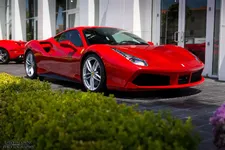


- Messages
- 14,861
- Name
- Derek
My guess is it is an aerodynamic device to direct more air into the radiators?The car is stunning except for that middle piece under the front bumper. WTF is that?
M


Similar threads


- Sticky
- Article
- Replies
- 360
- Views
- 26,388


- Replies
- 511
- Views
- 41,928


Ferrari
Ferrari S.p.A. is an Italian luxury sports car manufacturer based in
Maranello, Italy. Founded in 1939 by Enzo Ferrari (1898-1988), the company
built its first car in 1940, adopted its current name in 1945, and began
to produce its current line of road cars in 1947. Ferrari became a public
company in 1960, and from 1963 to 2014 it was a subsidiary of Fiat S.p.A.
It was spun off from Fiat's successor entity, Fiat Chrysler Automobiles, in 2016.
Official website: Ferrari
Official website: Ferrari
Trending content


-
GERMAN CAR FORUM
German Car Forum is an online community established in 2005, designed for car enthusiasts. It is a member-driven platform and news aggregator, providing the latest information and updates on various automobile brands. -
QUICK NAVIGATION
-
USER MENU