Auto Motor Road test of the 450SEL 6.9 from 1975
Mercedes 450 SEL 6.9
The Mercedes 450 SEL 6.9 sets new standards in the automotive top class. Helmut Eicker wrote the article in issue 21/1975.
There are, of course, a whole series of explanations for Daimler-Benz's long-term business success - even in the crisis year 1974, the Stuttgart carmakers were spared any short-time work - there are of course a whole series of explanations: The careful expansion and model policy as well as the unparalleled cultivation of the diesel passenger car are among the most important.
No less significant for the long-term success of the oldest car factory in the world are also the consistent pursuit of highly developed technology and the best possible quality, for safety and value-preserving model constancy. The Mercedes-Benz 450 SEL 6.9 presented in May can be seen as an eloquent example of this company philosophy, the top model of the S-Class and the successor to the 300 SEL 6.3, which expired in 1972 and had been sold around 6,500 times by then.
While the 6.9 looks rather simple on the outside, it documents its top position within the series with unusually high-quality and extensive equipment.
With the demanding 6.9 project, not only the technical side was treated with extraordinary care - the timing for the start of series production was chosen with care and a lot of intuition: they waited until the discussion about the car became more objective and thus more friendly. No less thorough was the question of how the new flagship should present itself from the outside. After all, the 6.9 competes in the absolute top class of international automobile construction, where representation and prestige play important roles and where not a few potent buyers want to show at first glance in which noble automotive price class they have settled.
In Untertürkheim, however, the decision was made in favor of elegant understatement and encased the elaborate 6.9 technology with the comparatively simple body shape that is also used for the 280 SEL, 350 SEL and 450 SEL models, although, according to Swabian custom, it is not due to the reference to the economic advantages of this solution are lacking. In fact, the top model of the S-Class can only be recognized by the rear label, the standard headlight wipers and the slightly wider tire dimensions. It can already be seen today that the management board's decision to bring the 6.9 into its current form was correct: In order to be able to meet demand, the originally planned production of 1,000 units per year had to be doubled.
With velor upholstery
Functional or safety-related disadvantages did not have to be accepted in any case with the body, which has been in production since 1972. With the high quality level, the generous amount of space, the dignified equipment and well thought-out details such as the dirt-repellent wind deflector profiles in the area of the front, rear and side windows, it still meets the highest demands today.
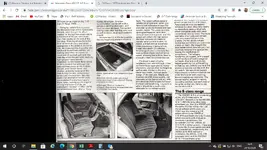
While the normal 450 SEL leaves little to be desired in the body area, the 6.9 also pampers its passengers with a number of valuable, standard equipment details that effectively underline its leading position. An air conditioning system that works according to the refrigerator principle and is integrated into the heating system ensures physical well-being, which is also supported by thermal insulation all-round glazing. The high-quality velor upholstery, the height adjustment on both front seats and the folding armrests on the front passenger seat also convey a sense of well-being, which, however, impairs the easy access to the backrest adjustment.
The 450 SEL 6.9 is characterized by above-average security features and excellent workmanship, as well as extensive, high-quality standard equipment.
While automatic three-point seat belts and headrests on all four seats are used for accident safety, power steering, automatic transmission, central locking and electric, but in the test car, all too leisurely operating window lifters make operation easier. At no extra charge, the 6.9 also comes with a tachometer with an integrated quartz clock and laminated glass on the front and heated rear window, which avoids unnecessary power consumption because the heating switches off automatically after a certain period of time. An automatic timer is also provided for the interior lighting, which does not go out immediately after the door is closed, but only a few seconds later.
A device that is primarily useful for driving on speed-restricted American highways is the so-called cruise control. A small lever to the left of the steering wheel allows you to maintain any speed above 40 km / h without accelerating by tapping it. Even without this technical gimmick, the handling of the test car once again made it clear what an unmatched high quality standard Sindelfingen Karosseriebau is characterized by today. It is evidenced by the soft, yet full slap of the doors, as well as their absolute locking security or the perfect fit of all interior cladding - to name just a few examples.
The spacious interior is characterized by ease of use and high quality.
In contrast to the slightly different exterior, the technology under the body of the 6.9 differs very significantly from that of the sister models. Based on the eight-cylinder engine of the earlier 6.3 liter, an engine was created in Untertürkheim that not only meets the highest demands in terms of performance and smoothness, but also takes into account contemporary requirements for maintenance and environmental friendliness during its development. The increase in displacement, which came about by enlarging the cylinder bore from 103 to 107 mm (stroke 95 mm), was primarily carried out to compensate for performance-reducing emission control measures as well as power-consuming auxiliary drives for hydropneumatics and refrigeration compressors, but it certainly also had prestige. Reasons.
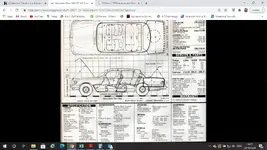
The nominal output of the exactly 6,834 ccm V8 equipped with a Bosch K-Jetronic is an impressive 286 hp at 4,250 rpm. No less impressive is the torque curve, which reaches its maximum of 56 mkg at 3,000 rpm and does not drop below the impressive 50 mkg limit in the wide range from 1,000 to 4,200 revolutions.
The large eight-cylinder impresses with both power and sophistication.
Sports car performance
With these values, the 6.9 is so well equipped that even the high vehicle weight of almost two tons cannot prevent the luxury liner from advancing into sports car-like performance ranges. The measurements carried out by auto motor und sport with this most powerful German sedan resulted in an acceleration from 0 to 100 km / h in 8.2 s, for the kilometer with a standing start it took 28.8 s, and recorded the maximum speed the stopwatches 234 km / h.
If these values are already highly remarkable in themselves, then the way in which they come about in the perfect interaction of the engine and automatic transmission. Despite the weight of the vehicle, the irrepressible power of the equally quiet and supple engine ensures maximum drive comfort and driving pleasure. The rear axle ratio, which is longer than that of the 450 SEL and reduces the engine speed, has a noise-reducing effect. The differential is self-locking with the aid of multi-disc clutches so that the high drive power is safely transmitted to the road.
Not conspicuous details, but emphasized solidity determine the exterior of the 70,000 mark car.
If this measure seems sufficient for driving on dry roads, it can hardly hide the fact that the 6.9 is a little more difficult to handle on slippery roads. A certain improvement, also with regard to the high total weight, could be achieved here by using light metal for the voluminous cylinder block, because in this way the axle load ratio would be divided more favorably.
Other engine details, on the other hand, also appear future-proof in the long term. Dry sump lubrication not only guarantees lubrication reliability in extreme driving situations, but also extends the oil change intervals to 15,000 km due to its large oil volume. Ease of maintenance is also achieved through contactless and therefore wear-free transistor ignition and hydraulic valve clearance compensation. The same purpose is also served by new types of cylinder head gaskets made from Ferrolastic, which make the laborious tightening of the fastening screws superfluous, especially in the case of an eight-cylinder.
With hydropneumatics
The fact that handling the Mercedes 6.9 was an overall impressive experience is largely due to its excellent engine properties. The superior performance potential and the cultivated smoothness help the large-volume eight-cylinder to an absolute top position, which is also given a positive aspect by the fact that the test consumption of 23.2 liters / 100 km is within acceptable limits in view of the driving performance offered and the high vehicle weight held.
The chassis of the 6.9 is at the same technical level as the drive unit. Given the strict standards for driving safety and suspension comfort that are usual at Daimler-Benz, it was no easy undertaking to find an adequate solution in view of the power delivery required by the V8. According to the Mercedes technicians, it was not possible to achieve the desired - naturally very high - comfort results with conventional steel suspension despite the rear axle already used on the 450 SE / SEL with starting torque compensation and braking torque support and with braking support on the front axle. While such problems had led to air suspension on the earlier 300 SEL 6.3 at the time, a hydropneumatic suspension system was awarded on the new 6.9,
The hydropneumatic spring elements were integrated into the coupling axle.
The main advantage of this principle is that the automatic level control, which ensures constant spring travel regardless of the load, means that a considerably softer basic suspension can be selected. This greater softness of the suspension system leads to a more sensitive response compared to the steel suspension, even on small bumps in the floor and thus to an overall improved suppleness. In the case of rough unevenness and sudden acceleration or braking maneuvers, it also leads, in conjunction with the special suspension kinematics on the front and rear axles, to extremely effective stabilization of the body.
Outstanding comfort
The unusually good comfort image is rounded off by low rolling noises, which never have a disruptive effect even with increased air pressure, as recommended for motorway journeys and high loads. Damping rubber mountings between the body and the individual spring elements keep almost all vibrations and oscillations emanating from the wheels away from the body.
Even more than when only the driver is occupied, the high chassis effort is noticeable under full load: While the steel suspension tends to reach the limits of its performance in such situations, the higher system pressure of the hydropneumatics automatically ensures sufficient suspension reserves.
It is to the merit of the Mercedes engineers that, despite the above-average suspension comfort, the driving safety of the 6.9 was not neglected. Starting with absolutely safe straight-line stability at top speed, through problem-free cornering to precise and easy-to-use power steering, the large car always provides stable, smooth contact with the road. The self-steering behavior, which remains largely neutral even in fast corners, only changes into easily controllable oversteer if too much thrust is given to the drive wheels.
In contrast to other sedans designed on one side for comfort, the 6.9 also enables a decidedly sporty driving style at all times. The fact that the brakes sometimes struggle with the powerful heavyweight cannot be overlooked, but there is no need to worry either: the beginning of fading disappears after a very short driving distance, and the brake system is already able to cope with normal stress.
CONCLUSION
If one draws the conclusion from the extensive test program to which the 450 SEL 6.9 was subjected, it is less a single, particularly salient characteristic that fascinates about this car, but rather the unique balance and perfection with which all components are coordinated with one another. Superior performance, dignified equipment and excellent chassis qualities make the 6.9 a car that has no equal in the world.


 www.flickr.com