- Messages
- 87,671
- Rare icon of the 1990s: coveted small series and racing touring car with championship title in 1992
- The super sports car based on the ‘190’ – the first Mercedes-Benz compact class
- One of the brand’s most sought-after younger dream cars
No. 3/2026: Mercedes-Benz 190 E 2.5-16 Evolution II
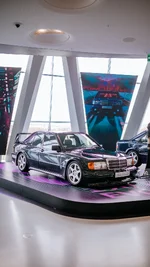
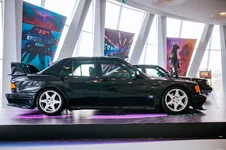
Stuttgart sports badge: Powerful spoilers and aprons, large wheels in flared wheel arches and a huge rear aerofoil: The Mercedes-Benz 190 E 2.5-16 Evolution II, known to fans as the ‘EVO II’ for short, clearly demonstrates its sporting potential even when stationary. This high-performance saloon with road approval finally catapulted the 201 model series into the realm of motor racing. In the 1990s, it was an absolute cult car and today it is an extremely rare and valuable younger dream car.
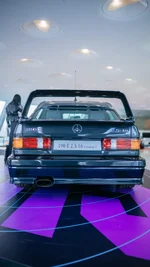
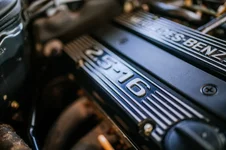
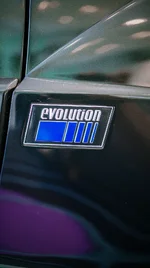
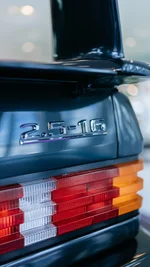
Characteristic features: The series’ top model is immediately recognisable thanks to its body modifications. On the right-hand side of the boot lid, the exhibit sports the iconic number sequence 2.5-16 – a reference to the 2.5-litre high-performance engine with four-valve technology. The discreet badges with the word “evolution” on the wings of this compact class definitively identify the exact model. Only the 190 E 2.5-16 Evolution II has them.
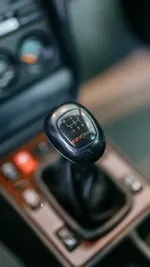
Number 222: Exactly 502 examples of the EVO II were produced as an exclusive series in 1990. They served to homologate the DTM racing touring car, which was put to extremely successful use in the popular racing series from July 1990 and with which Klaus Ludwig became DTM champion in 1992. The special “Youngtimer” exhibition shows vehicle number 222. This is revealed by the individual “222/500” badge on the shift lever of the five-speed transmission. Why the extra two vehicles? To be on the safe side, two more vehicles were built at the time, in order to fulfil the requirements for the homologation of this development stage of the DTM racing touring cars – the requirement was at least 500 units. All EVO IIs were painted in the colour blue-black metallic (colour code DB 199).
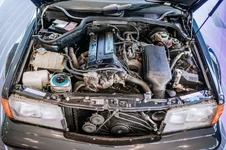
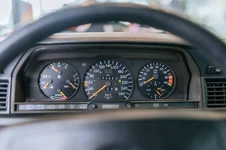
Compact power pack: The EVO II was a super-sporty statement from Mercedes-Benz. Its engine delivers 173 kW (235 hp) at 7,200 rpm, with a top speed of up to 250 km/h – the speedometer scale even goes up to 260 km/h. The M 102 E 25/2 engine is installed at an angle of 15 degrees and designed in line with the DTM technology of the time: the road version of the EVO II has a slightly smaller displacement (bore × stroke: 97.3 × 82.8 millimetres) than the DTM racing touring car (bore × stroke: 97.8 × 82.8 millimetres) – however, both are configured with a shorter stroke than the engine in the 190 E 2.5-16 presented in 1988 (bore × stroke: 95.5 × 87.2 millimetres). In the EVO II racing car, the engine initially produced 245 kW (333 hp) at 8,500 rpm and revved up to 9,500 rpm – in the 1992 master vehicle, it produced up to 274 kW (373 hp).
Optimisation in the wind tunnel: The EVO II was a sensation at the Geneva International Motor Show in March 1990. The sheer size of the light-alloy rear aerofoil was unusual for road-legal vehicles in 1990, and noticeable even to the layman. The aerodynamics of the wing can be finely adjusted using several screws. The rear window is partially covered to improve the airflow. A contemporary comparative photo of the 190 E 2.5-16, EVO and EVO II clearly shows how the body attachments become larger with each stage of development. This superlative car aroused a desire that continues to this day.
Subtle changes: A look at other details on the vehicle in the special exhibition reveals the considerable improvements compared to other “190s”. Some of these are quite discreet and hardly noticeable at first. The Mercedes star is several centimetres further down owing to the large rear aerofoil. The lock in the boot lid of the EVO II is therefore located in the brand logo – a very unusual position.
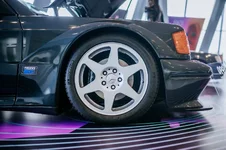
Roman wheels: The EVO II rides on mighty wheels. They fill out the heavily flared wheel arches – especially when the suspension’s three-stage hydraulic levelling system is set to maximum lowering. The 8.5 × 17-inch six-spoke light-alloy wheels with 245/40 ZR 17 low-profile tyres are legendary. Bruno Sacco, head of design at Mercedes-Benz from 1975 to 1999, is said to have commented as follows: “They remind me of a Roman chariot.” This gave the rims the nickname “combat wheels”. Not an entirely inappropriate comparison, as chariot races with modified chariots were among the most popular sporting events in ancient Rome. In a way, these racetracks were the early forerunners of modern circuits.
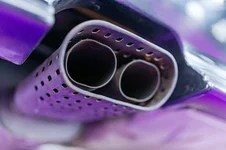
Attention to detail: Many details of the top model in the 201 series show the great attention the engineers and designers paid to this high-performance vehicle in 1990. These range from the perforated heat protection of the twin-flow exhaust system to the design of the interior. On the one hand, there are sport seats with maximum lateral support, and on the other, there is the rare interior trim with chequered fabric, a sunroof, a Becker Grand Prix radio with a cassette player and even air conditioning. The ABS anti-lock braking system came as standard.
Journalists’ favourite: The EVO II in the special “Youngtimer” exhibition was used as a test car for the press in 1990, and then transferred directly to the company’s vehicle collection. The top version of the “190” equipped in this way cost around DM 120,000 as standard. By way of comparison, the 190 E was available for DM 38,455 – less than a third of the top-of-the-range model. This made the EVO II a decidedly exclusive automobile, even at its premiere. Today, the coveted, sporty collector’s item is becoming increasingly valuable.
Continue reading...