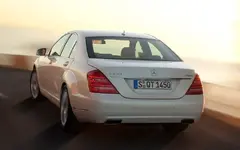
Merc1
Premium
The Lowest CO2 Emissions in the Luxury Segment
Six years ago, I attended the Electric Vehicle Symposium in Long Beach, California, and at the conclusion of a riveting presentation by a major advanced-tech battery manufacturer, a questioner asked about the prospects of lithium-ion batteries for automobiles. The presenter was stony-faced for a few seconds. And then responded with a cocked head "What do you mean by lithium batteries in cars?" Nickel metal hydride was then considered the cutting-edge in battery tech for hybrids, and this question about lithium-ion -- provoked by its chief advocate, the late Dr. Paul MacCready, who was elsewhere in the hall -- seemed beyond the presenter's grasp. The questioner might as well have asked when worm-holes in the fabric of space and time were going to let cars blink from one place to another.
Well, I've just driven the world's first mass-production automobile that employs a lithium-ion battery (the lithium-ion-using Tesla Roadster being a low-production affair). No, it isn't a full electric vehicle as Dr. MacCready would have preferred. But there, tucked in the corner of the Mercedes-Benz S 400 Hybrid's engine bay, was a 32-cell, 120 volt, 0.9 amp-hour, lithium-ion battery about the size of shoebox.
For lithium-ion's first foray into mass-production, the finicky battery type (dogged by YouTube videos of burning laptops) is getting kid-glove treatment. The most important kindness given it is cooling, performed by the AC-system's refrigerant which is circulated by an electric motor (this, required to provide air conditioning while the engine is shut-down.) To give you an idea how pampered this battery is, when we asked how long it'll endure before replacement, Mercedes' engineers responded "It'll last as long as the car itself" That's become a common claim about nickel metal hydride batteries, but I suspect both Tesla's and Chevy's Volt engineers are blanching at that proclamation being applied to lithium.
First Drive: 2010 Mercedes-Benz S400 Hybrid
M