Distronic Plus and Brake Assist Plus Reduce Rear-end collisions by 20%


PanterroR

Lap Time Luminary
Messages
21,867
f42f96cd27e92e639f3fa8af9fd86497.webp


In a recent study conducted by engineers at Mercedes-Benz, it was found that with the help of the company's DISTRONIC PLUS and Brake Assist PLUS, twenty percent of rear-end collisions could have been prevented in Germany alone. Even more noteworthy, the findings also revealed that on motorways, rear-end collisions could have been reduced even further, by an average of 36 percent.

The findings were based on a new procedure developed by Mercedes engineers - one that for the first time makes possible a predictive calculation of the usefulness of new safety technologies. Factors taken into account during the research included both official statistics and the analysis of the approximately 16,000 traffic accidents which have so far been studied within the framework GIDAS (German In-Depth Accident Study), as well as the reconstruction of more than 800 rear-end collisions.

For those of you unfamiliar with either DISTRONIC PLUS and Brake Assist PLUS, the systems are both radar-based, with around 40 percent of new S-Class models already equipped with the technology (and more than 80 percent of new C-Class models). DISTRONIC PLUS operates by keeping your vehicle at a previously chosen distance from the vehicle traveling in front of you, and, if necessary, is capable of braking your vehicle to a complete standstill, depending on the traffic situation.

In the event the traffic you're following slows too rapidly, the system provides a warning and calculates the required brake pressure required to safely stop the vehicle, which is then provided instantaneously by the Brake Assist PLUS system as soon as the brake pedal is depressed. Should you disregard the warning, the PRE-SAFE Brake system performs an emergency partial braking maneuver, significantly reducing the severity of the impact.

As for the potential impact Mercedes' safety systems are capable of making in the real world: in Germany, there are over 50,000 severe rear-end accidents every year, with 5,700 noting death or serious injuries. In the U.S., around 30 percent of all traffic accidents are of the result of rear-end collisions. Reducing both by 20 percent and the severity of even more would without question be a milestone achievement in improving automotive safety.

To learn more about Mercedes-Benz DISTRONIC PLUS and Brake Assist PLUS as well as their contribution to accident prevention, you can find the complete information in the official press release below.


6a5cc03c7de20625fcd70646a804f864.webp
c327b134cb1b2a64028227af1cb94506.webp


fb6d15673df33a35c8419b88cae66b4b.webp
18c7e2db7f24b0c665f4275259ac11dc.webp


d58f33249d602b4fc0ef1f9abb8d4537.webp


OFFICIAL PRESS RELEASE


Recent Mercedes-Benz accident study calculation: 20 percent fewer rear-end collisions thanks to DISTRONIC PLUS and Brake Assist PLUS

Stuttgart - DISTRONIC PLUS and Brake Assist PLUS, the Mercedes-Benz assistance systems based on sophisticated radar technology, make an effective contribution to accident prevention. This is the conclusion reached after an analysis carried out by Mercedes-Benz on the basis of representative accident research data. With the help of this technology an average of one fifth of all rear-end collisions could be prevented in Germany alone. And on motorways, rear-end collisions could be reduced even further: by an average of 36 percent. The Mercedes-Benz systems warn drivers when they are maintaining too little distance from the vehicle traveling in front and provide support in the event of emergency braking.


Engineers working for the Stuttgart-based car manufacturer have developed a procedure which for the first time makes possible a predictive calculation of the usefulness of new safety technologies. For this the specialists have taken into account both official statistics and the analysis of the approximately 16,000 traffic accidents which have so far been studied within the framework GIDAS (German In-Depth Accident Study).

The evaluation of the safety potential offered by the DISTRONIC PLUS and Brake Assist PLUS assistance systems is based on the reconstruction of more than 800 rear-end collisions. The focus of the representative study was the question: how many of those accidents could have been avoided if all the passenger cars had been equipped with this Mercedes-Benz technology?

The results confirmed the great safety effect of the systems: with DISTRONIC PLUS and Brake Assist PLUS an average of more than 20 percent of all rear-end collisions could be prevented. In a further one-quarter of all collisions the systems could contribute to a significant reduction of the severity of the accident.

The greatest safety potential is offered by the interaction of modern radar and braking technology on motorways, where around 36 percent of all rear-end collisions could be avoided.

Around 40 percent of all S-Class saloons equipped with radar technology

The DISTRONIC PLUS proximity control system keeps your vehicle at a previously chosen distance from the vehicle traveling in front and, if necessary brakes your vehicle to a complete standstill, depending on the traffic situation. If the distance to the preceding vehicle narrows down too rapidly, the system warns the driver and calculates the required brake pressure, which is then provided instantaneously by the Brake Assist PLUS system as soon as the brake pedal is depressed. Should the driver disregard the warning, the PRE-SAFE® Brake system performs an emergency partial braking manoeuvre, significantly reducing the severity of the impact.

Since 2005, Mercedes-Benz has offered these radar-based assistance systems for the S-Class, and since 2006 for the CL luxury coupé. Around 40 percent of all German customers buying new S-Class vehicles equip them with this safety technology; while the proportion of CL-Class outfitted with DISTRONIC PLUSand Brake Assist PLUSis even higher, exceeding 80 percent. Since 2005 Mercedes-Benz has delivered a total of more than 45,000 passenger cars featuring these innovative systems.

In order to calculate the safety benefits provided by this technology, Mercedes-Benz specialists make use of relevant data from the individual accidents, such as speed, distance to the other vehicle and driver’s braking behaviour. With these data, together with the governing algorithms of DISTRONIC PLUS and Brake Assist PLUS, the individual speed reduction is calculated. The engineers from Mercedes-Benz decided to apply a conservative calculation principle and did not take into account, for example, the additional safety-enhancing effect of the visual and audible distance warnings which prompt the driver to apply the brakes himself if the system determines it can no longer avoid a collision by itself. The analysis is based on the assumption that the drivers ignore these warnings.

In Germany there are over 50,000 severe rear-end collisions every year, causing death or serious injuries to around 5,700 people. Of all the accidents involving personal injury, one in six is a rear-end collision. In the United States this accident type makes up around 30 percent of all serious traffic accidents.

The engineers of the Stuttgart-based car manufacturer continue to work tirelessly on the development of further driver assistance systems aimed at helping to prevent road accidents.


Source: Distronic Plus and Brake Assist Plus Reduce Rear-end collisions by 20% - eMercedesBenz.com

:t-cheers:
 
Gotta love MB engineers. Such statistics. I used to sweat bullets over such a system, yet it has worked brilliantly in the field.

M
 
An update from the IIHS. ;)


Distronic PLUS and Cornering Headlamps Reduce Accidents!

This is a great little video by the Insurance Institute for Highway Safety (IIHS) reviewing how
certain new safety systems have decreased insurance claims.

To view this content we will need your consent to set third party cookies.
For more detailed information, see our cookies page.


Video Wording translated to Mercedes-Benz Language:

Forward Collision Avoidance Systems = Distronic PLUS with PRE SAFE Brake
Adaptive headlights = Adaptive High Beam Assist
Lane Departure Warning Systems = Lane Keep Assist
Lane Departure Warning Systems that steer the car back = Active Lane Keep Assist
BenzBlogger » Blog Archiv » Distronic PLUS and Cornering Headlamps Reduce Accidents!

HLDI examined forward collision systems offered on Acura, Mercedes-Benz and Volvo vehicles. PDL frequencies for Acura and Mercedes models were 14 percent lower when the vehicles were equipped with forward collision warning with autonomous braking than when they weren't.

http://www.iihs.org/news/rss/pr070312.html

(y)
 
To view this content we will need your consent to set third party cookies.
For more detailed information, see our cookies page.

As Senior Vice President of Engineering at Google, Vic Gundotra has been developing software for most of his life. So if anyone can appreciate the protective potential of the right algorithm, he can. But in this case, Vic's appreciation comes not because of what he does for a living, but because he's experienced it first hand. In this exclusive video, he tells you, in his own words, how the vehicle safety innovations in the S63 AMG may have helped him avoid disaster.

Learn more about the Distronic Plus Collision Sytem and other Mercedes-Benz innovative technologies at:http://www.mbusa.com/mercedes/innovation/advanced_technologies/overview

Join the conversation: http://www.facebook.com/mercedesbenzusa

:)
 
To view this content we will need your consent to set third party cookies.
For more detailed information, see our cookies page.

Significant reduction in accident figures thanks to driving assistance systems: Based on real-world accident profiles

Avoid accidents and reduce the consequences of accidents – this is the integrated approach adopted by Mercedes-Benz Accident Research under the heading "Real Life Safety". Mercedes-Benz is pursuing this strategy systematically with the new, radar-based COLLISION PREVENTION ASSIST system which is standard in all models in the new compact class. The company hopes that this will have a similarly positive effect on the incidence of accidents and their severity as other innovative safety features from the brand, such as ESP®, BAS or DISTRONIC.

Unlike other systems in compact-class vehicles already on the market, COLLISION PREVENTION ASSIST is not intended exclusively to minimise minor accident damage in an urban driving context. Instead, this solution aims to provide protection against typical rear-end collisions in hazardous driving situations at speeds above 30 km/h.


Field tests carried out by Mercedes-Benz in Europe, the US, Japan and South Africa over a total distance of more than 4.5 million kilometres since 2005 confirm that the most critical rear-end collision scenarios arise at speeds above 30 km/h. The speed profile of the tests conducted by Mercedes-Benz closely follows the real-world accident data from GIDAS (German In-Depth Accident Study), the largest project to record accident data in Germany.

Mercedes-Benz expects that COLLISION PREVENTION ASSIST will have a significantly positive effect on real-world accidents comparable to that seen following the introduction of ESP® as standard. Test results reinforce this view: tests involving 110 car drivers in the dynamic simulator saw the accident rate fall from 44 to 11 percent in three typical situations thanks to the combination of collision warning and adaptive braking assistance.

Accident statistics confirm the potential of driving assistance systems

Driving assistance systems make an important contribution to road safety. This is the result of analyses conducted by Mercedes-Benz Accident Research and investigations carried out by the insurance industry as well as independent bodies. A number of success stories can already be reported:

ESP®: following the introduction of ESP® as standard by Mercedes-Benz, the number of driver-related accidents involving the brand's vehicles in Germany fell by 42% (source: evaluation by Mercedes-Benz of the anonymised accident statistics of the Federal Statistical Office). Over 40% of all road traffic fatalities and 20% of those injured on the roads are victims of driver-related accidents.
Brake Assist (BAS): the accident rate for rear-end collisions involving Mercedes passenger cars fell by 8% following the introduction of BAS as standard (source: evaluation by Mercedes-Benz of the anonymised 50% random sample of the 1998-2003 accident statistics of the Federal Statistical Office).
Mercedes-Benz passenger cars equipped with DISTRONIC PLUS are involved in 7% fewer accidents and the material damage they suffer in accidents is 14% lower (source: IIHS Insurance Institute for Highway Safety).
DISTRONIC PLUS and BAS PLUS are capable of reducing the incidence of rear-end collisions by at least 20% and they can reduce the accident severity in 25% of rear-end collisions according to a statistically significant forecast. These figures are based on a study in which the effectiveness of the systems was assessed by retrospectively simulating real-world accident data with known driver behaviours (source: GIDAS German In-Depth Accident Study). Both systems are available for many Mercedes-Benz model series.
The combination of DISTRONIC PLUS, BAS PLUS and PRE-SAFE® Brake, which is also available for various Mercedes-Benz model series, is accompanied by a significant reduction in frontal collisions. This was shown by an analysis of replacement part orders for the Mercedes-Benz S-Class in the years 2005 to 2008. The analysis identified the difference in order levels for replacement parts for the front section of vehicles with and without DISTRONIC PLUS.
Source: Daimler

(y)
 
8b18f03653810e27dd9361dd395d6afb.webp

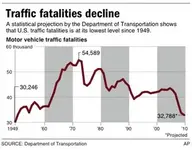
Increase in U.S. highway deaths this year puzzles experts

Calls grow for more bans on texting while driving

WASHINGTON (Reuters) -- U.S. traffic deaths rose 9 percent in the first half of 2012 compared with the same period last year, breaking a 5-year downward trend, according to preliminary data that experts cannot yet explain.

Road accidents killed 16,290 people from January through June, the most since 2009, the U.S. National Highway Traffic Safety Administration said Tuesday in a preliminary report that does not examine causes. A final report of vetted and analyzed data could take a year or more.

In the meantime experts can only guess about the causes, which could be linked to the weather, the economy, gasoline prices or traffic safety scourges such as the increase in texting or the use of synthetic or prescription drugs.

"While it's too soon to speculate on the contributing factors of any increase in deaths on our roadways, NHTSA is closely monitoring the data," administration spokeswoman Lynda Tran said in a statement on Tuesday.

After what the administration called a "historic" downward trend that resulted in a 60-year low for traffic deaths in 2011, "We may just be going back to the way it was before," said Barbara Harsha, executive director of the Governors Highway Safety Association.

Harsha's group advocates bans on texting while driving and the use of any hand-held cellphone. It also favors making it mandatory for convicted drunk drivers to use an ignition interlock device, which forces the driver to blow into an attachment that prevents the car from starting if too much alcohol is detected. Seventeen states require them.

"Clearly there's room for improvement in distracted driving -- we would like all 50 states to pass texting bans," Harsha said. "We'd practically eliminate alcohol impaired driving if we could get all offenders to use an ignition interlock." Source: Automotive News
 

Attachments

2e6f825c72fa50b7dd43ca3961657b76._.webp

Continental says collision-prevention systems that use stereo cameras, shown in testing, identify risks more clearly than radar alone.

f79fc0147ddaf655e3757a8a008ee2a1._.webp

Continental anti-collision systems include Emergency Steer Assist (ESA), pictured in testing, which automatically steers the vehicle around
pedestrians when there is insufficient distance left to avoid hitting them.

Continental develops camera-based collision-prevention system for Mercedes

ALZENAU, Germany -- Continental will begin production of an automatic-braking and pedestrian-detection system for Mercedes-Benz early next year.

The system will be the first unit offered by a major automaker to use a stereo camera to detect and prevent impacts with pedestrians and other obstacles on the road.

The camera will be integrated with a radar system that will offer collision detection of up to 200 meters.

The camera has a shorter object detection range of 35 meters compared with the radar, but its better object recognition allows it to identify and evaluate possible risks with more certainty, avoiding unnecessary intervention of the system for objects such as small animals. The two elements will work in tandem, with the radar identifying hazards and the camera evaluating them.

The system will has a feature called Emergency Steer Assist (ESA) that automatically steers the car around pedestrians when it calculates there is insufficient distance to bring the car to a standstill without hitting them.

The system also has Emergency Brake Assist (EBA) that brakes automatically at speeds of up to 70 km/h (44 mph) when there is an obstacle in the car's path.

A source at Continental told Automotive News Europe that Mercedes would offer the unit as an optional feature on high-end models. Mercedes will debut a new generation of its S-class flagship sedan next year.

Continental offers a range of active safety systems that use camera, radar and laser technology to help drivers avoid hitting pedestrians and other vehicles. In 2008, Volvo Cars was the first automaker to introduce an impact detection system based on Continental's short range Lidar laser system.

Collision warning and avoidance systems are expected to gain popularity among carmakers as Euro NCAP safety standards begin to rate vehicles on their success in avoiding car crashes from 2014 and their ability to prevent injury to pedestrians starting in 2016.

Friedrich Angerbauer, head of Continental's Advanced Driver Assistance Systems (ADAS) unit, declined to comment on which automaker would be offering the system first.
Continental develops camera-based collision-prevention system for Mercedes

(y)
 

Mercedes-Benz

Mercedes-Benz Group AG is headquartered in Stuttgart, Germany. Established in 1926, Mercedes-Benz Group produces consumer luxury vehicles and light commercial vehicles badged as Mercedes-Benz, Mercedes-AMG, and Mercedes-Maybach. Its origin lies in Daimler-Motoren-Gesellschaft's 1901 Mercedes and Carl Benz's 1886 Benz Patent-Motorwagen, which is widely regarded as the first internal combustion engine in a self-propelled automobile. The slogan for the brand is "the best or nothing".
Official website: Mercedes-Benz (Global), Mercedes-Benz (USA)

Trending content


Back
Top