You are using an out of date browser. It may not display this or other websites correctly.
You should upgrade or use an alternative browser.
You should upgrade or use an alternative browser.
Chiron [Official] Bugatti Chiron
- Thread starter DJRaze99
- Start date
-
- Tags
- bugatti bugatti chiron chiron
The Bugatti Chiron is a mid-engine two-seater sports car designed and developed in Germany by Bugatti Engineering GmbH. It was manufactured in Molsheim, France, by French automobile manufacturer Bugatti Automobiles S.A.S.. The successor to the Bugatti Veyron, the Chiron was first shown at the Geneva Motor Show on 1 March 2016.

hoffmeister_fan
Kraftwagen König
- Messages
- 11,262
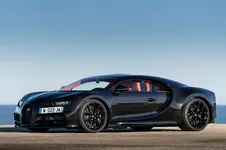
not entirely feeling an all-black Chiron. If you are gonna spend big money, there ought to be some color to highlight its design.


slicknick
Driving Dynamics Pro
- Messages
- 3,541
Only 4 stars from Autocar?
Bugatti Chiron 2017 review
We review the Bugatti Chiron, a 1487bhp £2.5m masterpiece that's set to become the world's fastest production car
What is it?
The Bugatti Chiron is just a car. That’s the thing to remember. Just a car, like any other: four wheels, some seats and a tank of petrol. It’s just that the Bugatti Chiron happens to be a car that’s able to do…what, exactly?
Well, some numbers, if I may. The official figure says the Chiron is able to do 420kph, or 261mph, but that’s misleading because it is both electronically limited and slower than the old Bugatti Veyron Super Sport was when that became the world’s fastest production car at 267.8mph. That had a mere 1183bhp. The new Chiron has 1479bhp to be getting on with. So it ought to go rather faster than the Veyron.
Especially given that the Chiron’s brief was very simple. The simplest that Bugatti boss Wolfgang Dürheimer – once head of Porsche R&D, but by dint of him being brilliant and several of his Volkswagen Group colleagues being suspect, now in charge of both Bugatti and Bentley – had encountered in his career.
“Be better than the Veyron in every respect,” it said.
Which means that, when Bugatti goes back to the Volkswagen Group’s Ehra-Lessien test track with the Chiron next year, to tell us exactly how fast it’ll go, it’ll be a bigger number than that official figure. Bigger than the Veyron Super Sport’s number, Dürheimer says, by a notable amount, although nobody at Bugatti yet cares to speculate how fast that might be. If it were 10% faster, and with 50% more power that’s not unreasonable, that’d be 295mph.
But it won’t be that. The Chiron will go, by my reckoning, only as fast as its tyres will allow before they explode. So my guess is they’ll test some to destruction on an aerospace rolling road, instruct a driver to swallow some brave pills, strap in, hold on and ease off at a few miles per hour under the point of detonation. Let’s call it, for the sake of argument, 275mph (this is my number, not theirs, and if I’m out by 5mph either way, so be it, it’s a plenty big number).
But it’s important because everything else you read about the Chiron here has to be tempered by that fact. A car defined by massive numbers is at once constrained and liberated by that singular top speed. It dominates yet compromises its character. Yes, it’s just a car. But it’s one that’ll do 275mph, and that entirely defines what it is like.

It means, for a start, that when they tell you about it, you stand there and they begin to hand you parts and show you graphs. The pursuit of such a big number is so obsessive that it is easy to get lost in the details. I would need hundreds of pages and minutes to tell you everything, but the short of it is this: the Chiron is a carbonfibre-tubbed two seater with conventionally opening doors. It has an 8.0-litre, 16-cylinder engine in a W configuration, which means four banks of four cylinders around a common crankshaft, the upper two banks with a 90deg V between them, and the lower two another 15deg each side of those. There are four turbos, two of which are blowing all the time and fed by eight exhausts apiece, to minimise what would otherwise be unimaginable lag. The other two are valved, to drop in and out depending on throttle position and rev range, and when they’re ‘on’, each of the four turbos is powered by four exhausts.
That they drop in and out helps to make a near-flat torque curve of 1180lb ft from 2000pm to 6000rpm, a number that seems no smaller no matter how many times you write it. It travels to all four wheels via a revised version of the Veyron’s Ricardo dual-clutch automatic transmission that uses heavier-duty clutches and lighter gears. Power goes mostly to the rear, but with a Haldex coupling pushing it to the front when the rears can’t cope. Which would be often.
Wheel sizes are up by an inch each end over the Veyron, so 20in fronts and 21s at the rear, but tyres are wider at the front (285mm) and narrower at the back (355mm) than on a Veyron Super Sport, for a better handling balance. Yes, Bugatti cares about track times and handling: by its calculations, it would be among the fastest cars in the world around Le Mans, thanks largely to its performance along the Mulsanne Straight.
Being a Volkswagen Group car, the Chiron must work all over the world, and 1479bhp and 1180lb ft wants an astonishing amount of cooling, so although the Chiron is low, at 1212mm, it is 2038mm wide.
Other notable details? Literally hours of them. Turbos that look about 50% bigger than the Veyron’s, a carbonfibre intake manifold, conrods that can take half as much more strain as a Veyron’s but weigh no more, 420mm diameter carbon-ceramic brake discs, a steering wheel milled from a solid piece of aluminium, suspension bushes that contain three different rubber compounds to give different responses laterally, longitudinally and vertically, and the CFRP underbody, flat apart from Naca ducts, a few strakes by the front wheels and a deeper diffuser and constructed from a honeycomb-cored composite that, in thinner form and with a smarter finish, comprises the car’s body – a body whose weave is so exquisitely constructed that you can leave it bare if you like, or colour it mildly through the clearcoat.
I could go on, and I will. The passenger cell is carbonfibre, naturally, but now so is the rear subframe/engine carrier. The engine is put in position at Bugatti’s Molsheim factory and the cell and carrier are assembled around it, joined by just 10 titanium bolts. It has, Bugatti says, a torsional rigidity of 50,000Nm per degree, so racing car levels of stiffness.
The other numbers are equally astonishing: 0-62mph in 2.5sec, 0-124mph in 6.5sec, 0-186mph in 13.6sec. And, let’s say, 275mph.
Never forget the 275mph.
Oh, one more number: £2,518,000, at the exchange rate as I write. There will be only 500 Chirons made, and the truth of it is that £2.5m each is too cheap. Yes, Bugatti will make money on the project, Dürheimer tells me, but not so much that Volkswagen would necessarily have sanctioned it in the climate the company currently finds itself. But still, yes, too cheap: it’s £2m before taxes, so multiply that by the 500 and you have £1bn with which to design, engineer, produce and support an entirely new car that is homologated for sale the world over and which must meet the VW Group’s exacting standards for seemingly trivial but no doubt expensive things like keeping its interior cool when it’s hot and clearing the windscreen when it’s cold. It is, after all, just a car.

What's it like?
Bugatti set out to sell 450 Veyrons, and after painting some of them like Ming vases and by getting pianists to put their name to others, eventually it got through them all, but it didn’t make a bean in the process. This time, Dürheimer says, it knows what it’s doing, so already 250 Chirons are sold and he’s confident of selling the rest. In two years’ time, he’ll have to go back to the VW Group board and pitch for a replacement.
This stuff is important. Not because a £2.5m hypercar matters a jot in the greater scheme of things, but because it is inevitable that more mainstream cars will get faster, stronger and more expensive, and with that will come the trickledown, the democratisation, of ultra-expensive materials and processes that the Chiron spearheads.
Among the materials there is leather, obviously, and metal, obviously, and not a lot else inside the Chiron. It feels beautifully assembled because it will be, but the leather covering is firm, not soft, because you’re aware that with weight to save – hey, we’ve 275mph to do – adding tens of kilos of insulation is a premium one cannot afford.
But there are reminders that this is a £2.5m car, as you’d hope. Stitching is lovely and the gaps between materials are nanometre perfect. The world’s longest automotive lighting bar, it says here, swoops around behind you, enhancing a feeling of separation between driver and passenger while splitting the view rearwards in two and making you wonder how they’ll do a convertible and how much floppier it’ll be.
The seats are supportive, not broad, and electrically adjusted, but the cabin feels wide. The steering wheel gets manual adjustment, a start button, a drive mode selector and shift paddles. The handbrake is electronic, the centre console ultra-slim (hence the swoopy bar, to add perceived width and strength down the car’s centre) and covered in a piece of beautifully machined and satin-polished metal, adorned with knobs that turn with the oiliness of those on a top-end hi-fi. There’s still a special key if you want to unlock the full 261mph top speed and not be limited to 236mph, but these days it lives in a socket in the car, so could as well be a button, which would save weight and not look like a metallised fob from a 2006 Skoda Octavia.

Visibility is pretty average but ergonomics are otherwise straight out of the VW Group handbook. So you thumb the starter like you might in an Audi and the engine fires to a voluble but, from a cylinder-count perspective, indistinct cacophony, and it is ready. Foot on brake, pull gearlever back to D, away you go.
Everything is where you expect it to be. You could be in a VW Golf – a 1479bhp, 8.0-litre, two-metre-wide Golf that can do 275mph or thereabouts, but a Golf nonetheless. I mean that in a flattering way. It’s a remarkable achievement.
The truth is that the road testing part of the experience doesn’t take very long. Not when, despite Bugatti’s assurances that we could test the Chiron properly, it presented us with a vehicle with a top speed of 261mph on roads with a maximum limit of 75mph and reminded us we were responsible for our own licences. I have no idea what the inside of a Portuguese prison looks like and no particular desire to find out, but if I look over my shoulder and whisper, there are things I can tell you.
How fast is it? It’s very fast, obviously, but so are lots of cars. But it is the way it is fast. It’s not fast in a Tesla Model S P100d way. The Tesla is immediate, it gets up and goes before the Veyron has decided which of its turbos to send air through. It isn’t Ariel Atom V8 fast, which is hairy and immediate like a superbike. It’s not even McLaren P1 kind of fast. The P1 has a torque dip-filling electric motor to get it going and, relatively speaking, a race-style engine, two-wheel drive and much less weight.
No, the Chiron has a far more literal interpretation of acceleration than any of these. There’s lag – quite a lot of it usually – before it inhales massively and, about a second after you ask it to, begins to push you along the road, in loping, increasingly urgent strides of noise and blur. It’s not a soulful noise but it’s not unpleasant and it is always overwhelming – like standing next to an express train or hovercraft as it leaves a station or waterside. The Chiron spools and rushes up to the relatively modest speeds I took it to and it simply doesn’t stop. Bugatti’s test driver tells me the car is still accelerating notably when it hits the 261mph limiter. So you lift off when you’re afraid, at which point it whistles and exhales a volume of air like the tube has blown off a bouncy castle. And so do you.
Ride and handling? The former is reasonable and on the road the latter is fairly unapproachable. You can swap between EB mode (the standard one), Highway and Handling but, god, all this ‘making it comfier for this road and stiffer for that one’ business is somehow unbecoming of a £2.5m hypercar.
EB mode adjusts the adaptive dampers’ stiffness automatically, while the other two stiffen their parameters and reduce ride height. But regardless of the mode, body control is always good and the ride always firm yet rarely crashy. In EB the Chiron will even ride Belgian pave, but the key benefit, other than it being less likely to ground out, is that this mode enhances comfort. In terms of that, then, and body control, it’s good, but closer to a Porsche 911 GT3’s level of jarring than a Ferrari 488 GTB’s curious plushness.
Steering weight is good, if unnecessarily heavy in Handling mode, and the self-centering just right. Solidity around the straight-ahead is reassuring (as you’d hope), the lock is mediocre and the directness and feel (or the electrically assisted approximation of it) is decent and about as good as it is in a Golf R, in case you’re thinking of trading up. It grips and it handles up to the point I was prepared to push, given that power arrives in a hurry and you’re driving a car that often feels every inch of its considerable width.

Should I buy one?
Didn’t Ettore Bugatti once say Bentley “built fast trucks”? Well, I don’t mean to be rude, but making a car with a desire to do 275mph while retaining a comfortable, leather and metal-lined interior brings compromises of its own when it comes to agility and driver involvement.
But that’s understandable. Commendable, even. It would have been easy to give the Chiron a vast engine and forget the rest, but that would have been no harder than tuning a Nissan GT-R to 2000bhp. The Chiron is more than that.
When we road tested the Bugatti Veyron Super Sport, people with limited familiarity with the car arrived at our test runway, climbed in, drove at 200mph, drove back to the start and climbed out again. Easy. The Chiron would do all of that but with an extra 50mph, extra luxury, comfort and handling on top. Its crowning triumph is that makes it makes the utterly remarkable seem almost ordinary. Just a car? Some car.
Bugatti Chiron
Location: Lisbon On sale: Now Price: £2,518,000 Engine W16, 7993cc, quad turbo petrol; Power 1479bhp at 6700rpm; Torque 1180lb ft at 2000-6000rpm; Gearbox Seven-speed dual clutch auto; Kerb weight 1995kg; Top speed 261mph (236mph in handling mode); 0-62mph 2.5sec; Economy 12.5mpg; CO2/BIK tax band 516g/km/37%
http://www.autocar.co.uk/car-review/bugatti/chiron/first-drives/bugatti-chiron-2017-review
slicknick
Driving Dynamics Pro
- Messages
- 3,541
From Auto Express:
http://www.autoexpress.co.uk/bugatti/chiron/98993/new-bugatti-chiron-reviewVerdict
5 stars
Some will say the Bugatti Chiron - all £2m and 261mph of it - is utterly pointless. And us? Well, it’s a technological masterpiece. More importantly, it’s a much more rounded machine than its predecessor, the Veyron. More characterful, more connected, more complete. An ultimate statement of speed, capability and kudos. For the world’s car-loving ultra high net worth community, the Chiron deservedly stands alone.

PanterroR
Lap Time Luminary
- Messages
- 21,867
Only 4 stars from Autocar?
Because even Bugatti cannot match the almighty Jaguar... Worrrd!







slicknick
Driving Dynamics Pro
- Messages
- 3,541
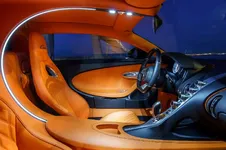
Cannot get over this color combo, still in awe....Me droolsWhat a sinister beast of a car. Despite the recent launches of shiny new cars, the Chiron remains untouched.

- Messages
- 14,859
- Name
- Derek
If it is up to me, I will probably kept the side "C" trim in polished aluminium, or in orange.Cannot get over this color combo, still in awe....Me drools

slicknick
Driving Dynamics Pro
- Messages
- 3,541
Second thatIf it is up to me, I will probably kept the side "C" trim in polished aluminium, or in orange.
lambornima
Porsche Perfektionist
- Messages
- 732
That all black one looks INSANE 
hoffmeister_fan
Kraftwagen König
- Messages
- 11,262
2 things came to my mind upon viewing this
1) I take back my criticism of the all black scheme. Granted, I'd go for another scheme, but it looks properly wide and bad-ass, and
2) It looks like a possessed koala badly in need of an exorcism.
slicknick
Driving Dynamics Pro
- Messages
- 3,541
https://www.driving.co.uk/car-reviews/first-drive/first-drive-review-bugatti-chiron/First Drive review: Bugatti Chiron
Approaching warp speed
15


Published 23 March 2017
By James Mills
Share Article
Pros
- Handling
- Comfort
- Performance
- Interior
- Practicality
- Costs
More arresting than Veyron
Easy to drive
Astonishing engine
Cons
Did you not see the price?
Barely room for a toothbrush and change of underwear
We didn't get to test it on a race track
Specifications
- Variant: Chiron
- Price: £2,506,480 (€2.4m plus taxes)
- Engine: 7,993cc, W16, quad-turbo
- Power: 1,479bhp @ 6,700rpm
- Torque: 1,180 lb ft @ 2,000-6,000rpm
- Transmission: 7-speed automatic, four-wheel drive
- Acceleration: 0-62mph: under 2.5sec
- Top Speed: 261mph (limited)
- Fuel: 12.5mpg
- co2: 516g/km
- Road tax band: Over 255 (£2,000 in first year, then £2,130 a year)
- Dimensions: 4,544mm x 2,038mm x 1,212mm
- Release Date: On sale now
First Drive review: Bugatti Chiron
Approaching warp speed
Excess all areas
At a glance
Pros
- Handling
- Comfort
- Performance
- Interior
- Practicality
- Costs
More arresting than Veyron
Easy to drive
Astonishing engine
Cons
Did you not see the price?
Barely room for a toothbrush and change of underwear
We didn't get to test it on a race track
Specifications
- Variant: Chiron
- Price: £2,506,480 (€2.4m plus taxes)
- Engine: 7,993cc, W16, quad-turbo
- Power: 1,479bhp @ 6,700rpm
- Torque: 1,180 lb ft @ 2,000-6,000rpm
- Transmission: 7-speed automatic, four-wheel drive
- Acceleration: 0-62mph: under 2.5sec
- Top Speed: 261mph (limited)
- Fuel: 12.5mpg
- co2: 516g/km
- Road tax band: Over 255 (£2,000 in first year, then £2,130 a year)
- Dimensions: 4,544mm x 2,038mm x 1,212mm
- Release Date: On sale now
More Info
Published 23 March 2017
By James Mills
Share Article
THERE IS a moment driving the new Bugatti Chiron when you appreciate precisely what it is that the world’s wealthiest individuals are paying for. And that moment happens the first time you floor the throttle and feel the 8-litre, W16 engine passing 3,800rpm.
Before this point, only two of its gigantic turbochargers, which are roughly the same size as your head, are helping force air through the sixteen combustion chambers. At 3,800rpm, a bypass valve opens and two more turbos gatecrash the party and you get an idea of how it must feel when a rogue wave hits a ship.
Where before it felt as quick as the fastest Ferrari, with all four turbos spinning the Chiron feels jet-fighter fast.
“This is what you came for!” the engine seems to shout, as there is a small explosion of power and noise and the world starts to rush by as though Captain James T. Kirk has given the command for warp speed.
There is nothing remotely like it. Which is why, for the world’s wealthiest individuals who like nothing more than to indulge in a spot of one-upmanship, the Bugatti Chiron is worth every penny.
That’s a lot of pennies, by the way. The successor to the legendary Veyron 16.4, which was £810,000 in 2005, costs €2.4m plus taxes, or a shade over £2.5m in today’s money.
But money isn’t an object for the sort of people that will buy a Chiron; Bugatti says that they are typically spending £260,000 personalising theirs. That’s enough for a new Ferrari 812 Superfast.
The likelihood is, however, that they will already own all manner of Ferraris, and any other luxury car you care to mention. Veyron customers owned an average of 42 cars.
In the 12 years since it was launched, nothing has come close to even catching up with the Veyron
So far, half of the 500 Chirons that will be built have been sold. The expectation is that once reviews from a select group of the world’s most prestigious media hit the shelves and start trending on social media and fire up the forums, the task of selling this multi-million pound plaything will take care of itself.
When the Bugatti Veyron first turned a wheel, in 2005, and set its turbochargers whistling like a doodlebug dropping from the sky, it left the world shell-shocked.
The Veyron was a hypercar without peer. But getting to that point pushed everyone involved in the project to breaking point. Like supersonic flight, or putting man on the moon, the engineers had had to venture into unknown territory.
They needed to figure out how to cool a 1,001hp engine that was in the middle of the car, out of the airflow. A gearbox had to be designed that could handle more power than a Formula One car but last for a lifetime, rather than one race. And the tyres should be able to handle being spun at the equivalent to 3,800 times the force of gravity.
The result was a car so fast that, according to Jeremy Clarkson, it made France the size of a small coconut. In the 12 years since then, nothing has come close to even catching up with the Veyron.
Now Bugatti wants to go faster still, and has spent the last five years perfecting its new baby. Next Spring, there will be an attempt to set a new Guinness World Record for the top speed of a production car. The Veyron Super Sport achieved 267.8mph in 2010.
How much faster might the Chiron go? Its electronically ‘limited’ top speed is 261mph. But the bets are on that the Chiron will top 280mph.
To achieve such feats, the W16 engine has been heavily reworked, with a lighter crankshaft, stronger, titanium conrods for the pistons and exhaust system, and a cooling system that can pump 800 litres of water through the engine every minute. At that rate of flow, a bath would be filled to the brim in 11 seconds.
These are merely tinkering compared to the main change: four huge turbochargers, which help generate an additional 500hp over the original Veyron – nearly as much as the engine in a Porsche 911 Turbo.
It takes the motor’s total power output to a comical 1,500hp – 1,479bhp total output. Getting to that point reduced grown men to tears, apparently. But their achievements are celebrated by stamping ‘1500’ on the top of the engine, which is uncovered and visible to the crowds that will gather at the petrol station.
To contain this pent-up energy, there’s a new generation carbon fibre monocoque, claimed to be stiffer than an LMP1 Le Mans racing car. The new Michelin tyres (at £10,000 for four, half the price of the Veyron’s run-flat items) had to be proved safe on a testing rig used for aircraft tyres. The larger brake callipers have pistons made from titanium.
That’s just for starters. New suspension with adaptive dampers and active aerodynamics adapt according to five driving modes and the speed of the car. And in a sign that Bugatti wants the Chiron to be as fun to drive on an Alpine pass as it is impressive to power along a deserted autobahn, the four-wheel drive system has been programmed with an “easy to drift” feature, addressing criticisms of the Veyron’s handling, which, understandably, erred on the side of caution.
Before driving the Chiron, I asked Wolfgang Dürheimer, the man in charge at Bugatti, if it’s noticeably faster than its predecessor. “It smokes the Veyron,” he said. He has raced the two side by side, from a rolling start, and says the Veyron “is a postage stamp in Chiron’s rear-view mirror” by the end of the five-mile straight at Volkswagen’s Ehra-Lessein test track.
I suggest Bugatti is going to need to build a bigger test track for whatever will be the Chiron’s replacement. He thinks I’m serious, and agrees, solemnly.
The Chiron sticks with a proven analogue speedometer. Why? Because when children peer through the windows, they’ll be able to see that it winds all the way around to 310mph
This is a more exciting looking car than the Veyron, one that should do the job of rankling fellow superyacht owners in Monaco harbour. The lower nose, menacing looking headlamps and broader shoulders give it a more muscular appearance, like Daniel Craig in a dinner jacket.
The interior shows off the car’s carbon fibre construction, with acres of the stuff on the centre console, dashboard, doors and steering wheel. The seats are comfortable, as is the driving position, and with relatively slender A-pillars it’s a relief to find the view of the road ahead is better any family car.
While most cars move to all-digital instruments, the Chiron deliberately sticks with a proven analogue speedometer. Why? Because when children peer through the windows, they’ll be able to see that it winds all the way around to 500km/h (310mph).
Despite all this talk of mind-warping power and eye-watering performance, the first impression is that even a grandparent could drive the Chiron to Eastbourne for a day by the seaside. At everyday speeds, it is no more challenging than a Nissan Micra.
The light steering, smooth brake pedal and seamless automatic gearbox make the tiger feel like a pussycat.
Potholes, cobbled roads and speedbumps are all shrugged off by the suspension, as are wayward cambers in the road.
It’s impressive stuff. But it’s only when you find an open stretch of road, free from other traffic, that you get your money’s worth.
Obviously, any car with this much power will be “I think I’ve just had a small accident in my trousers” fast. The Veyron had considerably less power and weighed more than the Chiron, and that car could set eyeballs spinning in their sockets.
But the clever trick with the Chiron is that it’s so docile and measured when pottering around. The throttle, steering and brake pedal all have the sort of perfectly measured, linear progression that lets a driver get to know a car without beads of sweat forming across their brow.
Nothing, however, can prepare you for the first time you pin the throttle pedal to the floor.
The W16 (16 cylinders in a “W” configuration) slams you back into the driver’s seat and the world starts to pass by in a blur. Then, at 3,800rpm, you experience the ‘hyperdrive’ moment. There’s a small explosion of noise, another kick from the engine as the second pair of turbochargers are effectively switched on by a bypass valve, and the Chiron knocks the wind out of you.

From this point, regardless of the gear selected, the Chiron is capable of manipulating the skin on your face. There is a grotesque helping of torque, with 1,180 lb ft from just 2,000rpm — more than twice that of a Porsche 911 Turbo S.
This is the true measure of muscle power, and it’s what gives the car its character. Squeeze the throttle through just half of its travel and you will surge past slower traffic like Valentino Rossi on a superbike at full throttle.
The Chiron is able to power to 200mph in what feels like as much time as it takes to sneeze. At such speeds, it’s as stable as a nuclear bunker.
Yet the eerie thing is that it’s only just getting warmed up. This is where the Chiron laughs in the face of cars from Aston, Ferrari, Lamborghini, McLaren and Porsche. Their fastest machines start running out of puff beyond 200mph. Whereas this one is just getting into its stride.
Bugatti claims it can accelerate from 0-62mph in under 2.5 seconds, reach 124mph in less than 6.5 seconds (the time it takes a Golf GTI to reach 62mph) and hit 186mph in under 13.6 seconds.
At everyday speeds, it is no more challenging than a Nissan Micra
Lifting off the throttle above 112mph, the rear spoiler changes its angle to act as an air brake. So even without touching the brake pedal, there is noticeable deceleration, akin to lifting off the throttle in an electric car as the motors turn into generators and recovery energy to the battery.
Switching to the winding roads outside Lisbon, and respecting all local laws, the Chiron continues to leave your mind boggling. Select the ‘Handling’ mode and the car hunkers down, the steering weights up and you can feel a surprising degree of information about how the tyres are coping with the demands of delivering 1,500hp to the road surface.
It’s composed, planted and feels smaller and more agile than a two tonne, 8-litre machine has any right to. But no matter how long the straights between bends are, they’ll pass by in the blink of an eye. So you’ll never feel more relieved than when you put the brakes to the test, which perform an emergency stop from extreme speeds without a hint of drama.
Pulling over to catch our breath and take photos, the rear spoiler remains raised on its hydraulically powered aluminium legs. Passersby might think the driver’s showing off, but there’s a legitimate reason for leaving the ironing-board wing in the air: it keeps ventilation duct above the exhaust muffler clear, which throws out heat like a white-hot barbeque.
In fact, every aspect of the Chiron’s bodywork has been designed to achieve just two things: cool the engine, so it doesn’t explode at 261mph, and pin the car to the ground, preventing unintended skyward acceleration above 200mph.
There wasn’t the opportunity to test the Chiron’s top speed or spend time with it on a racing circuit. It also comes at a price. But for the world’s wealthiest drivers it will be a price worth paying, and the Chiron has done more than enough to leave us in awe. With it, Bugatti has taken another giant leap forward, showing what man and machine are capable of achieving.
More significantly, it seems the company has built a machine that makes a Veyron feel like it’s got its shoelaces tied together.
Attachments







kingjr9000
Das Beste Enthusiast
- Messages
- 1,763
EVO
Bugatti Chiron review - the £2.5m hypercar we've been waiting for
RICHARD MEADEN
23 MAR 2017
Image 1 of16

Image 1 of 16
VERDICT:
Chiron sets a new benchmark for performance, capability and technology. Crucially it now adds driving enjoyment and engagement to the mix
EVO RATING:
PRICE:
£2.1m (excluding taxes)
FOR:
Performance, driving enjoyment, surprisingly refined
AGAINST:
Price
The simple answer would be the Veyron, but even Bugatti’s first effort pales when compared with the Chiron. More power, more torque and more speed are givens, but Bugatti’s eight-eyed monster also promises genuine tactility for a much improved sense of connection and enjoyment. It also promises even more refinement and even more exploitable performance. In short it promises to re-write the rules.
Engine, transmission and 0-60 time
Don’t be fooled into thinking the Chiron is propelled by a Veyron engine with the wick turned-up a bit. Yes, it’s an 8.0-litre W16 force-fed by a quartet of turbos, but most of the internals are all-new. To produce the power increase the turbos are much bigger than those fitted to the Veyron. Ordinarily this would mean increased turbo lag, but Bugatti engineers have mitigated this by blowing all the exhaust gasses through two of the turbos below 3800rpm, then feeding all four beyond that point. The crankshaft is stronger, but no heavier. The conrods are stronger and lighter. Everything has been subjected to painstaking scrutiny in order to strike a more efficient balance between strength and weight.
Image 2 of16

Image 2 of 16
The result is huge gains in power and torque over the Veyron. Peak power now stands at 1479bhp at 6700rpm, while peak torque is 1600Nm, from 2000rpm all the way to 6000. A truly astonishing figure and the key to acceleration times that blow your mind: 0-62mph arrives in less than 2.5sec; 124mph in 6.5; 186mph in 13.6sec. There’s no official figure for 0-248mph, but its rumoured to be around 30sec.
Technical highlights?
Entire books could be written on the technology contained within the Chiron. The bodywork is super-thin, super-strong carbon fibre with the finest sliver of aluminium honeycomb sandwiched at its core. Likewise the carbon chassis uses the same technology to save weight and add strength. Torsional rigidity is 50,000Nm per degree, flexural rigidity approximately 0.25mm per tonne. That’s comparable to a current LMP1 car.
The Chiron features a fully adaptive chassis that optimises damping, ride height, aerodynamics, steering and powertrain to deliver the right blend of compliance, stability, agility and responsiveness across its unprecedented performance envelope.
Image 8 of16

Image 8 of 16
Michelin has developed new tyres to cope with the demands of running at more than 260mph. An aerospace rig was used to simulate the stresses. The carbon ceramic brakes are 20mm larger (now 420mm front and 400mm rear) and 2mm thicker. These are gripped by all-new forged aluminium calipers - eight-piston at the front, six-piston at the rear - and built to an asymmetrical design to help dissipate the incredible amount of energy generated when slowing the 2-ton Chiron from high speeds. A new design of heat shield guides air through the discs to further aid cooling.
What’s it like to drive?
Down to the nitty gritty, then. With the Veyron it was almost as though Bugatti skipped this all-important aspect, such was the focus on hitting those once-incredible power and performance benchmarks, and making sure it was reliable and drivable.
> Read the latest Bugatti news here
This time around Bugatti knew the Chiron had to back-up the numbers with more feeling and emotion. Pretty much straight away you sense the connection and detail through the steering. Of course there’s tons of grip and unshakable traction - anything less would be extremely negligent given the power and torque on-tap - but it’s the fact you now know how much you’re using and how much is left that marks the Chiron out as something special.
Image 3 of16

Image 3 of 16
Its weight and that endless plateau of torque mean its not a flighty, fighty machine in the style of a P1 or LaFerrari, but it manages to feel both planted and calmly agile. The steering is extremely well-judged in terms of response, so you’re soon guiding the Chiron instinctively. Accurately, too, which is always a confidence booster. It feels a size smaller than it is.
The problem, if you can call it such, is the range and accessibility of the performance. A squeeze of the throttle sends you surging down the road with the insistence of an avalanche. Give it a proper push to the carpet and there’s the briefest sense of the W16 filling its lungs and then you simply punch from where you were to where you were looking, waaaaay down the straight. It’s more like matter transfer than conventional acceleration. Unfortunately it seems to leave your stomach and your senses somewhere in its wake, at least until your brain begins to recalibrate. Nothing in my experience connects the corners quite like this.
> McLaren P1 review
Thankfully the brakes are more than up to the task to stopping the thing. Those super-trick cooling fins without the disc shrouding work a treat, which combined with the airbrake mean you’re in seatbelt freefall when you brake from big speeds. All this stopping power comes with plenty of feel and finesse at lower speeds. Likewise the DSG transmission is super-smooth and virtually instantaneous. When left to shift by itself you’re always in the meat of the torque - hard not to be, truth be told - but it’s also satisfying to flip the paddles yourself.
Image 13 of16

Image 13 of 16
There are four dynamic modes, plus the VMAX mode, which is accessed by a secondary key mounted on the driver’s side door sill. This preps the car for a full 261mph charge, though it defaults back to 236mph if you apply more than a few degrees of steering lock.
Price and rivals
If you have to ask and all that. Still, seeing as you have, a Chiron will set you back £2.1m plus taxes. Of the 500 scheduled to be built, half have already got substantial deposits against them. And all from customers who have yet to drive the car. Around half of those are existing Veyron owners, the rest conquest customers. Amazingly, some have placed deposits on two cars: the first to be delivered as early as possible; the second later in the build phase to allow more time for greater personalisation. Now that’s a classy solution to a decidedly First World problem.
Image 5 of16

Image 5 of 16
Rivals? In all honesty there aren’t any. Texan tuning legend John Hennessey is busy developing his Venom F5 - a 290mph successor to the original Venom, which I drove and loved back in 2013. Knowing Hennessey he would be the first to say his cars are entirely different animals.
> Hennessey Venom GT review
Quite simply nothing combines the Chiron’s civility and savagery. Nor its engineering integrity and impeccable quality. Its capabilities are mind-blowing, its potency almost unimaginable. And yes, its performance - though ridiculously accessible - is all-but unusable unless you’re on a de-restricted autobahn. Something tells me this doesn’t matter a jot to those who will own one. Nor should it to you or I. So let’s just celebrate it for what it is: the most extraordinary supercar the world has ever seen.
http://www.evo.co.uk/bugatti/chiron...review-the-25m-hypercar-weve-been-waiting-for
Bugatti Chiron review - the £2.5m hypercar we've been waiting for
RICHARD MEADEN
23 MAR 2017
Image 1 of16
Image 1 of 16
VERDICT:
Chiron sets a new benchmark for performance, capability and technology. Crucially it now adds driving enjoyment and engagement to the mix
EVO RATING:
PRICE:
£2.1m (excluding taxes)
FOR:
Performance, driving enjoyment, surprisingly refined
AGAINST:
Price
The simple answer would be the Veyron, but even Bugatti’s first effort pales when compared with the Chiron. More power, more torque and more speed are givens, but Bugatti’s eight-eyed monster also promises genuine tactility for a much improved sense of connection and enjoyment. It also promises even more refinement and even more exploitable performance. In short it promises to re-write the rules.
Engine, transmission and 0-60 time
Don’t be fooled into thinking the Chiron is propelled by a Veyron engine with the wick turned-up a bit. Yes, it’s an 8.0-litre W16 force-fed by a quartet of turbos, but most of the internals are all-new. To produce the power increase the turbos are much bigger than those fitted to the Veyron. Ordinarily this would mean increased turbo lag, but Bugatti engineers have mitigated this by blowing all the exhaust gasses through two of the turbos below 3800rpm, then feeding all four beyond that point. The crankshaft is stronger, but no heavier. The conrods are stronger and lighter. Everything has been subjected to painstaking scrutiny in order to strike a more efficient balance between strength and weight.
Image 2 of16
Image 2 of 16
The result is huge gains in power and torque over the Veyron. Peak power now stands at 1479bhp at 6700rpm, while peak torque is 1600Nm, from 2000rpm all the way to 6000. A truly astonishing figure and the key to acceleration times that blow your mind: 0-62mph arrives in less than 2.5sec; 124mph in 6.5; 186mph in 13.6sec. There’s no official figure for 0-248mph, but its rumoured to be around 30sec.
Technical highlights?
Entire books could be written on the technology contained within the Chiron. The bodywork is super-thin, super-strong carbon fibre with the finest sliver of aluminium honeycomb sandwiched at its core. Likewise the carbon chassis uses the same technology to save weight and add strength. Torsional rigidity is 50,000Nm per degree, flexural rigidity approximately 0.25mm per tonne. That’s comparable to a current LMP1 car.
The Chiron features a fully adaptive chassis that optimises damping, ride height, aerodynamics, steering and powertrain to deliver the right blend of compliance, stability, agility and responsiveness across its unprecedented performance envelope.
Image 8 of16
Image 8 of 16
Michelin has developed new tyres to cope with the demands of running at more than 260mph. An aerospace rig was used to simulate the stresses. The carbon ceramic brakes are 20mm larger (now 420mm front and 400mm rear) and 2mm thicker. These are gripped by all-new forged aluminium calipers - eight-piston at the front, six-piston at the rear - and built to an asymmetrical design to help dissipate the incredible amount of energy generated when slowing the 2-ton Chiron from high speeds. A new design of heat shield guides air through the discs to further aid cooling.
What’s it like to drive?
Down to the nitty gritty, then. With the Veyron it was almost as though Bugatti skipped this all-important aspect, such was the focus on hitting those once-incredible power and performance benchmarks, and making sure it was reliable and drivable.
> Read the latest Bugatti news here
This time around Bugatti knew the Chiron had to back-up the numbers with more feeling and emotion. Pretty much straight away you sense the connection and detail through the steering. Of course there’s tons of grip and unshakable traction - anything less would be extremely negligent given the power and torque on-tap - but it’s the fact you now know how much you’re using and how much is left that marks the Chiron out as something special.
Image 3 of16
Image 3 of 16
Its weight and that endless plateau of torque mean its not a flighty, fighty machine in the style of a P1 or LaFerrari, but it manages to feel both planted and calmly agile. The steering is extremely well-judged in terms of response, so you’re soon guiding the Chiron instinctively. Accurately, too, which is always a confidence booster. It feels a size smaller than it is.
The problem, if you can call it such, is the range and accessibility of the performance. A squeeze of the throttle sends you surging down the road with the insistence of an avalanche. Give it a proper push to the carpet and there’s the briefest sense of the W16 filling its lungs and then you simply punch from where you were to where you were looking, waaaaay down the straight. It’s more like matter transfer than conventional acceleration. Unfortunately it seems to leave your stomach and your senses somewhere in its wake, at least until your brain begins to recalibrate. Nothing in my experience connects the corners quite like this.
> McLaren P1 review
Thankfully the brakes are more than up to the task to stopping the thing. Those super-trick cooling fins without the disc shrouding work a treat, which combined with the airbrake mean you’re in seatbelt freefall when you brake from big speeds. All this stopping power comes with plenty of feel and finesse at lower speeds. Likewise the DSG transmission is super-smooth and virtually instantaneous. When left to shift by itself you’re always in the meat of the torque - hard not to be, truth be told - but it’s also satisfying to flip the paddles yourself.
Image 13 of16
Image 13 of 16
There are four dynamic modes, plus the VMAX mode, which is accessed by a secondary key mounted on the driver’s side door sill. This preps the car for a full 261mph charge, though it defaults back to 236mph if you apply more than a few degrees of steering lock.
Price and rivals
If you have to ask and all that. Still, seeing as you have, a Chiron will set you back £2.1m plus taxes. Of the 500 scheduled to be built, half have already got substantial deposits against them. And all from customers who have yet to drive the car. Around half of those are existing Veyron owners, the rest conquest customers. Amazingly, some have placed deposits on two cars: the first to be delivered as early as possible; the second later in the build phase to allow more time for greater personalisation. Now that’s a classy solution to a decidedly First World problem.
Image 5 of16
Image 5 of 16
Rivals? In all honesty there aren’t any. Texan tuning legend John Hennessey is busy developing his Venom F5 - a 290mph successor to the original Venom, which I drove and loved back in 2013. Knowing Hennessey he would be the first to say his cars are entirely different animals.
> Hennessey Venom GT review
Quite simply nothing combines the Chiron’s civility and savagery. Nor its engineering integrity and impeccable quality. Its capabilities are mind-blowing, its potency almost unimaginable. And yes, its performance - though ridiculously accessible - is all-but unusable unless you’re on a de-restricted autobahn. Something tells me this doesn’t matter a jot to those who will own one. Nor should it to you or I. So let’s just celebrate it for what it is: the most extraordinary supercar the world has ever seen.
http://www.evo.co.uk/bugatti/chiron...review-the-25m-hypercar-weve-been-waiting-for

TopspeedPT
Track Technician
- Messages
- 3,752
Similar threads

- Replies
- 650
- Views
- 52,452


- Replies
- 0
- Views
- 88

- Article
- Replies
- 0
- Views
- 71

Bugatti
Bugatti Automobiles S.A.S. is a French luxury sports car manufacturer. The company was
founded in 1998 as a subsidiary of the Volkswagen Group and is based in Molsheim, Alsace,
France. The original Bugatti automobile brand was established by Ettore Bugatti (1881-1947)
in 1909 at Molsheim and built sports, racing and luxury cars. In November 2021, the company
became part of Bugatti Rimac, a joint venture between Rimac Group and Porsche AG.
Official website: Bugatti
Official website: Bugatti
Trending content


-
GERMAN CAR FORUM
German Car Forum is an online community established in 2005, designed for car enthusiasts. It is a member-driven platform and news aggregator, providing the latest information and updates on various automobile brands. -
QUICK NAVIGATION
-
USER MENU