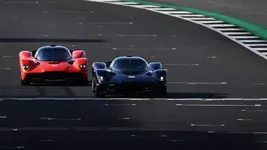
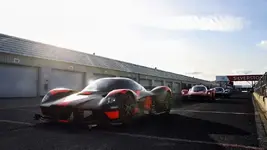
This is how the Silverstone lap times would look, using the info from the Rosberg video:
Valkyrie AMR Pro - 1:23.208 - 105%
F1 - 1:27.369 - 100%
Valkyrie (Track Pack, LRH, Slicks) 1:30.070 - 97%
Valkyrie - (Low Ride Height, Slicks) 1:31.970 - 95%
LMP1 - 1:36.015 - 91.00%
Valkyrie (Low Ride Height) - 1:38.970 - 88.28%
LMP2 - 1:40.948 - 86.55%
LMGTE Pro - 1:54.171 - 76.52%
LMGTE Am - 1:56.034 - 75.30%
GT3 - 2:02.687 - 71.21%
Senna - 2:09.277 - 67.58%
Normally, slicks - when compared to top street legal tires like Trofeo Rs or Cup 2s - are about 2-3s per minute faster, depending on exactly what slick tire you are running and what circuit you are on. Which, incidentally, also means that the Senna still wouldn't quite be able to match a GT3 car

. Perhaps the difference is bigger when very high levels of downforce are present, but provisionally I put the non-slick Valkyrie at being 7s slower. Which would roughly match the "faster than LMP2 on Cup2s" claim.
However, do I think that a car sold to customers will actually be this fast? Not really.
One thing I haven't seen anyone really talk about yet is suspension. Yet it is with suspension that race cars gain a major advantage over any road car - and it is an advantage that you can't simply make up without making the road car undrivable. For example:
Normal cars use something called the Ackermann steering geometry, which basically means that when cornering the inner tire is set to turn slightly more than the outside tire, so that the tires don't slip when having to cover slightly different distances during the turn. However, for complicated reasons having to with slip angles and tire contact patches, racing cars can choose to employ anti-Ackermann geometry to maximize grip on fast circuits. This is something that a road car could never do because doing so actually decreases grip in slower corners, it would destroy tires immediately and it would lead to very bad handling.
To manipulate the size of the tire contact patch during hard cornering, racing cars run a lot of negative camber. Again, on a road car you don't really wanna do dial too much because it results in excessive tire wear and bad handling on any road that isn't completely flat.
Most racing cars have zero KPI to gain camber and therefore grip while turning. This creates a large scrub angle, which results in toe out during braking. That is not a problem if you are mostly always braking while going in a straight line, but is pretty dangerous on road cars driven by people of varying skill, on varying roads, with varying conditions.
Race cars can dial in a lot of caster, which you might not want to do on a road car because it makes the steering very heavy.
Race cars don't have to use rubber inserts in their suspension for comfort, so they get better control over toe angles and other aspects.
There is also a limit to how stiff you can make the suspension on a road car before the car becomes too unstable when driving over bumpy terrain. But if you make the suspension too soft, especially on a car like the Valkyrie, you increase roll... you increase pitch which will mess with the underbody of the car which needs to stay perfectly level for maximum downforce... and your suspension will bottom out under all the downforce the car will be creating. The Valkyrie will have active suspension to deal with this exact problem, but even so, you can only do so much, because the car needs to have spring rates ready to deal with normal roads.
There is more, but to make this short, not only can race cars get away with lots of things that will increase the tire grip
considerably, but they can also be
set up individually for each track. The only thing that the Valkyrie can do is lower its ride height. That might lead to some suspension geometry improvements (in addition to downforce gains), but it might also lead to a lot of drawbacks and it
probably will if the car is set up to handle well while driven on the road with the normal ride height.
My guess is that the simulator numbers being fed to us by Aston Martin are with the Valkyrie having a suspension setup specifically for Silverstone. Which is nowhere close to what the setup will be when the car is sold to customers. So I would put the actual real world number to about 1:50... and maybe something like 1:55 without adjusted ride height - the configuration you will actually be able to enjoy on the road.
But, it's worth mentioning that all I know about suspension I learned from youtube videos, so I might be wrong

.