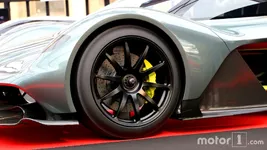
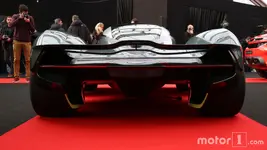
Valkyrie [Official] Aston Martin - From AM-RB 001 to Valkyrie


The Aston Martin Valkyrie (also known by its code-names as AM-RB 001 and Nebula) is a limited production hybrid sports car collaboratively built by Aston Martin, Red Bull Racing Advanced Technologies, and several other parties. Production: November 2021 – December 2024.
Aston Martin AM-RB 001 likely to feature semi-active suspension
Red Bull is recruiting automotive engineers with experience of semi-active suspension and hybrid systems for the hypercar’s development

c9485173c48beec5188f5f1c325e2543.webp


Aston Martin AM-RB 001


Red Bull Racing's recruitment website
39832e018416a33dbbed868c00690ba7.webp

(Adrian Newey's Williams FW14B)

The Aston Martin AM-RB 001 hypercar looks likely to feature semi-active suspension when it arrives in 2018 because project partner Red Bull Advanced Technologies is recruiting engineering experts with knowledge of such systems to work on the car’s development.

A situations vacant advert posted on Red Bull’s website says the company has “a number of exciting opportunities for highly motivated and skilled engineers to join Red Bull Advanced Technologies (RBAT) and to be part of the team working on the groundbreaking AM-RB 001 hypercar”.

Aston Martin AM-RB 001 - what we know so far

The Milton Keynes company is collaborating with Aston Martin on the new machine, the design of which was revealed for the first time in July.

The company is interested in hearing from “experienced engineers within the motorsport and automotive industry”. Significantly, RBAT is looking for a controls engineer with experience of hybrid systems and semi-active suspension.

9ac1363d5206ebe64eb8ffd1f6b70c50.webp


Active suspension is a specialist area for Red Bull design boss Adrian Newey who, together with Aston’s design chief Marek Reichman and special operations chief David King, is leading the project.

Aston Martin would not comment on whether the AM-RB 001 would have semi-active suspension, but project chiefs have previously spoken about the £2-3m car having “innovative” adjustable suspension to ensure it can meet its twin aims of being comfortable enough to “potter down to the shops in”, as Newey puts it, but also cope with substantial aerodynamic loading such as that experienced during high-speed laps of a race track.

The suspension - most likely an inboard pushrod arrangement - will “employ principles honed by Newey over his 30-year career”, as Aston said at the car's launch, and RBAT’s search for an engineer versed in “semi-active suspension” suggests AM-RB 001 could draw on the learnings of some of Newey’s most successful Formula 1 designs.

Whereas today’s fully active suspension systems replace traditional springs with hydraulic actuators controlled by the car’s ECU, semi-active versions use electronically adjusted dampers. They also tend to be cheaper to implement than fully active systems and consume less power.

Although active suspension is now outlawed in Formula 1, Newey was chief designer on the Williams FW14B, which used the system to devastating effect on the track, playing a key role in Nigel Mansell’s world championship victory in 1992.


RBAT is also searching for an electronics engineer who is skilled in areas such as “hybrid installation” and “driver controls” and a mechanical design engineer with knowledge of “automotive drivetrain integration, including hybridisation”.

The AM-RB 001’s main power supply is a bespoke “high revving, high capacity” V12. An F1-inspired energy recovery system (ERS) will also feature and harvest kinetic energy from braking, although it isn’t clear how much it will augment the overall power output, which is said to be in the region of 900-1000bhp. Intriguingly, the company has said the car has no reverse gear, so reversing could be done via power harvested by the ERS.

The task of engineering the AM-RB 001 is being shared between Q by Aston Martin Advanced (the company’s special projects division) and RBAT, with production taking place at Gaydon.

Other jobs up for grabs at Red Bull Advanced Technologies related to AM-RB 001 include a project manager, mechanical design engineers, an aerodynamicist, simulation and modelling engineers and finite element analysis engineers.
 
How Aston Martin and Red Bull Racing Reinvented Car Design
The new AM-RB 001 could usher in an era where even family sedans fly like F-1 race cars

7068defed46fde29d9d2790eb1b132e9.webp
ENLARGE
Aston Martin’s AM-RB 001 will be the world’s fastest street-legal car when it arrives in 2018. And its unprecedented aerodynamics could usher in the ultrafast self-driving vehicles we’ve only seen in science fiction.
One thing unites all cars built for the road, from the dumpiest Chevy sedans to the most erotic exotics. In the eyes of a wind tunnel, they are all pigs.

“What about the almighty sleekness of a Lamborghini or a Ferrari?” you might ask. To the wind tunnel they look like Conestoga wagons, or Spanish galleons, or equestrian statuary. We are talking air resistance here, or drag, caused both by automobiles’ size and irregular shape. Rub your eyes and look again. Bumpers, mirrors, wheels and tires, windshields the size of dining room tables. If the teardrop is nature’s most aero-efficient form, the automobile flies through the air like a kidney stone.

And lift. Ugh. Again, as a wind tunnel sees things, a modern car looks like a wing: flat on the bottom and round on top. The faster you go, the more the wing wants to take flight. Meanwhile, in the few inches of ground clearance underneath the car, hurricane winds pile up to form a ragged zone of high pressure, lifting the car until the tires barely have any purchase.


But what if road cars were shaped differently? What if, rather than becoming draggy and unstable with speed, family sedans became more stable, the invisible hand of the air pressing them to the tarmac rather than prying them loose? Formula One cars do this, and that ability in street-legal vehicles is the missing link between our current predicament and an alternate reality of high-speed mass transportation: silver rivers of cars pouring along expressways at unrestricted speeds. But even the best artificially intelligent autopilot can’t take us there until we fix the hardware, until auto makers teach road cars to stay on the road at 200-plus miles per hour.

Adrian Newey, the chief technical officer for Red Bull Racing, gets paid a lot of money to see things as a wind tunnel sees them. He is the most accomplished race engineer in history, having won 10 F1 constructor’s championships with multiple teams over three decades. But Newey never worked on a road car before the one you see here, the AM-RB 001, a collaboration between Red Bull Racing and the British luxury-car maker Aston Martin. At the July unveiling in Gaydon, England, Aston Martin CEO Andy Palmer pulled the silk off a static model of the car, this lithe and improbable sculpture, suggesting a zero-altitude spaceship, or an animate flow of molten green lipstick. Behold a car that will attempt the previously unthinkable: to deliver racecar-rivaling performance in a drive-to-the-store passenger car with airbags and audio system. And with a fire-breathing V-12 too. Take that, Green Party.

‘If the ideas embodied in here hold sway, future cars could all look very different.’

Only 175 copies of the 001 will be made, 150 street-legal and 25 track-only. Beginning in the first quarter of 2019, they will head out the door for the price of about $3 million each.

Ordinarily, this is the sort of car I love to hate—a grand complication tourbillion of vanity, bought and sold by kings and kleptocrats as a way to keep score of their crimes. Newey feels my pain.

“You could criticize this car as being for a wealthy or privileged few,” Newey says. “And that’s true. But you can equally say that art is pointless because art buyers are in the same category. For me it’s about learning from Aston Martin about road cars, so the technology that goes into this car can be reapplied in more mainstream vehicles.”

The 001’s magic resides in the Newey-designed underbody. By virtue of its remarkable shape, the car generates not lift but what is called downforce—where the force of the air pins the car to the earth—and in unprecedented amounts. The unofficial figure of 4,000 pounds total downforce (track-only package) was whispered to me more in astonishment than confidence. Theoretically the 2,200-pound 001 could drive upside down across the roof of a tunnel, held up only by the force of the aero. Now, that’s stable. If the ideas embodied in here hold sway, future cars could all look very different, reborn in a design language that fundamentally alters the automobile’s historic relationship with the air. Actually stands it on its head.

a3af65beab231fcef62d69cad6d05e10.webp
ENLARGE
With a projected 0 to 200 mph time of around 10 seconds, the AM-RB 001 will be as fast as it is sleek. PHOTO: TOBIAS HURTZLER FOR THE WALL STREET JOURNAL
“This technology can be applied to all cars, absolutely,” Aston Martin chief designer Marek Reichman told me when we met. “Watch this space.”

It seems hard to fathom, in the presence of the 001 model, that anything about it could translate to cars real earthlings drive; yet you don’t have to be an engineer to appreciate the aero-sleekness. “All fast things in nature are beautiful,” Reichman said, as we walked around the model together.

In its way, the 001 points at a glaring absurdity of the world’s fastest cars. At top speed they are practically out of control. The Bugatti Veyron 16.4 Super Sport—world’s fastest production car—tops out at 268 mph. But the 1,200-horsepower, 4,052-pound car can hit that speed only on the virtually endless test track at Ehra-Lessien, VW’s facility in Germany. In order to hit that top speed, the Veyron must lower its stabilizing rear wing, assuming “zero downforce” posture to lower drag. In the words of Bugatti test driver Pierre-Henri Raphanel, the experience is “a little bit scary.”

For the past 60 years, engineers and designers have battled the air with an arsenal of spoilers and rear wings—the kind you’ve seen in “Fast and Furious” movies. But big wings have their own problems. They trade downforce for added drag. So-called adaptive rear wings—rising and lowering on hydraulic struts—add weight and complication. And they look ridiculous parked in front of the club.

The 001 doesn’t have a big wing hidden anywhere. The car’s upper half seems full of volition and art for art’s sake, untroubled by scoops, spoilers or technical surfaces.

“Adrian and I hate big wings,” Reichman says. “Because the lower half of the car is doing all the mechanical work, the upper half offered more design freedom.”

In racing, such downforce-generating forms are known as ground effects. As the name suggests, ground effects work better the closer a car is to the ground. That’s why race cars virtually skim the track.

“The key will be the car’s active suspension,” Newey says, which will allow the 001 to sink lower as the driver requires. The 001’s computers will also realize when it’s on a racetrack and will hunker down to its lowest ground clearance, perhaps just a couple of inches, settling its huge ground-effects ducktail even closer to the deck. The lower the posture, the lower the drag and higher the downforce. That’s the have-your-cake-and-eat-it of sports-car aerodynamics.

Newey didn’t share any details of the 001’s active suspension, but he has been considering the sports-car paradox for decades. “I studied aero at the University of Southampton,” he says. “My final-year project in 1979 and ’80 was on ground-effects aerodynamics applied to road cars and sports cars.”

Other cars use active suspension to gain some ground-effects advantage. The Bugatti Veyron and McLaren P1, for example. But the performance of Newey’s aero-hull is on a different order of magnitude.

“Nothing remotely like it has ever been tried on a road car,” says project engineer David King. “The numbers we are getting in the simulation are amazing.”

Most startling, if the numbers pan out, will be the way the 001 can rip through corners. According to King, the 25 track-only copies of the car will be able to hold the line while cornering at up to four g of lateral acceleration, at which point the average driver’s helmeted head weighs 100 pounds and wants very much to depart its moorings. Most sports cars, even track-ready beasts like a Porsche 911 GT3, struggle to make more than 1.5 g of lateral acceleration.

To a lifetime car enthusiast, much of what Newey, Reichman and King are proposing seems fantastic, or even delusional. Perhaps more futuristic than the aerodynamics is the target for vehicle weight. Built of F1-caliber composites and alloys of unobtainium, the 001 will tip the scales at a mere 1,000 kilos (2,200 pounds dry weight, without fluids).

By way of contrast, the McLaren P1 hybrid—a million-quid, 903-horsepower winged beast, also built by F1 specialists—weighs a whopping 3,075 pounds.

“It’s an extremely tough target for a road car,” Newey says. One small cheat: The 001 will be a bit cozier than your average Aston Martin. It measures only 39.5 inches at the top of its canopied roof. The seat bottoms will be about 4 inches above the asphalt. In order to minimize drag, the canopy is barely wide enough for driver and passenger to sit shoulder-to-shoulder and nearly on their backs, like Gemini astronauts.

“You will have to be good friends,” King says.

But those thousand kilos will have the services of a midmounted, gas-powered V-12 engine producing an even 1,000 horsepower, giving the car true 1:1 power-to-weight; that is, 1,000 horsepower per metric ton.

The Newtonian payoff promises to be world historical, the stuff of laughing-gas dreams: Straightline acceleration of 0 to 200 mph is expected to come in around 10 seconds. Imagine you and your (soon-to-be-estranged) loved one are laced into the custom-molded leather seats, your heels above your hips. Ahead, a dry lake bed. You touch the fuse.

Painful vertigo, blurred vision, heavy chest, butterflies swarm in your bladder…the V-12 engine pitch-soars, bang-bang-bang goes the transmission. Ten seconds later, in the time it took to read the previous sentence, the 001 will be scything the wind at more than 200 mph, still accelerating hard. No telling where your wits will be.

Skittish? The 001’s F1-style brakes should haul the car to a stop from 200 mph in about five seconds. You’ll want to secure loose items in cabin and mouth.

“Everything about making a sports car gets easier with less weight, from cooling to suspension, from handling to tires,” Reichman said. “When you get to 1:1 power to weight, the world changes.”

The McLaren P1 is the most athletic series-production automobile I’ve ever driven. A pro driver can hustle a P1 around Belgium’s curvaceous Circuit de Spa-Francorchamps in 2:38, an outrageous figure for a car that could then drive home on public roads.

At the unveiling in July, Palmer, the Aston Martin CEO, said that the track versions of the 001 would circulate Spa as fast as a Le Mans prototype racer—just under two minutes—at least 38 seconds ahead of the P1, which might as well be a million years from the driver’s seat.

3c64dca1c99de065c7709ae150ffe566.webp
ENLARGE
The 001 could usher in the lighting-fast highways of our dreams. PHOTO: TOBIAS HUTZLER FOR THE WALL STREET JOURNAL
It may seem strange that this avatar of the future should be powered by a technological relic, a gasoline-burning V-12. Amid all the scrounging and wheedling over grams in the months to come, the honking hot dozen looks anachronistic, even willful.

“The V-12 was an emotional choice,” King says. “But cars are not just rational but emotional. There is still something quite charismatic about the sound of a high-revving V-12.”

Is the 001 the top of Mount Petroleum? By virtue of its timing, the 001 could be the last, greatest sports car graced by the holy fire of gasoline, certainly with a churning V-12. From China to California to Europe—especially the exotic-car playground of London—governments are contemplating how to phase out the internal-combustion engine in light vehicles. The Paris climate accords practically require it.

“It’s as inevitable as death and taxes that there will be emissions-free zones in Europe,” Reichman says. The world’s fastest cars will more and more be relegated to track use only, as thoroughbred horses were in the early 20th century. “This car will offer something that perhaps is not repeatable,” the designer says. “And if gas-powered cars are going away, building the 001 will make building the 002 easier.”

The wind tunnels of the future will thank him.
 
d7700b352629ac53fa407dfd6c917416.webp

1. The First Line of Defense (Front nose)
The double-deck front wing acts as an aero-balancing element and keeps the 001’s nose on the ground. The wing’s curvature also helps evacuate air from the hollow space between the wheels, while the wingtip cheats the airflow around the tires.

2. The Emptiness Underneath (Arrow out of rear)
At high speeds, the air flowing under a vehicle gets compressed and pressurized, causing lift. The diffuser under the 001 acts like an inverted wing to accelerate air under the car. Diffusers are essential in F1, but one this elaborate has never been attempted. “It’s the biggest diffuser I have ever seen,” Red Bull Racing's Adrian Newey says.

3. Very Close Quarters (Canopy)

To minimize aero-drag, the teardrop-shaped canopy is small, just wide enough for two grown men to sit (almost) comfortably side by side. Like elite prototype racers, the 001 will have “gullwing” doors that rotate vertically to open up, not out.

4. The Double-Edged Concession (Small spoiler)
Unlike all other “hypercars,” which rely on large and elaborate rear wings, the 001 generates most of its downforce through its shape. But it does have a small double-bladed airfoil positioned in the path of the rear exhaust. Known as a “blown spoiler,” this device creates additional downforce by redirecting the engine’s blast.

5. Trailing Off (Wheel fins)
Normally, a main source of drag is the air that pours off the front tires and under the car. These wheel-wake control vanes deflect that turbulence away from the car, preventing high-pressure stagnation and lift. Also, the designer Reichman says, “The car looked a bit strange without them.”
 
However, the information about the weight could be wrong. Newly always said keeping the weight below a 1000kg, but the times are stating dry weight at a 1000kg(then again, even some car sites get weight wrong).
 
while i am skeptical to 0-200mph since it does have less power and torque compared to the regera/one:1 it also has less drag and less weight, also the quote seems to come from the journalist as there are no credits given, the article does bring some interesting points to the table though

while adrians other creations, the X2010/11/14 can do it easily
 
Lets see how Newly and Aston progress with this project, right now the car still seems like a highly improbable road car.
 
Bugatti Chiron will become pointless if AM-RB 001 can achieve the claimed performance.
 
Quick info on Aston Martin:
- Dealers have received the allocation for the RB 001 (I've heard of one dealer who will receive 3)
- next gen Vantage will look very close to the DB10 and receive a dual clutch transmission (very good news for AM)
- DBX will come next year
- DB11 will receive the V8 next year

DBX
02126db65ac07a2b7c24b1ef5afbc610.webp
 
Bugatti Chiron will become pointless if AM-RB 001 can achieve the claimed performance.

the 0-200 mph claim has no name attached to it, it may be the journalist who came up with it for more clicks, but at this point it's anyones guess
 
- next gen Vantage will look very close to the DB10 and receive a dual clutch transmission (very good news for AM)

Hopefully they have spent more time on the design. In the Bond movie it looked too familiar and unfinished compared with the smoking hot Jaguar CX75.
 
Bugatti Chiron will become pointless if AM-RB 001 can achieve the claimed performance.
In a way the Bugatti Veyron was pointless and same with the Chiron, nobody need a car like that, but people want it, and VW made the cars because they can.
 
Scary stuff at 1:55.

To view this content we will need your consent to set third party cookies.
For more detailed information, see our cookies page.
 
Aston hypercar secrets revealed
December 03, 2016

Aston-Marton-AM-RB-035_Unveiling-Abu-Dhabi_Max-Verstappen_1.webp

All the nitty-gritty on Aston Martin's ballistic AM-RB 001 from the man who's designing it

Aston Martin claims its 150-unit AM-RB 001 hypercar – co-developed with Red Bull Racing – is already four times oversubscribed, despite a $4m-plus pricetag (ex-UK).

Company CEO Andy Palmer says the circa-1000bhp (746kW) tarmac missile will have a “sexy” name (AM-RB 001 is just the internal designation) and will rewrite all performance benchmarks for road-registerable vehicles when deliveries start in late 2018.


Design director Marek Reichman gave motoring.com.au the inside line on the upcoming halo car:

Motoring: Is the biggest difference between the AM-RB 001 and the likes of the LaFerrari, P1 and 918 Spyder the fact it weighs only 1000kg?
MR:
The benefit of being light is that you’re not loading things. Given that it weighs only 1000kg, it means the brakes don’t have to be so big. It means the steering has a great feel. The reason we can keep it to 1000kg is because all the electronics and pipework is sat behind the driver. All the connections for the cooling are in the rear part of the car, so everything is set up in the most efficient way possible. What’s more, everything that takes place in the car, the driver feels. They’re not muted from the experience. It’s powered by a high-revving, naturally aspirated V12, and we wanted this to be the most incredible sounding car out there. You’ll be able to take off any piece of the car and put it up on a pedestal. It will be a piece of art.

How much of what we see here will go into production?
MR:
This is 95 per cent the final car. Now I’m just working on the areas where we need a bit more cooling, or a bit more exiting air, so there’s more airflow around the car. There will also be small cameras integrated into the A-pillars in lieu of wing mirrors. But effectively what you see is how it will be when it’s driving around on the road late next year. The first prototypes will be on the road in late 2017, and then 2018 it will be finished. Deliveries to customers will start in late 2018 and into 2019. The track derivative will be rolled out after the road-going version.

Aston-Martin-AM-RB-001_10-q1h4.webp


Is the V12 in any way related to the existing 6.0-litre unit?
MR:
We haven’t disclosed the capacity yet, but the V12 will be naturally aspirated and displace between 6 and 7 litres… and it will rev to 9500rpm. It’s an all-new engine with a much more open angle between the Vee (the existing Aston V12s are 60-degree units) as we don’t care about the width, but we do care about the height, because we want to keep the centre of gravity as low as possible. It will have a flat-plane crank for the same reason. We’re developing the single-clutch sequential gearbox with Xtrac (which provides the gearboxes for Aston Martin’s race cars), and this is a much lighter solution than a dual-clutch transmission.

I presume the KERS system that supplements the V12 makes use of Red Bull’s know-how?
MR:
It’s kind of a KERS system, but it’s more like a big capacitor. So, if you imagine something that stores energy and provides a boost when needed. It has enough storage to start the car in the morning and drive at low speeds, but it’s not a hybrid system – it’s an 80hp (60kW) KERS boost system in which there’s no need to lug around big battery packs and so forth.

Aston-Martin-AM-RB001_33-uol1.webp


How difficult was it to package the big V12, plus this system into the car?
MR:
It’s difficult, but it’s what we do every day, and it’s what Adrian Newey does every day. If you look at the back of an F1 car with the panels off, now that’s a packaging challenge. The real satisfaction is from creating something where every single millimetre is considered. Nothing is done to excess. Even when we talk about a cut line or surface finish, we calculate weight.

Where on the scale between usability and extreme performance did you and Adrian agree to orient the car?
MR:
The first thing Adrian and I agreed on was that we wanted to be able to get into the car and drive it to the pub, have a glass of water and then drive it away. The idea was that customers should think: “I can’t wait to drive my 001”, even if it’s down to the shops for a pint of milk. Yet they’ll still be able to track the car, even if it’s not the track derivative (which will be rolled out later). So, our ethos was to create a car that can deliver 4.5Gs of lateral cornering, and have acceleration that’s off the charts, thanks to its one-to-one ratio (one bhp per kilo). It can compete with a race-trimmed F1 car, yet you can drive it on the roads… and it’s easy. It’s not an opera-style show and tell. It’s just about the driving.


Aston-Martin-AM-RB-037_Marek-Reichman_Dr.webp


Will you steer clear of driver-assist electronics as much as you can?
MR:
Obviously with this kind of power and performance, you need some electronic traction and stability controls. We have all of that, but we also have direct steering and a naturally aspirated engine. We don’t need a lot of electronic controls in the steering, because the car is light. We use the light weight of the car to enhance the driving feel, and this means you can eliminate a lot of the electronic systems.

Are these powered gullwing doors?
MR:
Yes, it’s a powered gullwing door, so as it opens you can either step into the tub or sit on the sill and then swing your legs into the cabin. This is something that can be elegantly done even by a woman in a miniskirt. Believe it or not, that was one of the considerations! This car is about driveability. We want the owners to use their cars and this means it shouldn’t be intimidating or difficult to use. It’s about getting in the car and driving it.

Aston-Martin-AM-RB001_31-qsjf.webp


What were the parameters for interior packaging?
MR:
I’m six-foot four (1.93m) and I’m the proxy for this car. I can sit in it quite comfortably. It’s a lot like being in the bathtub, you put your head back, you put your feet up, and that’s what you do in the car… you’re literally prone in it. You don’t have to use your muscles, as your head is supported by the headrest. The seat is fixed, but the pedals and column adjust to suit your height. What we’ll do with customers is to fix their seat in the car according to their frame, and put the pedals and steering column in a place where they have a suitable range of adjustment. They’ll be able to move them slightly to get their preferred driving position.

This is obviously a low-volume car, but will you still have to crash-test it to meet regulations?
MR:
Yes, unfortunately we do have to crash-test four cars. But because the car is so rigid, we can do offset barrier, side and rear on one tub. So, we can crash multiple times with one car. The nosecone helps, as the whole front of the car is crash structure.

Aston-Martin-AM-RB001_32-248e.webp


What about pedestrian impact regulations?
MR:
That’s a sharp front splitter on the car… That actually helps, as the legislation is that you have to basically break the ankle to make the pedestrian fall over onto the bonnet. The most difficult cars are the ones that are tall, because how do you possibly break an ankle in that case?

The ride height will obviously be adjustable, no?
MR:
Yes, it will have a riser system for bumps and ramps. There’s also a self-raising function at low speeds, whereby a camera automatically spots speed humps and raises the car. There will also be an active rear spoiler – like an F1-inspired DRS system. But there’s no need for the spoiler to serve as an air brake because the car is very light. You only need an air brake in cars like Bugattis because they weigh 2000kg.

Can you elaborate on the materials used for this car’s construction?
MR:
It’s a mixture of F1-technology carbons and Kevlar where we need to use it. But the great thing about an F1 tub is that there’s different thicknesses of carbon depending on the rigidity required, but always reducing weight. So we’re learning from Red Bull’s F1 expertise in everything we’re doing. The whole car is carbon and titanium, and the wheels are carbon and magnesium. There isn’t a single piece of steel in the whole car. The engine block is aluminium, while the upper components are carbon.

Aston-Martin-AM-RB001_30-ju0t.webp


That aerodynamic channelling under the front looks unlike any other road car out there?
MR:
That was one of the biggest challenges, because you’re basically exposing the chassis to stones etc. We had to do a lot of work in developing the underside, not just in terms of aerodynamics, but also in terms of safety and as a safety cell for the occupants.

Presumably, some 001s will at some point be involved in a crash. Will owners need to then send the damaged car back to the factory for repairs?
MR:
All the dealerships that will sell this car will receive the training to repair it… within reason. But if the damage is severe enough to warrant a chassis scan, then it will need to come back to the factory.

Do you have any Nurburgring Nordschleife and top speed projections?
MR:
We do have a Nordschleife projection, but I’m not in a position to share it. Top speed will be upwards of 250mph (402kph).

There are arguably two great designers working on this car – yourself and Adrian Newey – both with presumably different ideas. Did this result in a lot of conflicts?
MR:
(Laughs) Everybody in the company was worried about the first time we would meet. I’m pretty determined in what I like, and so is Adrian. Luckily we get on like a house on fire. Sometimes we argue a point, but at the end of the day we always find a resolution. That’s why I say we don’t stop at answer number one, two, three or four. Sometimes it’s answer number seven that gives us what we want. We set out to find a solution that isn’t a compromise to either party. We have a very similar philosophy as I like simplicity and purity. Apart from being technically brilliant, Adrian is also an aesthete. He knows what something beautiful looks like. Sometimes those partnerships don’t work but, in this instance, it’s been a very good one.
 
http://www.motorauthority.com/news/...ng-with-cosworth-v-12-175-unit-production-run

Aston Martin hypercar coming with Cosworth V-12, 175-unit production run

0e34162953376ea4eafe4a603c2b320e.webp

Aston Martin AM-RB 001
A year ago Aston Martin came out with the surprise announcement that it was developing a hypercar in partnership with the Red Bull Racing Formula One team. Last summer we received a preview in the form of a concept car and since thennumerous details have emerged.

On Wednesday, Aston Martin added more details to the pile by listing a number of key partners for the project which is still being referred to by the code name AM-RB 001. The list includes legendary engine builder Cosworth, engineering powerhouse Ricardo, carbon fiber specialist Multimatic, and high-performance electric car expert Rimac.

Cosworth, which has decades of experience building F1 engines, has been tasked with developing a 6.5-liter V-12 for the AM-RB 001. We’ve previously heard that the engine will rev to 9,500 rpm and come with a flat-plane crank to ensure a wicked sound.

No power figures have been released but the engine, working in concert with a hybrid system, will deliver enough horsepower to ensure a 1:1 power to weight ratio, measured in horsepower per kilograms. The AM-RB 001 is expected to weigh around 1,000 kg (2,200 pounds), so we should be looking at an output of around 1,000 hp. About 900 hp is expected to come from the V-12 alone.

The engine will be mated to a paddle-shifted 7-speed transmission developed by Ricardo, the same company that develops engines for McLaren’s road cars. Aston Martin says the transmission will adhere to the AM-RB 001’s ethos of “minimal mass and maximum efficiency,” suggesting it may be a sequential transmission rather than a dual-clutch unit.

dcb5b0f2dad1449e7ed703b5ef8a00c9.webp


75ae552a7f8099a74e9e3adc34f2c077.webp


d12a5736f5961ec01a5983c180cd9e2c.webp


Drive is expected to go to the rear wheels only, aided along by the aforementioned hybrid system. This system is designed to provide boost only, as opposed to a full electric mode, and will rely on brake energy regeneration as its primary source of power. Rimac, maker of the Concept_One electric supercar, is developing the lightweight battery for the system.

Meanwhile, Canada’s Multimatic, the same company building the Ford GT supercar and a partner of previous Aston Martin projects such as the One-77 and Vulcan hypercars, is building the carbon fiber monocoque structure for the AM-RB 001, dubbed the MonoCell.

Other partners involved in the project include Alcon and Surface Transforms for the brakes, Bosch for the engine, stability and traction control units, and Wipac for the LED lights.

Separately, Aston Martin has confirmed that just 175 examples will be built. Of the 175 cars, 25 will be track-only versions. The remaining 150 will consist of all road-going versions plus any prototypes. Though both the road and track cars will be extreme, it’s the latter that’s expected to approach or even surpass the performance of an LMP1 endurance racer.

A reveal will take place next year ahead of the start of deliveries in early 2019. By then, Mercedes-AMG will have launched its own hypercar. While the two cars have similar performance targets, designers of the AMG have taken a very different approach, utilizing the turbocharged 1.6-liter V-6-based hybrid powertrain of the current crop of Mercedes AMG F1 cars and combining it with a “through-the-road” hybrid all-wheel-drive system.
 
http://www.astonmartin.com/en/live/...martin-announces-am-rb-001-technical-partners

ASTON MARTIN ANNOUNCES AM-RB 001 TECHNICAL PARTNERS
Published: Feb 14, 2017

Tags:

a60cdb3e5c9869a58b83c3d098b9f7c7.webp

15 February 2017, Gaydon: With design and engineering work on the AM-RB 001 hypercar progressing apace, Aston Martin, Red Bull Advanced Technologies and project partner AF Racing today confirm some of the key technical partners for AM-RB 001.

Working to the exacting brief of both brands, the technical partners have been selected for their unrivalled expertise and willingness to push the performance boundaries. Together with Adrian Newey, Red Bull Racing’s Chief Technical Officer and Aston Martin’s VP and Chief Special Operations Officer, David King and his team, they will embrace the challenges inherent with delivering a car poised to redefine the limits of road car performance.

The heart of every Aston Martin is its engine. Never more so than in the AM-RB 001, which is why it has been entrusted to legendary engine builder, Cosworth. An illustrious name with an impeccable motorsport pedigree, the UK-based company will bring all its Formula One and high performance production engine experience to bear in the design and manufacture of the AM-RB 001’s bespoke, high-revving 6.5-litre naturally aspirated V12 engine.

Mated to AM-RB 001’s all-new engine is a bespoke 7-speed paddle-shift transmission. Designed and manufactured by Ricardo, to Red Bull Advanced Technologies’ specification, the gearbox will be the perfect partner to Cosworth’s V12. Conforming to the radical hypercar’s ethos of minimal mass and maximum efficiency and led by Red Bull Advanced Technologies’ simulation work, Ricardo will deploy intelligent engineering solutions to achieve Newey’s uncompromising goals.

Not content with commissioning the ultimate road-legal internal combustion engine, the AM-RB 001 also boasts a lightweight hybrid battery system supplied by Rimac. Acknowledged as world-leaders in high-performance battery technology, the Croatian-based company has showcased its capabilities with the innovative Concept-One: the world’s first - and fastest - all-electric hypercar.

With lightweight construction paramount the AM-RB 001’s MonoCell is constructed from carbon fibre by world-leading composite experts, Multimatic. A long-standing technology partner on projects such as One-77 and Aston Martin Vulcan, Multimatic will combine its unrivalled manufacturing experience with Red Bull Advanced Technologies’ knowledge gained from the design and build of ultra-competitive, championship-winning Formula One cars.

With a power-to-weight ratio of 1:1 - that’s to say one bhp for every kilogram of kerbweight - the AM-RB 001 requires a braking system that’s more than the equal of its powertrain. Step forward Alcon and Surface Transforms, who together are responsible for supplying the lightweight, high performance brake calipers and carbon discs required to deliver the stopping power.

To guarantee maximum efficiency, performance and dynamic control, electronics expert Bosch has been entrusted with developing bespoke Engine Control Unit (ECU), Traction Control Unit (TCU) and Electronic Stability Programme (ESP) systems for the AM-RB 001, while UK light manufacturer, Wipac, is responsible for the hypercar’s full LED headlamps and tail lamps.

Adrian Newey, Red Bull Racing’s Chief Technical Officer, says of the technical partners supporting the AM-RB 001 project: “Much like Formula One, designing, engineering and building a car like the AM-RB 001 is a massive team effort. To achieve great things you need to surround yourself with the best people. Experience, creativity, energy, diligence and perfectionism are absolute must-have qualities in every area of the project. Having great technical partners such as those working with us is both reassuring and motivating. Together we aim to produce an innovative piece of engineering art.

David King, VP and Chief Special Operations Officer, commented: “Making the AM-RB 001 presents huge challenges. It’s a real test of everyone involved, but that’s as it should be, for we’re genuinely raising the bar with this car. That’s what makes the project so special, and why having the right technical partners is so critical. Some of those names we’re working with are long-standing suppliers of Aston Martin, but there are some new names in there, too. Whether forging fresh partnerships or building on existing relationships, the AM-RB 001 project is a shared engineering adventure we’re all relishing.”

A maximum of 150 road going AM-RB 001s will be built, including all remaining prototypes, with 25 additional track-only versions. First deliveries are due to commence in 2019.
 

Aston Martin

Aston Martin Lagonda Global Holdings PLC is a British manufacturer of luxury sports cars and grand tourers headquartered in Gaydon, Warwickshire, England, United Kingdom. Founded in 1913 by Lionel Martin and Robert Bamford, and steered from 1947 by David Brown, it became associated with expensive grand touring cars in the 1950s and 1960s, and with the fictional character James Bond following his use of a DB5 model in the 1964 film Goldfinger. Their sports cars are regarded as a British cultural icon.
Official website: Aston Martin

Trending content


Back
Top