New electric engine for hybrid vehicles to come from Mercedes-Benz plant in Berlin


MBFanToDeath

Autobahn Adventurer
Messages
881


f932489fb3f65de5057cc77b34c1dc48.jpg


OFFICIAL PRESS RELEASE
Berlin, Mar 30, 2010


  • Site to take over production of a key technology for the future
  • Investment of around EUR 40 million in development and production
  • Historical origins of electric engine construction are in Berlin

Berlin – The Mercedes-Benz plant in Berlin is to produce a new generation of transmission-integrated electric engines for Mercedes-Benz hybrid vehicles from 2012 onwards. As a result of this decision, the site will add a key technology of the future to its production portfolio. The intensive collaboration between the plant and the research and development departments will create excellent conditions for the further development and production of the latest technologies.

Volker Stauch, Head of Powertrain Production at Mercedes-Benz Cars, says: “The electrification of the drive system will play an important part in mobility in the future. The Berlin plant already has a wealth of expertise in the manufacture of electrically controlled components. Through this decision, this site will play an even more important part in shaping the future drive systems portfolio of Mercedes-Benz.”

Thomas Uhr, head of the Mercedes-Benz plant in Berlin, adds: “The whole team in Berlin has worked long and hard on building up the site’s potential in the field of electric mobility. It is thanks to our employees that our overall package has proved convincing. Our goal is to continue to gain points with our services in future and to help shape the age of electric mobility.”

With this decision, Mercedes-Benz Cars is continuing its strategy of building up technology for the electrification of drive systems as a core competence, also in production. The decision to award the contract for the development and production of the new transmission-integrated electric engine to Berlin was made as part of the overall strategy of actively shaping sustainable mobility. As part of this strategy, Daimler has also taken on a leading role in the development and production of battery cells and the future manufacture of lithium ion battery systems in two joint ventures with Evonik Industries AG.

Investment in future technologies

A hall with a surface area of 4,000 m² is currently being converted for the new scope of production at the Berlin plant. The company is to invest around EUR 40 million in total in the development and production of the new engine. The necessary machinery and equipment is to be set up in the new production buildings by early 2011. A total of 50 employees will be involved in the development and production of these electric engines at the site. The engines are expected to be used in Mercedes-Benz hybrid vehicles from 2012 onwards.

The electric engine is a transmission-integrated version, i.e. the electric engine is built in as part of the automatic transmission and can develop an engine power of 15 kW and more. It boosts performance by interacting with the combustion engine and lowers consumption by recovering energy during braking, for example, which charges the battery.

Tradition of electric engine production in Berlin

With a history going back over 100 years, the Berlin plant is firmly rooted in the German capital. The history of the electric engine has its origins here. Even at the end of the 19th century, the electric engine was already being regarded as an alternative to the combustion engine. Motorfahrzeug und Motorenfabrik Berlin-Marienfelde [Berlin-Marienfelde motor vehicle and engine factory], the precursor to the current Mercedes-Benz plant in Berlin, presented its first electric vehicle as early as 1898. The partner for the project was the Columbia Electric Company in Connecticut, USA, which continued to produce electric cars until 1918. The licensing agreement with the Berlin plant, which originated from the company Altmann & Cie. GmbH, was signed in 1897. In 1899, Motorfahrzeug- und Motorenfabrik Berlin-Marienfelde offered four different passenger cars based on the US patent. However, Columbia Electric’s electromobile system was unable to keep up with the rapid development of the combustion engine, and production in Berlin-Marienfelde stopped in 1902. In the same year, Daimler-Motoren-Gesellschaft merged with Motorfahrzeug- und Motorenfabrik Berlin-Marienfelde, following a resolution passed on 16 August.

The Berlin plant currently produces V6 and V8 diesel engines and V12 biturbo engines for the Mercedes-Benz and Maybach brands. It also focuses on product development and production in the area of components and parts.

Dates, figures and facts about the Berlin plant:

Total area: 501,502 m²
Area taken up by buildings: 235,915 m²
Employee numbers (site/MBC share): 2,853/ 2,740
Plant manager: Thomas Uhr
Year plant founded: 1902
Annual production: Engines 104,544
As at: 12/2009

Past and present highlights:

1902 Takeover of Motorfahrzeug- und Motorenfabrik Berlin AG (MMB) by Daimler-Motoren-Gesellschaft (DMG)
1936 Construction of large engines for ships and aircraft and production of off-road commercial vehicles
1962 Plant included in the production network for Daimler-Benz plants
1997 Production of the smart petrol engine begins
2005 Production of the new generation of V6/V8 diesel engines begins
2007 Production of BlueTEC versions of the V6 diesel engine begins

© 2010 The World Of Mercedes-Benz /////AMG. All rights reserved.
© 2010 Daimler AG. All rights reserved.

Source: The World Of Mercedes-Benz /////AMG
 
starting around 2012 or so?


9f708021708e810dfa5518786de3f575.webp


Mercedes-Benz Prepares Big Increase in Hybrid Car Production

Coming Soon: Hybrids in all Mercedes lines, including diesel-hybrids and plug-in hybrids.

Based strictly on past U.S. sales numbers, Mercedes-Benz has not been serious about hybrid cars. Between its Mercedes S400 Hybrid sedan and ML450 Hybrid SUV, the company sold 1,21 hybrid units in 2010—representing 0.6% of the overall hybrid market. Yet, Dr. Christian Mohrdieck, Daimler’s director of fuel cell and battery-drive development, last week told HybridCars.com that Daimler, the maker of Mercedes-Benz vehicles, is making a big investment in hybrids. “In the future, we will have hybrid models in all our car lines,” Mohrdieck said. “This is one step to reduce emissions and increase fuel economy.”

According to Mohrdieck, there will be “bigger numbers” of hybrids coming out in Mercedes’s E-Class, C-Class, R-Class, and M-Class vehicles. He also said that consumers should expect diesel-hybrids and plug-in hybrids in the United States. An S-Class plug-in hybrid concept offering 20 miles of all-electric range was first shown at the 2009 Frankfurt motor show. “Plug-in hybrid is a very good concept for bigger cars, but you have to look at the right balance of battery size and engine size, in order to have the right performance and acceptable cost level,” Mohrdieck said.

f904ea85bd66e9d6e3c6bfe61917b88f.webp


Daimler’s apparent slow start on hybrids could be a matter of perception—when viewing the company’s hybrid production from a global perspective. Mohrdieck said that the overall take-rate of the S400—the number of hybrids sold compared to the same model with a conventional powertrain—is about 15 to 20 percent worldwide. “It’s 15 percent on average, and in some markets it goes up to 20 percent.” Mohrdieck said that “China is crazy about hybrids,” and has become a big market for all Mercedes vehicles, including hybrids.

Meanwhile in the United States, in 2010 Mercedes sold four times as many clean diesel vehicles as hybrids—tallying nearly 8,000 sales or nearly 10 percent of the U.S. clean diesel market.

Dr. Mohrdieck said that Daimler is investing meaningful budgets to battery-electric and fuel cars, but not nearly as much as on internal combustion and hybrid cars, “because they are already high volume products...There will be a lot of hybrids in the near future,” said Mohrdieck.

Mercedes-Benz Prepares Big Increase in Hybrid Car Production | Hybrid Cars
 
I really don't this is the answer, but I guess they have to do it.


M
 
This diesel hybrid might appear at the end of 2011? :t-cheers:
* It's a full hybrid as it can drive on electric power.

* Full consumption is about 25% lower than in an equivalent mild hybrid.


761908_1389489_5616_3744_10C185_04.webp


761911_1389498_5616_3744_10C185_07.webp


761912_1389501_5616_3744_10C185_081.webp


761913_1389504_5616_3744_10C185_13.webp


The E300 BlueTEC HYBRID consumes 4.1 litres of fuel per 100 kilometres (CO2 109 g/km).

It will be launched at the end of 2011


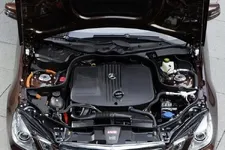
With the E 300 BlueTEC HYBRID, Mercedes-Benz is offering a look ahead to Western Europe’s first diesel hybrid. It pairs a 2.2-litre four-cylinder diesel engine developing 150 kW (204 hp) with a powerful hybrid module. Its 15 kW electric motor, positioned between the internal combustion engine and the 7-speed automatic transmission, assists the diesel engine when the car is accelerating (boost effect) and is used for the recuperation of braking energy in alternator mode, although it is also suitable for driving using electric power alone. Based on the innovative modular system for hybrid vehicles developed by Mercedes-Benz, the diesel hybrid ushers in a new era of hybrid drives. The E 300 BlueTEC HYBRID consumes 4.1 litres of fuel per 100 kilometres (CO2 109 g/km). It will be launched at the end of 2011.

The technical basis for the E 300 BlueTEC HYBRID is the E 250 CDI with a four‑cylinder diesel engine developing 150 kW (204 hp). For the new hybrid model, the Mercedes-Benz engineers have used the fuel-efficient 4-cylinder diesel engine in combination with a compact electric motor developing 15 kW. The electric motor draws its energy from a high-voltage, lithium-ion battery, which has already proven itself in the S 400 Hybrid. Despite the high overall output of up to 165 kW (224 hp) and a torque of over 580 Nm, the E 300 BlueTEC HYBRID consumes no more than 4.1 litres of fuel per 100 km (NEDC), equivalent to CO2 emissions of 109 g/km. Fuel consumption is therefore on a par with extremely efficient small cars, while the hybrid drive system outperforms current six‑cylinder diesel engines in terms of output and driving enjoyment.

The exemplary fuel consumption figures are due in no small part to innovative hybrid components and a sophisticated operation strategy incorporating the following principal features:
  • Even at low revs, the electric motor assists the diesel engine with high torque (boost effect). The result is excitingly high, clearly noticeable agility
  • When driving for longer distances or on the motorway, the intelligent electronics recognise the driving situation and automatically adjust the load point of the internal combustion engine to achieve a lower specific fuel consumption, thereby helping to save fuel and reduce emissions
  • Thanks to a clutch between the engine and the electric motor, the E 300 BlueTEC HYBRID can cover short distances at speeds of up to 35 km/h using electric drive alone. Consequently, the internal combustion engine does not even need to be started in most cases when driving in stop-and-go urban traffic or manoeuvring in parking spaces
  • The internal combustion engine in the new diesel hybrid is switched off as soon as the vehicle starts to coast down from 80 km/h; in this case, the electric motor just keeps the road speed constant. Experts call this effective driving state “sailing”
  • The diesel engine is started smoothly as soon as the driver releases the brake pedal, hits the accelerator pedal or reaches a defined limit speed during acceleration
  • Recuperation starts as soon as the driver releases the accelerator pedal – in this case, the electric motor functions as an alternator and converts the kinetic energy into electrical energy, which is stored in the high-voltage battery. Even when braking, part of the energy is converted into electrical energy
The E300 BlueTEC Hybrid offers all the driving characteristics of a full hybrid, such as purely electric driving, stop/start function, recuperation, boost effect and, for the first time, “sailing” and silent starting of the internal combustion engine by the high-voltage electric motor.

Even with hybrid technology on board, the E 300 BlueTEC still provides hallmark Mercedes-Benz comfort. The air conditioning compressor and the steering are powered electrically, meaning that both systems operate even when the internal combustion engine is not running. What’s more, none of these measures restrict boot space and variability in the slightest, as all of the hybrid technology, including the high-voltage battery, is housed in the engine compartment. This is made possible thanks to Mercedes-Benz’s sophisticated modularisation concept and the extremely compact components.

Mercedes-Benz at the 2010 Geneva International Motor Show: E300 BlueTEC HYBRID | eMercedesBenz
 
That one very economical car and is bound to become a urban favourite for taxi drivers if priced right.
 
4.1 L per 100 km is very good when it's coming from a car like the E-class. I've been impressed with the compactness of Mercedes Hybrid systems. They seem to be really stressing trying to keep the utility of their vehicles while incorporating the hybrid systems. That said I still wouldn't consider the E300 Hybrid Diesel a full hybrid despite the fact the car can move just on the electric motor alone, unlike the S400 Hybrid. So I'm expecting much bigger gains when full hybrids with higher capacity batteries are used with the new MOVE generation engines.
 
Damn. Pretty soon my brand new car is going to have an antique for a motor.
 
an update. Mercedes says to stay tuned. ;)

Rumormill: Mercedes E300 Bluetec diesel hybrid could make it to the U.S.

by Matt Davis (RSS feed) on May 16th, 2011 at 11:31AM

672bd2cf04f839bc106938d989333642.webp


We're about to witness the first-ever mass-production diesel hybrid in this summer's Peugeot 3008 Hybrid4 crossover; this sort of powertrain has had engineers and many consumers drooling for a few years. The miles-per-gallon possibilities and environmental benefits are fascinating right away. All that has held them at bay was the expense of development and production, plus the unwanted risk of passing that big price tag on to buyers.

Mercedes confirms that its E300 Bluetec Hybrid is on the way and will be on sale by the end of 2012. We asked them right away what this means for Mercedes' diesel investment in the United States. The team members in Germany grinned a lot and said they could neither confirm or deny anything at this time. But to stay tuned.

The first viable diesel hybrid from Stuttgart for public consumption was first shown at this past March's Geneva Motor Show. It combines a latest-generation 2.2-liter four-cylinder diesel good for 204 horsepower with an ultra-sophisticated 20-hp electric motor module. Effective combined torque, however, booms out at 428 pound-feet from way down low in the revs, while estimated miles per gallon in European city/highway combined cycle hits 57.4 mpg at its best. For the EPA cycle, knock that down to a more earthbound 45 mpg or so average in normal driving. Still, not too shabby for an E-Class, kids.

The lithium-ion battery assembly used in the E300 Bluetec Hybrid is the same one tried and liked already in the S400 Hybrid. Please, oh, please, get this baby over here for a near-future One Lap of America.

Mercedes E300 Bluetec diesel hybrid could make it to the U.S.
:t-cheers:
 
Two Mercedes-Benz E-Class hybrids to make it to Detroit. ;)


2012_mercedes-benz_e-class_f34_12-de-as_1216111_1600.webp


2012_mercedes-benz_e-class_r34_12-de-as_1216111_1600.webp


2012_mercedes-benz_e-class_cc_12-de-as_1216111_1600.webp


2012_mercedes-benz_e-class_eng_12-de-as_1216111_1600.webp


2012_mercedes-benz_e-class_ip_12-de-as_1216111_1600.webp


2012_mercedes-benz_e-class_tag_12-de-as_1216111_1600.webp


2012_mercedes-benz_e-class_tag_12-de-as_1216112_1600.webp


2013 Mercedes-Benz E400 Hybrid To Debut: 2012 Detroit Auto Show

By Paul Lienert, Inside Line

Just the Facts:

Mercedes-Benz will unveil two new hybrid versions of its midrange E-Class — one diesel, one gasoline — at the upcoming Detroit auto show in January.
The gasoline-electric E400 Hybrid is intended initially for the U.S. market and eventually will be sold in China and Japan.
The diesel-electric E300 Bluetec Hybrid will go on sale first in Europe, and will be available as a sedan and a wagon.


STUTTGART, Germany — Mercedes-Benz will unveil two new hybrid versions of its midrange E-Class — one diesel, one gasoline — at the upcoming 2012 Detroit Auto Show in January.

The gasoline-electric E400 Hybrid is intended initially for the U.S. market and eventually will be sold in China and Japan. The diesel-electric E300 Bluetec Hybrid will go on sale first in Europe, and will be available as a sedan and a wagon.

The heart of both models is what Mercedes-Benz calls the "intelligent modular hybrid concept," which features a lithium-ion battery pack and a 20kW electric motor that produces 184 pound-feet of torque. The hybrid powertrain can accommodate either a diesel or gasoline engine, and includes a stop/start system to enhance fuel economy and reduce emissions, as well as regenerative braking to help keep the battery charged.

The E400 Hybrid mates the electric motor to a 3.5-liter V6 gasoline engine rated at 302 horsepower and 273 lb-ft of torque. The combination should achieve projected EPA fuel economy of 24 mpg in city driving and 31 mpg on the highway, compared with 20/30 for the standard 2012 Mercedes-Benz E350 sedan.

The E300 Bluetec Hybrid couples the electric motor with a 3.0-liter V6 turbodiesel that makes 201 hp and 369 lb-ft. Combined fuel economy on the European test cycle is projected at 56 mpg.

Mercedes-Benz said it will be the first premium manufacturer to offer a diesel-hybrid production model in Europe.

Inside Line says: It will be interesting to see if Mercedes-Benz shares the hybrid system with Nissan — and which Nissan and Infiniti models might be the recipients.


PS. The M35h is good, maybe Mercedes can learn from Nissan? Infiniti M35h Hybrid Named To Wards Top 10 Engines

de5c61dde649e0d4947e5687736e55cb.webp

:t-cheers:
 
4.2l/100km for a large sedan like the E..is amazing..
 
c72f101ec7498dc77c121638c98facff.webp
f8fedf901e32e81de0a4b2aebbd46df4.webp


Mercedes-Benz launches hybrid offensive: The world's most economical luxury-class model

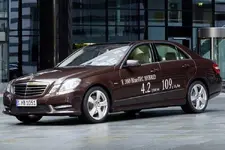
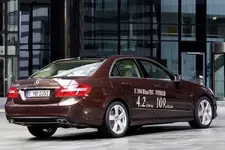
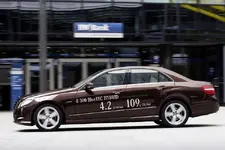
Mercedes-Benz E 300 BlueTEC HYBRID: 4.2 l of diesel/100 km, 109 g of CO2/km
Mercedes-Benz E 400 HYBRID: fuel economy of 27 mpg
More torque and performance without compromising on space and usable boot volume
Available in Saloon and Estate versions (E 300 BlueTEC HYBRID)
Modular hybrid concept using lithium-ion batteries
Reduction in CO2 emissions and fuel consumption of around 15 percent compared with the E 250 CDI
Impressive driving experience thanks to start/stop function, regenerative braking, boost effect, purely electric motoring and "sailing" function


Mercedes-Benz is opening a new chapter in its brand's core segment and at the same time setting new standards for luxury-class business vehicles: the E 300 BlueTEC HYBRID, available as a Saloon and Estate, impresses with new record values when it comes to efficiency. It boasts exemplary consumption levels (4.2 l/100 km[1]) as well as impressive performance: the 4-cylinder diesel engine of the E 300 BlueTEC HYBRID has 150 kW (204 hp) and 500 Nm. Combined with an electric motor producing 20 kW and 250 Nm, this results in a coherent overall concept. The E 300 BlueTEC HYBRID is the most economical luxury-class vehicle in the world.

The V6-cylinder petrol engine in the E 400 HYBRID produces 225 kW (306 hp) and 370 Nm, and is also supplemented by a further 20 kW and 250 Nm from the electric motor. The consumption figures based on the American CAFE standard are: City 24 mpg, Highway 31 mpg, Combined 27 mpg.

"With these two E-Class models we are now continuing our comprehensive hybrid offensive. The modular technology opens up a quick way for us to complement other model series with hybrid models", explains Professor Dr. Thomas Weber, Daimler Board Member for Group Research and Head of Mercedes-Benz Cars Development. "With a clear focus on the different requirements of global markets, we are able to offer precisely the models which our customers want. The E-Class hybrids provide a clear reduction in consumption as well as a very impressive driving experience: they represent hybrid motoring at the premium level."

The new models do not require their passengers to have to compromise when it comes to space, however, whether in terms of the interior or the luggage compartment. And there are also additional benefits to the intelligent modular hybrid concept, which represents a comprehensive enhancement of the Mercedes-Benz S 400 HYBRID which has advanced to the position of clear market leader since 2009: no changes to the vehicle body are required, the hybrid module is both flexible and modular, thus allowing its use in other model series, and in addition to diesel and petrol variants there will also be right-hand drive variants. Meanwhile, the extra cost involved here is only moderate. The new hybrid models will be celebrating their world premiere at the Detroit Motor Show (14 to 22 January 2012) and will appear on the market over the course of the year. The E 300 BlueTEC HYBRID is initially planned to be launched on the European market, while the E 400 HYBRID will be made available on the American market first, followed by other countries such as Japan and China later.


Highlights of the E 300 BlueTEC HYBRID at a glance:

- Compact, intelligent and modular hybrid concept: no changes to the body of the base vehicle are necessary
- Also available as an Estate
- Space, safety and comfort remain unchanged
- No compromises in terms of space, safety and comfort
- Significant increase in comfort with start/stop operation; noiseless start, complete climatic comfort
- Top marks for consumption in the luxury-class business vehicle segment: 4.2 litres/100 km, 109 g CO2/km
- Part of the intelligent downsizing strategy of Mercedes-Benz: increase in the engine output of the E 300 BlueTEC HYBRID with 150 kW + 20 kW electric motor/500 Nm + 250 Nm, compared with the E 250 CDI (150 kW/500 Nm), positioning it at the same level as the E 300 CDI (170 kW/540 Nm)
- Fuel savings of around 15 percent compared with the E 250 CDI – even in actual road traffic conditions
- Impressive hybrid driving experience (start/stop function, regenerative braking, boost effect, purely electric motoring and "sailing" function)


Highlights of the E 400 HYBRID at a glance:

- Compact, intelligent and modular hybrid concept: no changes to the body of the base vehicle are necessary
- No compromises in terms of space, safety and comfort
- Significant increase in comfort with start/stop operation; noiseless start, complete climatic comfort
- Consumption combined (CAFE): 27 mpg
- Part of the intelligent downsizing strategy of Mercedes-Benz: increase in the engine output of the E 400 HYBRID by some 20 kW and 250 Nm thanks to the electric motor
- Impressive hybrid driving experience (start/stop function, regenerative braking, boost effect, purely electric motoring and "sailing" function)

[1] All consumption and performance figures are preliminary figures based on the Saloon model, as at December 2011

Mercedes-Benz launches hybrid offensive: The world's most economical luxury-class model | Daimler Global Media Site > Mercedes-Benz Cars > Mercedes-Benz P. Cars > E-Class

:t-cheers:
 
Is the E300 BlueTEC HYBRID for real this time or is it another concept?

They appear to be for real this time around? :)

"The new hybrid models will be celebrating their world premiere at the Detroit Motor Show (14 to 22 January 2012) and will appear on the market over the course of the year."
 
So the E400 Hybrid will compete with the ActiveHybid 5?

Depends? The E400 HYBRID starts on the American market. :)

"The E 300 BlueTEC HYBRID is initially planned to be launched on the European market, while the E 400 HYBRID will be made available on the American market first, followed by other countries such as Japan and China later."
 
Car and Driver on the E400 HYBRID.


2013 Mercedes-Benz E400 Hybrid

Facing hybrid mid-sizers from every major competitor, Mercedes-Benz gets on board.

DECEMBER 2011 BY ALEXANDER STOKLOSA

Mercedes-Benz must like variety. It refuses to adhere to a single way of building fuel-efficient cars. The M- and S-class have both offered buyers a choice of hybrid and diesel powertrains, and now the company is taking that approach with the E-class as well. At the upcoming Detroit auto show, Mercedes will debut the 2013 E400 hybrid, which joins the diesel E350 BlueTec.

The E400’s hybrid system is an evolution of the larger S400’s setup (as opposed to the more complex unit in the last-gen ML450 hybrid). The S-class pairs a 275-hp, 3.5-liter V-6 with a 20-hp electric motor, while the E400 gets a 302-hp, direct-injection, 3.5-liter V-6 and a 27-hp electric motor. In both cars, the motor is sandwiched between the gas engine and a seven-speed automatic transmission. The major difference between the two systems has to do with their respective electric motors and their operating capabilities. The S400’s motor produces 118 lb-ft of torque, while the E’s makes 184. The S400 can’t move without the gas engine firing, but the E400 can go up to 22 mph and cover up to half a mile on the electric motor alone. As in the S400, a stop/start system and regenerative braking are standard in the E400, and both cars house their lithium-ion battery packs in the engine bay. This placement means they avoid the reduction in trunk space that most other hybrids suffer.

998fa319ce2071e854c1c9c7da663416.webp


The hybrid tech boosts the E-class’s fuel economy to an estimated 24 mpg in the city and 31 on the highway, increases of 4 and 1 over the gas-only E350. The diesel E350 returns 21 mpg in the city and 32 on the highway. You may be thinking, “Why doesn’t someone make a diesel hybrid to create the ultimate fuel-sipping combo?” Mercedes is introducing just such a car alongside the E400—the E300 BlueTec hybrid. While the E400 will go on sale here in the second half of 2012, the diesel hybrid is for the European market alone.

The E400 hybrid may seem redundant with the E350 BlueTec already in Mercedes’ U.S. lineup. But diesels remain something of a niche product here, and the E-class’s major competitors from BMW, Audi, Infiniti, and Lexus either are available as hybrids or will be in the next year. That’s a lot of variety, but not, we imagine, necessarily the kind Mercedes likes.

2013 Mercedes-Benz E400 Hybrid – Auto Shows – Car and Driver

:t-cheers:
 

Mercedes-Benz

Mercedes-Benz Group AG is headquartered in Stuttgart, Germany. Established in 1926, Mercedes-Benz Group produces consumer luxury vehicles and light commercial vehicles badged as Mercedes-Benz, Mercedes-AMG, and Mercedes-Maybach. Its origin lies in Daimler-Motoren-Gesellschaft's 1901 Mercedes and Carl Benz's 1886 Benz Patent-Motorwagen, which is widely regarded as the first internal combustion engine in a self-propelled automobile. The slogan for the brand is "the best or nothing".
Official website: Mercedes-Benz (Global), Mercedes-Benz (USA)

Trending content


Back
Top