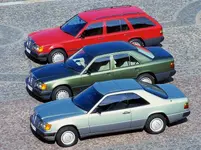
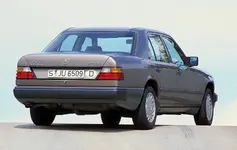
The W124 design story from "Auto and Design Magazine" dated March 1985
And also very interesting reading of the full history and models brought out in the nearly 12years of production:
Mercedes E-class W124 – Young Classic Car
Mercedes-Benz introduced the name in the Mercedes E-Class W124 series
A wide variety of models and body variants
Innovations range from 4MATIC to clean diesel engines
Mercedes E-Class W124
When Mercedes-Benz introduced the W124 series sedan in November 1984 they caught the attention of dealers and the public. But this premiere 30 years ago will be the last for the time of production until 1997 Series invariably apgreidvana of firsts. And for the first time in the winter of 2009, the 124 took its first steps towards becoming a Young Classic. Since 1993, the W124 series was designated the first Mercedes E-Class, this is the first car Mercedes-Benz 4MATIC function with automatic all-wheel drive back in 1985, and in 1990, Mercedes-Benz E 500 was the first midsize model equipped with a V8 engine. These stages provide the framework for a biography of this model series, which appeared not only as Sedan, wagon, coupe and convertible, but also as chassis Sedan long wheelbase versions, and as such served six major players – Mercedes model initiative -Benz.
The first generation of this midsize sedan made its debut at the end of November 1984 in Seville, Spain. Mercedes-Benz presented the eagerly awaited new saloon (W 124 series) in the upper midsize segment 200 D, 250 D, 300 D, 200, 230 E, 260 E and 300 E. In addition, 200 E version for export to Italy. In terms of design and engineering the number of elements of the 190 model (W 201), the predecessor of the C-Class from 1982. Parallel to the compact class was evident, for example, the use of high-strength steel and other materials to reduce weight.
Despite the lightweight design engineers Mercedes-Benz, made further safety improvements – thanks in part to innovative methods of design and development. For example, the 124 series is the first model of the vehicle, subject to the Mercedes-Benz not only classic crash tests, but also the computer accident simulation. The passenger cell is extremely rigid in terms of side impact and sustainability and resistance to rollover and is equipped with ingenious front and rear crumple zones. Salon midsize series also meets the criteria for an asymmetrical frontal collision with 40 percent overlap at 55 km / h In addition, potential areas of contact with pedestrians and cyclists were designed to absorb the energy of impact should the situation arise.
Elegant lines enhanced environmental performance
Mercedes E-Class W124
Developed by Bruno Sacco (Bruno Sacco), Galitzendorf Joseph (Joseph Gallitzendörfer) Pfeiffer and Peter (Peter Pfeiffer), the logic of the design of the saloon was pragmatic and functional. Characteristic rear end, for example, is particularly advantageous in terms of drag. Aerodynamic optimization of the new sedan (drag coefficient of Cd = 0,44 in the W 123 series to Cd = 0,29 or 0.32 in the W 124 series, depending on engine type) reduces fuel consumption significantly compared to previous model. In 1984 there were few differences in design between the powerful six-cylinder models and the four-cylinder variants with moderate power. Externally all models are identical except for the rear silencer with a six-cylinder models with two tailpipes, and additional air vents in the front spoiler and 300 D models equipped with air conditioning.
Engineers develop from scratch a number of W124 series engines. All new, for example, six-cylinder engines with direct injection models 260 E (kV/170 125 hp) and E 300 (140 hp kVt/190). All three diesel engines for the new Diesel generation of 124 – 200 D (53 kVt/72 hp), 250 D (66 kW / 90 hp) and 300 D (80 kVt/109 hp) – were designed as a modular series. Eccentric-sweep windshield wiper to clean the panoramic windscreen made its debut in the W 124. She cleans 86% of the windscreen – the largest swept area in the world of cars during the launch of the W124. Outstanding ride characteristics on the other hand, are provided by the tried and tested front and rear axle design from the compact class. This incorporated a shock another nest independent front suspension with feature anti-dive control and an independent multi (multi-link/multi-link) rear suspension.
Saloon’s big brother: the Estate
Mercedes E-Class W124 E500
The history of the 124 series is characterized by a previously unrivaled variety of models, body styles and innovations. Presentation of the Estate (S124 series of Mercedes E-class) in September 1985 at the International Motor Show (IAA) in Frankfurt is an important step towards expanding 124 family. Estate was largely identical to the Saloons in terms of technological and stylistic design. In addition to changes in the back of the roof and other concomitant changes, there were no differences to the body. The only changes to the major assemblies, braking system and chassis were to adapt to the increased payload, otherwise they are taken from the Saloons virtually unchanged. Depending on the engine, the drag coefficient of the Estate model ranged from Cd = 0,34 to 0,35.
If possible, the designers incorporated into the Estate the safety standards achieved in the Saloons. In particular, they use the latest findings from research into the safety of the development of the rear overhang of the body of the wagon, a critical area rear ends. One example is the fuel tank, which featured slanting abutting surface. This ensures that in the event of a rear impact in deformation of the rails will bring the tank and it will be displaced downwards cables will be secured cables to avoid contact with the road.
The close relationship between the sedan and wagon is evident in the engines fitted to them. Genuine Estate range consists of eight models, which – with one exception – used engines that also featured in the sedan. 3.0 – liter six-cylinder turbodiesel engine with 300 TD TURBO output of 105 hp kVt/143 was developed by engineers at Mercedes-Benz based aspirated Saloon unit. In this modified form, the turbocharged compression ignition engine was used in the export version of the 300 SDL from the S-Class.
Mercedes E-class W124 – Driving elegance with two doors: Buy
Mercedes E-Class 300CE 24V
In 1987 Mercedes-Benz expanded the model of the 124 series even more. First, in March, two Coupé models made their debut at the Geneva Motor Show, thus the number of body variants on three. As with the 123 series, there were close technical and stylistic similarities with the limousine. However, the basic assembly of these new models was modified so that the coupe wheelbase is shorter by 8.5 cm. This serves to emphasize the sporty character and make the two-door version of a fully independent body, in terms of design and form.
Reinforced A-pillars, side sills and doors, and a particularly high proportion of high-strength steel is used to compensate for the lack of B-pillars. One characteristic design element that differs from other coupes body variants were the rub strips with integrated chrome strips. Positioned between the wheel arches at bumper height, thus creating a visual link between the front and rear aprons are painted in contrasting colors – metallic.
Model range initially included the 230 and 300CE. Their engines, a 2.3-liter four-cylinder engine and a 3-liter six-cylinder with mechanically / electronically controlled fuel injection are the same as in the saloon versions. And to all other mechanical components are identical compartments with four doors colleagues. The only visible features that distinguish them from other models were the twin tailpipe of the six-cylinder and place the rear cover plate.
For the joy of driving in the open: Convertible
Mercedes E-Class W124 Convertible
In September 1991 Mercedes-Benz launches premiered another body variant, the 300 CE-24 Cabriolet, production of which began in 1992. After a break of about 20 years, the middle class once again available four-seater convertible. The car is based on the Coupé, although preparation for the role of a vehicle with a retractable roof has taken significant investment projects. About 1000 parts must be redesigned just to strengthen the chassis. For example, the A-pillars were welded to interior sections of the weakest areas for achieving high strength and hardness.
Complete safety system is achieved by combining these pillar with an automatic roll bar. Designed specifically for the 300 CE-24 Cabriolet and located behind the rear seats, this linear bar goes almost vertically upwards within 0.3 seconds of turning. Fully retractable soft top incorporates the wealth of ingenious technical detail – including, for example, heated rear windscreen made of safety glass and with a double frame mounted to the outer skin, providing a secure rear view.
For special purposes: chassis with partial body
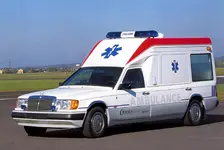
As was common with models of Mercedes-Benz in the previous decades, the Mercedes E-class W124 series chassis is also provided for equipping a specific body depending on the needs of the local or foreign bodies. It could develop into an ambulance and a hearse or other vehicle with special functions. The novelty here is that these chassis were based on the station wagon produced in the same factory in Bremen. In addition to the normal length of the vehicle had a longer long-wheelbase version. Since 1989, there have been long-wheelbase Saloon. This six-door version is 80 centimeters longer than the series Saloon in overall length and wheelbase.
Milestones in safety and environmental
Mercedes E-Class W124 T-Model – Wagon
W124 series introduced numerous technological achievements. Among the notable premieres was the introduction of the 4MATIC automatic four-wheel drive in 1985. This system of all-wheel includes complex electronic control unit and an additional front-wheel drive with transfer case and differential. In addition to automatic 4MATIC-wheel drive, the concept of “Mercedes-Benz Dynamic Governance” also includes an automatic locking differential (ASD) and control system acceleration skid (ASR) – which means that in this package Mercedes- Benz offers three speed automatic electronic dynamic control systems – each system uses signals from the anti-lock braking system ABS.
Also in 1985, the Stuttgart optional system for emission control with three-way catalytic converter for all petrol-engined models in the 124 series except the 200 model equipped with a carburetor. From September 1986 the catalytic converter became standard, and even the carburettor model 124 series is available now on this system to control emissions.
Development of the series
Mercedes E-Class W124 interior
During the twelve years of producing the W124 series was regularly improved and further developed by engineers at Mercedes-Benz. This manifested itself in the emergence of new models and technical innovation. They include, for example, 300D Turbo and 300D Turbo 4MATIC saloons, introduced in 1987, with turbodiesel units from the corresponding station wagon models. Then in 1988 at the Paris Motor Show, the 200E (hitherto produced only for the Italian market) and 250D (featuring a modified version of the turbocharged 2.5-liter engine in the compact class-W201).
In September 1988 Mercedes-Benz introduced diesel engines for the Mercedes E-Class W124 250D and 300D Turbo with redesigned prechambers and oblique injection for more efficient combustion. This reduces emissions of particulate matter (soot), while increasing power. Furthermore, in September 1988, all models are enhanced with standard equipment package, including anti-lock brakes (ABS) and a heated right exterior mirror.
As part of the “Diesel ’89″ in February 1989 turbocharged diesel passenger cars were equipped with revised engines. They also include new prechambers with oblique injection, which has led to improved levels of emission and power. Emissions are further reduced by using a complex system of emission control (AGR), which combines the oxidising catalytic converter specially designed for diesel engines with a carefully tuned exhaust gas recirculation unit. This highly effective system is available from October 1990 as an option for models with diesel engines and weather six months later for turbocharged models.
The first facelift model
Mercedes E-Class W124
In September 1989 Mercedes-Benz presented a completely revised model for the midsize category at the IAA International Motor Show in Frankfurt. The focus of the model refinement of stylistic changes in housing and redesigned interior. The most distinctive feature of the facelifted models have plastic side moldings with chrome strip integrated. The new interior design is centered around the new seats and numerous improvements in various details.
Revised model program for the Mercedes E-Class W124 series offers five brand new models. Now for the saloon, coupe and wagon was the 3-liter, six-cylinder engine with four valves per cylinder and variable camshaft incoming valves taken from model 300 SL-24. But given the different installation conditions it was not possible to install the same catalytic converter in the SL 300 E-24, 300 CE-24 and 300 TE-24 models. Therefore, output was 162 hp kVt/220 – KVt/11.01 8.1 hp less than the sports car (170 hp kVt/231).
Along with these top models in the series, the Stuttgart company also introduced a fourth body variant in the midsize class – the long wheelbase Saloon. This restored the sales program long version after an absence of four years. Long body was developed in close cooperation with the firm Binz bodies based in Lorch (Lorh) who then care for series production. The wheelbase has been increased by 80 centimeters to 3.60 meters, while also increasing the total length of 80 cm Unlike the preceding models with a long wheelbase version of the 250D and 260 E are six full-size doors and center seat in terms of depth of seat and backrest height nearly matches that of the rear. Serial production of the long saloons began in May 1990.
Super sports car from the midsize series
Mercedes E-Class W124 AMG
Exclusively as a saloon, 500E made its debut at the Paris Motor Show in October 1990 – this is the new top model in the 124 series, and the first E-Class equipped with V8 engine. Series production began in February 1991. External 500E at first glance no different to its sister models. It can not be said for the point. The newcomer is equipped with a V8, 5-liter, four-valve engine that produces 240 hp kVt/326.4, which was based on and-tested power unit from the 500 SL and delivered a breathtaking performance. The Saloon mated to a four-speed automatic transmission can reach 100 km / h, a place for 5.9 seconds, top speed is automatically limited to 250 km / h Standard equipment includes skid control (ASR) to prevent slippage of the drive wheels even at full acceleration.
To improve the quality of the emissions, the amount of double catalytic converter was increased from 3.9 to 5.8 liters, the system is supported by secondary air injection and exhaust gas recirculation. 500E for the first time used a new version of the four-valve V8 engine, featuring a different injection system, fuel injection, modified crankcase, Bosch LH-Jetronic system electronically controlled fuel injection and engine block the same height as the engine block the 4.2 liter version.
Distinctive features of the 500E include subtly increased overhang wheel arches, fog lamps integrated into the front bumper and 16-inch alloy wheels with eight holes with tires 225/55 ZR 16. The chassis is 23 mm lower than the other models, and to compensate for spring load, the rear axle is equipped as standard with hydropneumatic self-leveling rear suspension.
Sold two million copies of the Bestseller – Mercedes E-Class W124 before second facelift
Mercedes E-Class W124 Coupe
Two millionth car from the W124 series rolled off the production line in June 1992. Just a few weeks later, the midsize series is subjected to a second treatment. This time Mercedes-Benz focuses on engine and equipment. The petrol versions are completely revised engine range, now completely to four valves per cylinder. This meant that the four and six-cylinder units now have the same bore, making production more flexible and economical.
Apart from the new range of petrol engines for model refinement also includes greatly enhanced standard equipment package for all midsize models. In October 1992, standard equipment includes airbags, central locking and electrically adjustable exterior mirrors on both sides. In addition, the four-cylinder models are equipped with five-speed transmission at no extra cost.
The new model 400E appeared on the European market at the same time as the facelifted midsize models. This variant of the W 124 was produced in September 1991 for export to the U.S. and Japan. As the new top of the range car in the large-displacement models, the car boasts the familiar 4.2-liter V8 engine with four valves per cylinder and 205 kW. / 279 hp.
In 1993 for the first time in the world of technology has been used four valves per cylinder in five and six-cylinder turbocharged diesel engine. This not only provides increased torque and power, but also reduces fuel consumption at full load up to 8%. Furthermore, optimization of the combustion process meant that exhaust particulate emissions are reduced by 30 percent.
Change the name for the W124 series: the first Mercedes E-Class
Mercedes E-Class W124 Tuning
New nomenclature came into effect for the 124 series from the start of sales of the new revised models in June 1993. According to the S-Class and the new C-Class, the midsize category henceforth renamed the Mercedes E-Class. This means that the model designations were now also change the class to which the vehicle belonged to is represented by a letter of the alphabet. This letter was followed by a three-digit number based as previously on the engine. Coding of body as a coupe and wagon was now abandoned, as they are distinct. In the case of models powered by diesel engine, the words “Diesel” or “Turbodiesel”, placed in three-digit number replaces the earlier cuts. Thus D is 250 E 250 Diesel.
Along with the change in nomenclature, the most striking feature of the modified vehicles was the radiator grille, redesigned in line with the Mercedes S-Class. The so-called integrated radiator is much thinner chrome frame compared with the previous design, and the Mercedes star was positioned – the saloons of the S-Class – the bonnet. Lighthouse also changed: the front turn signals with colorless lenses are the rear with bi-chromatic coating.
There were also changes the shape of the boot lid, wheels and bumpers. Steel wheels with six holes and the bumper moldings are now the same color as the rest. The rear bumper molding has come to the rear wheel arch.
Around that time, a stage E60 AMG as the new top model of the range offered by the company owned tuner has a 6-liter V8 M 119. This sports saloon developing 280 kW / 381 hp at 5600 / min AMG, also revised Coupé and Convertible models: they also appear on the market in 1993 as the E 36 AMG, delivering 200 hp kVt/272 at 5750 / min
End of production, beginning a career as a Young Classic
In June 1995, two years after the last facelift, Mercedes-Benz introduced the E-Class saloons of the W210 series, the successor to the 124 series. Production of the W124 series Saloons ended shortly thereafter, depending on the model between June and August 1995. Production of the wagon continued until 1996. Mercedes-Benz also continues to produce CKD (“completely knocked down” – “completely disused”) parts of the Mercedes E-Class E250 and E220 Diesel until 1996 and shipped them for installation of Pune in India. The last of the production line down convertible in 1997.
For a period of more than eleven years, the production amounted to 2,058,777 sedan, wagon 340,503, 141,498 coupes, convertibles 6343, 2342 sedan with a long wheelbase and 6,398 chassis with partial bodies for special purpose vehicles – a total of 2,555,861 cars.
With the end of production, the Stuttgart company opened a new chapter in the “auto”-biography of their 124 series. With its classic lines and multiple body variants, the series has begun to establish itself as an attractive young Classic.
And on his 25th birthday in 2009, the first cars in the series will officially receive the rank of “youngtimer” or recent classics – a piece of automotive heritage with youthful radiance. This is reflected in the information collected by Mercedes-Benz Young Classics collection where dream cars such as the E500 and 300 CE waiting for enthusiasts on a trip down memory lane to relive the history of the Mercedes E-Class W124 series.