- Overall global car sales grew 5%, excluding China, supported by strong sales in Europe and the U.S.
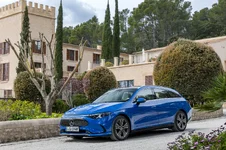
- Strong BEV growth for Mercedes-Benz Cars in Europe (+34%) and Germany (+36%), driven by the all-new electric CLA
- Order books for electric CLA, GLB and GLC filled well into the second half of the year; Order intake for the new S-Class in Europe above expectations following January sales release
- Double-digit sales growth in eVans (+29%) and stable demand for commercial vans
- Strong pipeline of new products: Q1 highlights included the world premieres of the new
S-Class, VLE, Mercedes-Maybach S-Class, GLE, and GLS
Mercedes-Benz Cars
In line with expectations, Mercedes-Benz Cars recorded wholesale deliveries of 419,400 (-6%) cars in the first quarter. Excluding China, global sales increased by 5% compared with the prior year. Growth in the U.S. and Europe partially offset lower sales in China amid model-cycle effects, macroeconomic uncertainties and challenging market conditions. While recent model launches are supporting sales prospects in the coming quarters, the company continues to closely monitor the geopolitical environment, the conflict in the Middle East and its potential impact on global consumer sentiment.
“The first quarter was characterised by sales growth outside of China, alongside an excellent market response to our newly launched models. The new electric GLC has generated more orders in the first three months than any other electric vehicle in our history, while order intakes for the other new models, including the new Mercedes-Benz S-Class, significantly exceed our expectations. Further tailwinds will come from the recently unveiled GLE and GLS, alongside the upcoming world premiere of the all-new electric C-Class. As the availability of our new products scales up, we remain highly focused on converting strong customer interest into overall sales momentum in the coming months.”
Mathias Geisen, Member of the Board of Management of Mercedes-Benz Group AG,
Sales & Customer Experience
Mercedes-Benz Cars sales by regions and markets
In Europe, the positive trend of the previous quarter continued. Sales increased by 7% in the region. The development in Germany was particularly encouraging, with sales rising by 9%. Driven by the all-new electric CLA, Mercedes-Benz recorded exceptional overall battery-electric vehicle (BEV) growth in Europe (+34%) and Germany (+36%). As demand for the new CLA exceeds global production capacities, output is running at full capacity in three shifts at the Rastatt plant. In Rastatt, manufacturing of the all-new CLA Coupé and CLA Shooting Brake started last year, alongside the A-Class, GLA, and EQA. The Bremen plant is producing the electric GLC in three shifts, including additional Saturday shifts. In addition, the recent market introduction of the high-tech hybrid versions of the new CLA is expected to further support growth in the upcoming months.
The United States proved to be a growth driver in the quarter, with sales increasing by 20% compared with the prior-year period. Strong wholesale growth reflects seasonal phasing and targeted network preparation to optimally equip retail partners for the coming months. Mercedes-AMG (+5%) and Mercedes-Maybach (+34%) recorded clear year‑on‑year growth, underlining continued demand for Top‑End vehicles in the U.S. Going forward, the company will place even greater focus on the localisation of products and value creation in this region. This commitment is exemplified by the Tuscaloosa plant, which recently celebrated its 30th anniversary and marked the production of its five-millionth vehicle.
As expected, first-quarter sales in China declined, primarily due to active steering and the planned phase-out of current models ahead of upcoming generational changeovers, particularly in the Entry segment. Despite this, Mercedes-Benz maintained its leading position in the vehicle segment priced above 1 million RMB. 2026 marks a transition year for Mercedes-Benz in China, influenced by the replacement of several key models. The company is rapidly expanding its portfolio of both battery-electric and state-of-the-art electrified combustion-engine vehicles. To meet strong local demand for highly intelligent cars, these new models are being equipped with the latest China-specific premium infotainment systems and advanced driver-assistance systems powered by the Mercedes-Benz Operating System (MB.OS). The recently unveiled Mercedes-Benz S-Class and Mercedes-Maybach S-Class exemplify this strategy, launching as the first Top-End combustion-engine models in China to feature these state-of-the-art smart technologies.
Sales development in the 'Rest of the World' (RoW) region saw an overall decline in the past quarter (‑14%). This was primarily driven by lower volumes in Turkey, alongside the impact of ongoing geopolitical challenges and the conflict in the Middle East. However, Argentina provided a very positive counterweight within the region: Following an overall improvement in the economic environment and the elimination of the local luxury tax, Mercedes-Benz recorded a noticeable revival in customer demand, which translated into an encouraging increase in sales.
Mercedes-Benz Cars Battery Electric sales
Mercedes-Benz recorded solid growth (+9%) in BEV sales, driven by strong demand for the company’s new generation of fully electric models. The attractiveness of the all-new electric CLA is particularly reflected in strong BEV growth in Europe (+34%) and Germany (+36%), where the CLA is already available to customers. Whereas in Europe the xEV share rose to 41% (Q1 2025: 37%), a planned phase-out of Plug-In Hybrid models in China led to a global xEV share of 19% (Q1 2025: 20%).
The strong market response to the electric CLA, which was awarded “Car of the Year 2026” in Europe, the electric GLC and GLB, as well as the upcoming world premiere of the all-new electric C-Class later this month, underpins the company’s ambition to significantly increase electric vehicle sales this year and double the xEV share in the medium term.
Mercedes-Benz Cars Top-End
The Top-End segment remains a cornerstone of the brand’s success, securing a 15% share in the first quarter, perfectly in line with expectations. Following the launch of the new flagship S-Class, the new Mercedes-Maybach S-Class has now been presented to the public and will reach markets in a stepwise rollout throughout the year. Furthermore, the product launch programme in the Top-End SUV segment continued with the recent world premiere presentation of the new GLS at the Tuscaloosa plant.
Overall sales in the Top-End segment (-5%) were affected by model changeovers, particularly for the Mercedes-Benz S-Class and the Mercedes-AMG derivatives of the A-Class. Demand for Mercedes-AMG was driven in particular by the E 53 HYBRID 4MATIC+ Saloon and Estate (+43%) and the CLE 53 4MATIC+ Coupé and Cabriolet (+32%).
| Mercedes-AMG E 53 HYBRID 4MATIC+ Saloon | combined energy consumption, weighted: 18.1–17.5 kWh/100 km plus 3.3–2.9 l/100 km | combined fuel consumption with discharged battery: 9.2–8.6 l/100 km | combined CO₂ emissions, weighted: 75–66 g/km | combined CO₂ class weighted: B | CO₂ class with discharged battery: G¹ Mercedes-AMG E 53 HYBRID 4MATIC+ Estate | combined energy consumption, weighted: 18.4–17.8 kWh/100 km plus 3.5–3.1 l/100 km | combined fuel consumption with discharged battery: 9.5–8.9 l/100 km | combined CO₂ emissions, weighted: 80–70 g/km | combined CO₂ class weighted: B | CO₂ class with discharged battery: G¹ Mercedes-AMG CLE 53 4MATIC+ Coupé | combined fuel consumption: 9.6–9.1 l/100 km | combined CO₂ emissions: 218–207 g/km | CO₂ class: G¹ Mercedes-AMG CLE 53 4MATIC+ Cabriolet | combined fuel consumption: 9.8–9.3 l/100 km | combined CO₂ emissions: 223–213 g/km | CO₂ class: G¹ |
Sales overview Mercedes-Benz Cars
| Q1 2026 | Change Q1 2025 | ||||
| Mercedes-Benz Group | 499,700 | -6% | |||
| – thereof BEVs | 50,400 | +11% | |||
| Mercedes-Benz Cars | 419,400 | -6% | |||
| – thereof BEVs | 44,300 | +9% | |||
| Mercedes-Benz Cars sales by segment* | |||||
| – Top-End | 61,500 | -5% | |||
| – Core | 248,000 | -6% | |||
| – Entry | 109,800 | -7% | |||
| Mercedes-Benz Cars sales by regions and markets | |||||
| Europe** | 158,400 | +7% | |||
| – thereof Germany | 49,300 | +9% | |||
| Asia | 153,500 | -23% | |||
| – thereof China | 111,600 | -27% | |||
| North America*** | 89,600 | +16% | |||
| – thereof U.S. | 81,100 | +20% | |||
| Rest of World | 17,900 | -14% |
*Top-End: Mercedes-AMG, Mercedes-Maybach, G-Class, S-Class, GLS, EQS and EQS SUV
*Core: All derivatives from C- and E-Class, incl. EQE and EQE SUV
*Entry: All derivatives from A- and B-Class incl. EQA, EQB
** Europe: European Union, United Kingdom, Switzerland and Norway
*** North America: USA, Canada and Mexico
All figures rounded. Preliminary figures subject to change pending final reports.
Mercedes-Benz Vans
“With the world premiere of the VLE showcased at the beginning of March, Mercedes-Benz Vans has entered into a new era. The VLE is redefining the segment of the privately positioned van. Its powerful combination of space, comfort, and an unparalleled digital experience creates fresh momentum in the market and opens up new potential for future sales growth. In addition, our focus remains on exceeding the expectations of our commercial customers by delivering an end-to-end customer experience across the entire vehicle lifecycle, thus strengthening customer loyalty and fostering sustainable growth.“
Thomas Klein, Head of Mercedes-Benz Vans
Mercedes-Benz Vans sold 80,300 units in the first quarter of 2026. Overall, sales were influenced by the ongoing volatile and competitive market environment, as well as lower consumer demand for midsize vans in China. This was partially compensated by positive development in the Rest of World region (+35%) due to healthy customer demand across various markets. In Europe, including Germany, sales in Q1 reached previous year’s level. Furthermore, Q1 saw stronger customer order intake compared to the same quarter last year (+2%).
Sales of commercial vans remained at a stable level compared to the previous year. Especially the large vans continued to be in solid demand with sales up by 4%, once again proving the relevance of the commercial segment for Mercedes-Benz Vans. Sales of eVans continued to grow in Q1 by 29% compared to the previous year’s quarter, leading to a slightly increased global EV share of 8% (Q1 2025: 6%) with Europe reaching 10% (Q1 2025: 8%).
Mercedes-Benz Vans entered 2026 by presenting the all-new electric VLE built on the new, modular, and highly flexible van architecture. The VLE reinvents the privately positioned van segment, combining limousine-like ride and handling with MPV-style versatility.
Sales overview Mercedes-Benz Vans
| Q1 2026 | Change Q1 2025 | ||||
| Mercedes-Benz Vans | 80,300 | -3% | |||
| – thereof eVans | 6,100 | +29% | |||
| Mercedes-Benz Vans sales by segments* | |||||
| Commercial Vans | 67,800 | +0% | |||
| – thereof commercial large vans | 44,400 | +4% | |||
| – thereof commercial midsize vans | 16,600 | -14% | |||
| – thereof commercial small vans | 6,800 | +24% | |||
| Private Vans | 12,500 | -19% | |||
| – thereof private midsize vans | 10,800 | -22% | |||
| – thereof private small vans | 1,700 | +5% | |||
| Mercedes-Benz Vans sales by regions and markets | |||||
| Europe** | 57,100 | -0% | |||
| – thereof Germany | 21,000 | -2% | |||
| Asia | 2,800 | -61% | |||
| – thereof China | 600 | -86% | |||
| North America*** | 8,900 | -11% | |||
| – thereof U.S. | 7,200 | -5% | |||
| Rest of World | 11,400 | +35% |
*Private vans: mid-size vans include V-Class and EQV, small vans include T-Class and EQT 200 standard (energy consumption combined: 20.9 - 19.3 kWh/100 km | CO₂ emissions combined: 0 g/km | CO₂ class: A)¹
*Commercial vans: large vans include (e)Sprinter, mid-size vans include (e)Vito, small vans include (e)Citan
** Europe: European Union, United Kingdom, Switzerland and Norway
*** North America: USA, Canada and Mexico
All figures rounded. Preliminary figures subject to change pending final reports.
The comparative period for the percentage changes stated in this document is the respective prior-year period, unless otherwise stated.
Continue reading...