
PanterroR
Lap Time Luminary
- Messages
- 21,867
I know there are many people on this board that like to know everything in detail, so i'll post this what i've found:

2007 BMW M3 V8 enlarge
Index of Other Reviews
How to Keep Your BMW Collectible
INTRODUCTION
Thank goodness, BMW finally introduced the V-8 for the M3 on March 22nd, 2007.
It's rated, in the European press release, at 295 ft-lbs of torque at 3,900 RPM and 420HP at 8,300 RPM.
Six cylinder engines are great for practical vehicles like semi trucks and Toyotas, but I prefer the smoothness and effortless torque of at least eight cylinders. I'm lazy: I want to be gone without having to shift. Hopefully this little eight moves even at 2,000 RPM; we'll see.
The new M3 V8 follows BMW's other M engines, which is to take a small engine and develop power through high RPMs. Torque is ordinary, but the throttle and valvegear is BMW's usual magic allowing higher RPMs. This engine needs to be wound out to make power. Sadly it's a spinner, not a torquer, so it may not have the effortless American luxury of larger eights. Again, we'll see.
This new V8 is 33 pounds (15 kg) lighter than the straight-six it replaces! This new V8 weighs 445 pounds (202 kg).

BMW M3 V8 Timing Chains. enlarge
ACCREDITATION
Hard data and photos here are from BMW's European press information.
US data is unannounced.
SPECIFICATIONS (European model, US Specs TBA)
Basics
Type: 90 degree quad-cam four-valve V8.
Size: 4.0 Liters, a nice starting point for the first model year.
Torque: Only 295 ft-pounds of torque (400 N-m) at 3,900 RPM, sadly less than a BMW 540. Torque is at least 251 ft-lbs (340 N-m) from 2,000 to 6,500 RPM. BMW uses this weaker torque to let it use lighter drivetrain components to save weight. This V8's torque is barely 10% more than the old six.
Horsepower: 420 HP at 8,300 RPM.
Redline: 8,300 or 8,400 RPM, depending on where you read it in the press release.
Compression Ratio: 12:1.
Details

BMW M3 V8 Exploded View. enlarge
Fuel: Otto RON 98 (95).
Fuel has 2 octane numbers: RON (Research Octane Number), used in Europe, and MON (Motor Octane Number), which is RON-10.
In the USA we use AKI (Anti-Knock Index), which equals (RON+MON) / 2. For this engine's needs we'd need (98+88) / 2, or an AKI of 93. Thus this motor, at least in European form, wants to see a yellow sticker of "93" on the pump.
Sadly here in sunny California, where all these cars wind up anyway, we have to look long and hard for fuel above 91 AKI, which is the water we buy today as premium. In my motorcycling days I was known as "Rocket Fuel Rockwell," since my BMW R100S ran on 98 AKI leaded premium. The club (Long Island's SSMC) set our routes so I could get the good stuff at airports and racetracks.
Displacement: 3,999 cc.
Bore and Stroke: 3.62” (92mm) bore x 2.96" (75.2mm) stroke.
Block: Siliconized Aluminum, no liners.
Heads: Aluminum.
Valves: 4 per cylinder, 1.38" and 1.20" (35 and 30.5mm).

BMW M3 V8 Heads
VANOS variable valve lift and timing.
Throttle Valves: Eight throttle butterflies. Each bank of four is on the same shaft.

2007 BMW M3 V8 Throttle Valves
Cylinder spacing: 3.86" (98mm).
Main Bearing diameter: 2.36" (60mm).
Bearing Width: 1.11" (28.2mm).
Piston Weight, including pins and rings: 17 oz (481.7g).
Rod weight: 22 oz (623 g).
Oiling: Conventional wet-sump oiling, two oil pumps and two sumps.
Electronic oil level monitoring, just like my Mercedes for the past 20 years.

BMW M3 V8 Oil Pan and Pumps

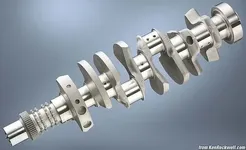
BMW M3 V8 Crank Crank Weight: 44 pound (20 kg)

BMW M3 V8, no vanity cover. enlarge
Intake stacks: made of 30% fiberglass.
Headers: check these out:

BMW M3 V8 headers
FUN FACTS
Power Curve

2007 BMW M3 V8 Power Curve
Multiply the left N-m torque scale by 0.7236 to get ft-pounds.
BMW makes mistakes. The y-axis scale reading from 40 to 440 is in HP, not kW. They labeled it incorrectly.
Block
The block comes from BMW’s foundry in Landshut (near Munich), where BMW builds the engine blocks for their Formula 1 cars.
It's made of aluminum silicon alloy. The cylinder walls have hard silicon crystals, not iron liners. This is common; my 1990s Mercedes are the same thing.
The cylinder liners are formed by exposing hard silicon crystals. Iron-coated pistons run directly in these uncoated, honed cylinder bores.
The blocks are made with a low-pressure die-casting process from an over-eutectic aluminum alloy, with at least 17 per cent silicon.
Eutectic has to do with melting; I had a girlfriend who did eutectic art, which was how she melted wax. Cool word, but no big deal; it's even in my default spelling checker.
Eutectic is the composition of an alloy with the lowest melting point. This is about 12% (by weight) silicon in aluminum-silicon alloys.
A 17% (by weight) silicon alloy precipitates silicon flakes, or chunks, as it cools down in the mold. That's how we get the phrase "over eutectic." These silicon flakes are great for solid lubrication, the same way graphite works in older cast iron blocks.
Since aluminum alloys are lighter and dissipate heat better than iron, they are great for engine blocks.
Creep-resistant magnesium alloys are slowly starting to show up in BMW 6 cylinders. Those are pressure cast with the same aluminum - 17% silicon liners for the combustion chambers... pretty cool machines with robots doing the job and everything! Magnesium is even lighter than aluminum.
Plug-Measured Combustion

BMW M3 V8 Spark Plug and Coil
Since the 1980s we've used knock sensors that listened for mechanical knocking. These are used to retard spark timing as needed. Every car has these today.
BMW has gotten very clever and electrically measures the spark plug gap to detect knocking, as well as misfires and bad combustion.
This saves cost and improves reliability because the extra knock sensors and their wiring are no longer needed.
BMW calls this "ion flow technology." Burning fuel causes ionization, and BMW measures ionization by measuring plug electrode resistance. (It took BMW at least ten paragraphs to say the same thing.)

BMW M3 V8, stacks removed. enlarge.
Drive by Wire
The throttle valves are not connected to the pedal.
Instead, the pedal is connected to an electronic sensor which talks to the computer.
The computer moves the throttle butterflies electronically as it sees fit.
Low-Pressure VANOS
Unlike the BMW M5 and BMW M6 high-pressure VANOS (variable valve lift and timing) systems, the low-pressure VANOS system of this V8 uses a double (not single) chain to connect the crankshaft and cam sprocket. The cam sprocket connects to the camshaft with a step motor, not helical gearing.
This low-pressure M double-VANOS runs with regular engine oil pressure on the step motor. This eliminates the separate high-pressure system of the V10s.
The intake cam can vary up to 58° and the exhaust cam up to 48.° Maximum rate of crank angle adjustment is 360° per second.
Brake Energy Regeneration
Heh heh, this is a great patent!
This has nothing to do with regeneration or getting energy from the brakes, but this sounds cooler to the layman than calling it what it is.
The new M3 waits to draw most of its electrical power from the alternator during deceleration and engine braking. This way it draws less when accelerating, and also can help the brakes a little bit by adding to engine braking.
This is something everyone should have thought of 20 years ago when A/C compressors were designed to click off at full throttle, but BMW thought of this first today. It's simply letting the engine and other computers control the excitation current of the alternators based also on engine and brake loads.
The battery has to work a little harder smoothing out the load, but that's why it's there in the first place.
Brilliant! Just like BMW's water-cooled alternators, only we engineers really appreciate how clever this is. Most people will never notice, except in infinitesimally better fuel efficiency and the potential for minor voltage fluctuations while driving. Since the dash lighting ought to be LED and the headlights xenon, it's not difficult to regulate these to ignore the supply voltage.
BMW uses AGM (absorbent glass mat) batteries, which have fiberglass sheets between the lead to hold the acid.
Source: BMW M3 V8

2007 BMW M3 V8 enlarge
Index of Other Reviews
How to Keep Your BMW Collectible
INTRODUCTION
Thank goodness, BMW finally introduced the V-8 for the M3 on March 22nd, 2007.
It's rated, in the European press release, at 295 ft-lbs of torque at 3,900 RPM and 420HP at 8,300 RPM.
Six cylinder engines are great for practical vehicles like semi trucks and Toyotas, but I prefer the smoothness and effortless torque of at least eight cylinders. I'm lazy: I want to be gone without having to shift. Hopefully this little eight moves even at 2,000 RPM; we'll see.
The new M3 V8 follows BMW's other M engines, which is to take a small engine and develop power through high RPMs. Torque is ordinary, but the throttle and valvegear is BMW's usual magic allowing higher RPMs. This engine needs to be wound out to make power. Sadly it's a spinner, not a torquer, so it may not have the effortless American luxury of larger eights. Again, we'll see.
This new V8 is 33 pounds (15 kg) lighter than the straight-six it replaces! This new V8 weighs 445 pounds (202 kg).
BMW M3 V8 Timing Chains. enlarge
ACCREDITATION
Hard data and photos here are from BMW's European press information.
US data is unannounced.
SPECIFICATIONS (European model, US Specs TBA)
Basics
Type: 90 degree quad-cam four-valve V8.
Size: 4.0 Liters, a nice starting point for the first model year.
Torque: Only 295 ft-pounds of torque (400 N-m) at 3,900 RPM, sadly less than a BMW 540. Torque is at least 251 ft-lbs (340 N-m) from 2,000 to 6,500 RPM. BMW uses this weaker torque to let it use lighter drivetrain components to save weight. This V8's torque is barely 10% more than the old six.
Horsepower: 420 HP at 8,300 RPM.
Redline: 8,300 or 8,400 RPM, depending on where you read it in the press release.
Compression Ratio: 12:1.
Details
BMW M3 V8 Exploded View. enlarge
Fuel: Otto RON 98 (95).
Fuel has 2 octane numbers: RON (Research Octane Number), used in Europe, and MON (Motor Octane Number), which is RON-10.
In the USA we use AKI (Anti-Knock Index), which equals (RON+MON) / 2. For this engine's needs we'd need (98+88) / 2, or an AKI of 93. Thus this motor, at least in European form, wants to see a yellow sticker of "93" on the pump.
Sadly here in sunny California, where all these cars wind up anyway, we have to look long and hard for fuel above 91 AKI, which is the water we buy today as premium. In my motorcycling days I was known as "Rocket Fuel Rockwell," since my BMW R100S ran on 98 AKI leaded premium. The club (Long Island's SSMC) set our routes so I could get the good stuff at airports and racetracks.
Displacement: 3,999 cc.
Bore and Stroke: 3.62” (92mm) bore x 2.96" (75.2mm) stroke.
Block: Siliconized Aluminum, no liners.
Heads: Aluminum.
Valves: 4 per cylinder, 1.38" and 1.20" (35 and 30.5mm).
BMW M3 V8 Heads
VANOS variable valve lift and timing.
Throttle Valves: Eight throttle butterflies. Each bank of four is on the same shaft.
2007 BMW M3 V8 Throttle Valves
Cylinder spacing: 3.86" (98mm).
Main Bearing diameter: 2.36" (60mm).
Bearing Width: 1.11" (28.2mm).
Piston Weight, including pins and rings: 17 oz (481.7g).
Rod weight: 22 oz (623 g).
Oiling: Conventional wet-sump oiling, two oil pumps and two sumps.
Electronic oil level monitoring, just like my Mercedes for the past 20 years.
BMW M3 V8 Oil Pan and Pumps
BMW M3 V8 Crank Crank Weight: 44 pound (20 kg)
BMW M3 V8, no vanity cover. enlarge
Intake stacks: made of 30% fiberglass.
Headers: check these out:
BMW M3 V8 headers
FUN FACTS
Power Curve
2007 BMW M3 V8 Power Curve
Multiply the left N-m torque scale by 0.7236 to get ft-pounds.
BMW makes mistakes. The y-axis scale reading from 40 to 440 is in HP, not kW. They labeled it incorrectly.
Block
The block comes from BMW’s foundry in Landshut (near Munich), where BMW builds the engine blocks for their Formula 1 cars.
It's made of aluminum silicon alloy. The cylinder walls have hard silicon crystals, not iron liners. This is common; my 1990s Mercedes are the same thing.
The cylinder liners are formed by exposing hard silicon crystals. Iron-coated pistons run directly in these uncoated, honed cylinder bores.
The blocks are made with a low-pressure die-casting process from an over-eutectic aluminum alloy, with at least 17 per cent silicon.
Eutectic has to do with melting; I had a girlfriend who did eutectic art, which was how she melted wax. Cool word, but no big deal; it's even in my default spelling checker.
Eutectic is the composition of an alloy with the lowest melting point. This is about 12% (by weight) silicon in aluminum-silicon alloys.
A 17% (by weight) silicon alloy precipitates silicon flakes, or chunks, as it cools down in the mold. That's how we get the phrase "over eutectic." These silicon flakes are great for solid lubrication, the same way graphite works in older cast iron blocks.
Since aluminum alloys are lighter and dissipate heat better than iron, they are great for engine blocks.
Creep-resistant magnesium alloys are slowly starting to show up in BMW 6 cylinders. Those are pressure cast with the same aluminum - 17% silicon liners for the combustion chambers... pretty cool machines with robots doing the job and everything! Magnesium is even lighter than aluminum.
Plug-Measured Combustion
BMW M3 V8 Spark Plug and Coil
Since the 1980s we've used knock sensors that listened for mechanical knocking. These are used to retard spark timing as needed. Every car has these today.
BMW has gotten very clever and electrically measures the spark plug gap to detect knocking, as well as misfires and bad combustion.
This saves cost and improves reliability because the extra knock sensors and their wiring are no longer needed.
BMW calls this "ion flow technology." Burning fuel causes ionization, and BMW measures ionization by measuring plug electrode resistance. (It took BMW at least ten paragraphs to say the same thing.)
BMW M3 V8, stacks removed. enlarge.
Drive by Wire
The throttle valves are not connected to the pedal.
Instead, the pedal is connected to an electronic sensor which talks to the computer.
The computer moves the throttle butterflies electronically as it sees fit.
Low-Pressure VANOS
Unlike the BMW M5 and BMW M6 high-pressure VANOS (variable valve lift and timing) systems, the low-pressure VANOS system of this V8 uses a double (not single) chain to connect the crankshaft and cam sprocket. The cam sprocket connects to the camshaft with a step motor, not helical gearing.
This low-pressure M double-VANOS runs with regular engine oil pressure on the step motor. This eliminates the separate high-pressure system of the V10s.
The intake cam can vary up to 58° and the exhaust cam up to 48.° Maximum rate of crank angle adjustment is 360° per second.
Brake Energy Regeneration
Heh heh, this is a great patent!
This has nothing to do with regeneration or getting energy from the brakes, but this sounds cooler to the layman than calling it what it is.
The new M3 waits to draw most of its electrical power from the alternator during deceleration and engine braking. This way it draws less when accelerating, and also can help the brakes a little bit by adding to engine braking.
This is something everyone should have thought of 20 years ago when A/C compressors were designed to click off at full throttle, but BMW thought of this first today. It's simply letting the engine and other computers control the excitation current of the alternators based also on engine and brake loads.
The battery has to work a little harder smoothing out the load, but that's why it's there in the first place.
Brilliant! Just like BMW's water-cooled alternators, only we engineers really appreciate how clever this is. Most people will never notice, except in infinitesimally better fuel efficiency and the potential for minor voltage fluctuations while driving. Since the dash lighting ought to be LED and the headlights xenon, it's not difficult to regulate these to ignore the supply voltage.
BMW uses AGM (absorbent glass mat) batteries, which have fiberglass sheets between the lead to hold the acid.
Source: BMW M3 V8




 .
.

 ..and bare tehnology behind producing this masterpiece is to admire also..


