sako97
Autotechnik Ace
- Messages
- 5,655
I have archives of articles on the development of past MBs & BMWs, so I figured I bring them back to the modern web. In chronological order from the first development article in 1998 to the 2006 followup press release before the debut of the first facelift.
----
"Autoweek" March 1998
Exposed! Mercedes Faces the Future
We unmask the next SL
by Greg Kable
When most people think of Mercedes-Benz, the SL is the car that comes to mind. Peering through the disguise on the car seen in this first batch of spy photos, our illustrator has unmasked the face of Mercedes-Benz for the first decade of the new millennium.
The strength of the SL's image stems from the model's history as the company's technological flagship, from desmodromic valvegear through ABS and traction control. That tradition goes on the line when Mercedes-Benz pulls the wraps off this all-new SL in late 2000, for sale the following year.
Drawing on a heritage of Stuttgart sports cars that harks back to the legendary 300SL roadster of 1957 (itself derived from a 1954 coupe and a `52 racer) the next generation of the big German roadster will move closer to sporting than touring. That's according to engineers at Mercedes-Benz - engineers who said the same thing about the previous SL when we got our first spy-shots almost a dozen years ago. That car was and is more sporting than its predecessor, though not so overtly as some competitors that have been introduced since the current model came to market in 1989.


Graphics left: Autoweek/Ron Barry Illustration...........Photo right and text below: Autoweek
Contrasting today's model (right) with our illustration of the next-generation SL (left), based on spy-photos of a camouflaged prototype, the lowered nose and new headlight treatment are the most obvious changes. Note, too, the steeper windshield rake and tapered tail, heavily disguised in the photos.
It will be 12 years, then, between all-new models. Codenamed R230, the next SL has been in development for more than 18 months, with its key components fitted to E-Class engineering mules. It wasn't until late last month that proper SL-bodied prototypes hit the Mercedes-Benz test track at Untertuerkheim for the first stages of an intensive, two-and-a-half-year test program.
Our exclusive spy photographs of this first outing for the new body reveal that the next SL retains the familiar long-snout/short-tail look. Yet clearly, the car's shape has evolved, with more rounded forms at the rear, greater tapering effect at the corners and slightly shorter overhangs. Mercedes' emerging new family of engines has allowed Mercedes stylists to reduce the height of the hood to give it a much sleeker profile, with less front-end bulkiness. Still, the overall dimensions appear to have changed little.
The fresh appearance was designed by an in-house team led by Michael Mauer, who's credited with the styling of the SLK, and with the recent C-Class facelift. The 34-year-old German wants the SL to look more aggressive, yet not be perceived as merely a bolder version of the SLK. "The SL is a different car, both in proportions and in what it represents. You'll notice detailed similarities, but the SL will retain its own distinct appearance," he told us.
The new SL's sportier face is expected to feature a variation on the E-Class headlight theme, with twin lights at each side grouped close together under a one-piece clear plastic cover - a distinction from theSLK's lozenge-shaped lamps.
Don't rule out Mercedes coming up with something revolutionary for the roof structure, just as the current model's folding top was itself revolutionary when it arrived, preceding the SLK and its own complex-design folding hard top. Car Top Systems, a joint venture operated with Stuttgart neighbor Porsche, puts some of the world's most advanced automotive roofing technology at Mercedes' disposal. One option is a folding aluminium structure like the SLK's, though our spies say the more likely standard equipment would be a double-layered cloth top like today's, with a simplified hydraulic mechanism and lightweight magnesium frame. Also expected are further variations on the removable Panorama glass hard top, an option on the current model, to extend R230's appeal.
Inside, the new SL will retain its familiar two-seat layout, though we hear that there has been a push to deliver greater space behind the seats, in a bid to distance the car from the SLK. Speculation that the SL would gain small rear seats seems inaccurate, by the looks of the prototype. The car also will sport a typical Mercedes dashboard treatment, although probably with a slightly more retro look, akin to, but not as extreme, as the SLK's.
Consideration was given to clothing R230 in an all-aluminium bodyshell to lighten the car and match the technology that rival Audi offers in its aluminium A8. But German supplier sources confirm that the SL will head into the next century with a predominately steel body. Aluminium could be used for the hood and door skins.
Underpinning the new SL will be a heavily modified version of the E-Class rear-wheel-drive platform, according to Stuttgart insiders. In a move similar to that which saw the C-Class metamorphose into the SLK, Mercedes engineers have altered the wheelbase and track to suit the sports car's needs, while retaining high-cost items such as suspension pick-up points. Suspension will be double wishbones (front) and multilinks (rear), with an adaptive system allowing on-the-fly changes to shock absorber rates. Look for big improvements in steering feel due to the adoption of a modified rack-and-pinion system.
The new SL will offer a choice of V6, V8 or V12 engines, the latter featuring a new cylinder-cutoff mechanism as alluded to on the gargantuan Maybach concept car - itself also likely to enter production. All three engines are aluminium units, resulting in a considerable weight reduction on the front axle. They also feature twin-spark ignition and three valves per cylinder, a combination Mercedes engineers say provides the best compromise between power and efficiency, while also meeting European standards for drive-by noise.
A five-speed automatic transmission will be standard on all U.S. models. But those hankering for a manual shifter shouldn't despair. Mercedes is working on a new sequential manual transmission and hopes to have it out in time for the launch of R230, if not before. Details are scant, though the German carmaker admits to having studied the system used on the Ferrari F355 F1.
Price? Today's V12-propelled SL600 stickers at USD 125,000. Maintaining the top model's exclusivity demands a healthy price tag, but Mercedes isn't immune to competition, as evidenced by the USD 10,000 price cut on the `98 model of the V8-powered SL500.
Mercedes' interest in moving more toward sporting is underscored by the new Sport option for the `98 model SLs - 18 inch wheels, wider in the rear than in the front, and distinct AMG bodywork. Also, the six-cylinder SL320 was dropped from the U.S. market this year.
It's unlikely Mercedes will launch its new model SL in America with the complete range of engines being prepped for Europe. The lineup there should eventually include a 218-hp 3.2-liter V6, a 279-hp 4.3-liter V8, a 300-hp 5.0 liter V8, and a 5.8-liter V12. The latter is expected to make more than 400 hp, compared with 394 hp in today's SL600.
With weight of about 3750 pounds, expect the SL580 to deliver an electronically limited 155-mph top speed, and hit 60 mph from standstill in less than six seconds. Today's SL600 gets to 62 mph in 6.1 seconds. Fuel consumption and tailpipe emissions will be dramatically reduced, in line with toughened world standards.
News that AMG has a range of supercharged engines in the works sets the scene for a stomping Kompressor model. The decision depends upon emission levels and packaging concerns. But insiders say a blown version of the yet-to-be-unveiled 5.0-liter V8 is at test bed stage and delivering 420 hp...enough to ensure that the king-of-the-hill V8-powered SL60 AMG (381 hp, 0-60mph in 5.6 seconds) gets a hard-edged successor to carry its crown.
Drivetrain aside, the R230 has also been earmarked for a raft of high-tech driver aids. Improved versions of the existing brake assist, stability control and satellite navigation systems will be standard. Newer features such as radar-managed cruise control ((Distronic)), voice-activated interior controls, and the long-touted active body control, a stabilizing system that minimizes body roll during hard cornering, will likely top a long list of optional equipment - all aimed at seeing the SL retain its image as a technological tour de force.
Just to confirm all this, at a ritzy European cocktail reception we asked Daimler-Benz chairman Juergen Schrempp about what was coming on the next SL. He looked at us for a second, Johannesburg Reisling in one hand, Marlboro filter in the other, and said, "We have now one SL, and in the future we will have another."
See? Told ya.
Mark Vaughn contributed to this report.
------
"Auto Motor und Sport" 1999
written by Wolfgang Koenig
Under Cover
It's only fair the new SL gets what the SLK already has: When not in use it hides its hard top in the trunk. But that's not the only invention.
Mercedes SL-drivers mostly are pleased drivers. The qualities of the racers became very attached to them because they combine to a unique profile of characteristics. A SL combines solidity and comfort with discreet sportiveness, one drives classy and as secure as in a S-Class and at the same time enjoys the advantages of an all-year cabrio thanks to the standard luxury-soft-top.
Also the limitation to two seats proved to be in line with market requirements: The typical SL-buyer belongs to the so-called "empty nesters" where the children are fully fledged and the space required shrank. In addition to that the limitation to two seats elegantly protects of inconvenient requests for rides: Where there is no space to take no-one will take place.
No wonder, too, that Mercedes under no circumstances wants to give up this SL-mix which has proven successful for decades. From the SL of the future, which shall go into production in the beginning of the year 2001, one can expect everything of, but no cultural revolution.
The first complete prototype of the new SL, internally denoted as R230 and unmasked by "Auto Motor und Sport", can prove that. The new one turns out to be as a logical and consequent evolution of the old one - some centimetres longer and wider, a bit more round and lower as well as a bit more sporty, but all in all a typical SL. Most attention attracting: The SL shows more face.
Overlapping round headlights now flank a smaller and more levelled grille in the style of the SLK. No doubt for character is taken care of. But the discreet optical relationship with the smaller SLK of course is no coincidence. The new SL shall become the SLK of the mature man, but without the slightly geriatric touch of the present model (R129).
Part of it is that in the future the SL-driver, too, not has to live without the comfort of a retractable hardtop. Like in the SLK the hard top will be forwarded into the trunk at the touch of a button. But the mechanism is different. Whilst in the SLK it folds together via hinges over the rear window in the SL the two parts space-saving slide on top of each other. That creates space for luggage so that in the future - a must in the USA - two complete golf equipments can be stowed away.
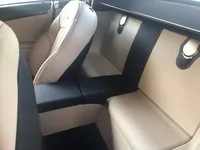
But the interior space will be more luxurious, too, which above all will be of benefit to the space behind the seats. It shall be enough to convert the SL into an - even though extremely tight - 2+2 seater by installing a jump seat bench.
As before an automatically extendible roll over bar will give protection in case of rolling over. Further improvements in the passive safety do stand in the guidelines of the R230 as well as a noticeable weight reduction, a conflict of targets which forces the Mercedes engineers to an increased use of lightweight construction materials.
The result is a multiple-material body in which aluminium, electron (magnesium casting) and plastics alternate with conventional sheet steel. Although it sticks to its base of steel light metals for hoods, doors and roof as well as plastic fenders in the front will help to slim the SL.
In the meantime there's no more talk of the 200 to 300 kilograms which in the beginning should have resulted. Insiders expect a net saving of 100 to 150 kilograms.
The purification goes hand in hand with a thorough technical renovation. Aluminium-chassis with double-transverse arm suspension in front and multi-link suspension in the rear, rack and pinion steering, air suspension, thus innovations which do have their premiere with the S-Class in autumn ((1998)), ((for articles about the new S-Class W220 click here)), will be found also in the new SL. Together with the drivetrain moved far back and the resulting, well balanced weight distribution shall have resulting dynamic driving qualities which are a credit to a sports car.
Even from the air suspension the Mercedes engineers do expect new horizons of tuning. Refined by a so-called ABC (Active Body Control)-system, it enables the SL to shoot around bends with a minimum inclination to the sides, but without reducing the comfort of suspension. The exact opposite: And with comfort, too, the new R230 clearly shall outshine it's predecessor............................
The SL-identity is preserved. In the future, too, it'll attract those buyers who can do without the classic sports car attributes trouble and fuss, but know to appreciate an extra portion agility and pleasure of driving. And there also shall be no lack of power, because as ever the engine range will culminate in a V12-engine. Technically this 5.8 litre-V12 will have nothing in common with the actual engines because it is based upon a new three-valve V8-engine. Output: Around 400 hp.
Like the V12 the rest of the engine range comes from the general equipment of the new S-Class. One step below ranges the new five-litre-V8 (300 hp), just presented in the G-model. SL-newcomers can reach for the V6 with 3.2 litres. For filling the gap between V8 and V12 one furthermore takes into account a V10.
Apart from that with the development of the R230 there is no reason for exaggerated excitement. After all the actual SL still turns up. Even after more than eight years it's effect of attraction seems not to have died at all as the production figures show. In 1997 it were more than 15.000 specimen, a remarkable success for a two-seater in this price range.

Total SL production figures for each year
Since the introduction of the current SL R129 they add up to 164.100 which gives an average of 19.850 in the last eight years (eliminating 1989 when the car was presented in March only at the Geneva Salon in Switzerland).
The exact figures are:
1989 5.327 of 542.160 MB's total = 0.98%
. (plus 8.867 R107 = 14,194 SL's = 2.61%)
1990 20.767 of 574.395 MB's total = 3.62%
1991 26.004 of 577.990 MB's total = 4.50%
1992 26.238 of 531.456 MB's total = 4.94%
1993 18.760 of 480.571 MB's total = 3.90%
1994 17.454 of 590.060 MB's total = 2.96%
1995 18.860 of 581.919 MB's total = 3.24%
1996 15.774 of 626.590 MB's total = 2.52%
Graphic copyright: Auto Motor und Sport
The graphics text says:
Long-term effect: Still in the ninth year of production the SL reaches considerable figures
To retain this until the model change, Mercedes plans another face-lift in summer. Despite of minimum detail modifications on the body which include redesigned rear lights the innovations above all show up under the hood: With the SL280 and SL320 the actual V6-generation the up to now inline-six-engines, the SL500 gets the new V8. Only top of the line SL600 engine remains untouched.
That Mercedes still has complete control of the manufacturing of sports cars of the uncompromising type shall be proven by two real treats from the department of dream cars. Directed by in-house tuner AMG one can expect the sale of the street version of the martial CLK GTR ((price DM 3.074.000,-- = ~ US$ 1.618.000 assumed US$ 1 = DM 1.90, limited production of 25 cars)) this year.
And in October, at the Paris Salon, Mercedes wants to clarify that they don't want to leave the PR-effects of mid-engine-studies with twelve-cylinder-engines to VW. That would show who'll be the master.
---------
"Autoweek" summer 1999
Slicker, lighter SL.
"Aluminium intensive" describes the 2001 Mercedes-Benz SL ((R230)), which insiders say uses aluminium at least as much as the new S-Class ((W220)) does. "Powerful" is another key word. The SL`s optional 5.0-liter supercharged V8 will be a version of the 5.5-liter blown V8 seen in the Vision SLR, which, by the way has been spotted testing with five-spoke slotted wheels in place of the Detroit show car's thin-spoke wheels.
All the aluminium on the 2000 S (plus its trimmer body) saved about 660 pounds over the 1999 model ((W140)), so we can expect similar savings for the SL. The new SL may have plastic front fenders, as well. The SL gets an elaborate fold-away hardtop, like that on the SLK.
Expect the SL to debut at the Paris ((motor)) show next spring.
End of article - as usual MBEP webmaster's remarks in ((blabla)), but (blabla) belongs to original text.
------
"Autocar" May 2000
Big Guns Plan Super Roadsters

Photo copyright: Autocar
New Sports Car Stars
Expect a right royal battle between three major new luxury droptops due in the next 18 months: facelifted Jaguar XK8, all-new Mercedes SL and high-performance Lexus
JAGUAR, LEXUS and Mercedes are all preparing stunning new luxury sports cars to be launched by the end of the next year.
Jaguar is readying a facelift for its flagship XK8 coupe and cabrio ahead of an all-new car in 2004. Mercedes is completing work on an all-new version of its SL, arch rival to the big cat.
Lexus is poised to get in on the act by giving the go-ahead for a production version of its striking Sport Coupe concept.
These cars will join the BMW Z8 and Cadillac Evoq at the top end of the sports car market, creating an unprecedented selection of cars for well-heeled buyers to chose from.
Mercedes is making rapid progress with its new SL, which is due to be launched at the Frankfurt Motor Show in September next year.
Our latest spy shots show the car testing with its SLK-style roof retracted and the pop-up roll-over bar in place, together with a clear view of the rear-end styling.
The new SL has a tough act to follow. The current car is still selling strongly despite having been in production for 11 years. Mercedes believes it can sell up to 20,000 new SLs a year, with prices a fraction higher than for the current model. An entry-level V6 SL320 should cost under £60,000 when it goes on sale here in 2002.
The SL will get the new Active Body Control system, which made its debut on the CL coupe, keeping body roll in check while delivering a smooth ride. Merc engineers are working on a more sporting setting for the SL.
The company believes the SL should aim not only at the likes of the ((Jaguar)) XK8, but also appeal buyers of more performance-orientated machinery such as the Porsche 911 cabriolet and even the new Ferrari 360 Modena Spider.
A hot AMG SL55 version is currently under consideration. This genuine supercar could boast a 5.5-litre supercharged V8 producing in excess of 400bhp. It will get Mercedes' five-speed automatic gearbox, which will eventually swell to six speeds. A six-cog manual 'box will be offered on the V6-engined cars, which could also benefit from a floor-mounted clutchless gearshift.
------
(Amazing how spot on Huckfeldt was in the interior over a year before debut. His presence at Autobild is missed.)
"Auto Bild" April 2000
New SL: Half SLK, half SLR

Photo: Auto Bild/Huckfeldt
The countdown for the new SL at Mercedes is continuing. From spring 2001 on the luxury-roadster shall be at the dealerships. With the model change the Swabians say goodbye to the traditional cloth roof. Instead a folding top in the style of the successful SLK will be used . The advantage: At the push of a button the vario-roof makes a full coupe from the roadster and vice versa.
As expected the technicians have further improved the next roof generation. So an additional pair of joints shall take care for making the stiff cap in folded state even smaller than until now. Rumours have it that the protective curtain, which separates roof and luggage in the trunk, will be pulled in fully automatic. Despite vario-roof the volume of the trunk will be fully kept up. With closed roof one can pack even a bit more than until now.
Inside Mercedes now brings the SL to S-Class level, too. Multi-function steering-wheel, and automatic climate control come as standard; Comand, keyless go, Distronic and other amenities will be charged extra. In the SL320 for the first time the new six-speed manual transmission will be used. Apart from that the five-speed automatic transmission with tip-function dominates. In the medium term there will even be six-speed automatic transmissions. The 5.0-litre V8 and the 5.7-litre V12 is already known from the S-Class. New in the range is the 5.0-litre V8 supercharged engine from AMG, who are said to have 450 hp ((DIN)) and 620 Nm ((torque)). As one expects from a real sports car, Mercedes will equip the next SL with a completely new designed chassis, which contains all technic-features from ABC to ESP. Also with the brakes the 2+2-seater shall point the way to the future with its high-tech braking system. More conventional in contrast is the design, which in the frontal area will not orientate at the SLR, but on the good CL Coupe.
-----
"Auto Bild", Aug. 2000
written by Georg Kacher

Photo copyright: Autocar
A Power-Plant with Folding Roof
The new Mercedes SL wants to set standards. With vario roof, air suspension super-brake and up to 500 hp
A new SL always is an event - in the end the Swabian roadster legend is newly born only once in a blue moon. The last time was 1989. With that the SL has the double half-life period as the C- or E-Class and at the time of its market introduction nearly inevitably far ahead of time. This is especially true for the next SL-generation, which shall be presented on the IAA ((Frankfurt Motor Show)) in September 2001 and from October on will stand at the dealers.
The sixth Mercedes with the prestigious SL-abbreviation in an impressive way combines old virtues with new qualities. Kept unchanged for example will be the active roll-over protection via automatically popping up roll-over bar, the complete equipment with air condition and electric seat adjustment as well as the fully-automatic roof.


Both photos copyright: AutoBild
In contrast to the actual car the roof is not made of cloth but of plastic and metal. The roof constructed after the example of the SLK changes the car by the push of a button from roadster to coupe - and vice versa. Even in open state the ttrunk of the new SL shall be able to hold 265 litres - and with that can take on the predecessor any time.
With closed roof the capacity shall even be enhanced to 380 litres. To the advantages of the patented roof - so insiders - belong the good round view, the heated glass rear window, the low noise level and the easy operation.
As first car in the world the new SL will be equipped with an electro-hydraulic brake. The EHB-brake developed together with Bosch promises a better response behaviour, an optimized dosage ability, constant pedal forces and a shortened stopping distance.

Photo copyright: AutoBild
The Airmatic (air suspension) which comes with all variants at no extra charge allows the choice between a comfort-orientated and a sportive chassis setting. At extra charge Mercedes wants to offer the new SL with ceramic brakes and roll-stability system ABC ((Active Body Control)). But the latter only in conjunction with conventional springs and shock absorbers.
Future entry-level model will be the 224 hp strong SL 320: The little demanded SL 280 is cancelled. Above ranges the SL 500 with an unchanged 306 hp. New in the range: The AMG-variant which - not least because of the BMW Z8 - should have roughly 400 hp. In contrast to the C32 V6 with the V8 the AMG-technicans refrained from the help of a supercharger. Instead one wants to mobilize the additional horsepowers with conventional tuning measures. To that belongs a newly designed intake- and exhaust section as well as a lighter, friction-reduced valve gear.
But that isn't all. Although Mercedes in the mid-term will newly crown the programme with the SLR, already the new SL top model reaches for the stars - and for the competition from Munich, Zuffenhausen and Maranello. Although the future supercar takes over the model designation from the predecessor SL 600 the twelve-cylinder is not to be recognized anymore.

The 5.8-litre three-valve taken over from the S-Class experiences an unexpected explosion of power by the equipment with two turbochargers and two intercoolers. Original sound from Stuttgart: "We are only at the beginning with the homologation, but the bandwidth already is fixed with 450 to 500 hp.
Photo copyright: AutoBild
Even more gigantic will be the maximum torque, which is in the range of 800 newton metres.
The final specification not at last depends on if we will succeed to tune the life span of transmission, differential and drive shafts to the maximum figures."
Certain is that the new SL will only be available with the proven automatic transmission. But the five-speed transmission in the mid-term has to make place for one with six steps.
Also in the medium term one has to expect the change to gasoline direct-injection engines which will be executed at Mercedes from bottom to the top (four cylinder engines first).
----
Sketches:


------
World premiere for new SL generation in Hamburg
31 July 2001
In the Deichtor Halls in Hamburg, the Mercedes-Benz SL 500 – the first model from the new R 230 roadster series – celebrates its world premiere. The new sports car displays a host of innovations. It is the first SL to feature an advanced developed variant of the vario roof introduced in the Mercedes-Benz SLK and the active suspension system Active Body Control (ABC).


Open-top car and coupé in one – the roof folds in 16 seconds
Equipped with the most advanced dynamic handling systems
Lightweight body with a high proportion of aluminium
The R230-series SL was presented to the press in July 2001 at Deichtorhallen in Hamburg. Owing to a combination of advanced electronic chassis systems which was unique in the world at the time, the R 230 offered an outstanding driving experience coupled with highest levels of operating safety and so set trends for sports cars and car building in general.
At market launch, the first model available was the Mercedes-Benz SL 500 with an output of 225 kW (305 bhp). In autumn 2001, it was joined by the SL 55 AMG with a supercharged V8 engine and 350 kW (476 bhp). In 2002, the SL 350, featuring a 180 kW (245 bhp) 3.7-litre V6 engine, followed, and finally in January 2003 Mercedes-Benz introduced the SL 600 with the powerful 368 kW (500 bhp) 5.5-litre V12 biturbo engine as its new flagship model.
The extensive standard equipment of the SL included, for example, leather-upholstered integral seats plus memory function for the electric seat and steering wheel adjustment (additionally stored in the electronic ignition key); multifunction steering wheel, automatic climate control and stereo car radio. As optional extras, innovative assistance systems like the DISTRONIC proximity control system, the TELEAID automatic emergency call system, the COMAND control and display system or an electronic tyre pressure monitoring system were available.
Leather, fine wood and aluminium are the materials used to create the typical exclusivity and perceived value of the SL. There was a choice of two types of leather, four high-quality trim variants and five appointment colours. Matt-finished chrome framed the four individual, classic chronometer-style instruments on the dashboard and was also to be found in other details of the interior.
The design combines tradition and future
The design of the R 230 series blends tradition and future through distinctive details. For instance, the air intakes in the front wings take up a typical feature of the 300 SL from the 1950s. The thin, wing-like segments on these side air intakes – called fins by experts – also are a reminiscence. The designers use this stylistic element additionally to give a sporty touch to the grilles of the openings on the bonnet.
The horizontally elongated radiator grille has always been an unmistakable feature of the SL. The R 230 series took up this tradition, but showed it in an up-to-date interpretation, thrusting a louvred radiator grille with a flatter slope than previously into the wind. This, in combination with the more pronounced wedge shape of the body, made the front end appear very dynamic and powerful. The four louvres surrounded the Mercedes star, which in its accustomed size and position clearly indicated the brand to which the two-seater belonged.
These typical traditional SL features harmonised with the new elements, the headlamps, for example: on each side two of the familiar four “eyes” merged into one without giving up their basic oval shape. The up-to-date clear-lens look effectively enhanced the standard bi-xenon headlamps and gave an additional touch of brilliance to the front-end design.
The long bonnet took up the curves of the headlamps and carried them towards the rear in a terse arch. The design of the muscular wings also evolved from this ensemble. The soft lines of the bonnet and wings merged smoothly into the taut lines that gave structure to the sides of the body at the shoulderline. Another line developed in the lower part of the wings from the verve generated by the side air intakes. It gave a formal hold to the large, quiescent surfaces of the doors, creating a visual bond with the rear end. The steeply raked windscreen emphasised the sports car character, accentuating its low, wedge-shaped silhouette.
16 seconds of roof acrobatics
Unlike its predecessors the R 230-series SL always carries its hardtop with it. The integration of the SL’s steel vario-roof into the car's flowing lines is proof of the car's high design quality.
At the push of a button, or via remote control, the roof can be opened or closed within 16 seconds. An extremely complex swivelling mechanism ensures that the three roof components disappear into the upper part of the boot in a space-saving way. Underneath it, 235 litres of luggage space are available. With the top up, the vehicle offers 317 litres of space, including the luggage box in the spare wheel recess: that amounts to 52 litres more than the previous model. Since mid-2002, a glass sunroof variant is also available.
Further features underscored the impression of dynamism and elegance created by the R 230 series, for example the body with the powerfully shaped front apron, the muscular curves and the pronounced wedge shape, but also stylistic elements like the distinctive outline of the side skirts, the wide wheels (diameter: 43.18 centimetres) or the oval tailpipes of the exhaust system. All body parts – from door handle to bumper – were painted the colour of the car body so that from a formal viewpoint and in terms of its colour the sports car appeared cast in one piece. This also applied to the rear end, characterised by large, triangular-shaped tail lights. Here again instead of a play of colours, there was elegant consistency: the tail light lenses were a uniform red – special filters in front of the reflectors ensured that the turn indicators still appeared yellow and the reversing light white.
SBC™ Sensotronic Brake Control
The technical innovations of the R 230 series included the Sensotronic Brake Control SBC™ electrohydraulic braking system, which had its première in this series. It operated in conjunction with the ESP® Electronic Stability Program and the Active Body Control ABC active suspension system, which minimises body movements and any tendency to skid when cornering and braking.
Sensotronic Brake Control SBC™ was also a gateway to the world of future “by wire” systems that no longer transmit the driver’s commands mechanically or hydraulically, but electronically – by cable. The most important performance characteristics of SBC™ include extremely dynamic brake pressure build-up and a reliable “feel” for driver and vehicle behaviour thanks to sophisticated sensor technology. For example, the system interprets a rapid shifting of the driver’s foot from the accelerator to the brake pedal as an emergency situation, automatically increases the pressure in the brake lines and simultaneously positions the brake pads on the brake discs so that they can grab the disc without delay and with full force when the driver depresses the brake pedal. Thanks to this, the stopping distance is three per cent shorter in an emergency stop. In addition, thanks to variable brake force distribution, SBC™ affords more safety when braking on bends or on difficult surfaces, depending on wheel contact force and slip. Owing to greater dynamics and precision SBC™ also enhances the performance of the BAS Brake Assist and the ESP® Electronic Stability Program.
This package of highly efficient electronic control systems initiated a revolutionary trend in automobile manufacture in the area of chassis, handling safety and driving dynamics.
Suspension with ABC Active Body Control
These systems are supported by wheel suspensions which react sensitively in conjunction with the ABC Active Body Control. At the front a state-of-the-art four-link system ensures optimal road roar and tyre vibration characteristics, precise wheel location and steering. The lower elements of the front axle, the steering gear of the rack-and-pinion steering, and the engine mounts are connected with an aluminium frame-type integral support which also celebrated its première in the new SL.
In the SL of the R 230 series, the multi-link independent rear suspension, still unsurpassed for wheel location, is made entirely of aluminium for the first time, including wheel carriers and sub-frame. To improve the oversteer/understeer characteristics even more, the axle geometry was modified in detail.
Safety redefined
Ever since the “Pagoda” at the latest, the abbreviation SL has been synonymous with pioneering achievements in the areas of active and passive safety in open-top sports cars. With an entirely new, comprehensive concept the R 230-series SL clearly outstrips the previous safety standards to make it a model in the area of vehicle safety in particular for sports cars. The concept makes allowance for all aspects of active and passive vehicle safety – from accident avoidance with the aid of electronic handling dynamics systems like SBC™, Active Body Control ABC, Brake Assist BAS, acceleration skid control ASR, or ESP®, to the structural integrity of the body with a high level of passenger cell rigidity in every conceivable type of accident.
Some of the things contributing to occupant protection together with the high-strength body structure: two-stage airbags for driver and front passenger, new head/thorax bags in the doors, newly developed integral seats, high-performance belt tensioners, belt force limiters, or the sensor-controlled roll-over bar, which goes into action, whether the vario-roof is open or closed.
In the event of an accident, the TELEAID automatic emergency call system (optional extra) developed by Mercedes-Benz ensures that emergency services and police are automatically alarmed and guided to the accident scene by satellite navigation.
Safety development between rating tests and reality
The R 230-series SL has passed the most rigorous crash tests such as an offset frontal impact at 64 km/h or the 90-degree side collision at 50 km/h, both of which are included in the European NCAP (New Car Assessment Program) procedure and which make the highest demands on the vehicle structure, especially in the case of open-top cars. The engineers devoted just as much attention to the aspect of ease of repair, which they investigated in frontal and rear impacts at a collision speed of 15 km/h in each case. The body structure of the SL affords the greatest possible safety to occupants and meets the objective of reasonably priced repair.
In a frontal or rear collision at speeds above 15 km/h, the bodyshell structure of the SL provides an exemplary high level of occupant protection thanks to many innovative details. Around 33 per cent of the bodyshell is made of high-strength sheet metal affording maximum resistance coupled with minimum material thickness. All components crucial to crash safety and body stiffness are made from high-strength steel sheet. The fuel tank is made of sheet steel and is located in a protected position above the rear axle.
Fuel economy a high priority
Fuel economy in the R 230-series SL is a topic which runs like a thread through many chapters of the design specifications. The lightweight body plays a decisive role in achieving a favourable fuel economy in all the vehicle variants: bonnet, front wings, doors, boot lid, tank partition and other components are made from aluminium; in particular the 1.40 metre long bonnet is a remarkable lightweight component.
The sophisticated aerodynamics of the smooth body including underbody, designed to reduce drag, helps to save fuel as well as minimise noise. The drag coefficient value of 0.29 for the closed car is a very remarkable figure; in the previous R 129 (with hardtop) it was still 0.32. The open-top SL of the R 230 series has a cd of only 0.34 (R 129: cd = 0.40 with the side windows closed).
Debut with the SL 500
In summer 2001 the SL 500, featuring a 5-litre V8 engine (M 113) delivering 225 kW (306 bhp) and torque of 460 newton metres debuted first. It was one of the most powerful engines of its segment, did clearly better than the stringent EU 4 emission standards required, and accelerated the SL 500 from 0 to 100 km/ in 6.3 seconds. The top speed was 250 km/h (electronically limited). The proven five-speed automatic transmission with electronic control, two shift programs and torque converter lockup clutch were standard equipment in the SL 500. A newly developed touch shift permitted very fast manual gear-changes.
In September 2001, the SL 55 AMG followed with its première at the IAA International Motor Show in Frankfurt on the Main. Equipped with a new V8 supercharged engine, it was the most powerful Mercedes-Benz passenger car at the time. The 5.5-litre power plant (M 113) developed 350 kW and delivered a maximum, constant torque of 700 newton metres from 2650 rpm to 4500 rpm. The car spurted from 0 to 100 km/h in 4.7 seconds; its electronically-limited top speed was 250 km/h. The engine was combined with a five-speed automatic transmission including steering wheel gearshift buttons.
The AMG version was distinguishable on the outside from the SL 500 among other things by bumpers with an even more powerful styling, distinctively shaped side skirts, dark-tinted tail lights, exclusive multi-spoke wheels (diameter: 45.72 centimetres) and four chrome-plated exhaust pipes.
In the interior, the more firmly upholstered integral seats with a special perforation and coloured topstitching, high-quality aluminium trim elements with a sand-cast look, and dashboard instruments with light dials, silver-coloured symbol discs and red needles emphasised the character of this sports car.
In 2002, the SL 350 followed, with a 180 kW (245 bhp) 3.7-litre V6 engine (M 112). It accelerated the car in 7.2 seconds from 0 to 100 km/h and achieved an electronically limited top speed of 250 km/h. It featured SEQUENTRONIC automated six-speed manual transmission as standard, operated via two shift paddles on the steering wheel. The electronically-controlled five-speed automatic transmission with touch shift was available as an optional extra.
A V12 engine in the flagship model
In January 2003, Mercedes-Benz presented the SL 600 with a 368 kW (500 bhp) 5.5-litre V12 biturbo engine (M 275) as new flagship of the series. It produced a tremendous torque of 800 newton metres, available already at 1800 rpm and constant up to 3600 rpm. The newly-developed Mercedes-Benz twelve-cylinder engine with two turbochargers and air-to-water intercooler, three-valve-per-cylinder technology, alternating-current twin-spark ignition and other high-tech innovations is one of the most advanced passenger car engines in the world. It affords effortless superiority in any driving situation. The SL 600 needed only 4.7 seconds to go from 0 to 100 km/h. Its top speed was electronically limited to 250 km/h. From the outside the SL 600 can be recognised by a radiator grille with discreet chrome inlays, silver-painted brake callipers, V12 emblems on the side air intakes, bi-xenon headlamps and exclusive light-alloy wheels. The front wheels have tyres of size 255/40 R 18, the rear wheels tyres of size 285/35 R 18.
Only 12 units: SL 350 “Mille Miglia Edition 2003”
Based on the SL 350, in June 2003 Mercedes-Benz presented the “Mille Miglia Edition 2003” special model to commemorate the legendary road race. Only 12 of these were built. They were painted in a special “Silver Arrow” metallic finish and had matt-finished aluminium shoulderline trim strips, beautifully designed light-alloy wheels (diameter: 45.72 centimetres), wide-base tyres of size 255/40 ZR 18 (front) and 285/35 ZR 18 (rear) and “Mille Miglia” badges in the air outlet grilles of the front wings and on the boot lid.
The vario-roof of the special model was made of glass and gave the passengers a panoramic view. The special features in the interior included two-tone nappa leather appointments: the seats were in “classic red”, an accent colour already used in the legendary SL sports cars of the 1950s. The roof was lined with soft Alcantara, and the trim elements on the centre console and the doors were aluminium with a matt-finished surface. With the aid of a new laser technique the designers worked the “ Mille Miglia” logo and even the course of the thousand-mile race into the leather covers of the head restraints.
Other standard equipment items on the special model included the control and display system COMAND, the parking assist PARKTRONIC, multicontour backrests, CD changer and sound system. The V6 engine of the special model was combined with a five-speed automatic transmission as standard.
A special model on the 50th birthday
In 2004, Mercedes-Benz celebrated the appearance of the 300 SL in 1954 with the special model “Edition 50” , available as SL 350 and SL 500 in a series limited to a total of 550 units. The visual highlights included a matt silver-painted radiator grille with chrome trim strips, light-alloy wheels (diameter: 45.72 centimetres) in turbine design, shoulderline trim strips in a high-sheen finish, a draught-stop frame with high-sheen finish and darkened tail lights.
In the interior, the instrument cluster was trimmed with a leather/Alcantara combination. The seats, luxury climatised seats with multicontour function as standard, had nappa leather covers; the head restraints showed a lasered “Edition 50” logo. The trim elements in the interior were made of a decorative new aluminium material or, alternatively, black ash wood. Depending on personal taste, if desired the leather appointments also could be had in two-tone condor silver/black or single-tone designo black with topstitching in quartz. A comprehensive range of standard equipment was included: for example, the COMAND APS radio and navigation system with CD changer and surround sound system, but also bi-xenon headlamps with headlamp cleaning system and PARKTRONIC.
In 2004, the new top-of-the-range model, the SL AMG was launched. Powered by an AMG 6.0-litre V12 biturbo engine producing 450 kW (612 bhp) and a torque of 1000 newton metres, it was the mightiest production roadster in the world. Impressive proof of the exceptional power of the AMG twelve-cylinder engine was the fact that it could accelerate from a standstill to 100 km/h in just 4.2 seconds. In 2004, the V12 biturbo engine won the “International Engine of the Year” award in the category “Best Performance Engine”.
-----
Frankfurt: firework of innovations for brand anniversary
13 September 2001


At the Frankfurt International Motor Show, Mercedes-Benz presents the SL 55 AMG.
This particularly sporty version of the new SL (R 230 series) is the first model to feature the new powerful 5.5-litre V8 supercharged M 113 ML engine, which develops an output of 350 kW / 476 hp.
Also making their debut are the S 63 AMG and CL 63 AMG with a 326 kW / 444 hp 6.3-litre V12 engine from the M 137 series. Premieres are also celebrated by the G 270 CDI, the new entry-level model from the G-Class, the refined M-Class (163 series) and the Vaneo, the innovative compact van based on the A-Class.
In addition to new special models and the showcar smart tridion4, the smart brand presents an alternative drive called smart hyper ("hybrid performance"), which features a combination of diesel engine and electric motor. The appearance at the IAA motor show is staged under the title "The Story of Passion" and marks the end of events celebrating the 100th anniversary of the Mercedes-Benz brand.
----
"Autoweek" March 1998
Exposed! Mercedes Faces the Future
We unmask the next SL
by Greg Kable
When most people think of Mercedes-Benz, the SL is the car that comes to mind. Peering through the disguise on the car seen in this first batch of spy photos, our illustrator has unmasked the face of Mercedes-Benz for the first decade of the new millennium.
The strength of the SL's image stems from the model's history as the company's technological flagship, from desmodromic valvegear through ABS and traction control. That tradition goes on the line when Mercedes-Benz pulls the wraps off this all-new SL in late 2000, for sale the following year.
Drawing on a heritage of Stuttgart sports cars that harks back to the legendary 300SL roadster of 1957 (itself derived from a 1954 coupe and a `52 racer) the next generation of the big German roadster will move closer to sporting than touring. That's according to engineers at Mercedes-Benz - engineers who said the same thing about the previous SL when we got our first spy-shots almost a dozen years ago. That car was and is more sporting than its predecessor, though not so overtly as some competitors that have been introduced since the current model came to market in 1989.
Graphics left: Autoweek/Ron Barry Illustration...........Photo right and text below: Autoweek
Contrasting today's model (right) with our illustration of the next-generation SL (left), based on spy-photos of a camouflaged prototype, the lowered nose and new headlight treatment are the most obvious changes. Note, too, the steeper windshield rake and tapered tail, heavily disguised in the photos.
It will be 12 years, then, between all-new models. Codenamed R230, the next SL has been in development for more than 18 months, with its key components fitted to E-Class engineering mules. It wasn't until late last month that proper SL-bodied prototypes hit the Mercedes-Benz test track at Untertuerkheim for the first stages of an intensive, two-and-a-half-year test program.
Our exclusive spy photographs of this first outing for the new body reveal that the next SL retains the familiar long-snout/short-tail look. Yet clearly, the car's shape has evolved, with more rounded forms at the rear, greater tapering effect at the corners and slightly shorter overhangs. Mercedes' emerging new family of engines has allowed Mercedes stylists to reduce the height of the hood to give it a much sleeker profile, with less front-end bulkiness. Still, the overall dimensions appear to have changed little.
The fresh appearance was designed by an in-house team led by Michael Mauer, who's credited with the styling of the SLK, and with the recent C-Class facelift. The 34-year-old German wants the SL to look more aggressive, yet not be perceived as merely a bolder version of the SLK. "The SL is a different car, both in proportions and in what it represents. You'll notice detailed similarities, but the SL will retain its own distinct appearance," he told us.
The new SL's sportier face is expected to feature a variation on the E-Class headlight theme, with twin lights at each side grouped close together under a one-piece clear plastic cover - a distinction from theSLK's lozenge-shaped lamps.
Don't rule out Mercedes coming up with something revolutionary for the roof structure, just as the current model's folding top was itself revolutionary when it arrived, preceding the SLK and its own complex-design folding hard top. Car Top Systems, a joint venture operated with Stuttgart neighbor Porsche, puts some of the world's most advanced automotive roofing technology at Mercedes' disposal. One option is a folding aluminium structure like the SLK's, though our spies say the more likely standard equipment would be a double-layered cloth top like today's, with a simplified hydraulic mechanism and lightweight magnesium frame. Also expected are further variations on the removable Panorama glass hard top, an option on the current model, to extend R230's appeal.
Inside, the new SL will retain its familiar two-seat layout, though we hear that there has been a push to deliver greater space behind the seats, in a bid to distance the car from the SLK. Speculation that the SL would gain small rear seats seems inaccurate, by the looks of the prototype. The car also will sport a typical Mercedes dashboard treatment, although probably with a slightly more retro look, akin to, but not as extreme, as the SLK's.
Consideration was given to clothing R230 in an all-aluminium bodyshell to lighten the car and match the technology that rival Audi offers in its aluminium A8. But German supplier sources confirm that the SL will head into the next century with a predominately steel body. Aluminium could be used for the hood and door skins.
Underpinning the new SL will be a heavily modified version of the E-Class rear-wheel-drive platform, according to Stuttgart insiders. In a move similar to that which saw the C-Class metamorphose into the SLK, Mercedes engineers have altered the wheelbase and track to suit the sports car's needs, while retaining high-cost items such as suspension pick-up points. Suspension will be double wishbones (front) and multilinks (rear), with an adaptive system allowing on-the-fly changes to shock absorber rates. Look for big improvements in steering feel due to the adoption of a modified rack-and-pinion system.
The new SL will offer a choice of V6, V8 or V12 engines, the latter featuring a new cylinder-cutoff mechanism as alluded to on the gargantuan Maybach concept car - itself also likely to enter production. All three engines are aluminium units, resulting in a considerable weight reduction on the front axle. They also feature twin-spark ignition and three valves per cylinder, a combination Mercedes engineers say provides the best compromise between power and efficiency, while also meeting European standards for drive-by noise.
A five-speed automatic transmission will be standard on all U.S. models. But those hankering for a manual shifter shouldn't despair. Mercedes is working on a new sequential manual transmission and hopes to have it out in time for the launch of R230, if not before. Details are scant, though the German carmaker admits to having studied the system used on the Ferrari F355 F1.
Price? Today's V12-propelled SL600 stickers at USD 125,000. Maintaining the top model's exclusivity demands a healthy price tag, but Mercedes isn't immune to competition, as evidenced by the USD 10,000 price cut on the `98 model of the V8-powered SL500.
Mercedes' interest in moving more toward sporting is underscored by the new Sport option for the `98 model SLs - 18 inch wheels, wider in the rear than in the front, and distinct AMG bodywork. Also, the six-cylinder SL320 was dropped from the U.S. market this year.
It's unlikely Mercedes will launch its new model SL in America with the complete range of engines being prepped for Europe. The lineup there should eventually include a 218-hp 3.2-liter V6, a 279-hp 4.3-liter V8, a 300-hp 5.0 liter V8, and a 5.8-liter V12. The latter is expected to make more than 400 hp, compared with 394 hp in today's SL600.
With weight of about 3750 pounds, expect the SL580 to deliver an electronically limited 155-mph top speed, and hit 60 mph from standstill in less than six seconds. Today's SL600 gets to 62 mph in 6.1 seconds. Fuel consumption and tailpipe emissions will be dramatically reduced, in line with toughened world standards.
News that AMG has a range of supercharged engines in the works sets the scene for a stomping Kompressor model. The decision depends upon emission levels and packaging concerns. But insiders say a blown version of the yet-to-be-unveiled 5.0-liter V8 is at test bed stage and delivering 420 hp...enough to ensure that the king-of-the-hill V8-powered SL60 AMG (381 hp, 0-60mph in 5.6 seconds) gets a hard-edged successor to carry its crown.
Drivetrain aside, the R230 has also been earmarked for a raft of high-tech driver aids. Improved versions of the existing brake assist, stability control and satellite navigation systems will be standard. Newer features such as radar-managed cruise control ((Distronic)), voice-activated interior controls, and the long-touted active body control, a stabilizing system that minimizes body roll during hard cornering, will likely top a long list of optional equipment - all aimed at seeing the SL retain its image as a technological tour de force.
Just to confirm all this, at a ritzy European cocktail reception we asked Daimler-Benz chairman Juergen Schrempp about what was coming on the next SL. He looked at us for a second, Johannesburg Reisling in one hand, Marlboro filter in the other, and said, "We have now one SL, and in the future we will have another."
See? Told ya.
Mark Vaughn contributed to this report.
------
"Auto Motor und Sport" 1999
written by Wolfgang Koenig
Under Cover
It's only fair the new SL gets what the SLK already has: When not in use it hides its hard top in the trunk. But that's not the only invention.
Mercedes SL-drivers mostly are pleased drivers. The qualities of the racers became very attached to them because they combine to a unique profile of characteristics. A SL combines solidity and comfort with discreet sportiveness, one drives classy and as secure as in a S-Class and at the same time enjoys the advantages of an all-year cabrio thanks to the standard luxury-soft-top.
Also the limitation to two seats proved to be in line with market requirements: The typical SL-buyer belongs to the so-called "empty nesters" where the children are fully fledged and the space required shrank. In addition to that the limitation to two seats elegantly protects of inconvenient requests for rides: Where there is no space to take no-one will take place.
No wonder, too, that Mercedes under no circumstances wants to give up this SL-mix which has proven successful for decades. From the SL of the future, which shall go into production in the beginning of the year 2001, one can expect everything of, but no cultural revolution.
The first complete prototype of the new SL, internally denoted as R230 and unmasked by "Auto Motor und Sport", can prove that. The new one turns out to be as a logical and consequent evolution of the old one - some centimetres longer and wider, a bit more round and lower as well as a bit more sporty, but all in all a typical SL. Most attention attracting: The SL shows more face.
Overlapping round headlights now flank a smaller and more levelled grille in the style of the SLK. No doubt for character is taken care of. But the discreet optical relationship with the smaller SLK of course is no coincidence. The new SL shall become the SLK of the mature man, but without the slightly geriatric touch of the present model (R129).
Part of it is that in the future the SL-driver, too, not has to live without the comfort of a retractable hardtop. Like in the SLK the hard top will be forwarded into the trunk at the touch of a button. But the mechanism is different. Whilst in the SLK it folds together via hinges over the rear window in the SL the two parts space-saving slide on top of each other. That creates space for luggage so that in the future - a must in the USA - two complete golf equipments can be stowed away.
But the interior space will be more luxurious, too, which above all will be of benefit to the space behind the seats. It shall be enough to convert the SL into an - even though extremely tight - 2+2 seater by installing a jump seat bench.
As before an automatically extendible roll over bar will give protection in case of rolling over. Further improvements in the passive safety do stand in the guidelines of the R230 as well as a noticeable weight reduction, a conflict of targets which forces the Mercedes engineers to an increased use of lightweight construction materials.
The result is a multiple-material body in which aluminium, electron (magnesium casting) and plastics alternate with conventional sheet steel. Although it sticks to its base of steel light metals for hoods, doors and roof as well as plastic fenders in the front will help to slim the SL.
In the meantime there's no more talk of the 200 to 300 kilograms which in the beginning should have resulted. Insiders expect a net saving of 100 to 150 kilograms.
The purification goes hand in hand with a thorough technical renovation. Aluminium-chassis with double-transverse arm suspension in front and multi-link suspension in the rear, rack and pinion steering, air suspension, thus innovations which do have their premiere with the S-Class in autumn ((1998)), ((for articles about the new S-Class W220 click here)), will be found also in the new SL. Together with the drivetrain moved far back and the resulting, well balanced weight distribution shall have resulting dynamic driving qualities which are a credit to a sports car.
Even from the air suspension the Mercedes engineers do expect new horizons of tuning. Refined by a so-called ABC (Active Body Control)-system, it enables the SL to shoot around bends with a minimum inclination to the sides, but without reducing the comfort of suspension. The exact opposite: And with comfort, too, the new R230 clearly shall outshine it's predecessor............................
The SL-identity is preserved. In the future, too, it'll attract those buyers who can do without the classic sports car attributes trouble and fuss, but know to appreciate an extra portion agility and pleasure of driving. And there also shall be no lack of power, because as ever the engine range will culminate in a V12-engine. Technically this 5.8 litre-V12 will have nothing in common with the actual engines because it is based upon a new three-valve V8-engine. Output: Around 400 hp.
Like the V12 the rest of the engine range comes from the general equipment of the new S-Class. One step below ranges the new five-litre-V8 (300 hp), just presented in the G-model. SL-newcomers can reach for the V6 with 3.2 litres. For filling the gap between V8 and V12 one furthermore takes into account a V10.
Apart from that with the development of the R230 there is no reason for exaggerated excitement. After all the actual SL still turns up. Even after more than eight years it's effect of attraction seems not to have died at all as the production figures show. In 1997 it were more than 15.000 specimen, a remarkable success for a two-seater in this price range.
Total SL production figures for each year
Since the introduction of the current SL R129 they add up to 164.100 which gives an average of 19.850 in the last eight years (eliminating 1989 when the car was presented in March only at the Geneva Salon in Switzerland).
The exact figures are:
1989 5.327 of 542.160 MB's total = 0.98%
. (plus 8.867 R107 = 14,194 SL's = 2.61%)
1990 20.767 of 574.395 MB's total = 3.62%
1991 26.004 of 577.990 MB's total = 4.50%
1992 26.238 of 531.456 MB's total = 4.94%
1993 18.760 of 480.571 MB's total = 3.90%
1994 17.454 of 590.060 MB's total = 2.96%
1995 18.860 of 581.919 MB's total = 3.24%
1996 15.774 of 626.590 MB's total = 2.52%
Graphic copyright: Auto Motor und Sport
The graphics text says:
Long-term effect: Still in the ninth year of production the SL reaches considerable figures
To retain this until the model change, Mercedes plans another face-lift in summer. Despite of minimum detail modifications on the body which include redesigned rear lights the innovations above all show up under the hood: With the SL280 and SL320 the actual V6-generation the up to now inline-six-engines, the SL500 gets the new V8. Only top of the line SL600 engine remains untouched.
That Mercedes still has complete control of the manufacturing of sports cars of the uncompromising type shall be proven by two real treats from the department of dream cars. Directed by in-house tuner AMG one can expect the sale of the street version of the martial CLK GTR ((price DM 3.074.000,-- = ~ US$ 1.618.000 assumed US$ 1 = DM 1.90, limited production of 25 cars)) this year.
And in October, at the Paris Salon, Mercedes wants to clarify that they don't want to leave the PR-effects of mid-engine-studies with twelve-cylinder-engines to VW. That would show who'll be the master.
---------
"Autoweek" summer 1999
Slicker, lighter SL.
"Aluminium intensive" describes the 2001 Mercedes-Benz SL ((R230)), which insiders say uses aluminium at least as much as the new S-Class ((W220)) does. "Powerful" is another key word. The SL`s optional 5.0-liter supercharged V8 will be a version of the 5.5-liter blown V8 seen in the Vision SLR, which, by the way has been spotted testing with five-spoke slotted wheels in place of the Detroit show car's thin-spoke wheels.
All the aluminium on the 2000 S (plus its trimmer body) saved about 660 pounds over the 1999 model ((W140)), so we can expect similar savings for the SL. The new SL may have plastic front fenders, as well. The SL gets an elaborate fold-away hardtop, like that on the SLK.
Expect the SL to debut at the Paris ((motor)) show next spring.
End of article - as usual MBEP webmaster's remarks in ((blabla)), but (blabla) belongs to original text.
------
"Autocar" May 2000
Big Guns Plan Super Roadsters
Photo copyright: Autocar
New Sports Car Stars
Expect a right royal battle between three major new luxury droptops due in the next 18 months: facelifted Jaguar XK8, all-new Mercedes SL and high-performance Lexus
JAGUAR, LEXUS and Mercedes are all preparing stunning new luxury sports cars to be launched by the end of the next year.
Jaguar is readying a facelift for its flagship XK8 coupe and cabrio ahead of an all-new car in 2004. Mercedes is completing work on an all-new version of its SL, arch rival to the big cat.
Lexus is poised to get in on the act by giving the go-ahead for a production version of its striking Sport Coupe concept.
These cars will join the BMW Z8 and Cadillac Evoq at the top end of the sports car market, creating an unprecedented selection of cars for well-heeled buyers to chose from.
Mercedes is making rapid progress with its new SL, which is due to be launched at the Frankfurt Motor Show in September next year.
Our latest spy shots show the car testing with its SLK-style roof retracted and the pop-up roll-over bar in place, together with a clear view of the rear-end styling.
The new SL has a tough act to follow. The current car is still selling strongly despite having been in production for 11 years. Mercedes believes it can sell up to 20,000 new SLs a year, with prices a fraction higher than for the current model. An entry-level V6 SL320 should cost under £60,000 when it goes on sale here in 2002.
The SL will get the new Active Body Control system, which made its debut on the CL coupe, keeping body roll in check while delivering a smooth ride. Merc engineers are working on a more sporting setting for the SL.
The company believes the SL should aim not only at the likes of the ((Jaguar)) XK8, but also appeal buyers of more performance-orientated machinery such as the Porsche 911 cabriolet and even the new Ferrari 360 Modena Spider.
A hot AMG SL55 version is currently under consideration. This genuine supercar could boast a 5.5-litre supercharged V8 producing in excess of 400bhp. It will get Mercedes' five-speed automatic gearbox, which will eventually swell to six speeds. A six-cog manual 'box will be offered on the V6-engined cars, which could also benefit from a floor-mounted clutchless gearshift.
------
(Amazing how spot on Huckfeldt was in the interior over a year before debut. His presence at Autobild is missed.)
"Auto Bild" April 2000
New SL: Half SLK, half SLR
Photo: Auto Bild/Huckfeldt
The countdown for the new SL at Mercedes is continuing. From spring 2001 on the luxury-roadster shall be at the dealerships. With the model change the Swabians say goodbye to the traditional cloth roof. Instead a folding top in the style of the successful SLK will be used . The advantage: At the push of a button the vario-roof makes a full coupe from the roadster and vice versa.
As expected the technicians have further improved the next roof generation. So an additional pair of joints shall take care for making the stiff cap in folded state even smaller than until now. Rumours have it that the protective curtain, which separates roof and luggage in the trunk, will be pulled in fully automatic. Despite vario-roof the volume of the trunk will be fully kept up. With closed roof one can pack even a bit more than until now.
Inside Mercedes now brings the SL to S-Class level, too. Multi-function steering-wheel, and automatic climate control come as standard; Comand, keyless go, Distronic and other amenities will be charged extra. In the SL320 for the first time the new six-speed manual transmission will be used. Apart from that the five-speed automatic transmission with tip-function dominates. In the medium term there will even be six-speed automatic transmissions. The 5.0-litre V8 and the 5.7-litre V12 is already known from the S-Class. New in the range is the 5.0-litre V8 supercharged engine from AMG, who are said to have 450 hp ((DIN)) and 620 Nm ((torque)). As one expects from a real sports car, Mercedes will equip the next SL with a completely new designed chassis, which contains all technic-features from ABC to ESP. Also with the brakes the 2+2-seater shall point the way to the future with its high-tech braking system. More conventional in contrast is the design, which in the frontal area will not orientate at the SLR, but on the good CL Coupe.
-----
"Auto Bild", Aug. 2000
written by Georg Kacher
Photo copyright: Autocar
A Power-Plant with Folding Roof
The new Mercedes SL wants to set standards. With vario roof, air suspension super-brake and up to 500 hp
A new SL always is an event - in the end the Swabian roadster legend is newly born only once in a blue moon. The last time was 1989. With that the SL has the double half-life period as the C- or E-Class and at the time of its market introduction nearly inevitably far ahead of time. This is especially true for the next SL-generation, which shall be presented on the IAA ((Frankfurt Motor Show)) in September 2001 and from October on will stand at the dealers.
The sixth Mercedes with the prestigious SL-abbreviation in an impressive way combines old virtues with new qualities. Kept unchanged for example will be the active roll-over protection via automatically popping up roll-over bar, the complete equipment with air condition and electric seat adjustment as well as the fully-automatic roof.
Both photos copyright: AutoBild
In contrast to the actual car the roof is not made of cloth but of plastic and metal. The roof constructed after the example of the SLK changes the car by the push of a button from roadster to coupe - and vice versa. Even in open state the ttrunk of the new SL shall be able to hold 265 litres - and with that can take on the predecessor any time.
With closed roof the capacity shall even be enhanced to 380 litres. To the advantages of the patented roof - so insiders - belong the good round view, the heated glass rear window, the low noise level and the easy operation.
As first car in the world the new SL will be equipped with an electro-hydraulic brake. The EHB-brake developed together with Bosch promises a better response behaviour, an optimized dosage ability, constant pedal forces and a shortened stopping distance.
Photo copyright: AutoBild
The Airmatic (air suspension) which comes with all variants at no extra charge allows the choice between a comfort-orientated and a sportive chassis setting. At extra charge Mercedes wants to offer the new SL with ceramic brakes and roll-stability system ABC ((Active Body Control)). But the latter only in conjunction with conventional springs and shock absorbers.
Future entry-level model will be the 224 hp strong SL 320: The little demanded SL 280 is cancelled. Above ranges the SL 500 with an unchanged 306 hp. New in the range: The AMG-variant which - not least because of the BMW Z8 - should have roughly 400 hp. In contrast to the C32 V6 with the V8 the AMG-technicans refrained from the help of a supercharger. Instead one wants to mobilize the additional horsepowers with conventional tuning measures. To that belongs a newly designed intake- and exhaust section as well as a lighter, friction-reduced valve gear.
But that isn't all. Although Mercedes in the mid-term will newly crown the programme with the SLR, already the new SL top model reaches for the stars - and for the competition from Munich, Zuffenhausen and Maranello. Although the future supercar takes over the model designation from the predecessor SL 600 the twelve-cylinder is not to be recognized anymore.
The 5.8-litre three-valve taken over from the S-Class experiences an unexpected explosion of power by the equipment with two turbochargers and two intercoolers. Original sound from Stuttgart: "We are only at the beginning with the homologation, but the bandwidth already is fixed with 450 to 500 hp.
Photo copyright: AutoBild
Even more gigantic will be the maximum torque, which is in the range of 800 newton metres.
The final specification not at last depends on if we will succeed to tune the life span of transmission, differential and drive shafts to the maximum figures."
Certain is that the new SL will only be available with the proven automatic transmission. But the five-speed transmission in the mid-term has to make place for one with six steps.
Also in the medium term one has to expect the change to gasoline direct-injection engines which will be executed at Mercedes from bottom to the top (four cylinder engines first).
----
Sketches:
------
World premiere for new SL generation in Hamburg
31 July 2001
In the Deichtor Halls in Hamburg, the Mercedes-Benz SL 500 – the first model from the new R 230 roadster series – celebrates its world premiere. The new sports car displays a host of innovations. It is the first SL to feature an advanced developed variant of the vario roof introduced in the Mercedes-Benz SLK and the active suspension system Active Body Control (ABC).
Open-top car and coupé in one – the roof folds in 16 seconds
Equipped with the most advanced dynamic handling systems
Lightweight body with a high proportion of aluminium
The R230-series SL was presented to the press in July 2001 at Deichtorhallen in Hamburg. Owing to a combination of advanced electronic chassis systems which was unique in the world at the time, the R 230 offered an outstanding driving experience coupled with highest levels of operating safety and so set trends for sports cars and car building in general.
At market launch, the first model available was the Mercedes-Benz SL 500 with an output of 225 kW (305 bhp). In autumn 2001, it was joined by the SL 55 AMG with a supercharged V8 engine and 350 kW (476 bhp). In 2002, the SL 350, featuring a 180 kW (245 bhp) 3.7-litre V6 engine, followed, and finally in January 2003 Mercedes-Benz introduced the SL 600 with the powerful 368 kW (500 bhp) 5.5-litre V12 biturbo engine as its new flagship model.
The extensive standard equipment of the SL included, for example, leather-upholstered integral seats plus memory function for the electric seat and steering wheel adjustment (additionally stored in the electronic ignition key); multifunction steering wheel, automatic climate control and stereo car radio. As optional extras, innovative assistance systems like the DISTRONIC proximity control system, the TELEAID automatic emergency call system, the COMAND control and display system or an electronic tyre pressure monitoring system were available.
Leather, fine wood and aluminium are the materials used to create the typical exclusivity and perceived value of the SL. There was a choice of two types of leather, four high-quality trim variants and five appointment colours. Matt-finished chrome framed the four individual, classic chronometer-style instruments on the dashboard and was also to be found in other details of the interior.
The design combines tradition and future
The design of the R 230 series blends tradition and future through distinctive details. For instance, the air intakes in the front wings take up a typical feature of the 300 SL from the 1950s. The thin, wing-like segments on these side air intakes – called fins by experts – also are a reminiscence. The designers use this stylistic element additionally to give a sporty touch to the grilles of the openings on the bonnet.
The horizontally elongated radiator grille has always been an unmistakable feature of the SL. The R 230 series took up this tradition, but showed it in an up-to-date interpretation, thrusting a louvred radiator grille with a flatter slope than previously into the wind. This, in combination with the more pronounced wedge shape of the body, made the front end appear very dynamic and powerful. The four louvres surrounded the Mercedes star, which in its accustomed size and position clearly indicated the brand to which the two-seater belonged.
These typical traditional SL features harmonised with the new elements, the headlamps, for example: on each side two of the familiar four “eyes” merged into one without giving up their basic oval shape. The up-to-date clear-lens look effectively enhanced the standard bi-xenon headlamps and gave an additional touch of brilliance to the front-end design.
The long bonnet took up the curves of the headlamps and carried them towards the rear in a terse arch. The design of the muscular wings also evolved from this ensemble. The soft lines of the bonnet and wings merged smoothly into the taut lines that gave structure to the sides of the body at the shoulderline. Another line developed in the lower part of the wings from the verve generated by the side air intakes. It gave a formal hold to the large, quiescent surfaces of the doors, creating a visual bond with the rear end. The steeply raked windscreen emphasised the sports car character, accentuating its low, wedge-shaped silhouette.
16 seconds of roof acrobatics
Unlike its predecessors the R 230-series SL always carries its hardtop with it. The integration of the SL’s steel vario-roof into the car's flowing lines is proof of the car's high design quality.
At the push of a button, or via remote control, the roof can be opened or closed within 16 seconds. An extremely complex swivelling mechanism ensures that the three roof components disappear into the upper part of the boot in a space-saving way. Underneath it, 235 litres of luggage space are available. With the top up, the vehicle offers 317 litres of space, including the luggage box in the spare wheel recess: that amounts to 52 litres more than the previous model. Since mid-2002, a glass sunroof variant is also available.
Further features underscored the impression of dynamism and elegance created by the R 230 series, for example the body with the powerfully shaped front apron, the muscular curves and the pronounced wedge shape, but also stylistic elements like the distinctive outline of the side skirts, the wide wheels (diameter: 43.18 centimetres) or the oval tailpipes of the exhaust system. All body parts – from door handle to bumper – were painted the colour of the car body so that from a formal viewpoint and in terms of its colour the sports car appeared cast in one piece. This also applied to the rear end, characterised by large, triangular-shaped tail lights. Here again instead of a play of colours, there was elegant consistency: the tail light lenses were a uniform red – special filters in front of the reflectors ensured that the turn indicators still appeared yellow and the reversing light white.
SBC™ Sensotronic Brake Control
The technical innovations of the R 230 series included the Sensotronic Brake Control SBC™ electrohydraulic braking system, which had its première in this series. It operated in conjunction with the ESP® Electronic Stability Program and the Active Body Control ABC active suspension system, which minimises body movements and any tendency to skid when cornering and braking.
Sensotronic Brake Control SBC™ was also a gateway to the world of future “by wire” systems that no longer transmit the driver’s commands mechanically or hydraulically, but electronically – by cable. The most important performance characteristics of SBC™ include extremely dynamic brake pressure build-up and a reliable “feel” for driver and vehicle behaviour thanks to sophisticated sensor technology. For example, the system interprets a rapid shifting of the driver’s foot from the accelerator to the brake pedal as an emergency situation, automatically increases the pressure in the brake lines and simultaneously positions the brake pads on the brake discs so that they can grab the disc without delay and with full force when the driver depresses the brake pedal. Thanks to this, the stopping distance is three per cent shorter in an emergency stop. In addition, thanks to variable brake force distribution, SBC™ affords more safety when braking on bends or on difficult surfaces, depending on wheel contact force and slip. Owing to greater dynamics and precision SBC™ also enhances the performance of the BAS Brake Assist and the ESP® Electronic Stability Program.
This package of highly efficient electronic control systems initiated a revolutionary trend in automobile manufacture in the area of chassis, handling safety and driving dynamics.
Suspension with ABC Active Body Control
These systems are supported by wheel suspensions which react sensitively in conjunction with the ABC Active Body Control. At the front a state-of-the-art four-link system ensures optimal road roar and tyre vibration characteristics, precise wheel location and steering. The lower elements of the front axle, the steering gear of the rack-and-pinion steering, and the engine mounts are connected with an aluminium frame-type integral support which also celebrated its première in the new SL.
In the SL of the R 230 series, the multi-link independent rear suspension, still unsurpassed for wheel location, is made entirely of aluminium for the first time, including wheel carriers and sub-frame. To improve the oversteer/understeer characteristics even more, the axle geometry was modified in detail.
Safety redefined
Ever since the “Pagoda” at the latest, the abbreviation SL has been synonymous with pioneering achievements in the areas of active and passive safety in open-top sports cars. With an entirely new, comprehensive concept the R 230-series SL clearly outstrips the previous safety standards to make it a model in the area of vehicle safety in particular for sports cars. The concept makes allowance for all aspects of active and passive vehicle safety – from accident avoidance with the aid of electronic handling dynamics systems like SBC™, Active Body Control ABC, Brake Assist BAS, acceleration skid control ASR, or ESP®, to the structural integrity of the body with a high level of passenger cell rigidity in every conceivable type of accident.
Some of the things contributing to occupant protection together with the high-strength body structure: two-stage airbags for driver and front passenger, new head/thorax bags in the doors, newly developed integral seats, high-performance belt tensioners, belt force limiters, or the sensor-controlled roll-over bar, which goes into action, whether the vario-roof is open or closed.
In the event of an accident, the TELEAID automatic emergency call system (optional extra) developed by Mercedes-Benz ensures that emergency services and police are automatically alarmed and guided to the accident scene by satellite navigation.
Safety development between rating tests and reality
The R 230-series SL has passed the most rigorous crash tests such as an offset frontal impact at 64 km/h or the 90-degree side collision at 50 km/h, both of which are included in the European NCAP (New Car Assessment Program) procedure and which make the highest demands on the vehicle structure, especially in the case of open-top cars. The engineers devoted just as much attention to the aspect of ease of repair, which they investigated in frontal and rear impacts at a collision speed of 15 km/h in each case. The body structure of the SL affords the greatest possible safety to occupants and meets the objective of reasonably priced repair.
In a frontal or rear collision at speeds above 15 km/h, the bodyshell structure of the SL provides an exemplary high level of occupant protection thanks to many innovative details. Around 33 per cent of the bodyshell is made of high-strength sheet metal affording maximum resistance coupled with minimum material thickness. All components crucial to crash safety and body stiffness are made from high-strength steel sheet. The fuel tank is made of sheet steel and is located in a protected position above the rear axle.
Fuel economy a high priority
Fuel economy in the R 230-series SL is a topic which runs like a thread through many chapters of the design specifications. The lightweight body plays a decisive role in achieving a favourable fuel economy in all the vehicle variants: bonnet, front wings, doors, boot lid, tank partition and other components are made from aluminium; in particular the 1.40 metre long bonnet is a remarkable lightweight component.
The sophisticated aerodynamics of the smooth body including underbody, designed to reduce drag, helps to save fuel as well as minimise noise. The drag coefficient value of 0.29 for the closed car is a very remarkable figure; in the previous R 129 (with hardtop) it was still 0.32. The open-top SL of the R 230 series has a cd of only 0.34 (R 129: cd = 0.40 with the side windows closed).
Debut with the SL 500
In summer 2001 the SL 500, featuring a 5-litre V8 engine (M 113) delivering 225 kW (306 bhp) and torque of 460 newton metres debuted first. It was one of the most powerful engines of its segment, did clearly better than the stringent EU 4 emission standards required, and accelerated the SL 500 from 0 to 100 km/ in 6.3 seconds. The top speed was 250 km/h (electronically limited). The proven five-speed automatic transmission with electronic control, two shift programs and torque converter lockup clutch were standard equipment in the SL 500. A newly developed touch shift permitted very fast manual gear-changes.
In September 2001, the SL 55 AMG followed with its première at the IAA International Motor Show in Frankfurt on the Main. Equipped with a new V8 supercharged engine, it was the most powerful Mercedes-Benz passenger car at the time. The 5.5-litre power plant (M 113) developed 350 kW and delivered a maximum, constant torque of 700 newton metres from 2650 rpm to 4500 rpm. The car spurted from 0 to 100 km/h in 4.7 seconds; its electronically-limited top speed was 250 km/h. The engine was combined with a five-speed automatic transmission including steering wheel gearshift buttons.
The AMG version was distinguishable on the outside from the SL 500 among other things by bumpers with an even more powerful styling, distinctively shaped side skirts, dark-tinted tail lights, exclusive multi-spoke wheels (diameter: 45.72 centimetres) and four chrome-plated exhaust pipes.
In the interior, the more firmly upholstered integral seats with a special perforation and coloured topstitching, high-quality aluminium trim elements with a sand-cast look, and dashboard instruments with light dials, silver-coloured symbol discs and red needles emphasised the character of this sports car.
In 2002, the SL 350 followed, with a 180 kW (245 bhp) 3.7-litre V6 engine (M 112). It accelerated the car in 7.2 seconds from 0 to 100 km/h and achieved an electronically limited top speed of 250 km/h. It featured SEQUENTRONIC automated six-speed manual transmission as standard, operated via two shift paddles on the steering wheel. The electronically-controlled five-speed automatic transmission with touch shift was available as an optional extra.
A V12 engine in the flagship model
In January 2003, Mercedes-Benz presented the SL 600 with a 368 kW (500 bhp) 5.5-litre V12 biturbo engine (M 275) as new flagship of the series. It produced a tremendous torque of 800 newton metres, available already at 1800 rpm and constant up to 3600 rpm. The newly-developed Mercedes-Benz twelve-cylinder engine with two turbochargers and air-to-water intercooler, three-valve-per-cylinder technology, alternating-current twin-spark ignition and other high-tech innovations is one of the most advanced passenger car engines in the world. It affords effortless superiority in any driving situation. The SL 600 needed only 4.7 seconds to go from 0 to 100 km/h. Its top speed was electronically limited to 250 km/h. From the outside the SL 600 can be recognised by a radiator grille with discreet chrome inlays, silver-painted brake callipers, V12 emblems on the side air intakes, bi-xenon headlamps and exclusive light-alloy wheels. The front wheels have tyres of size 255/40 R 18, the rear wheels tyres of size 285/35 R 18.
Only 12 units: SL 350 “Mille Miglia Edition 2003”
Based on the SL 350, in June 2003 Mercedes-Benz presented the “Mille Miglia Edition 2003” special model to commemorate the legendary road race. Only 12 of these were built. They were painted in a special “Silver Arrow” metallic finish and had matt-finished aluminium shoulderline trim strips, beautifully designed light-alloy wheels (diameter: 45.72 centimetres), wide-base tyres of size 255/40 ZR 18 (front) and 285/35 ZR 18 (rear) and “Mille Miglia” badges in the air outlet grilles of the front wings and on the boot lid.
The vario-roof of the special model was made of glass and gave the passengers a panoramic view. The special features in the interior included two-tone nappa leather appointments: the seats were in “classic red”, an accent colour already used in the legendary SL sports cars of the 1950s. The roof was lined with soft Alcantara, and the trim elements on the centre console and the doors were aluminium with a matt-finished surface. With the aid of a new laser technique the designers worked the “ Mille Miglia” logo and even the course of the thousand-mile race into the leather covers of the head restraints.
Other standard equipment items on the special model included the control and display system COMAND, the parking assist PARKTRONIC, multicontour backrests, CD changer and sound system. The V6 engine of the special model was combined with a five-speed automatic transmission as standard.
A special model on the 50th birthday
In 2004, Mercedes-Benz celebrated the appearance of the 300 SL in 1954 with the special model “Edition 50” , available as SL 350 and SL 500 in a series limited to a total of 550 units. The visual highlights included a matt silver-painted radiator grille with chrome trim strips, light-alloy wheels (diameter: 45.72 centimetres) in turbine design, shoulderline trim strips in a high-sheen finish, a draught-stop frame with high-sheen finish and darkened tail lights.
In the interior, the instrument cluster was trimmed with a leather/Alcantara combination. The seats, luxury climatised seats with multicontour function as standard, had nappa leather covers; the head restraints showed a lasered “Edition 50” logo. The trim elements in the interior were made of a decorative new aluminium material or, alternatively, black ash wood. Depending on personal taste, if desired the leather appointments also could be had in two-tone condor silver/black or single-tone designo black with topstitching in quartz. A comprehensive range of standard equipment was included: for example, the COMAND APS radio and navigation system with CD changer and surround sound system, but also bi-xenon headlamps with headlamp cleaning system and PARKTRONIC.
In 2004, the new top-of-the-range model, the SL AMG was launched. Powered by an AMG 6.0-litre V12 biturbo engine producing 450 kW (612 bhp) and a torque of 1000 newton metres, it was the mightiest production roadster in the world. Impressive proof of the exceptional power of the AMG twelve-cylinder engine was the fact that it could accelerate from a standstill to 100 km/h in just 4.2 seconds. In 2004, the V12 biturbo engine won the “International Engine of the Year” award in the category “Best Performance Engine”.
-----
Frankfurt: firework of innovations for brand anniversary
13 September 2001
At the Frankfurt International Motor Show, Mercedes-Benz presents the SL 55 AMG.
This particularly sporty version of the new SL (R 230 series) is the first model to feature the new powerful 5.5-litre V8 supercharged M 113 ML engine, which develops an output of 350 kW / 476 hp.
Also making their debut are the S 63 AMG and CL 63 AMG with a 326 kW / 444 hp 6.3-litre V12 engine from the M 137 series. Premieres are also celebrated by the G 270 CDI, the new entry-level model from the G-Class, the refined M-Class (163 series) and the Vaneo, the innovative compact van based on the A-Class.
In addition to new special models and the showcar smart tridion4, the smart brand presents an alternative drive called smart hyper ("hybrid performance"), which features a combination of diesel engine and electric motor. The appearance at the IAA motor show is staged under the title "The Story of Passion" and marks the end of events celebrating the 100th anniversary of the Mercedes-Benz brand.


 .
.