Mercedes-Benz is celebrating “140 Years of Innovation” this year. This tradition of invention and relentless pursuit of the best solution is also a key factor in the numerous motorsport successes of the brand with the three-pointed star. They range from endurance racing to rallying and Formula 1. This chapter of the company’s history is correspondingly diverse. Here is a brief summary of some of the important anniversaries and milestones. The Mercedes-Benz Group Archive offers many more data, stories and photos in the expanded and restructured Motorsport section of the Multimedia Archive and Research System M@RS.
- 1986: Mercedes-AMG achieves first DTM successes – start with Mercedes-Benz 190 E 2.3-16 (40 years)
- 1926: First victories for the new Mercedes-Benz brand (100 years)
- 1986: First victory for a Sauber-Mercedes in the Sports Car World Championship (40 years)
- 1956: Mercedes-Benz 300 SL “Gullwing” wins the Liège-Rome-Liège long-distance rally (70 years)
- Birthdays
27 April 1986 – 40 years ago
Starting point 1986: Mercedes-Benz celebrates numerous brilliant successes in the DTM
- A total of 16 manufacturers’ and twelve drivers’ titles in the DTM by 2025
- Record winner Bernd Schneider with five titles
- Mercedes-AMG will start with two customer teams in the popular championship in 2026
Europe’s favourite touring car series, the DTM, has been held since 1984. Since then, Mercedes-Benz has collected 16 manufacturers’ and twelve drivers’ titles in the German Touring Car Championship by 1996 and the German Touring Car Masters from 2000 onwards. Since 2005, only the abbreviation DTM has been used officially. Many successes were achieved by multiple champions such as Bernd Schneider, Klaus Ludwig and Gary Paffett. The success of Volker Weidler in the 1986 season gives a foretaste of this: the then reigning German Formula 3 champion is signed by RSM team boss Helmut Marko from the third race of the season. The vehicle of their choice: the Mercedes-Benz 190 E 2.3-16. The team is based in Graz, with AMG from Affalterbach supplying and looking after the engines. Weidler wins his first DTM race at the Nürburgring on 27 April 1986 and celebrates another victory two weeks later at the AVUS in Berlin. He is runner-up in the 1986 DTM championship behind Kurt Thiim in a Rover Vitesse. Mercedes-Benz will also be competing in the DTM in the current season, which opens at the Red Bull Ring in Austria from 25 to 27 April 2026. Two teams will race the Mercedes-AMG GT3. The drivers are the current runner-up Lucas Auer, Maro Engel, Jules Gounon and Tom Kalender.
11 and 22 July 1926 – 100 years ago
First Mercedes-Benz victories in the German Grand Prix and in Spain
- Rudolf Caracciola wins the race in Berlin with co-driver Eugen Salzer
- The “Regenmeister” (“Rainmaster”) puts his mark on motorsport in the 1930s
- Triple victory with Mercedes-Benz 24/100/140 PS Model K in Guipúzcoa/San Sebastián
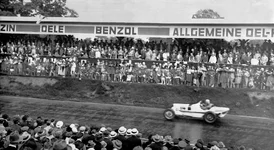
In the summer of 1926, the new Mercedes-Benz brand celebrates important racing victories. The first German Grand Prix was held on 11 July 1926 in Berlin on the AVUS race track (an automobile traffic and training road) : A few days after the merger of Daimler-Motoren-Gesellschaft (DMG) with Benz & Cie. on 28 and 29 June 1926 to form what was then Daimler-Benz AG, a racing car starts for Mercedes-Benz for the first time. The race is won by a young man who will go on to become the most successful racing driver of the 1930s – Rudolf Caracciola. Despite the most adverse weather conditions and a spark plug change in the middle of the race over 391 kilometres (20 laps), he wins after just under three hours. This is how Caracciola earns the honorary name “Regenmeister” (“Rainmaster”). On 22 July 1926, the Mercedes-Benz 24/100/140 PS Model K scores a triple victory in Spain: Otto Merz, Rudolf Caracciola and Christian Werner win the 12-hour race “Grand Prix of San Sebastián” in Guipúzcoa, Spain. The Model K supercharged sports car is developed from the 24/100/140 PS touring car already used for sporting events. It is the direct predecessor of the S series (W 06). This legendary sports car family of the brand with supercharged engine ranges from the Type S (“Sport”) from 1927 to the SSKL (“Super-Sport-Kurz-Leicht” – or “Super Sport Short Light” in English) in 1931. The successes in the summer of 1926 were the prelude to numerous victories and top placings for Mercedes-Benz in international motorsport, which continue to this day.
24 August 1986 – 40 years ago
First victory for a Sauber-Mercedes at the Nürburgring
- Pioneering for the brand’s later factory involvement in motorsport
- Outstanding Mike Thackwell at the wheel of the C8
- Mercedes-Benz has been represented in motorsport without interruption from 1988 to the present day
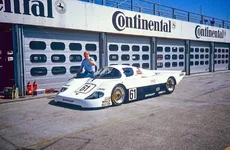
In 2026, George Russell and Kimi Antonelli will compete in the Formula 1 World Championship, driving Mercedes-AMG F1 W 17 E Silver Arrows. Mercedes-Benz is thus continuing a record-breaking series: the brand has been represented in motorsport without interruption since 1988. Two years earlier, in 1986, Team Sauber paves the way for the brand’s return to international motorsport with its own chassis and turbocharged Mercedes-Benz eight-cylinder engines. A Sauber-Mercedes C8 wins a race in the Sports Car World Championship for the first time on 24 August 1986 at the Nürburgring. In heavy rain and fog, Mike Thackwell shines in particular; his partner is Henri Pescarolo. From 1988 onwards, Peter Sauber’s team becomes a factory racing team. Two sports car world championships in 1989 and 1990 follow, as well as the Le Mans victory in 1989. Mercedes-Benz switches to Formula 1 with Sauber in 1994.
29 August to 2 September 1956 – 70 years ago
Mairesse/Génin win the Liège-Rome-Liège long-distance race in a 300 SL “Gullwing”
- More than 5,000 kilometres in around 90 hours with almost no breaks
- In 1956, the route also leads through what was then Yugoslavia
- After 1964, high-speed driving on public roads comes to an end
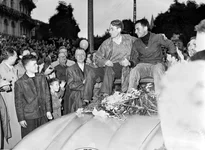
Long-distance races on public roads, some of which are not closed off, would be unthinkable today. 50 years ago and more, they are the great challenges in international motorsport. Mercedes-Benz celebrates successes in the Carrera Panamericana (1952), the Argentine Grand Prix (1961 to 1964), the Mille Miglia (1931 and 1955) and the Targa Florio (1922, 1924 and 1955), for example. At the height of its success, Mercedes-Benz bids farewell to Formula 1 and the World Sports Car Championship at the end of 1955. However, the brand continues to compete in events such as the Liège-Rome-Liège Rally, which is regarded as a particularly tough test in Europe. The teams cover around 5,000 kilometres on partly unpaved roads. It’s a race which lasts some 90 hours, as there are virtually no breaks. In 1956, Rome is replaced by Zagreb in Yugoslavia as the turning point of the rally, although the event initially remains known by its original name. Willy Mairesse/Willy Génin win the race in a Mercedes-Benz 300 SL “Gullwing” (W 198), repeating the victory of Olivier Gendebien/Pierre Stasse from 1955. Mercedes-Benz is then successful in 1962 and 1963 with the 220 SEb (W 111) and the 230 SL “Pagoda” (W 113). The long-distance route now runs from Liège to Sofia and back. From 1965 onwards, there are no more licences for such rallies.
Birthdays
- 50 years: Ricardo Zonta is born on 23 March 1976 in Curitiba, Brazil. He wins the drivers’ title in the FIA GT Championship together with Klaus Ludwig in 1998. In the Mercedes-Benz CLK LM, they secure the title in the final race at Laguna Seca (25 October 1998) ahead of their teammates Bernd Schneider and Mark Webber. From 1999 to 2002, Zonta is a member of the field of Formula 1 drivers.
- 45 years: Racing driver Gary Paffett is born on 24 March 1981 in Bromley, England. From 2003, the Briton starts for Mercedes-Benz in the DTM. His impressive record: DTM champion in 2005 and 2018, runner-up four times. Paffett wins 23 of 186 DTM races, making him one of the five most successful DTM drivers. He competes in Formula E in the 2018/2019 season.
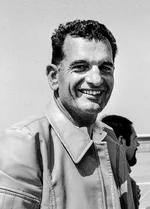
- 65 years: Mike Thackwell is born on 30 March 1961 in Auckland, New Zealand. In the early 1980s, he is regarded as a great talent – like his compatriots Bruce McLaren, Denny Hulme and Chris Amon. At the age of 19, he makes a brief guest appearance in Formula 1 for Tyrrell. He becomes the European Formula 2 champion in 1984. In 1986 and 1987, he is a driver for the Sauber-Mercedes team in Group C.
- 95 years: Erich Waxenberger is born on 9 April 1931 in Miesbach, Bavaria. From 1953, he works as a test and development engineer for Mercedes-Benz and also demonstrates considerable driving skills. In 1977, Waxenberger takes over the rally organisation as head of the sports department and celebrates great success with the SLC Coupés. He dies on 18 July 2017 at the age of 86.