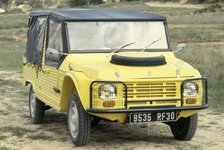
- Citroën is celebrating the 55th anniversary of the Méhari, revealed on 16 May 1968 at the Deauville golf course
- Between 1968 and 1987, 144,953 units were produced, mainly at the Citroën factory in Forest, Belgium
- This atypical, all-terrain and all-season vehicle was renowned for its modularity, practicality and economic benefits
- The Méhari became an iconic model both for Citroën and more widely within the automotive world and enjoyed a diverse career which included film appearances and service with the French army
- The Méhari shares this distinctive and leisure-oriented attitude with the Citroën C3 Pluriel, which will soon celebrate its 20th anniversary, and more recently with My Ami Buggy
Citroën is celebrating 55 years since the reveal of the Méhari, which was shown for the first time at the Deauville golf course on 16 May 1968.
The Méhari’s unusual pick-up design was built on a Dyane 6 platform, while the model produced between 28 and 32hp and featured an innovative ABS (acrylonitrile butadiene styrene) plastic body designed by Roland de La Poype.
During the Méhari’s almost 20 years in production between 1968 and 1987, 144,953 units were built (including 1,213 4x4 Méhari), making it a surprising success. The Méhari was mainly produced in the Citroën factory in Forest, Belgium, but also in seven other factories in France, Spain and Portugal.
AN ALL-TERRAIN AND ALL-SEASON VEHICLE
The Méhari’s name derives from the name given to dromedary camels in North Africa and the Sahara. These animals are known for their off-road ability, their resistance and their ability to transport both goods and passengers over long distances – making it a fitting name for a model known for its ability to adapt to all terrains.
From the outside, the Méhari doesn't appear to be suitable for all seasons, as it looks more like a small convertible used during the summer holidays. Thanks to a winter cover, the car is completely sealed, turning it into a vehicle that can be used all year round.
PRACTICAL, MODULAR AND ECONOMICAL
The Méhari is highly modular, being able to transform part of its floor into a backrest, which allows it to add two seats at the rear and thus accommodate up to four passengers.
The body is made up of only 11 easily repairable parts and can be cleaned with a single blast of water both inside and outside. This makes the car easy to maintain and economical for its customers.
THREE UNIQUE VERSIONS
Although it was produced for almost 20 years, only three different versions of the Méhari were added to the range, including two limited editions.
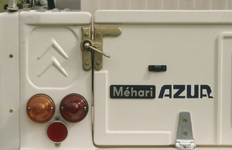
In 1979, Citroën introduced a new variant of the Méhari with the 4x4 version. Then, in 1983, two special editions were launched. The first to be launched was the Méhari Plage, with its holiday look and bright yellow colour scheme, which was sold in Spain and Portugal. Finally, in April 1983 the Méhari Azur was launched in France, Italy and Portugal, limited to just 700 units.
A DIVERSE CAREER
The Méhari was a popular choice among organisations as varied as the police, customs, airports, racecourses and many others, but also appealed to shopkeepers, craftsmen and private individuals.
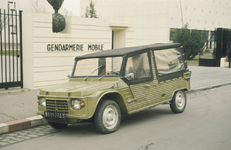
The model enjoyed a long career with the French army, which ordered a total of 11,457 Méhari between 1972 and 1987. The Méhari 4x4 also served as a medical assistance vehicle, with ten vehicles taking part in the 1980 Paris-Dakar Rally to provide medical support along the route.
Finally, the Méhari even appeared in films, most notably ‘Le Gendarme de Saint Tropez’ starring Louis de Funès.
Continue reading...