
phaeton
AMG Aficionado
25 years of Volkswagen in China
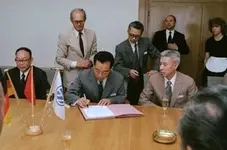
Signing the contract about trial assembly with „Shanghai Tractor & Automobile Corporation”, 1982
The signing of a trial assembly contract on June 8, 1982 marked the beginning of the Volkswagen Group’s involvement in China.
Wolfsburg, 08 June 2007 - 25 years ago today, Volkswagen began gradually establishing production facilities in the Far East’s most important market of the future. With over 700,000 vehicles produced, the joint ventures Volkswagen Shanghai and FAW-Volkswagen established under these plans secure the Volkswagen Group’s market leadership in China.
Corporate policy at Volkswagenwerk AG in the 1980s concentrated on the development of new sales markets. While exports to the industrialized nations of Western Europe stagnated, new opportunities were opening up in Asia. The People’s Republic of China in particular, with its vast resources, its low level of motorization and its nascent automotive industry, offered excellent options for the future. The government in Peking set the framework for possible cooperation under China’s planned economy, backing joint ventures with the Western investor with a view to benefiting from the engineering know-how and the financial strength of the Wolfsburg-based automaker. The trial assembly contract laid the foundation for the German-Sino success story, and the establishment of "Shanghai Volkswagen Automotive Company, Ltd." (SVW) on February 16, 1985 marked the first milestone. As early as September 1, 1985, the Santana, the first Volkswagen model to be assembled in China, was already leaving the assembly line, and the enormous success of the vehicle spurred the development of the plant and the company.
The first phase of establishing a modern production facility in Shanghai was concluded in 1991. Given the large number of components for the Santana produced locally, the vehicle was no longer classed as an import, but considered a Volkswagen "made in China". Consequently, import restrictions on sales of this volume model no longer applied and deliveries quickly soared. Volkswagen reinforced the subsequent market leadership on February 6, 1991 by setting up a further joint venture. "FAW-Volkswagen Automotive Company, Ltd." (FAW) located in Changchun was a new factory with an initial annual production capacity of 150,000 vehicles, and production of the Jetta commenced in Changchun at the end of 1993. Rising sales were the reward for the far-sighted investment policy pursued by Europe’s largest automaker: while only 33,851 vehicles were sold in China in 1990, deliveries had increased tenfold by the year 2000.
New production capacity was built up in China to keep pace with the ongoing boom in the automotive sector on Asia’s strongest growth market. By 2003, the three production plants of Shanghai Volkswagen and the two FAW factories in Changchun had expanded sales to just under 700,000 units. Further joint ventures to produce engines in Shanghai and Dalian, gearboxes in Shanghai and vehicle components in Changchun closed the capacity gap by 2004 and raised the local content of the eleven models now produced in China. Over the last three years, Volkswagen has faced the challenge presented by the growing number of foreign automakers pushing into the Chinese market. The Volkswagen Group responded to competitive pressure by introducing attractive new models. Support for the local supplier industry and stronger integration of the Chinese joint ventures in the VW procurement alliance generated positive synergy effects, thus also realizing cost benefits.
By laying these foundations, Volkswagen reinforced its position, selling 711,186 vehicles last year. Developments show that China, as the second most important market after Germany, already plays a significant role in the future of the multiple-brand automaker from Wolfsburg.
Signing the contract about trial assembly with „Shanghai Tractor & Automobile Corporation”, 1982
The signing of a trial assembly contract on June 8, 1982 marked the beginning of the Volkswagen Group’s involvement in China.
Wolfsburg, 08 June 2007 - 25 years ago today, Volkswagen began gradually establishing production facilities in the Far East’s most important market of the future. With over 700,000 vehicles produced, the joint ventures Volkswagen Shanghai and FAW-Volkswagen established under these plans secure the Volkswagen Group’s market leadership in China.
Corporate policy at Volkswagenwerk AG in the 1980s concentrated on the development of new sales markets. While exports to the industrialized nations of Western Europe stagnated, new opportunities were opening up in Asia. The People’s Republic of China in particular, with its vast resources, its low level of motorization and its nascent automotive industry, offered excellent options for the future. The government in Peking set the framework for possible cooperation under China’s planned economy, backing joint ventures with the Western investor with a view to benefiting from the engineering know-how and the financial strength of the Wolfsburg-based automaker. The trial assembly contract laid the foundation for the German-Sino success story, and the establishment of "Shanghai Volkswagen Automotive Company, Ltd." (SVW) on February 16, 1985 marked the first milestone. As early as September 1, 1985, the Santana, the first Volkswagen model to be assembled in China, was already leaving the assembly line, and the enormous success of the vehicle spurred the development of the plant and the company.
The first phase of establishing a modern production facility in Shanghai was concluded in 1991. Given the large number of components for the Santana produced locally, the vehicle was no longer classed as an import, but considered a Volkswagen "made in China". Consequently, import restrictions on sales of this volume model no longer applied and deliveries quickly soared. Volkswagen reinforced the subsequent market leadership on February 6, 1991 by setting up a further joint venture. "FAW-Volkswagen Automotive Company, Ltd." (FAW) located in Changchun was a new factory with an initial annual production capacity of 150,000 vehicles, and production of the Jetta commenced in Changchun at the end of 1993. Rising sales were the reward for the far-sighted investment policy pursued by Europe’s largest automaker: while only 33,851 vehicles were sold in China in 1990, deliveries had increased tenfold by the year 2000.
New production capacity was built up in China to keep pace with the ongoing boom in the automotive sector on Asia’s strongest growth market. By 2003, the three production plants of Shanghai Volkswagen and the two FAW factories in Changchun had expanded sales to just under 700,000 units. Further joint ventures to produce engines in Shanghai and Dalian, gearboxes in Shanghai and vehicle components in Changchun closed the capacity gap by 2004 and raised the local content of the eleven models now produced in China. Over the last three years, Volkswagen has faced the challenge presented by the growing number of foreign automakers pushing into the Chinese market. The Volkswagen Group responded to competitive pressure by introducing attractive new models. Support for the local supplier industry and stronger integration of the Chinese joint ventures in the VW procurement alliance generated positive synergy effects, thus also realizing cost benefits.
By laying these foundations, Volkswagen reinforced its position, selling 711,186 vehicles last year. Developments show that China, as the second most important market after Germany, already plays a significant role in the future of the multiple-brand automaker from Wolfsburg.


