
Shining Star
Chicane Challenger
- Messages
- 2,462




The Volkswagen bus, like no other car, stands for the spirit of freedom. It debuted over 60 years ago in 1950 with a contagiously simple design. Its internal Volkswagen code name was T1 for Transporter 1. The Germans called it the Bulli, and to Americans it was the Microbus. It was driven on all continents. And the world's first van is still appreciated by a fan base which spans the globe. Now Volkswagen is reinterpreting the compact original form of this automotive legend and sending it into the future - in the form of a concept vehicle for a new generation VW Bulli! It is spacious like it was in 1950, it is as inspirational as ever, and it has clean styling like never before.
In this vehicle, Volkswagen is finishing what it started in 2001: ten years ago, the vision of a new Volkswagen Bulli led to an unforgettable concept vehicle known as the Microbus. But some visions need to mature before they yield something new. Now, the time is right for this vision. That is because the concept was sharpened, and the necessary, sustainable technologies are now at hand. More compact and affordable than the earlier concept vehicle, it is now being shown at the 2011 Geneva Motor Show. The new VW Bulli - powered by an electric motor and fitted with six seats and infotainment control via iPad.
This concept has the potential to establish a new, fifth brand of people carrier next to the Caddy, Touran, Sharan and its large counterpart - the Caravelle. The Volkswagen Bulli could even become an icon like the T1 Samba that still trades at extremely high prices today - one of those few vehicles that simply do not fade with time.
Zero emissions - up to 300 km on a single battery charge
Thanks to highly advanced drive technologies, the Bulli being shown in Geneva is what is referred to as a 'zero emissions vehicle,' because the concept is electrically powered. Zero emissions at the tailpipe. The VW Bulli's electric motor outputs 85 kW of power and an impressive 270 Newton metres of torque. As is usual with this type of drive, its maximum forces are generated from standstill. The silent motor is supplied with energy from a lithium-ion battery with a maximum storage capacity of 40 kWh. This electrifying combination enables driving ranges of up to 300 km - a high value for an electric car. When the Bulli's battery is charged at an "electric refuelling station" specially designed for electric vehicles, the charging process takes less than one hour.
The new Bulli accelerates from 0 to 100 km/h in 11.5 seconds, and its top speed is 140 km/h (electronically limited). Its range and driving performance not only make the compact vehicle ideal for short distances; but also ideal for most commuters and recreational activities with zero tailpipe emissions.
Naturally, the concept can also incorporate Volkswagen's extremely efficient petrol and diesel direct injection engines as alternative drives. Engines with 1.0 or 1.4 litre displacement that are fuel efficient yet strong; this is downsizing by the book. Ideal for anyone who wants to cover maximum distances with minimal fuel consumption.
Bulli - the idea goes back 64 years
Without the Dutch Volkswagen importer Ben Pon, the T1 might not have existed, and of course neither would the Volkswagen Bulli concept vehicle at Geneva. That is because Pon was the person who on 23 April, 1947, sketched a picture of a compact bus in his notebook. Actually, the Dutchman's drawing was a simple side view of a radically shortened public omnibus placed over the wheelbase of a Beetle with an "m" for "motor" written on it. That was it. The world's first van was born. Great ideas usually just take a few strokes of the pen, but then they require a dedicated effort to implement them. Volkswagen designers took this sketch and created the bus that became an automotive icon with the characteristic "V" in front.
The Bulli concept vehicle now follows in the footsteps of the original bus and demonstrates the concept of maximum space utilisation with the characteristic "V" with VW logo at the front end and the cleanest of proportions. In the process, the concept vehicle's design follows the maxims of the new Volkswagen "design DNA." Retro? Hardly. It is a Volkswagen! The team led by Walter de Silva, Head of Volkswagen Group Design, and Klaus Bischoff, Head of Design of the Volkswagen brand, developed the "design DNA" for the modern era based on styling principles of the bestselling Beetle, Golf I and T1.
Design - visual world of a masterpiece
The new edition of the Bulli is 3.99 metres long, 1.75 metres wide and 1.70 metres tall. The T1 was somewhat longer and taller, but narrower. With a wheelbase of 2.62 metres, the Volkswagen Bulli utilises the overall length very well. Also striking here are the Bulli's relatively large track widths (1.50 m front and rear) in relation to body width.
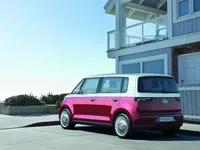
Front end: Like the Samba bus before it, the Bulli being presented in Geneva also has two-tone paint - in this case white and red. The "V" on the bonnet, is kept white. The bonnet does house the engine: instead of rear-wheel drive with a boxer engine, as on the Samba, the Volkswagen Bulli has an electric motor located forward of the front axle and front-wheel drive. Here it is a compact integral drive whose primary components are an E-motor, high-voltage pulse inverter and DC/DC converter for the 12-Volt electrical system.
In keeping with the Volkswagen design DNA, there is a horizontal layout of the narrow dual headlights with L-shaped LED daytime running lights and turn indicators implemented as LEDs arranged in an inverted L shape at each outer corner. Incidentally, LEDs not only exhibit tremendous luminous power and long life; due to their low energy consumption they are ideal for the electrically powered Bulli of 2011. Located between the headlights in the bonnet is, as always, the VW logo. On the level beneath, one finds - once again arranged in a horizontal line - the air intakes for the passenger compartment and for battery cooling or for cooling the alternative conventional drives.
Finally, the bumper that is seamlessly integrated in the front end completes the design. Laterally, it exhibits a large round fog light on each side, another air intake in the middle, and a front spoiler in black below. This line matches the lines of the side sills.
Side profile: The Bulli's two-tone paint also distinguishes the sides. Treated in white is the entire area above what is known as the character line. Originating in the wings is a white stripe that runs to the distinctive D-pillars; above them, the entire roof section is painted in this colour. The continuous line of windows creates an especially striking contrast between the white sections. Here the visually slender black pillars executed in the style of the 2001 Microbus concept are visually striking. Painted in red are the door mirror housings protruding from the line of windows.
Beneath the character line is the red body area. Design elements such as the distinctive wheel housings, the additional shape modulation in the door surfaces above the side sills and the headlights that wrap around to the sides with minimal seams are details that would not have been possible to manufacture in this form and precision on a T1. Concealed in the sandwiched floor behind the sills is the 1,450 kg Volkswagen Bulli's lithium-ion battery. The white door handles are practical, opening in the direction of pull. The 18-inch alloy wheels are especially attractive. At their centres are stylised chrome hubcaps - another tribute to the bus of years past. Shorter than ever are the overhangs at the front and rear.
Rear section: The Volkswagen design DNA with its horizontal lines also dominates the rear of the new Bulli. Viewed from the bottom upwards, above the body-coloured bumper (including black, stylised diffuser) there is the tailgate that extends across the entire width of the vehicle. In the tailgate, the narrow LED rear lights continue a theme from the Microbus concept of 2001. At the centre, but smaller than at the front end: the VW symbol. When all six seating locations are fully occupied, there is a 370 litre bootspace behind the tailgate.
Interior space - melding of car and iPad
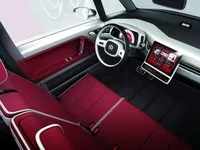
Like the body design, the interior is also marked by a level of clarity whose consistent application can only be found at Volkswagen. The passenger compartment - immersed in light during the day thanks to its panoramic sunroof - also harbours some surprises.
A practical highlight: like the T1 in times past, thanks to its level floor the new Bulli is also equipped with a single bench seat in front. The van offers space for three in the rear as well.
An infotainment highlight: a removable iPad in the centre console serves as a multifunctional touchscreen. Along with Internet-based iPad applications and the media centre, it also handles control of such functions as Bluetooth hands-free telephone and a navigation system. Integrated right on the iPad mount are controls for the climate control system and the centrally located hazard warning switch.
Typical Volkswagen: all cockpit details are clearly organised and designed to be intuitive. Running laterally across the entire width is a line with air vents. In front of the driver, there is a speedometer in the shape of a semicircle. A colour multifunction display, also semi-circular in shape, can be used to view and control (via multifunctional keys in the steering wheel and on it) the navigation system, telephone, trip computer and media centre - the entire unit of speedometer and multifunction display also communicates with the iPad. The key word here is sound: a system produced by legendary guitar and amplifier manufacturer Fender (USA) ensures that the music sounds as though it were being performed live. At Woodstock in 1969, Jimi Hendrix played "The Star-Spangled Banner" - the American national anthem - on a Fender Stratocaster guitar.
What is not found in the Volkswagen Bulli is a tachometer (unnecessary with an electric motor) or a conventional gear shift or gear selection lever (also unnecessary with an electric motor). The latter is replaced by a rotary switch to the right of the driver, which is used to activate forward and reverse gears. A pushbutton in the same switch is used to start and stop the motor. Another rotary switch to the left of the driver is used to control the lighting functions.
Seats become reclining surface in an instant
The outer and middle seat positions of the front bench seat can be folded down (2/3 split); the rear beach seat, meanwhile, can be completely stowed. When the rear bench seat is stowed, cargo capacity increases to 1,600 litres. In addition - and here the new Bulli is reminiscent of its legendary ancestor - the seat system can be transformed into a large reclining surface with just a few manual movements. This turns the compact MPV into a compact camper - the ultimate companion for a weekend trip.
At least as important for many users, however, is that the seating system should not only be versatile but also offer maximum comfort. The seat position is comfortably high and is equally relaxing. As an added benefit, it offers an optimised view forward as well. And that is how it was in the T1 too. Contributing to peace of mind aboard today's vehicle is the fact that the new era Bulli is equipped with all conceivable safety features. And that is the crucial difference: the car has essentially been reinvented since the days of the first T1 aka the Bulli aka the Microbus.
Source: VW


